


Key Insights
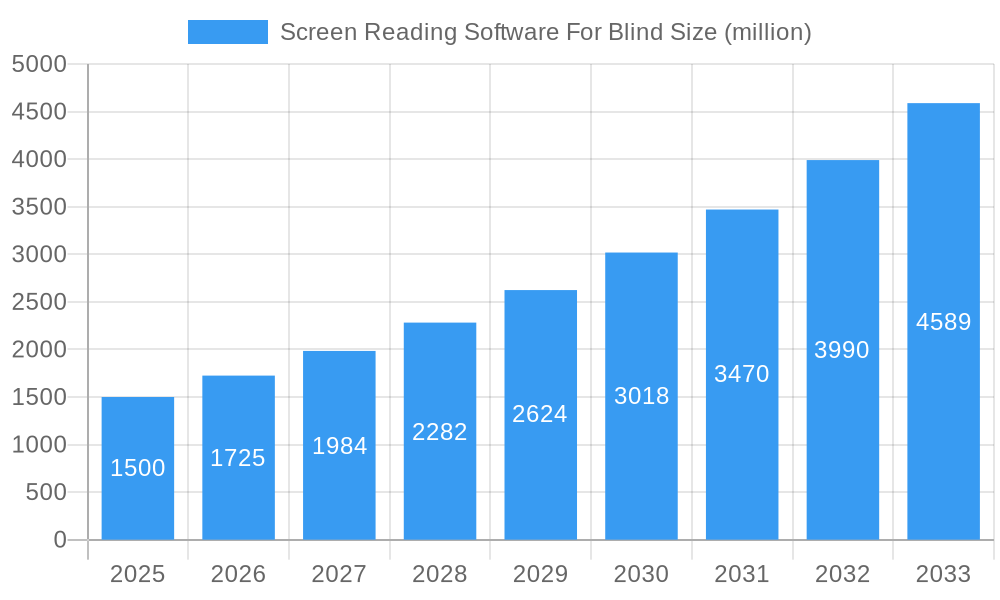
The global market for Screen Reading Software for the Blind is poised for substantial growth, driven by increasing global awareness of accessibility needs and advancements in assistive technology. With an estimated market size of approximately USD 1.5 billion in 2025, the sector is projected to expand at a Compound Annual Growth Rate (CAGR) of around 15% over the forecast period of 2025-2033. This robust growth is primarily fueled by the rising adoption of digital technologies by visually impaired individuals, necessitating sophisticated software solutions for seamless interaction with computers, smartphones, and other digital devices. Government initiatives promoting digital inclusion and the growing demand for personalized assistive tools further bolster market expansion. The "Totally Blind" segment is expected to dominate, accounting for a significant share due to the fundamental need for screen readers in this demographic.
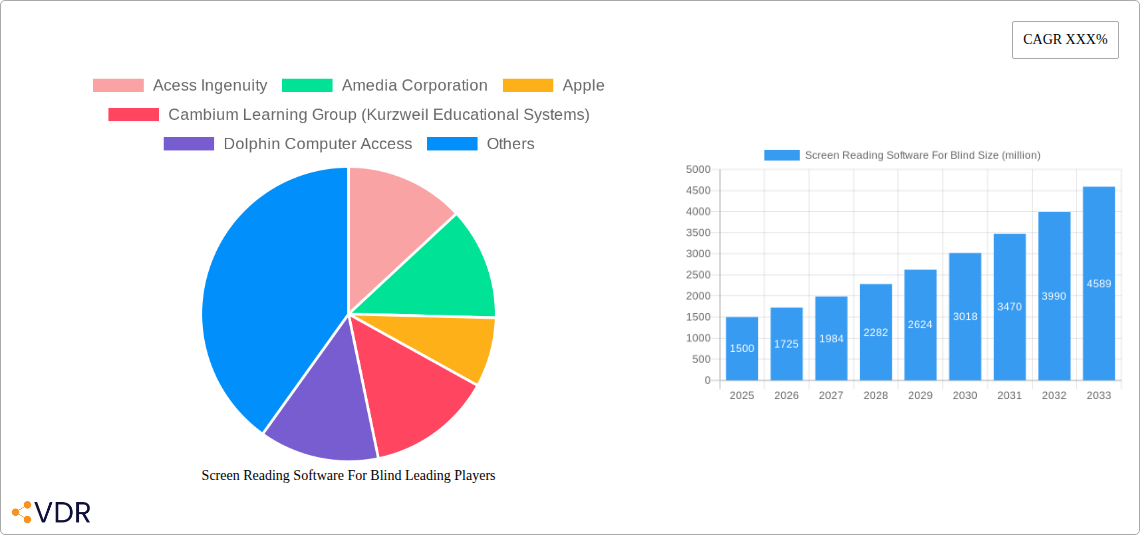
Screen Reading Software For Blind Market Size (In Billion)

The market is segmented by application into "Totally Blind," "Half Blind," and "Others," with "Totally Blind" applications expected to command the largest market share due to their critical reliance on comprehensive screen reading functionalities. In terms of type, both "Cloud-based" and "Local Deployment" solutions are gaining traction. Cloud-based solutions offer flexibility, accessibility from multiple devices, and continuous updates, while local deployments provide enhanced data security and offline functionality. Key market drivers include increasing government mandates for digital accessibility, the proliferation of smart devices, and the continuous innovation in artificial intelligence and natural language processing, which are enhancing the intuitiveness and functionality of screen readers. However, challenges such as the high cost of advanced software and a lack of widespread awareness in certain regions may temper growth. Leading companies like Apple, Microsoft, and Dolphin Computer Access are at the forefront of innovation, investing heavily in research and development to offer more intuitive and feature-rich screen reading solutions.
Screen Reading Software For Blind Company Market Share
This in-depth report offers a definitive analysis of the global Screen Reading Software For Blind market, providing critical insights for industry stakeholders. Spanning from 2019 to 2033, with a base year of 2025 and a forecast period of 2025–2033, this report meticulously examines market structure, growth trajectories, regional dominance, product innovation, key drivers, barriers, opportunities, and the competitive landscape. Leveraging high-traffic keywords like "screen reader software," "assistive technology," "blindness software," and "visually impaired solutions," this report is optimized for maximum search engine visibility. It delves into both parent and child markets, offering a holistic view of the ecosystem. All quantitative values are presented in millions of units.
Screen Reading Software For Blind Market Dynamics & Structure
The global screen reading software for blind market exhibits a moderate concentration, with key players like Apple, Microsoft, and Freedom Scientific holding significant sway. Technological innovation remains the primary driver, fueled by advancements in AI, natural language processing, and cloud computing, enabling more sophisticated and intuitive user experiences. Regulatory frameworks, particularly those mandating accessibility standards (e.g., WCAG), are increasingly shaping product development and market entry. Competitive product substitutes, while limited in direct functionality, include alternative accessibility tools and specialized hardware. End-user demographics are primarily individuals with total blindness, followed by those with low vision, and a smaller segment of users with other print disabilities. Mergers and acquisitions (M&A) are a notable trend, with larger technology firms acquiring specialized assistive technology companies to expand their accessibility offerings. The market is characterized by a steady pace of innovation, with an estimated X% of companies actively investing in R&D for enhanced features. M&A deal volumes are predicted to remain stable at approximately Y million units annually, driven by the strategic imperative to integrate cutting-edge assistive technologies. Barriers to innovation include the high cost of specialized development and the need for extensive user testing within the visually impaired community.
- Market Concentration: Moderate, with a few dominant players and a growing number of niche providers.
- Technological Innovation Drivers: AI, Natural Language Processing (NLP), Cloud Computing, Machine Learning.
- Regulatory Frameworks: Accessibility standards (WCAG, Section 508), government mandates for inclusive technology.
- Competitive Product Substitutes: Braille displays, magnifiers, human transcription services.
- End-User Demographics: Primarily totally blind individuals (estimated X% of user base), followed by half blind (Y%), and others (Z%).
- M&A Trends: Strategic acquisitions to enhance product portfolios and expand market reach.
Screen Reading Software For Blind Growth Trends & Insights
The screen reading software for blind market is poised for robust growth, driven by increasing global awareness of digital accessibility and the persistent need for robust assistive technologies. The market size is projected to evolve from an estimated $XX million in 2024 to a substantial $YY million by 2033, reflecting a compound annual growth rate (CAGR) of approximately ZZ%. Adoption rates are steadily increasing, influenced by widespread digital transformation across education, employment, and daily life. Key technological disruptions, such as the integration of AI-powered voice recognition and advanced AI summarization capabilities, are enhancing the functionality and user-friendliness of screen readers. Consumer behavior shifts towards greater reliance on digital platforms for information access and communication are further fueling demand. Market penetration is estimated to reach XX% of the target population by 2033, a significant increase from YY% in 2024. The rising prevalence of age-related visual impairments and the growing adoption of smartphones and smart devices equipped with built-in screen reader functionalities are also crucial growth catalysts. Furthermore, government initiatives and non-profit organizations advocating for digital inclusion are actively promoting the adoption of these essential tools. The shift from traditional, standalone software to cloud-based solutions is also accelerating, offering greater flexibility and accessibility across devices. This evolution is underpinned by a commitment to democratizing access to information and digital resources for the visually impaired community worldwide.
Dominant Regions, Countries, or Segments in Screen Reading Software For Blind
The Totally Blind application segment, accounting for an estimated XX% of the market in 2025, is a primary driver of growth in the screen reading software for blind industry. This dominance stems from the fundamental need for comprehensive auditory access to digital content among individuals with complete vision loss. North America, particularly the United States, is a leading region, estimated to hold YY% of the global market share in 2025. This leadership is attributed to strong economic policies supporting assistive technology adoption, advanced technological infrastructure, and a highly developed ecosystem of accessibility advocacy groups and government funding initiatives. The presence of major technology giants and specialized assistive technology companies in this region further bolsters its position.
- Dominant Application Segment: Totally Blind (Estimated XX% market share in 2025).
- Key Drivers: Essential for full digital access, high reliance on auditory feedback, consistent demand for comprehensive features.
- Dominant Region: North America (Estimated YY% market share in 2025).
- Key Drivers: Robust economic policies, advanced technological infrastructure, strong advocacy networks, significant government investment in accessibility.
- Leading Country (within dominant region): United States.
- Key Drivers: Pioneering accessibility legislation, widespread adoption of digital devices, strong R&D in assistive technology, presence of key market players.
- Dominant Type: Local Deployment (Estimated ZZ% market share in 2025), though Cloud-based is rapidly gaining traction.
- Key Drivers (Local Deployment): Established user base, perceived security advantages, offline functionality.
- Growth Potential (Cloud-based): Increasing internet penetration, device independence, cost-effectiveness, continuous updates.
Screen Reading Software For Blind Product Landscape
The product landscape for screen reading software for blind is characterized by continuous innovation aimed at enhancing user experience and functionality. Leading products now incorporate sophisticated AI-driven features, such as intelligent summarization of lengthy texts, real-time object recognition within images, and more natural-sounding synthesized speech. Applications are increasingly tailored for diverse platforms, including desktop operating systems, mobile devices, and web browsers. Performance metrics focus on speed, accuracy of speech output, responsiveness, and the seamless integration with various applications and operating systems. Unique selling propositions often highlight customizable voice options, advanced navigation shortcuts, and robust integration with other assistive technologies. Technological advancements are pushing the boundaries of what's possible, moving towards more personalized and context-aware assistive solutions that adapt to individual user needs and preferences, making digital content truly accessible for everyone.
Key Drivers, Barriers & Challenges in Screen Reading Software For Blind
Key Drivers:
- Increasing Digital Inclusion Initiatives: Global push for digital accessibility and equal access to information.
- Technological Advancements: AI, NLP, and cloud computing are enhancing software capabilities.
- Growing Awareness of Visual Impairments: Rising incidence of blindness and low vision globally.
- Government Mandates and Regulations: Legislation requiring digital accessibility standards.
- Expansion of Smart Device Adoption: Increased use of smartphones and tablets with integrated accessibility features.
Barriers & Challenges:
- High Development Costs: Specialized software development and rigorous testing require significant investment.
- User Adoption and Training: Ensuring users are effectively trained and comfortable with complex software.
- Compatibility Issues: Maintaining seamless compatibility across diverse operating systems and software updates.
- Internet Connectivity Dependence (for cloud-based solutions): Hinders access in areas with poor internet infrastructure.
- Competition from Emerging Technologies: Need for continuous innovation to stay ahead of evolving assistive tools.
- Pricing Sensitivity: Affordability remains a concern for a significant portion of the target market, estimated to impact XX% of potential users.
Emerging Opportunities in Screen Reading Software For Blind
Emerging opportunities lie in the development of more intuitive, AI-powered screen readers that offer personalized learning experiences and proactive assistance. Untapped markets, particularly in developing economies with growing digital penetration, present significant growth potential. Innovative applications, such as real-time translation of visual content into auditory information for complex documents or interactive media, are on the horizon. Evolving consumer preferences are leaning towards seamless integration across all devices and platforms, emphasizing cloud-based solutions that offer unparalleled flexibility and accessibility. The potential for integration with augmented reality (AR) and virtual reality (VR) technologies to provide enhanced spatial awareness and contextual information for visually impaired users is another significant emerging frontier, promising to redefine digital interaction.
Growth Accelerators in the Screen Reading Software For Blind Industry
Growth accelerators in the screen reading software for blind industry are multifaceted and poised to drive sustained expansion. Technological breakthroughs in AI and machine learning are leading to more sophisticated natural language processing and intelligent content interpretation, significantly enhancing user experience. Strategic partnerships between established technology giants and specialized assistive technology providers are accelerating product development and market penetration. Market expansion strategies targeting emerging economies, where digital inclusion is a growing priority, will unlock substantial new user bases. Furthermore, the increasing focus on digital accessibility in educational institutions and workplaces, often driven by regulatory requirements and a commitment to diversity and inclusion, acts as a potent growth catalyst. The ongoing development of more affordable and accessible hardware that complements screen reading software will also play a crucial role in driving adoption.
Key Players Shaping the Screen Reading Software For Blind Market
- Acess Ingenuity
- Amedia Corporation
- Apple
- Cambium Learning Group (Kurzweil Educational Systems)
- Dolphin Computer Access
- Essilor (Humanware)
- Ezhermatic SA de CV
- Freedom Scientific
- Kochi System Development
- Lingit (Lingspeak)
- LVI Low Vision International
- Microsoft
- Serotek
- Upward Spiral Software (TalkButton)
- VisioBraille GmbH (BAUM Retec)
Notable Milestones in Screen Reading Software For Blind Sector
- 2019: Introduction of enhanced AI-driven summarization features in leading screen readers.
- 2020: Increased adoption of cloud-based screen reading solutions due to remote work trends.
- 2021: Major operating system updates with improved built-in screen reader functionalities.
- 2022: Launch of new screen readers with advanced object recognition capabilities for image descriptions.
- 2023: Significant investments in R&D for next-generation AI-powered assistive technologies by key players.
- 2024: Growing emphasis on cross-platform compatibility and seamless integration across devices.
In-Depth Screen Reading Software For Blind Market Outlook
The future market outlook for screen reading software for blind is exceptionally promising, driven by a confluence of accelerating factors. Continued advancements in artificial intelligence and machine learning will lead to increasingly intelligent and personalized assistive experiences, making digital content more navigable and understandable than ever before. Strategic collaborations between major technology firms and specialized assistive technology developers are expected to accelerate innovation and broaden market reach. The expansion into emerging markets, coupled with a growing global emphasis on digital inclusion in education and employment, will fuel substantial user acquisition. The development of more affordable and integrated hardware solutions will further democratize access. The market is set for sustained growth, driven by an unyielding commitment to empowering individuals with visual impairments through cutting-edge technology.
Screen Reading Software For Blind Segmentation
-
1. Application
- 1.1. Totally Blind
- 1.2. Half Blind
- 1.3. Others
-
2. Type
- 2.1. Cloud-based
- 2.2. Local Deployment
Screen Reading Software For Blind Segmentation By Geography
-
1. North America
- 1.1. United States
- 1.2. Canada
- 1.3. Mexico
-
2. South America
- 2.1. Brazil
- 2.2. Argentina
- 2.3. Rest of South America
-
3. Europe
- 3.1. United Kingdom
- 3.2. Germany
- 3.3. France
- 3.4. Italy
- 3.5. Spain
- 3.6. Russia
- 3.7. Benelux
- 3.8. Nordics
- 3.9. Rest of Europe
-
4. Middle East & Africa
- 4.1. Turkey
- 4.2. Israel
- 4.3. GCC
- 4.4. North Africa
- 4.5. South Africa
- 4.6. Rest of Middle East & Africa
-
5. Asia Pacific
- 5.1. China
- 5.2. India
- 5.3. Japan
- 5.4. South Korea
- 5.5. ASEAN
- 5.6. Oceania
- 5.7. Rest of Asia Pacific
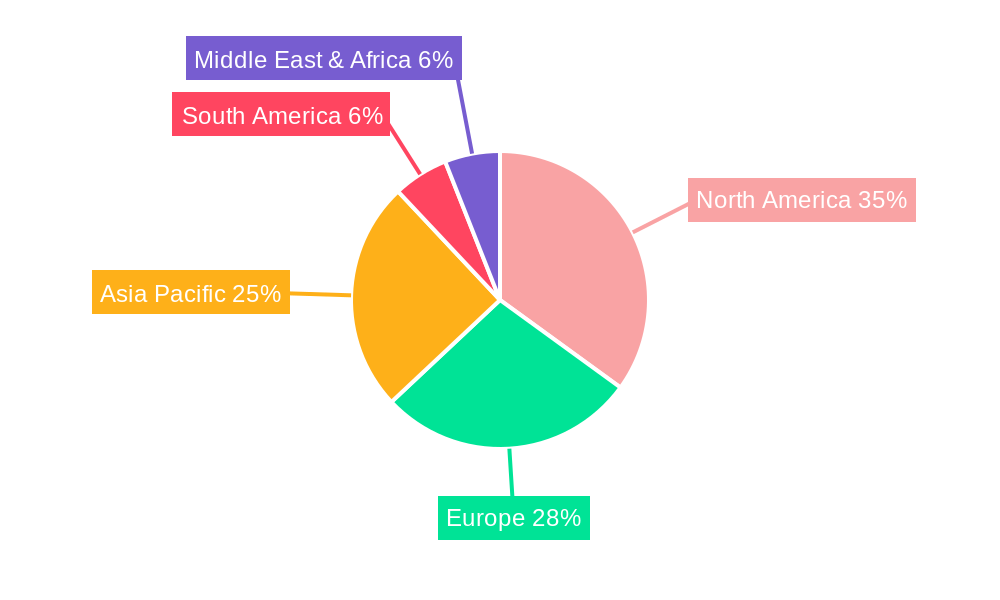
Screen Reading Software For Blind Regional Market Share
Geographic Coverage of Screen Reading Software For Blind
Screen Reading Software For Blind REPORT HIGHLIGHTS
| Aspects | Details |
|---|---|
| Study Period | 2020-2034 |
| Base Year | 2025 |
| Estimated Year | 2026 |
| Forecast Period | 2026-2034 |
| Historical Period | 2020-2025 |
| Growth Rate | CAGR of XXX% from 2020-2034 |
| Segmentation |
|
Table of Contents
- 1. Introduction
- 1.1. Research Scope
- 1.2. Market Segmentation
- 1.3. Research Methodology
- 1.4. Definitions and Assumptions
- 2. Executive Summary
- 2.1. Introduction
- 3. Market Dynamics
- 3.1. Introduction
- 3.2. Market Drivers
- 3.3. Market Restrains
- 3.4. Market Trends
- 4. Market Factor Analysis
- 4.1. Porters Five Forces
- 4.2. Supply/Value Chain
- 4.3. PESTEL analysis
- 4.4. Market Entropy
- 4.5. Patent/Trademark Analysis
- 5. Global Screen Reading Software For Blind Analysis, Insights and Forecast, 2020-2032
- 5.1. Market Analysis, Insights and Forecast - by Application
- 5.1.1. Totally Blind
- 5.1.2. Half Blind
- 5.1.3. Others
- 5.2. Market Analysis, Insights and Forecast - by Type
- 5.2.1. Cloud-based
- 5.2.2. Local Deployment
- 5.3. Market Analysis, Insights and Forecast - by Region
- 5.3.1. North America
- 5.3.2. South America
- 5.3.3. Europe
- 5.3.4. Middle East & Africa
- 5.3.5. Asia Pacific
- 5.1. Market Analysis, Insights and Forecast - by Application
- 6. North America Screen Reading Software For Blind Analysis, Insights and Forecast, 2020-2032
- 6.1. Market Analysis, Insights and Forecast - by Application
- 6.1.1. Totally Blind
- 6.1.2. Half Blind
- 6.1.3. Others
- 6.2. Market Analysis, Insights and Forecast - by Type
- 6.2.1. Cloud-based
- 6.2.2. Local Deployment
- 6.1. Market Analysis, Insights and Forecast - by Application
- 7. South America Screen Reading Software For Blind Analysis, Insights and Forecast, 2020-2032
- 7.1. Market Analysis, Insights and Forecast - by Application
- 7.1.1. Totally Blind
- 7.1.2. Half Blind
- 7.1.3. Others
- 7.2. Market Analysis, Insights and Forecast - by Type
- 7.2.1. Cloud-based
- 7.2.2. Local Deployment
- 7.1. Market Analysis, Insights and Forecast - by Application
- 8. Europe Screen Reading Software For Blind Analysis, Insights and Forecast, 2020-2032
- 8.1. Market Analysis, Insights and Forecast - by Application
- 8.1.1. Totally Blind
- 8.1.2. Half Blind
- 8.1.3. Others
- 8.2. Market Analysis, Insights and Forecast - by Type
- 8.2.1. Cloud-based
- 8.2.2. Local Deployment
- 8.1. Market Analysis, Insights and Forecast - by Application
- 9. Middle East & Africa Screen Reading Software For Blind Analysis, Insights and Forecast, 2020-2032
- 9.1. Market Analysis, Insights and Forecast - by Application
- 9.1.1. Totally Blind
- 9.1.2. Half Blind
- 9.1.3. Others
- 9.2. Market Analysis, Insights and Forecast - by Type
- 9.2.1. Cloud-based
- 9.2.2. Local Deployment
- 9.1. Market Analysis, Insights and Forecast - by Application
- 10. Asia Pacific Screen Reading Software For Blind Analysis, Insights and Forecast, 2020-2032
- 10.1. Market Analysis, Insights and Forecast - by Application
- 10.1.1. Totally Blind
- 10.1.2. Half Blind
- 10.1.3. Others
- 10.2. Market Analysis, Insights and Forecast - by Type
- 10.2.1. Cloud-based
- 10.2.2. Local Deployment
- 10.1. Market Analysis, Insights and Forecast - by Application
- 11. Competitive Analysis
- 11.1. Global Market Share Analysis 2025
- 11.2. Company Profiles
- 11.2.1 Acess Ingenuity
- 11.2.1.1. Overview
- 11.2.1.2. Products
- 11.2.1.3. SWOT Analysis
- 11.2.1.4. Recent Developments
- 11.2.1.5. Financials (Based on Availability)
- 11.2.2 Amedia Corporation
- 11.2.2.1. Overview
- 11.2.2.2. Products
- 11.2.2.3. SWOT Analysis
- 11.2.2.4. Recent Developments
- 11.2.2.5. Financials (Based on Availability)
- 11.2.3 Apple
- 11.2.3.1. Overview
- 11.2.3.2. Products
- 11.2.3.3. SWOT Analysis
- 11.2.3.4. Recent Developments
- 11.2.3.5. Financials (Based on Availability)
- 11.2.4 Cambium Learning Group (Kurzweil Educational Systems)
- 11.2.4.1. Overview
- 11.2.4.2. Products
- 11.2.4.3. SWOT Analysis
- 11.2.4.4. Recent Developments
- 11.2.4.5. Financials (Based on Availability)
- 11.2.5 Dolphin Computer Access
- 11.2.5.1. Overview
- 11.2.5.2. Products
- 11.2.5.3. SWOT Analysis
- 11.2.5.4. Recent Developments
- 11.2.5.5. Financials (Based on Availability)
- 11.2.6 Essilor (Humanware)
- 11.2.6.1. Overview
- 11.2.6.2. Products
- 11.2.6.3. SWOT Analysis
- 11.2.6.4. Recent Developments
- 11.2.6.5. Financials (Based on Availability)
- 11.2.7 Ezhermatic SA de CV
- 11.2.7.1. Overview
- 11.2.7.2. Products
- 11.2.7.3. SWOT Analysis
- 11.2.7.4. Recent Developments
- 11.2.7.5. Financials (Based on Availability)
- 11.2.8 Freedom Scientific
- 11.2.8.1. Overview
- 11.2.8.2. Products
- 11.2.8.3. SWOT Analysis
- 11.2.8.4. Recent Developments
- 11.2.8.5. Financials (Based on Availability)
- 11.2.9 Kochi System Development
- 11.2.9.1. Overview
- 11.2.9.2. Products
- 11.2.9.3. SWOT Analysis
- 11.2.9.4. Recent Developments
- 11.2.9.5. Financials (Based on Availability)
- 11.2.10 Lingit (Lingspeak)
- 11.2.10.1. Overview
- 11.2.10.2. Products
- 11.2.10.3. SWOT Analysis
- 11.2.10.4. Recent Developments
- 11.2.10.5. Financials (Based on Availability)
- 11.2.11 LVI Low Vision International
- 11.2.11.1. Overview
- 11.2.11.2. Products
- 11.2.11.3. SWOT Analysis
- 11.2.11.4. Recent Developments
- 11.2.11.5. Financials (Based on Availability)
- 11.2.12 Microsoft
- 11.2.12.1. Overview
- 11.2.12.2. Products
- 11.2.12.3. SWOT Analysis
- 11.2.12.4. Recent Developments
- 11.2.12.5. Financials (Based on Availability)
- 11.2.13 Serotek
- 11.2.13.1. Overview
- 11.2.13.2. Products
- 11.2.13.3. SWOT Analysis
- 11.2.13.4. Recent Developments
- 11.2.13.5. Financials (Based on Availability)
- 11.2.14 Upward Spiral Software (TalkButton)
- 11.2.14.1. Overview
- 11.2.14.2. Products
- 11.2.14.3. SWOT Analysis
- 11.2.14.4. Recent Developments
- 11.2.14.5. Financials (Based on Availability)
- 11.2.15 VisioBraille GmbH (BAUM Retec)
- 11.2.15.1. Overview
- 11.2.15.2. Products
- 11.2.15.3. SWOT Analysis
- 11.2.15.4. Recent Developments
- 11.2.15.5. Financials (Based on Availability)
- 11.2.1 Acess Ingenuity
List of Figures
- Figure 1: Global Screen Reading Software For Blind Revenue Breakdown (million, %) by Region 2025 & 2033
- Figure 2: North America Screen Reading Software For Blind Revenue (million), by Application 2025 & 2033
- Figure 3: North America Screen Reading Software For Blind Revenue Share (%), by Application 2025 & 2033
- Figure 4: North America Screen Reading Software For Blind Revenue (million), by Type 2025 & 2033
- Figure 5: North America Screen Reading Software For Blind Revenue Share (%), by Type 2025 & 2033
- Figure 6: North America Screen Reading Software For Blind Revenue (million), by Country 2025 & 2033
- Figure 7: North America Screen Reading Software For Blind Revenue Share (%), by Country 2025 & 2033
- Figure 8: South America Screen Reading Software For Blind Revenue (million), by Application 2025 & 2033
- Figure 9: South America Screen Reading Software For Blind Revenue Share (%), by Application 2025 & 2033
- Figure 10: South America Screen Reading Software For Blind Revenue (million), by Type 2025 & 2033
- Figure 11: South America Screen Reading Software For Blind Revenue Share (%), by Type 2025 & 2033
- Figure 12: South America Screen Reading Software For Blind Revenue (million), by Country 2025 & 2033
- Figure 13: South America Screen Reading Software For Blind Revenue Share (%), by Country 2025 & 2033
- Figure 14: Europe Screen Reading Software For Blind Revenue (million), by Application 2025 & 2033
- Figure 15: Europe Screen Reading Software For Blind Revenue Share (%), by Application 2025 & 2033
- Figure 16: Europe Screen Reading Software For Blind Revenue (million), by Type 2025 & 2033
- Figure 17: Europe Screen Reading Software For Blind Revenue Share (%), by Type 2025 & 2033
- Figure 18: Europe Screen Reading Software For Blind Revenue (million), by Country 2025 & 2033
- Figure 19: Europe Screen Reading Software For Blind Revenue Share (%), by Country 2025 & 2033
- Figure 20: Middle East & Africa Screen Reading Software For Blind Revenue (million), by Application 2025 & 2033
- Figure 21: Middle East & Africa Screen Reading Software For Blind Revenue Share (%), by Application 2025 & 2033
- Figure 22: Middle East & Africa Screen Reading Software For Blind Revenue (million), by Type 2025 & 2033
- Figure 23: Middle East & Africa Screen Reading Software For Blind Revenue Share (%), by Type 2025 & 2033
- Figure 24: Middle East & Africa Screen Reading Software For Blind Revenue (million), by Country 2025 & 2033
- Figure 25: Middle East & Africa Screen Reading Software For Blind Revenue Share (%), by Country 2025 & 2033
- Figure 26: Asia Pacific Screen Reading Software For Blind Revenue (million), by Application 2025 & 2033
- Figure 27: Asia Pacific Screen Reading Software For Blind Revenue Share (%), by Application 2025 & 2033
- Figure 28: Asia Pacific Screen Reading Software For Blind Revenue (million), by Type 2025 & 2033
- Figure 29: Asia Pacific Screen Reading Software For Blind Revenue Share (%), by Type 2025 & 2033
- Figure 30: Asia Pacific Screen Reading Software For Blind Revenue (million), by Country 2025 & 2033
- Figure 31: Asia Pacific Screen Reading Software For Blind Revenue Share (%), by Country 2025 & 2033
List of Tables
- Table 1: Global Screen Reading Software For Blind Revenue million Forecast, by Application 2020 & 2033
- Table 2: Global Screen Reading Software For Blind Revenue million Forecast, by Type 2020 & 2033
- Table 3: Global Screen Reading Software For Blind Revenue million Forecast, by Region 2020 & 2033
- Table 4: Global Screen Reading Software For Blind Revenue million Forecast, by Application 2020 & 2033
- Table 5: Global Screen Reading Software For Blind Revenue million Forecast, by Type 2020 & 2033
- Table 6: Global Screen Reading Software For Blind Revenue million Forecast, by Country 2020 & 2033
- Table 7: United States Screen Reading Software For Blind Revenue (million) Forecast, by Application 2020 & 2033
- Table 8: Canada Screen Reading Software For Blind Revenue (million) Forecast, by Application 2020 & 2033
- Table 9: Mexico Screen Reading Software For Blind Revenue (million) Forecast, by Application 2020 & 2033
- Table 10: Global Screen Reading Software For Blind Revenue million Forecast, by Application 2020 & 2033
- Table 11: Global Screen Reading Software For Blind Revenue million Forecast, by Type 2020 & 2033
- Table 12: Global Screen Reading Software For Blind Revenue million Forecast, by Country 2020 & 2033
- Table 13: Brazil Screen Reading Software For Blind Revenue (million) Forecast, by Application 2020 & 2033
- Table 14: Argentina Screen Reading Software For Blind Revenue (million) Forecast, by Application 2020 & 2033
- Table 15: Rest of South America Screen Reading Software For Blind Revenue (million) Forecast, by Application 2020 & 2033
- Table 16: Global Screen Reading Software For Blind Revenue million Forecast, by Application 2020 & 2033
- Table 17: Global Screen Reading Software For Blind Revenue million Forecast, by Type 2020 & 2033
- Table 18: Global Screen Reading Software For Blind Revenue million Forecast, by Country 2020 & 2033
- Table 19: United Kingdom Screen Reading Software For Blind Revenue (million) Forecast, by Application 2020 & 2033
- Table 20: Germany Screen Reading Software For Blind Revenue (million) Forecast, by Application 2020 & 2033
- Table 21: France Screen Reading Software For Blind Revenue (million) Forecast, by Application 2020 & 2033
- Table 22: Italy Screen Reading Software For Blind Revenue (million) Forecast, by Application 2020 & 2033
- Table 23: Spain Screen Reading Software For Blind Revenue (million) Forecast, by Application 2020 & 2033
- Table 24: Russia Screen Reading Software For Blind Revenue (million) Forecast, by Application 2020 & 2033
- Table 25: Benelux Screen Reading Software For Blind Revenue (million) Forecast, by Application 2020 & 2033
- Table 26: Nordics Screen Reading Software For Blind Revenue (million) Forecast, by Application 2020 & 2033
- Table 27: Rest of Europe Screen Reading Software For Blind Revenue (million) Forecast, by Application 2020 & 2033
- Table 28: Global Screen Reading Software For Blind Revenue million Forecast, by Application 2020 & 2033
- Table 29: Global Screen Reading Software For Blind Revenue million Forecast, by Type 2020 & 2033
- Table 30: Global Screen Reading Software For Blind Revenue million Forecast, by Country 2020 & 2033
- Table 31: Turkey Screen Reading Software For Blind Revenue (million) Forecast, by Application 2020 & 2033
- Table 32: Israel Screen Reading Software For Blind Revenue (million) Forecast, by Application 2020 & 2033
- Table 33: GCC Screen Reading Software For Blind Revenue (million) Forecast, by Application 2020 & 2033
- Table 34: North Africa Screen Reading Software For Blind Revenue (million) Forecast, by Application 2020 & 2033
- Table 35: South Africa Screen Reading Software For Blind Revenue (million) Forecast, by Application 2020 & 2033
- Table 36: Rest of Middle East & Africa Screen Reading Software For Blind Revenue (million) Forecast, by Application 2020 & 2033
- Table 37: Global Screen Reading Software For Blind Revenue million Forecast, by Application 2020 & 2033
- Table 38: Global Screen Reading Software For Blind Revenue million Forecast, by Type 2020 & 2033
- Table 39: Global Screen Reading Software For Blind Revenue million Forecast, by Country 2020 & 2033
- Table 40: China Screen Reading Software For Blind Revenue (million) Forecast, by Application 2020 & 2033
- Table 41: India Screen Reading Software For Blind Revenue (million) Forecast, by Application 2020 & 2033
- Table 42: Japan Screen Reading Software For Blind Revenue (million) Forecast, by Application 2020 & 2033
- Table 43: South Korea Screen Reading Software For Blind Revenue (million) Forecast, by Application 2020 & 2033
- Table 44: ASEAN Screen Reading Software For Blind Revenue (million) Forecast, by Application 2020 & 2033
- Table 45: Oceania Screen Reading Software For Blind Revenue (million) Forecast, by Application 2020 & 2033
- Table 46: Rest of Asia Pacific Screen Reading Software For Blind Revenue (million) Forecast, by Application 2020 & 2033
Frequently Asked Questions
1. What is the projected Compound Annual Growth Rate (CAGR) of the Screen Reading Software For Blind?
The projected CAGR is approximately XXX%.
2. Which companies are prominent players in the Screen Reading Software For Blind?
Key companies in the market include Acess Ingenuity, Amedia Corporation, Apple, Cambium Learning Group (Kurzweil Educational Systems), Dolphin Computer Access, Essilor (Humanware), Ezhermatic SA de CV, Freedom Scientific, Kochi System Development, Lingit (Lingspeak), LVI Low Vision International, Microsoft, Serotek, Upward Spiral Software (TalkButton), VisioBraille GmbH (BAUM Retec).
3. What are the main segments of the Screen Reading Software For Blind?
The market segments include Application, Type.
4. Can you provide details about the market size?
The market size is estimated to be USD XXX million as of 2022.
5. What are some drivers contributing to market growth?
N/A
6. What are the notable trends driving market growth?
N/A
7. Are there any restraints impacting market growth?
N/A
8. Can you provide examples of recent developments in the market?
N/A
9. What pricing options are available for accessing the report?
Pricing options include single-user, multi-user, and enterprise licenses priced at USD 3950.00, USD 5925.00, and USD 7900.00 respectively.
10. Is the market size provided in terms of value or volume?
The market size is provided in terms of value, measured in million.
11. Are there any specific market keywords associated with the report?
Yes, the market keyword associated with the report is "Screen Reading Software For Blind," which aids in identifying and referencing the specific market segment covered.
12. How do I determine which pricing option suits my needs best?
The pricing options vary based on user requirements and access needs. Individual users may opt for single-user licenses, while businesses requiring broader access may choose multi-user or enterprise licenses for cost-effective access to the report.
13. Are there any additional resources or data provided in the Screen Reading Software For Blind report?
While the report offers comprehensive insights, it's advisable to review the specific contents or supplementary materials provided to ascertain if additional resources or data are available.
14. How can I stay updated on further developments or reports in the Screen Reading Software For Blind?
To stay informed about further developments, trends, and reports in the Screen Reading Software For Blind, consider subscribing to industry newsletters, following relevant companies and organizations, or regularly checking reputable industry news sources and publications.
Methodology
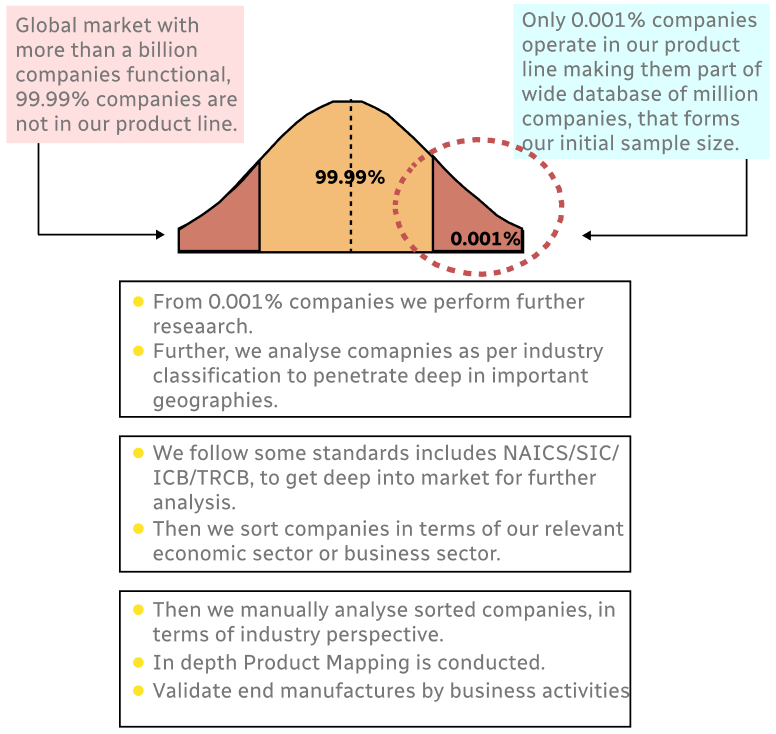
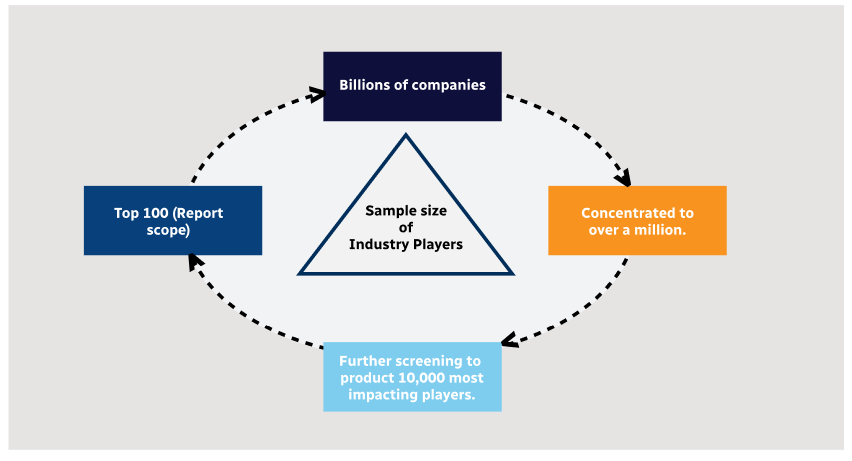
Step 1 - Identification of Relevant Samples Size from Population Database
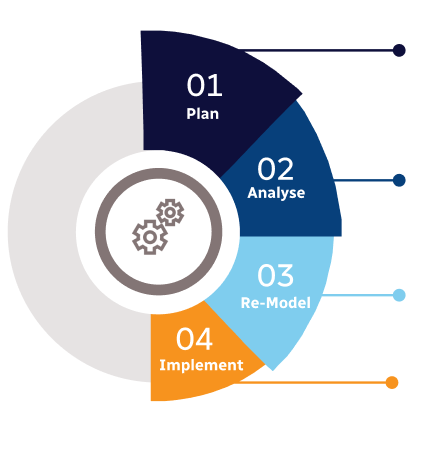
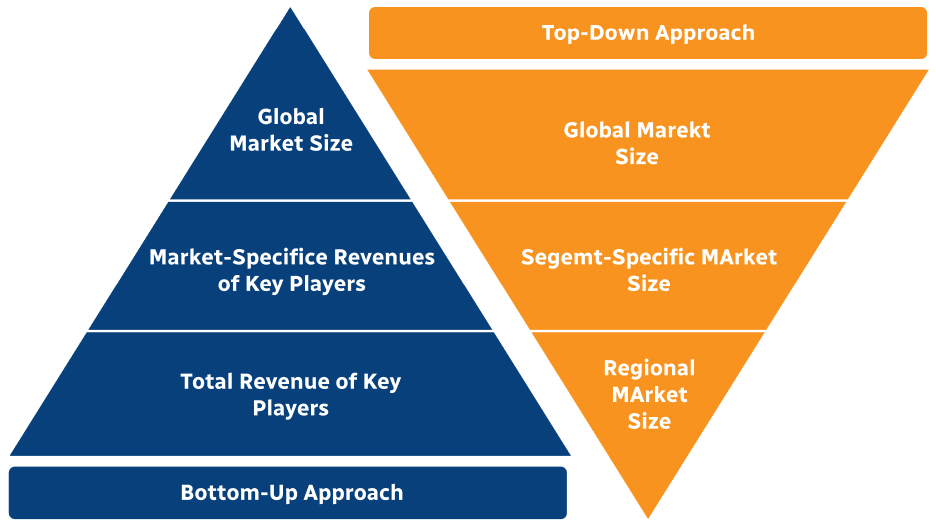
Step 2 - Approaches for Defining Global Market Size (Value, Volume* & Price*)
Note*: In applicable scenarios
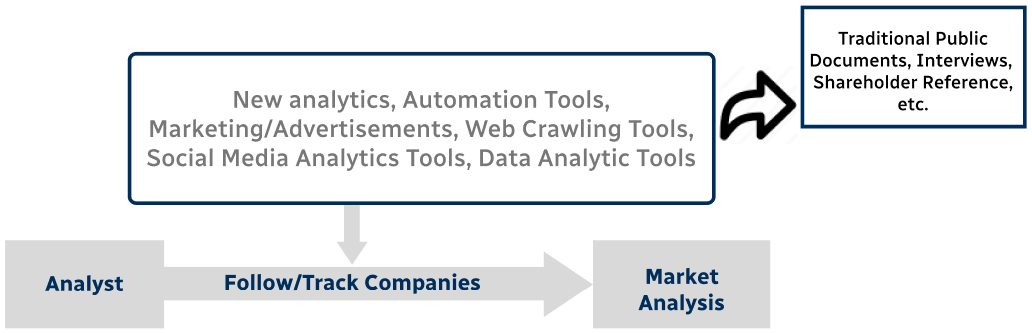
Step 3 - Data Sources
Primary Research
- Web Analytics
- Survey Reports
- Research Institute
- Latest Research Reports
- Opinion Leaders
Secondary Research
- Annual Reports
- White Paper
- Latest Press Release
- Industry Association
- Paid Database
- Investor Presentations
Step 4 - Data Triangulation
Involves using different sources of information in order to increase the validity of a study
These sources are likely to be stakeholders in a program - participants, other researchers, program staff, other community members, and so on.
Then we put all data in single framework & apply various statistical tools to find out the dynamic on the market.
During the analysis stage, feedback from the stakeholder groups would be compared to determine areas of agreement as well as areas of divergence