
Key Insights
The Long-Wave Infrared (LWIR) Lens market is poised for substantial expansion, with a projected market size of $656 million in 2025. This growth is underpinned by an impressive Compound Annual Growth Rate (CAGR) of 10.3% anticipated over the forecast period of 2025-2033. The burgeoning demand stems from critical applications across commercial and military sectors, where advanced thermal imaging capabilities are becoming indispensable. In the commercial realm, sectors such as industrial inspection, security and surveillance, automotive, and healthcare are increasingly adopting LWIR lenses for enhanced diagnostics, predictive maintenance, and safety. The military segment continues to be a significant driver, with ongoing investments in advanced defense systems, reconnaissance, and target acquisition technologies that heavily rely on high-performance LWIR optics.
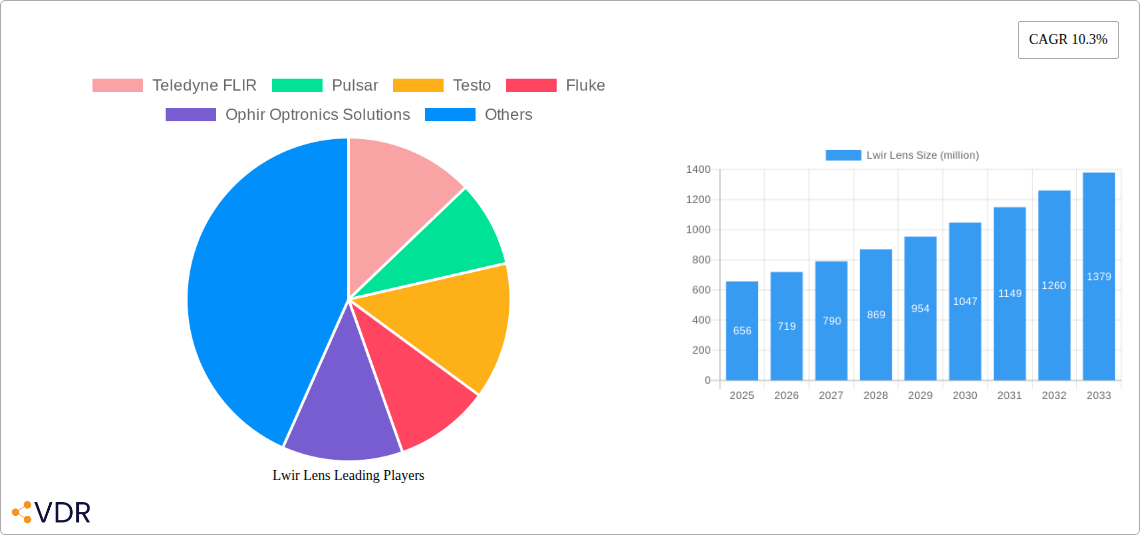
Lwir Lens Market Size (In Million)

Key trends shaping this market include advancements in athermalized lens technology, which offers stable performance across a wide temperature range, and the increasing sophistication of discrete and continuous zoom lenses, providing greater operational flexibility. These technological leaps are crucial for overcoming the inherent challenges in LWIR imaging, such as atmospheric turbulence and thermal drift. While the market is experiencing robust growth, potential restraints could include the high cost of advanced materials and manufacturing processes, as well as the need for specialized expertise in design and calibration. However, the persistent drive for improved thermal sensitivity, resolution, and miniaturization by leading companies like Teledyne FLIR, Pulsar, and Testo, coupled with a global push for enhanced situational awareness and automation, suggests that the LWIR Lens market will continue its upward trajectory, solidifying its importance across diverse industries worldwide.

Lwir Lens Company Market Share
Lwir Lens Market Dynamics & Structure
The LWIR (Long-Wave Infrared) lens market exhibits a moderately consolidated structure, with key players like Teledyne FLIR, Pulsar, and Testo holding significant market shares. Technological innovation is a primary driver, fueled by increasing demand for advanced thermal imaging solutions in defense, industrial inspection, and security applications. Regulatory frameworks, particularly concerning export controls for advanced imaging technologies and data privacy, influence market access and product development. Competitive product substitutes, while limited in direct LWIR lens capabilities, include other sensing modalities like visible light cameras and acoustic sensors, which can sometimes offer alternative solutions for specific use cases. End-user demographics are increasingly diverse, spanning defense forces, manufacturing plants, automotive manufacturers, and building inspection professionals, each with distinct performance requirements and budget considerations. Mergers and acquisitions (M&A) are active, with companies like Fluke and Ophir Optronics Solutions strategically acquiring smaller firms to expand their product portfolios and technological capabilities. For instance, the acquisition of Luminit by Teledyne FLIR aimed to bolster its infrared component offerings.
- Market Concentration: Moderately consolidated, with top 5 players accounting for approximately 65% of the global market revenue in 2025.
- Technological Innovation: Driven by advancements in focal plane arrays, lens coatings, and miniaturization for portable devices.
- Regulatory Frameworks: Focus on national security implications of advanced thermal imaging and data security compliance.
- Competitive Substitutes: Visible light cameras, acoustic sensors, and other non-thermal sensing technologies.
- End-User Demographics: Diversifying from primarily military to include industrial, automotive, and construction sectors.
- M&A Trends: Active, with strategic acquisitions to enhance product lines and R&D capabilities.
Lwir Lens Growth Trends & Insights
The LWIR lens market is poised for robust expansion, driven by a confluence of technological advancements, increasing adoption across diverse industries, and shifting consumer behavior towards sophisticated imaging solutions. The global market size for LWIR lenses is projected to witness substantial growth, expanding from an estimated value of $1,800 million in 2025 to reach $4,500 million by the end of the forecast period in 2033. This represents a Compound Annual Growth Rate (CAGR) of approximately 12.2% during the forecast period. This impressive trajectory is underpinned by the escalating demand for enhanced situational awareness, predictive maintenance, and non-destructive testing methodologies. Technological disruptions, such as the development of uncooled microbolometer detectors and advanced optical designs, are significantly improving the performance and reducing the cost of LWIR systems, thereby driving adoption rates. Consumer behavior is evolving, with an increasing appreciation for the value proposition of thermal imaging in applications ranging from home energy audits to advanced driver-assistance systems (ADAS) in vehicles. The penetration of LWIR technology into mainstream commercial applications is expected to accelerate, moving beyond its traditional stronghold in military and specialized industrial sectors. The continuous pursuit of higher resolution, wider fields of view, and enhanced spectral selectivity in LWIR lenses will further fuel market growth. Furthermore, the increasing integration of AI and machine learning algorithms with thermal imaging data is unlocking new analytical capabilities, enhancing the actionable insights derived from LWIR sensors and making them indispensable tools for a wider array of users. The shift towards miniaturization and cost-effectiveness of LWIR lenses is also a critical factor enabling their broader adoption, particularly in consumer electronics and portable diagnostic equipment.
Dominant Regions, Countries, or Segments in Lwir Lens
The Military application segment is currently the most dominant driver of growth in the global LWIR lens market, with its market share estimated at 45% in 2025, projected to grow at a CAGR of 13.5% during the forecast period. This dominance is fueled by continuous advancements in defense technologies, including uncooled thermal imagers for surveillance, targeting systems, and personal protective equipment for soldiers. The geopolitical landscape and the ongoing need for enhanced national security are primary catalysts for sustained investment in military-grade thermal imaging solutions. North America, particularly the United States, represents the leading country, accounting for approximately 30% of the global market revenue in 2025. This leadership is attributed to significant government expenditure on defense procurement, substantial R&D investments in defense technologies, and the presence of major defense contractors and LWIR lens manufacturers. Economic policies supporting military modernization and technological superiority further bolster its position.
The Athermalized Lens type segment is another key contributor to market dominance, holding an estimated 40% market share in 2025 and projected to grow at a CAGR of 11.8%. Athermalized lenses are critical for maintaining optical performance across a wide range of operating temperatures without active cooling, making them ideal for rugged military and demanding industrial applications. Their inherent stability and reliability make them a preferred choice for mission-critical systems.
- Dominant Application: Military – driven by defense spending, surveillance needs, and advanced targeting systems.
- Market Share (2025): 45%
- CAGR (2025-2033): 13.5%
- Dominant Country: United States – due to high defense budgets, R&D investments, and presence of key players.
- Market Share (2025): 30%
- CAGR (2025-2033): 12.8%
- Dominant Type: Athermalized Lens – essential for stable performance in variable temperature environments.
- Market Share (2025): 40%
- CAGR (2025-2033): 11.8%
- Growth Factors: Increasing demand for advanced surveillance, predictive maintenance, and safety systems.
- Regional Nuances: Europe shows strong growth in industrial and automotive applications, while Asia-Pacific is emerging rapidly due to increased manufacturing and defense modernization.
Lwir Lens Product Landscape
The LWIR lens product landscape is characterized by continuous innovation focused on enhanced performance, miniaturization, and cost-effectiveness. Manufacturers are actively developing lenses with improved spectral sensitivity, wider fields of view, and higher resolution to cater to evolving end-user demands. Key product advancements include the integration of advanced anti-reflective coatings for reduced signal loss and the development of more robust and compact lens designs for portable devices. Unique selling propositions often revolve around superior optical quality, exceptional durability in harsh environments, and specialized functionalities such as advanced thermal resolution and customized spectral bands. Technological advancements are enabling LWIR lenses to achieve unprecedented levels of detail and accuracy in thermal imaging.
Key Drivers, Barriers & Challenges in Lwir Lens
Key Drivers: The LWIR lens market is propelled by several key drivers. Foremost is the escalating demand for enhanced surveillance and reconnaissance capabilities in defense and security sectors, necessitating advanced thermal imaging solutions. The growing adoption of predictive maintenance in industrial settings to prevent equipment failures and optimize operational efficiency is another significant driver. Furthermore, the increasing integration of LWIR technology into automotive safety systems, such as pedestrian detection and advanced driver-assistance systems (ADAS), is opening up new avenues for growth. Technological advancements in microbolometer technology and optical design are also reducing costs and improving performance, making LWIR lenses more accessible.
Key Barriers & Challenges: Despite the strong growth trajectory, the LWIR lens market faces several barriers and challenges. High manufacturing costs, particularly for specialized and high-performance lenses, remain a significant impediment to widespread adoption in cost-sensitive applications. The complexity of the supply chain for rare earth materials and specialized coatings can lead to production bottlenecks and price volatility. Stringent export control regulations for advanced thermal imaging technologies can limit market access for certain regions and countries. Moreover, the need for specialized expertise for operating and interpreting thermal imaging data can present a barrier to entry for some end-users. Intense competition among established players and emerging manufacturers also puts pressure on pricing and profit margins.
Emerging Opportunities in Lwir Lens
Emerging opportunities in the LWIR lens market are multifaceted, driven by evolving technological capabilities and expanding application horizons. The growing demand for intelligent surveillance systems, where LWIR lenses are integrated with AI and machine learning for automated threat detection and anomaly identification, presents a significant opportunity. The expansion of LWIR technology into the consumer electronics sector, particularly in smartphones and smart home devices for applications like temperature monitoring and energy efficiency assessments, is another promising area. The automotive industry's push towards fully autonomous driving systems will further boost the demand for advanced LWIR sensors for all-weather visibility and object detection. Furthermore, the development of cost-effective, high-performance LWIR lenses for applications in agriculture (e.g., crop health monitoring) and healthcare (e.g., non-contact temperature screening) offers substantial untapped market potential.
Growth Accelerators in the Lwir Lens Industry
The LWIR lens industry's long-term growth is being accelerated by several pivotal factors. Continuous innovation in material science and optical engineering is leading to lighter, more compact, and more efficient lens designs, enabling their integration into a wider array of devices. Strategic partnerships and collaborations between lens manufacturers, sensor providers, and system integrators are fostering the development of comprehensive thermal imaging solutions tailored to specific industry needs. The increasing investment in R&D by both established players and emerging companies is driving the development of next-generation LWIR lenses with enhanced capabilities and reduced costs. Furthermore, the growing awareness and adoption of thermal imaging technology across diverse sectors, fueled by successful case studies and demonstrations, are creating a positive feedback loop for market expansion.
Key Players Shaping the Lwir Lens Market
- Teledyne FLIR
- Pulsar
- Testo
- Fluke
- Ophir Optronics Solutions
- Quanhom
- Shalom EO
- Qioptiq
- LightPath
- Tamron
Notable Milestones in Lwir Lens Sector
- 2019: Teledyne FLIR acquires Iso-Ray, expanding its expertise in cooled infrared detector technology.
- 2020: Pulsar launches its Thermion series of thermal riflescopes, significantly boosting consumer-level adoption.
- 2021: Fluke introduces the Ti401 PRO thermal camera, offering enhanced resolution and industrial-grade durability.
- 2022: Ophir Optronics Solutions launches a new line of high-performance LWIR lenses for demanding industrial applications.
- 2023: Testo releases its Smart Probes series, integrating thermal imaging capabilities into compact diagnostic tools.
- 2024: Advancement in uncooled microbolometer technology leads to a notable decrease in the cost of high-resolution LWIR sensors.
In-Depth Lwir Lens Market Outlook
The future outlook for the LWIR lens market is exceptionally promising, fueled by continuous technological advancements and expanding application footprints. Growth accelerators such as ongoing innovation in athermalized and continuous zoom lens technologies, coupled with strategic market expansion into burgeoning sectors like automotive and consumer electronics, are set to propel sustained expansion. The increasing integration of AI-powered analytics with LWIR data will unlock unprecedented capabilities, further solidifying the indispensable role of these lenses. Key players are expected to focus on product differentiation through enhanced resolution, spectral versatility, and miniaturization, catering to the evolving demands of both commercial and military end-users. The market is poised for significant growth, driven by a strategic convergence of technological prowess and market foresight.
Lwir Lens Segmentation
-
1. Application
- 1.1. Commercial
- 1.2. Military
- 1.3. Others
-
2. Type
- 2.1. Athermalized Lens
- 2.2. Discrete Zoom Lens
- 2.3. Continuous Zoom Lens
- 2.4. Others
Lwir Lens Segmentation By Geography
-
1. North America
- 1.1. United States
- 1.2. Canada
- 1.3. Mexico
-
2. South America
- 2.1. Brazil
- 2.2. Argentina
- 2.3. Rest of South America
-
3. Europe
- 3.1. United Kingdom
- 3.2. Germany
- 3.3. France
- 3.4. Italy
- 3.5. Spain
- 3.6. Russia
- 3.7. Benelux
- 3.8. Nordics
- 3.9. Rest of Europe
-
4. Middle East & Africa
- 4.1. Turkey
- 4.2. Israel
- 4.3. GCC
- 4.4. North Africa
- 4.5. South Africa
- 4.6. Rest of Middle East & Africa
-
5. Asia Pacific
- 5.1. China
- 5.2. India
- 5.3. Japan
- 5.4. South Korea
- 5.5. ASEAN
- 5.6. Oceania
- 5.7. Rest of Asia Pacific
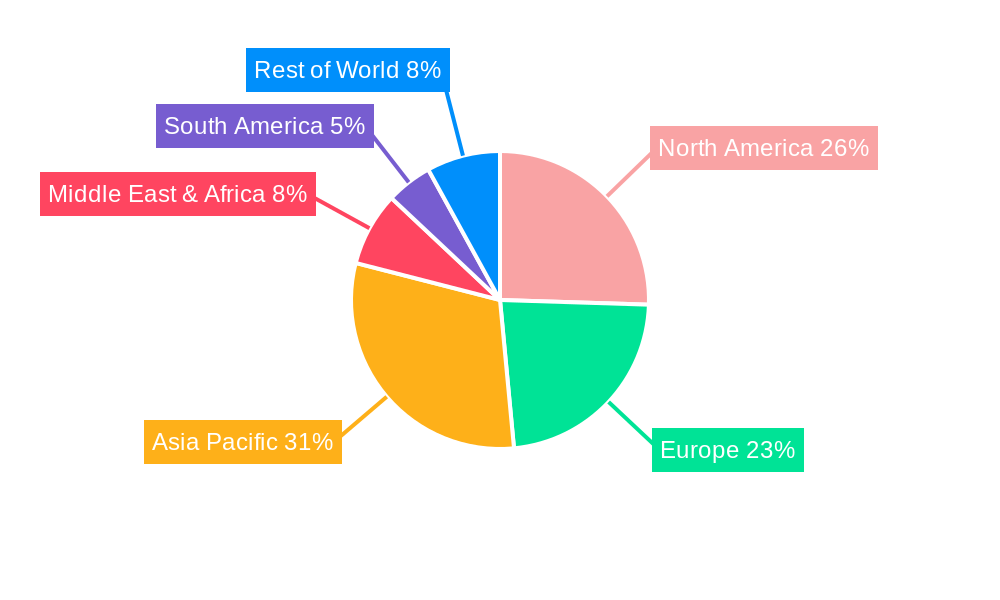
Lwir Lens Regional Market Share
Geographic Coverage of Lwir Lens
Lwir Lens REPORT HIGHLIGHTS
| Aspects | Details |
|---|---|
| Study Period | 2020-2034 |
| Base Year | 2025 |
| Estimated Year | 2026 |
| Forecast Period | 2026-2034 |
| Historical Period | 2020-2025 |
| Growth Rate | CAGR of 10.3% from 2020-2034 |
| Segmentation |
|
Table of Contents
- 1. Introduction
- 1.1. Research Scope
- 1.2. Market Segmentation
- 1.3. Research Methodology
- 1.4. Definitions and Assumptions
- 2. Executive Summary
- 2.1. Introduction
- 3. Market Dynamics
- 3.1. Introduction
- 3.2. Market Drivers
- 3.3. Market Restrains
- 3.4. Market Trends
- 4. Market Factor Analysis
- 4.1. Porters Five Forces
- 4.2. Supply/Value Chain
- 4.3. PESTEL analysis
- 4.4. Market Entropy
- 4.5. Patent/Trademark Analysis
- 5. Global Lwir Lens Analysis, Insights and Forecast, 2020-2032
- 5.1. Market Analysis, Insights and Forecast - by Application
- 5.1.1. Commercial
- 5.1.2. Military
- 5.1.3. Others
- 5.2. Market Analysis, Insights and Forecast - by Type
- 5.2.1. Athermalized Lens
- 5.2.2. Discrete Zoom Lens
- 5.2.3. Continuous Zoom Lens
- 5.2.4. Others
- 5.3. Market Analysis, Insights and Forecast - by Region
- 5.3.1. North America
- 5.3.2. South America
- 5.3.3. Europe
- 5.3.4. Middle East & Africa
- 5.3.5. Asia Pacific
- 5.1. Market Analysis, Insights and Forecast - by Application
- 6. North America Lwir Lens Analysis, Insights and Forecast, 2020-2032
- 6.1. Market Analysis, Insights and Forecast - by Application
- 6.1.1. Commercial
- 6.1.2. Military
- 6.1.3. Others
- 6.2. Market Analysis, Insights and Forecast - by Type
- 6.2.1. Athermalized Lens
- 6.2.2. Discrete Zoom Lens
- 6.2.3. Continuous Zoom Lens
- 6.2.4. Others
- 6.1. Market Analysis, Insights and Forecast - by Application
- 7. South America Lwir Lens Analysis, Insights and Forecast, 2020-2032
- 7.1. Market Analysis, Insights and Forecast - by Application
- 7.1.1. Commercial
- 7.1.2. Military
- 7.1.3. Others
- 7.2. Market Analysis, Insights and Forecast - by Type
- 7.2.1. Athermalized Lens
- 7.2.2. Discrete Zoom Lens
- 7.2.3. Continuous Zoom Lens
- 7.2.4. Others
- 7.1. Market Analysis, Insights and Forecast - by Application
- 8. Europe Lwir Lens Analysis, Insights and Forecast, 2020-2032
- 8.1. Market Analysis, Insights and Forecast - by Application
- 8.1.1. Commercial
- 8.1.2. Military
- 8.1.3. Others
- 8.2. Market Analysis, Insights and Forecast - by Type
- 8.2.1. Athermalized Lens
- 8.2.2. Discrete Zoom Lens
- 8.2.3. Continuous Zoom Lens
- 8.2.4. Others
- 8.1. Market Analysis, Insights and Forecast - by Application
- 9. Middle East & Africa Lwir Lens Analysis, Insights and Forecast, 2020-2032
- 9.1. Market Analysis, Insights and Forecast - by Application
- 9.1.1. Commercial
- 9.1.2. Military
- 9.1.3. Others
- 9.2. Market Analysis, Insights and Forecast - by Type
- 9.2.1. Athermalized Lens
- 9.2.2. Discrete Zoom Lens
- 9.2.3. Continuous Zoom Lens
- 9.2.4. Others
- 9.1. Market Analysis, Insights and Forecast - by Application
- 10. Asia Pacific Lwir Lens Analysis, Insights and Forecast, 2020-2032
- 10.1. Market Analysis, Insights and Forecast - by Application
- 10.1.1. Commercial
- 10.1.2. Military
- 10.1.3. Others
- 10.2. Market Analysis, Insights and Forecast - by Type
- 10.2.1. Athermalized Lens
- 10.2.2. Discrete Zoom Lens
- 10.2.3. Continuous Zoom Lens
- 10.2.4. Others
- 10.1. Market Analysis, Insights and Forecast - by Application
- 11. Competitive Analysis
- 11.1. Global Market Share Analysis 2025
- 11.2. Company Profiles
- 11.2.1 Teledyne FLIR
- 11.2.1.1. Overview
- 11.2.1.2. Products
- 11.2.1.3. SWOT Analysis
- 11.2.1.4. Recent Developments
- 11.2.1.5. Financials (Based on Availability)
- 11.2.2 Pulsar
- 11.2.2.1. Overview
- 11.2.2.2. Products
- 11.2.2.3. SWOT Analysis
- 11.2.2.4. Recent Developments
- 11.2.2.5. Financials (Based on Availability)
- 11.2.3 Testo
- 11.2.3.1. Overview
- 11.2.3.2. Products
- 11.2.3.3. SWOT Analysis
- 11.2.3.4. Recent Developments
- 11.2.3.5. Financials (Based on Availability)
- 11.2.4 Fluke
- 11.2.4.1. Overview
- 11.2.4.2. Products
- 11.2.4.3. SWOT Analysis
- 11.2.4.4. Recent Developments
- 11.2.4.5. Financials (Based on Availability)
- 11.2.5 Ophir Optronics Solutions
- 11.2.5.1. Overview
- 11.2.5.2. Products
- 11.2.5.3. SWOT Analysis
- 11.2.5.4. Recent Developments
- 11.2.5.5. Financials (Based on Availability)
- 11.2.6 Quanhom
- 11.2.6.1. Overview
- 11.2.6.2. Products
- 11.2.6.3. SWOT Analysis
- 11.2.6.4. Recent Developments
- 11.2.6.5. Financials (Based on Availability)
- 11.2.7 Shalom EO
- 11.2.7.1. Overview
- 11.2.7.2. Products
- 11.2.7.3. SWOT Analysis
- 11.2.7.4. Recent Developments
- 11.2.7.5. Financials (Based on Availability)
- 11.2.8 Qioptiq
- 11.2.8.1. Overview
- 11.2.8.2. Products
- 11.2.8.3. SWOT Analysis
- 11.2.8.4. Recent Developments
- 11.2.8.5. Financials (Based on Availability)
- 11.2.9 LightPath
- 11.2.9.1. Overview
- 11.2.9.2. Products
- 11.2.9.3. SWOT Analysis
- 11.2.9.4. Recent Developments
- 11.2.9.5. Financials (Based on Availability)
- 11.2.10 Tamron
- 11.2.10.1. Overview
- 11.2.10.2. Products
- 11.2.10.3. SWOT Analysis
- 11.2.10.4. Recent Developments
- 11.2.10.5. Financials (Based on Availability)
- 11.2.1 Teledyne FLIR
List of Figures
- Figure 1: Global Lwir Lens Revenue Breakdown (million, %) by Region 2025 & 2033
- Figure 2: North America Lwir Lens Revenue (million), by Application 2025 & 2033
- Figure 3: North America Lwir Lens Revenue Share (%), by Application 2025 & 2033
- Figure 4: North America Lwir Lens Revenue (million), by Type 2025 & 2033
- Figure 5: North America Lwir Lens Revenue Share (%), by Type 2025 & 2033
- Figure 6: North America Lwir Lens Revenue (million), by Country 2025 & 2033
- Figure 7: North America Lwir Lens Revenue Share (%), by Country 2025 & 2033
- Figure 8: South America Lwir Lens Revenue (million), by Application 2025 & 2033
- Figure 9: South America Lwir Lens Revenue Share (%), by Application 2025 & 2033
- Figure 10: South America Lwir Lens Revenue (million), by Type 2025 & 2033
- Figure 11: South America Lwir Lens Revenue Share (%), by Type 2025 & 2033
- Figure 12: South America Lwir Lens Revenue (million), by Country 2025 & 2033
- Figure 13: South America Lwir Lens Revenue Share (%), by Country 2025 & 2033
- Figure 14: Europe Lwir Lens Revenue (million), by Application 2025 & 2033
- Figure 15: Europe Lwir Lens Revenue Share (%), by Application 2025 & 2033
- Figure 16: Europe Lwir Lens Revenue (million), by Type 2025 & 2033
- Figure 17: Europe Lwir Lens Revenue Share (%), by Type 2025 & 2033
- Figure 18: Europe Lwir Lens Revenue (million), by Country 2025 & 2033
- Figure 19: Europe Lwir Lens Revenue Share (%), by Country 2025 & 2033
- Figure 20: Middle East & Africa Lwir Lens Revenue (million), by Application 2025 & 2033
- Figure 21: Middle East & Africa Lwir Lens Revenue Share (%), by Application 2025 & 2033
- Figure 22: Middle East & Africa Lwir Lens Revenue (million), by Type 2025 & 2033
- Figure 23: Middle East & Africa Lwir Lens Revenue Share (%), by Type 2025 & 2033
- Figure 24: Middle East & Africa Lwir Lens Revenue (million), by Country 2025 & 2033
- Figure 25: Middle East & Africa Lwir Lens Revenue Share (%), by Country 2025 & 2033
- Figure 26: Asia Pacific Lwir Lens Revenue (million), by Application 2025 & 2033
- Figure 27: Asia Pacific Lwir Lens Revenue Share (%), by Application 2025 & 2033
- Figure 28: Asia Pacific Lwir Lens Revenue (million), by Type 2025 & 2033
- Figure 29: Asia Pacific Lwir Lens Revenue Share (%), by Type 2025 & 2033
- Figure 30: Asia Pacific Lwir Lens Revenue (million), by Country 2025 & 2033
- Figure 31: Asia Pacific Lwir Lens Revenue Share (%), by Country 2025 & 2033
List of Tables
- Table 1: Global Lwir Lens Revenue million Forecast, by Application 2020 & 2033
- Table 2: Global Lwir Lens Revenue million Forecast, by Type 2020 & 2033
- Table 3: Global Lwir Lens Revenue million Forecast, by Region 2020 & 2033
- Table 4: Global Lwir Lens Revenue million Forecast, by Application 2020 & 2033
- Table 5: Global Lwir Lens Revenue million Forecast, by Type 2020 & 2033
- Table 6: Global Lwir Lens Revenue million Forecast, by Country 2020 & 2033
- Table 7: United States Lwir Lens Revenue (million) Forecast, by Application 2020 & 2033
- Table 8: Canada Lwir Lens Revenue (million) Forecast, by Application 2020 & 2033
- Table 9: Mexico Lwir Lens Revenue (million) Forecast, by Application 2020 & 2033
- Table 10: Global Lwir Lens Revenue million Forecast, by Application 2020 & 2033
- Table 11: Global Lwir Lens Revenue million Forecast, by Type 2020 & 2033
- Table 12: Global Lwir Lens Revenue million Forecast, by Country 2020 & 2033
- Table 13: Brazil Lwir Lens Revenue (million) Forecast, by Application 2020 & 2033
- Table 14: Argentina Lwir Lens Revenue (million) Forecast, by Application 2020 & 2033
- Table 15: Rest of South America Lwir Lens Revenue (million) Forecast, by Application 2020 & 2033
- Table 16: Global Lwir Lens Revenue million Forecast, by Application 2020 & 2033
- Table 17: Global Lwir Lens Revenue million Forecast, by Type 2020 & 2033
- Table 18: Global Lwir Lens Revenue million Forecast, by Country 2020 & 2033
- Table 19: United Kingdom Lwir Lens Revenue (million) Forecast, by Application 2020 & 2033
- Table 20: Germany Lwir Lens Revenue (million) Forecast, by Application 2020 & 2033
- Table 21: France Lwir Lens Revenue (million) Forecast, by Application 2020 & 2033
- Table 22: Italy Lwir Lens Revenue (million) Forecast, by Application 2020 & 2033
- Table 23: Spain Lwir Lens Revenue (million) Forecast, by Application 2020 & 2033
- Table 24: Russia Lwir Lens Revenue (million) Forecast, by Application 2020 & 2033
- Table 25: Benelux Lwir Lens Revenue (million) Forecast, by Application 2020 & 2033
- Table 26: Nordics Lwir Lens Revenue (million) Forecast, by Application 2020 & 2033
- Table 27: Rest of Europe Lwir Lens Revenue (million) Forecast, by Application 2020 & 2033
- Table 28: Global Lwir Lens Revenue million Forecast, by Application 2020 & 2033
- Table 29: Global Lwir Lens Revenue million Forecast, by Type 2020 & 2033
- Table 30: Global Lwir Lens Revenue million Forecast, by Country 2020 & 2033
- Table 31: Turkey Lwir Lens Revenue (million) Forecast, by Application 2020 & 2033
- Table 32: Israel Lwir Lens Revenue (million) Forecast, by Application 2020 & 2033
- Table 33: GCC Lwir Lens Revenue (million) Forecast, by Application 2020 & 2033
- Table 34: North Africa Lwir Lens Revenue (million) Forecast, by Application 2020 & 2033
- Table 35: South Africa Lwir Lens Revenue (million) Forecast, by Application 2020 & 2033
- Table 36: Rest of Middle East & Africa Lwir Lens Revenue (million) Forecast, by Application 2020 & 2033
- Table 37: Global Lwir Lens Revenue million Forecast, by Application 2020 & 2033
- Table 38: Global Lwir Lens Revenue million Forecast, by Type 2020 & 2033
- Table 39: Global Lwir Lens Revenue million Forecast, by Country 2020 & 2033
- Table 40: China Lwir Lens Revenue (million) Forecast, by Application 2020 & 2033
- Table 41: India Lwir Lens Revenue (million) Forecast, by Application 2020 & 2033
- Table 42: Japan Lwir Lens Revenue (million) Forecast, by Application 2020 & 2033
- Table 43: South Korea Lwir Lens Revenue (million) Forecast, by Application 2020 & 2033
- Table 44: ASEAN Lwir Lens Revenue (million) Forecast, by Application 2020 & 2033
- Table 45: Oceania Lwir Lens Revenue (million) Forecast, by Application 2020 & 2033
- Table 46: Rest of Asia Pacific Lwir Lens Revenue (million) Forecast, by Application 2020 & 2033
Frequently Asked Questions
1. What is the projected Compound Annual Growth Rate (CAGR) of the Lwir Lens?
The projected CAGR is approximately 10.3%.
2. Which companies are prominent players in the Lwir Lens?
Key companies in the market include Teledyne FLIR, Pulsar, Testo, Fluke, Ophir Optronics Solutions, Quanhom, Shalom EO, Qioptiq, LightPath, Tamron.
3. What are the main segments of the Lwir Lens?
The market segments include Application, Type.
4. Can you provide details about the market size?
The market size is estimated to be USD 656 million as of 2022.
5. What are some drivers contributing to market growth?
N/A
6. What are the notable trends driving market growth?
N/A
7. Are there any restraints impacting market growth?
N/A
8. Can you provide examples of recent developments in the market?
N/A
9. What pricing options are available for accessing the report?
Pricing options include single-user, multi-user, and enterprise licenses priced at USD 4250.00, USD 6375.00, and USD 8500.00 respectively.
10. Is the market size provided in terms of value or volume?
The market size is provided in terms of value, measured in million.
11. Are there any specific market keywords associated with the report?
Yes, the market keyword associated with the report is "Lwir Lens," which aids in identifying and referencing the specific market segment covered.
12. How do I determine which pricing option suits my needs best?
The pricing options vary based on user requirements and access needs. Individual users may opt for single-user licenses, while businesses requiring broader access may choose multi-user or enterprise licenses for cost-effective access to the report.
13. Are there any additional resources or data provided in the Lwir Lens report?
While the report offers comprehensive insights, it's advisable to review the specific contents or supplementary materials provided to ascertain if additional resources or data are available.
14. How can I stay updated on further developments or reports in the Lwir Lens?
To stay informed about further developments, trends, and reports in the Lwir Lens, consider subscribing to industry newsletters, following relevant companies and organizations, or regularly checking reputable industry news sources and publications.
Methodology
Step 1 - Identification of Relevant Samples Size from Population Database



Step 2 - Approaches for Defining Global Market Size (Value, Volume* & Price*)

Note*: In applicable scenarios
Step 3 - Data Sources
Primary Research
- Web Analytics
- Survey Reports
- Research Institute
- Latest Research Reports
- Opinion Leaders
Secondary Research
- Annual Reports
- White Paper
- Latest Press Release
- Industry Association
- Paid Database
- Investor Presentations

Step 4 - Data Triangulation
Involves using different sources of information in order to increase the validity of a study
These sources are likely to be stakeholders in a program - participants, other researchers, program staff, other community members, and so on.
Then we put all data in single framework & apply various statistical tools to find out the dynamic on the market.
During the analysis stage, feedback from the stakeholder groups would be compared to determine areas of agreement as well as areas of divergence

