


Key Insights
The global Ear Anatomy Models market is projected for substantial growth, reaching an estimated market size of $7.66 billion in 2025. The market is anticipated to expand at a Compound Annual Growth Rate (CAGR) of 14.95% through 2033. This robust expansion is driven by heightened demand for anatomical education and training within healthcare and educational institutions. The increasing incidence of hearing-related conditions and the consequent need for enhanced diagnostic and treatment comprehension further fuel the demand for precise ear anatomy models. Innovations in material science and manufacturing are leading to the development of more sophisticated and lifelike models, addressing the evolving requirements of medical professionals, students, and researchers. Key sectors driving demand include educational institutions and healthcare facilities, utilizing these models for instruction, patient awareness, and surgical training.
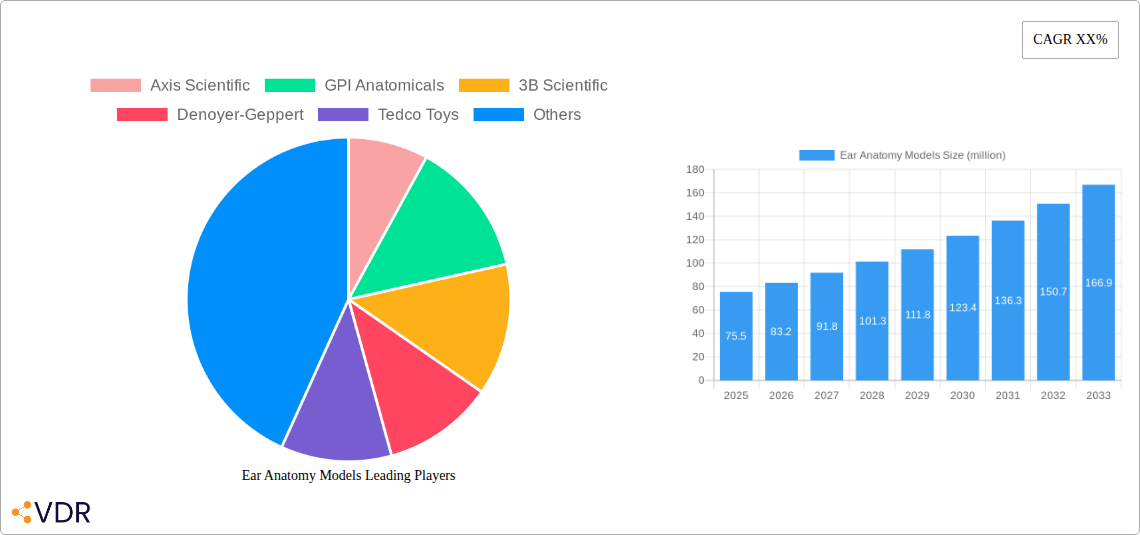
Ear Anatomy Models Market Size (In Billion)

The market offers a variety of model types, including reduced-size, natural-size, and enlarged-size models, each tailored to specific educational and clinical applications. Leading market participants, such as 3B Scientific, Axis Scientific, and GPI Anatomicals, are focused on continuous innovation to provide a broad range of ear anatomy models. Emerging trends include the incorporation of augmented reality (AR) and virtual reality (VR) for enriched learning experiences, alongside a growing preference for durable, high-fidelity models. While challenges like the cost of advanced models and the availability of digital alternatives exist, the inherent tactile and visual learning advantages of physical models are expected to maintain their significance. Geographically, North America and Europe currently dominate market share, supported by advanced healthcare and education systems and considerable medical research investment. However, the Asia Pacific region is poised for the most rapid expansion, driven by increased healthcare spending, a growing student demographic, and rising awareness in audiology and otolaryngology.
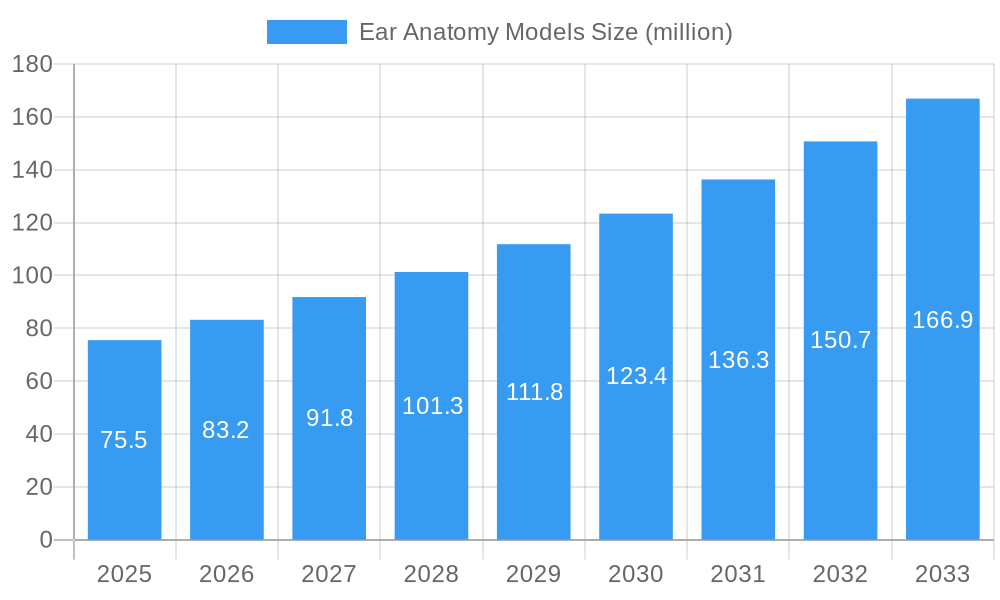
Ear Anatomy Models Company Market Share
Ear Anatomy Models Market Dynamics & Structure
The ear anatomy models market exhibits a moderate concentration, driven by a blend of established manufacturers and niche providers focusing on specialized educational and medical applications. Technological innovation plays a crucial role, with advancements in 3D printing and augmented reality (AR) integration for anatomical visualization significantly impacting product development. Regulatory frameworks, primarily focused on educational standards and material safety, also influence market entry and product design. Competitive product substitutes include digital anatomy platforms and existing traditional teaching aids, though physical models retain their importance for tactile learning and hands-on demonstration. End-user demographics span educational institutions (schools), healthcare facilities (hospitals), and individual learners, each with distinct purchasing drivers. Mergers and acquisitions (M&A) are observed periodically, aiming to consolidate market share, expand product portfolios, and gain access to new distribution channels.
- Market Concentration: Moderate, with key players like 3B Scientific and Axis Scientific holding significant shares, alongside specialized providers.
- Technological Innovation: 3D printing for high-fidelity models, integration of AR/VR for enhanced learning experiences, and development of durable, life-like materials.
- Regulatory Frameworks: Focus on educational standards, material biocompatibility (for medical models), and safety certifications.
- Competitive Substitutes: Digital anatomy software, interactive online learning platforms, and traditional illustrations.
- End-User Demographics: K-12 schools, universities, medical schools, ENT clinics, audiology practices, and individuals pursuing medical education.
- M&A Trends: Strategic acquisitions to broaden product lines, enhance distribution networks, and integrate emerging technologies.
Ear Anatomy Models Growth Trends & Insights
The global ear anatomy models market is poised for steady growth, driven by an increasing emphasis on comprehensive anatomical education and specialized medical training. The market size is projected to expand from an estimated $70 million in 2024 to reach approximately $110 million by 2033, reflecting a Compound Annual Growth Rate (CAGR) of around 5.5% during the forecast period. Adoption rates are particularly high in medical schools and audiology training programs where detailed, tactile understanding of the human ear's intricate structure is paramount. Technological disruptions, such as the integration of augmented reality with physical models, are significantly enhancing engagement and learning outcomes, leading to increased demand for advanced models.
Consumer behavior is shifting towards more interactive and immersive learning tools. Educators and students are increasingly seeking models that offer not just static representation but also dynamic learning capabilities. This trend is further fueled by a growing awareness of the importance of early and accurate diagnosis of hearing-related issues, necessitating well-trained professionals equipped with advanced learning aids. The 'Parents' market, encompassing children's educational toys and early learning kits focused on science, also presents a growing segment, albeit smaller, for simplified ear anatomy models. The 'Child' market specifically refers to models designed for pediatric learning and awareness programs related to ear health.
The market penetration of advanced ear anatomy models, including those with detailed cross-sections and functional components, is expected to rise as educational institutions and healthcare providers allocate budgets towards modernizing their teaching resources. The recurring need for replacement and the introduction of new educational curricula also contribute to sustained demand. The rising global incidence of hearing loss and related conditions further underpins the demand for effective training tools for healthcare professionals, thereby directly impacting the ear anatomy models market. The continuous innovation in materials science, leading to more durable and realistic models, also plays a vital role in their widespread adoption.
Dominant Regions, Countries, or Segments in Ear Anatomy Models
North America and Europe currently dominate the global ear anatomy models market, driven by robust healthcare infrastructure, advanced educational systems, and a high propensity for investing in advanced learning tools. The United States, in particular, stands out due to its extensive network of medical schools, research institutions, and a strong emphasis on STEM education in its school systems. The presence of major anatomical model manufacturers and distributors in these regions further solidifies their leadership position. Economic policies supporting research and development, coupled with significant investments in educational technology, are key drivers of market dominance.
- Dominant Region: North America, followed closely by Europe.
- Key Country: United States, Germany, United Kingdom.
- Driving Factors in Dominant Regions:
- Well-funded educational institutions and healthcare systems.
- High adoption rate of advanced teaching methodologies.
- Strong regulatory support for medical education and training.
- Significant market size for anatomical models.
- Presence of leading manufacturers and research centers.
Within the Application segment, Schools represent a substantial driver of growth, encompassing primary, secondary, and higher education institutions. The increasing integration of biology and health sciences into curricula, coupled with a growing emphasis on visual and tactile learning, fuels consistent demand for ear anatomy models. The Hospital segment is also a significant growth engine, particularly for training medical students, residents, and allied health professionals in otology and audiology. This segment demands models with higher fidelity and greater detail, often incorporating features for demonstrating surgical procedures or pathological conditions. The Others segment, which includes individual learners, private practices, and specialized training centers, contributes to market expansion through diverse needs.
- Dominant Application Segment: Schools, driven by curriculum integration and demand for visual learning aids.
- Growth Potential in Hospital Segment: Driven by specialized medical training needs and the demand for detailed, functional models.
In terms of Types, Natural Size ear anatomy models hold a significant market share due to their direct applicability in training and demonstration for medical professionals. These models offer realistic proportions and anatomical accuracy, crucial for understanding spatial relationships within the ear. The Enlarged Size models are highly sought after in educational settings, particularly for younger learners or for illustrating specific microscopic structures of the ear in detail, making complex anatomy more accessible. Reduced Size models, while offering portability and cost-effectiveness, cater to a broader educational market and are popular in primary and secondary school settings.
- Dominant Type: Natural Size models, favored for their realistic representation in medical training.
- Growth in Enlarged Size Models: Driven by their utility in detailed anatomical illustration and early education.
Ear Anatomy Models Product Landscape
The ear anatomy models market is characterized by a diverse product landscape, featuring innovations aimed at enhancing educational effectiveness and diagnostic capabilities. Manufacturers like Axis Scientific and 3B Scientific offer highly detailed, multi-part models that allow for disassembly and detailed study of ossicles, cochlea, and semicircular canals. Advanced models incorporate realistic textures and colors to represent different tissues and fluids. The integration of QR codes linking to online educational content and AR experiences is a notable technological advancement, transforming static models into interactive learning tools. Applications span from basic anatomical education in schools to advanced surgical simulation training in hospitals. Unique selling propositions include exceptional anatomical accuracy, durability, and the innovative integration of digital learning resources.
Key Drivers, Barriers & Challenges in Ear Anatomy Models
Key Drivers:
- Growing Emphasis on STEM Education: Increased integration of biology and anatomy in school curricula globally.
- Advancements in Medical Training: Demand for realistic and detailed anatomical models for otology, audiology, and ENT specialties.
- Technological Innovations: Development of 3D printed, AR-integrated, and highly detailed models enhancing learning engagement.
- Rising Global Incidence of Hearing Impairments: Increasing need for better diagnosis and treatment, driving demand for professional training tools.
Key Barriers & Challenges:
- High Cost of Advanced Models: Sophisticated models with AR integration can be expensive, limiting accessibility for some educational institutions.
- Digital Alternatives: Proliferation of virtual reality and digital anatomy software as potential substitutes.
- Budgetary Constraints in Educational Institutions: Limited funding for specialized teaching aids in some regions.
- Supply Chain Disruptions: Potential for delays in sourcing raw materials or manufacturing, impacting product availability.
- Intellectual Property and Copyright: Ensuring originality and avoiding infringement in model design.
Emerging Opportunities in Ear Anatomy Models
Emerging opportunities in the ear anatomy models sector lie in the burgeoning markets of developing nations, where investment in educational infrastructure and healthcare is on the rise. The integration of artificial intelligence (AI) for personalized learning experiences, where models can interact with educational software, presents a significant future avenue. Furthermore, the development of portable, low-cost yet highly accurate models for remote or mobile healthcare training can tap into underserved regions. An increasing focus on patient education also opens opportunities for developing simplified, user-friendly models for clinics to explain conditions and procedures to patients and their families.
Growth Accelerators in the Ear Anatomy Models Industry
The growth accelerators for the ear anatomy models industry are intrinsically linked to continuous technological advancements and strategic market expansion. The widespread adoption of augmented reality (AR) and virtual reality (VR) technologies, enabling immersive and interactive learning experiences, is a significant catalyst. Collaborations between model manufacturers and educational technology providers are crucial for developing integrated learning solutions. Furthermore, increasing government initiatives to promote scientific education and healthcare infrastructure development in emerging economies present substantial growth potential. The demand for specialized models catering to specific sub-fields like cochlear implant training or advanced audiology diagnostics will also act as a growth accelerator.
Key Players Shaping the Ear Anatomy Models Market
- Axis Scientific
- GPI Anatomicals
- 3B Scientific
- Denoyer-Geppert
- Tedco Toys
- SOMSO
- ESP Models
- Eisco Labs
- Erler-Zimmer
Notable Milestones in Ear Anatomy Models Sector
- 2019: Increased adoption of 3D printing technologies for producing highly detailed anatomical models.
- 2020: Launch of enhanced AR-compatible ear anatomy models, bridging the gap between physical and digital learning.
- 2021: Emergence of specialized models for cochlear implant simulation and audiology training.
- 2022: Growing focus on sustainable materials and manufacturing processes in model production.
- 2023: Expansion of digital content integration through QR codes and cloud-based platforms linked to models.
- 2024: Increased collaboration between anatomical model manufacturers and educational institutions to develop customized learning solutions.
In-Depth Ear Anatomy Models Market Outlook
The in-depth ear anatomy models market outlook remains robust, driven by the sustained demand for high-quality anatomical visualization tools in education and healthcare. The ongoing integration of immersive technologies like AR and VR will continue to revolutionize learning, making physical models even more valuable as anchors for digital experiences. Emerging economies present significant untapped potential, requiring localized product development and distribution strategies. Strategic partnerships between established players and innovative tech startups will be crucial for unlocking future growth, particularly in areas like AI-driven educational content. The increasing global focus on preventative healthcare and early intervention for hearing-related issues will further solidify the demand for accurate and accessible ear anatomy models.
Ear Anatomy Models Segmentation
-
1. Application
- 1.1. School
- 1.2. Hospital
- 1.3. Others
-
2. Types
- 2.1. Reduced Size
- 2.2. Natural Size
- 2.3. Enlarged Size
Ear Anatomy Models Segmentation By Geography
-
1. North America
- 1.1. United States
- 1.2. Canada
- 1.3. Mexico
-
2. South America
- 2.1. Brazil
- 2.2. Argentina
- 2.3. Rest of South America
-
3. Europe
- 3.1. United Kingdom
- 3.2. Germany
- 3.3. France
- 3.4. Italy
- 3.5. Spain
- 3.6. Russia
- 3.7. Benelux
- 3.8. Nordics
- 3.9. Rest of Europe
-
4. Middle East & Africa
- 4.1. Turkey
- 4.2. Israel
- 4.3. GCC
- 4.4. North Africa
- 4.5. South Africa
- 4.6. Rest of Middle East & Africa
-
5. Asia Pacific
- 5.1. China
- 5.2. India
- 5.3. Japan
- 5.4. South Korea
- 5.5. ASEAN
- 5.6. Oceania
- 5.7. Rest of Asia Pacific
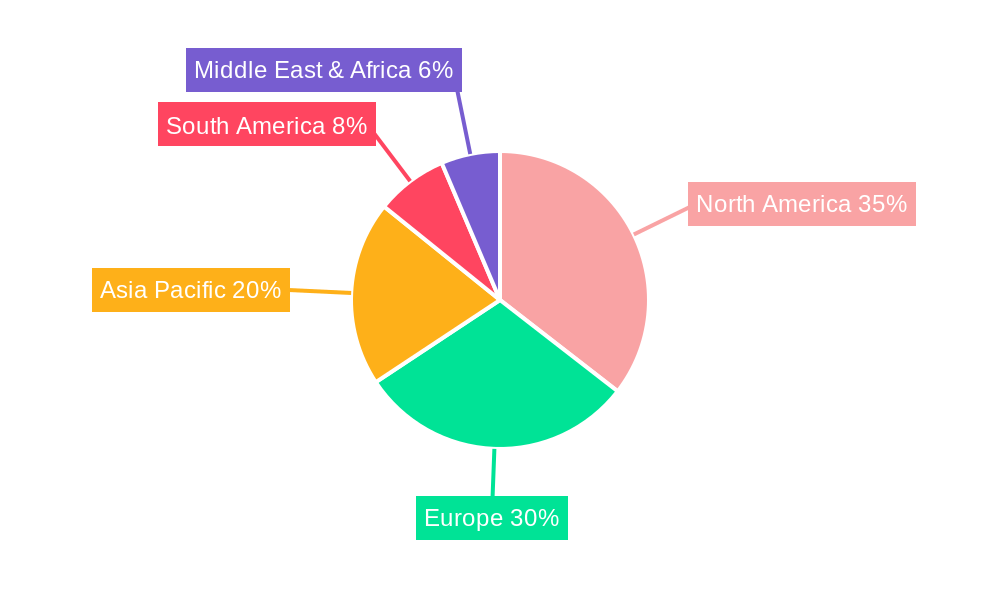
Ear Anatomy Models Regional Market Share
Geographic Coverage of Ear Anatomy Models
Ear Anatomy Models REPORT HIGHLIGHTS
| Aspects | Details |
|---|---|
| Study Period | 2020-2034 |
| Base Year | 2025 |
| Estimated Year | 2026 |
| Forecast Period | 2026-2034 |
| Historical Period | 2020-2025 |
| Growth Rate | CAGR of 14.95% from 2020-2034 |
| Segmentation |
|
Table of Contents
- 1. Introduction
- 1.1. Research Scope
- 1.2. Market Segmentation
- 1.3. Research Methodology
- 1.4. Definitions and Assumptions
- 2. Executive Summary
- 2.1. Introduction
- 3. Market Dynamics
- 3.1. Introduction
- 3.2. Market Drivers
- 3.3. Market Restrains
- 3.4. Market Trends
- 4. Market Factor Analysis
- 4.1. Porters Five Forces
- 4.2. Supply/Value Chain
- 4.3. PESTEL analysis
- 4.4. Market Entropy
- 4.5. Patent/Trademark Analysis
- 5. Global Ear Anatomy Models Analysis, Insights and Forecast, 2020-2032
- 5.1. Market Analysis, Insights and Forecast - by Application
- 5.1.1. School
- 5.1.2. Hospital
- 5.1.3. Others
- 5.2. Market Analysis, Insights and Forecast - by Types
- 5.2.1. Reduced Size
- 5.2.2. Natural Size
- 5.2.3. Enlarged Size
- 5.3. Market Analysis, Insights and Forecast - by Region
- 5.3.1. North America
- 5.3.2. South America
- 5.3.3. Europe
- 5.3.4. Middle East & Africa
- 5.3.5. Asia Pacific
- 5.1. Market Analysis, Insights and Forecast - by Application
- 6. North America Ear Anatomy Models Analysis, Insights and Forecast, 2020-2032
- 6.1. Market Analysis, Insights and Forecast - by Application
- 6.1.1. School
- 6.1.2. Hospital
- 6.1.3. Others
- 6.2. Market Analysis, Insights and Forecast - by Types
- 6.2.1. Reduced Size
- 6.2.2. Natural Size
- 6.2.3. Enlarged Size
- 6.1. Market Analysis, Insights and Forecast - by Application
- 7. South America Ear Anatomy Models Analysis, Insights and Forecast, 2020-2032
- 7.1. Market Analysis, Insights and Forecast - by Application
- 7.1.1. School
- 7.1.2. Hospital
- 7.1.3. Others
- 7.2. Market Analysis, Insights and Forecast - by Types
- 7.2.1. Reduced Size
- 7.2.2. Natural Size
- 7.2.3. Enlarged Size
- 7.1. Market Analysis, Insights and Forecast - by Application
- 8. Europe Ear Anatomy Models Analysis, Insights and Forecast, 2020-2032
- 8.1. Market Analysis, Insights and Forecast - by Application
- 8.1.1. School
- 8.1.2. Hospital
- 8.1.3. Others
- 8.2. Market Analysis, Insights and Forecast - by Types
- 8.2.1. Reduced Size
- 8.2.2. Natural Size
- 8.2.3. Enlarged Size
- 8.1. Market Analysis, Insights and Forecast - by Application
- 9. Middle East & Africa Ear Anatomy Models Analysis, Insights and Forecast, 2020-2032
- 9.1. Market Analysis, Insights and Forecast - by Application
- 9.1.1. School
- 9.1.2. Hospital
- 9.1.3. Others
- 9.2. Market Analysis, Insights and Forecast - by Types
- 9.2.1. Reduced Size
- 9.2.2. Natural Size
- 9.2.3. Enlarged Size
- 9.1. Market Analysis, Insights and Forecast - by Application
- 10. Asia Pacific Ear Anatomy Models Analysis, Insights and Forecast, 2020-2032
- 10.1. Market Analysis, Insights and Forecast - by Application
- 10.1.1. School
- 10.1.2. Hospital
- 10.1.3. Others
- 10.2. Market Analysis, Insights and Forecast - by Types
- 10.2.1. Reduced Size
- 10.2.2. Natural Size
- 10.2.3. Enlarged Size
- 10.1. Market Analysis, Insights and Forecast - by Application
- 11. Competitive Analysis
- 11.1. Global Market Share Analysis 2025
- 11.2. Company Profiles
- 11.2.1 Axis Scientific
- 11.2.1.1. Overview
- 11.2.1.2. Products
- 11.2.1.3. SWOT Analysis
- 11.2.1.4. Recent Developments
- 11.2.1.5. Financials (Based on Availability)
- 11.2.2 GPI Anatomicals
- 11.2.2.1. Overview
- 11.2.2.2. Products
- 11.2.2.3. SWOT Analysis
- 11.2.2.4. Recent Developments
- 11.2.2.5. Financials (Based on Availability)
- 11.2.3 3B Scientific
- 11.2.3.1. Overview
- 11.2.3.2. Products
- 11.2.3.3. SWOT Analysis
- 11.2.3.4. Recent Developments
- 11.2.3.5. Financials (Based on Availability)
- 11.2.4 Denoyer-Geppert
- 11.2.4.1. Overview
- 11.2.4.2. Products
- 11.2.4.3. SWOT Analysis
- 11.2.4.4. Recent Developments
- 11.2.4.5. Financials (Based on Availability)
- 11.2.5 Tedco Toys
- 11.2.5.1. Overview
- 11.2.5.2. Products
- 11.2.5.3. SWOT Analysis
- 11.2.5.4. Recent Developments
- 11.2.5.5. Financials (Based on Availability)
- 11.2.6 SOMSO
- 11.2.6.1. Overview
- 11.2.6.2. Products
- 11.2.6.3. SWOT Analysis
- 11.2.6.4. Recent Developments
- 11.2.6.5. Financials (Based on Availability)
- 11.2.7 ESP Models
- 11.2.7.1. Overview
- 11.2.7.2. Products
- 11.2.7.3. SWOT Analysis
- 11.2.7.4. Recent Developments
- 11.2.7.5. Financials (Based on Availability)
- 11.2.8 Eisco Labs
- 11.2.8.1. Overview
- 11.2.8.2. Products
- 11.2.8.3. SWOT Analysis
- 11.2.8.4. Recent Developments
- 11.2.8.5. Financials (Based on Availability)
- 11.2.9 Erler-Zimmer
- 11.2.9.1. Overview
- 11.2.9.2. Products
- 11.2.9.3. SWOT Analysis
- 11.2.9.4. Recent Developments
- 11.2.9.5. Financials (Based on Availability)
- 11.2.1 Axis Scientific
List of Figures
- Figure 1: Global Ear Anatomy Models Revenue Breakdown (billion, %) by Region 2025 & 2033
- Figure 2: North America Ear Anatomy Models Revenue (billion), by Application 2025 & 2033
- Figure 3: North America Ear Anatomy Models Revenue Share (%), by Application 2025 & 2033
- Figure 4: North America Ear Anatomy Models Revenue (billion), by Types 2025 & 2033
- Figure 5: North America Ear Anatomy Models Revenue Share (%), by Types 2025 & 2033
- Figure 6: North America Ear Anatomy Models Revenue (billion), by Country 2025 & 2033
- Figure 7: North America Ear Anatomy Models Revenue Share (%), by Country 2025 & 2033
- Figure 8: South America Ear Anatomy Models Revenue (billion), by Application 2025 & 2033
- Figure 9: South America Ear Anatomy Models Revenue Share (%), by Application 2025 & 2033
- Figure 10: South America Ear Anatomy Models Revenue (billion), by Types 2025 & 2033
- Figure 11: South America Ear Anatomy Models Revenue Share (%), by Types 2025 & 2033
- Figure 12: South America Ear Anatomy Models Revenue (billion), by Country 2025 & 2033
- Figure 13: South America Ear Anatomy Models Revenue Share (%), by Country 2025 & 2033
- Figure 14: Europe Ear Anatomy Models Revenue (billion), by Application 2025 & 2033
- Figure 15: Europe Ear Anatomy Models Revenue Share (%), by Application 2025 & 2033
- Figure 16: Europe Ear Anatomy Models Revenue (billion), by Types 2025 & 2033
- Figure 17: Europe Ear Anatomy Models Revenue Share (%), by Types 2025 & 2033
- Figure 18: Europe Ear Anatomy Models Revenue (billion), by Country 2025 & 2033
- Figure 19: Europe Ear Anatomy Models Revenue Share (%), by Country 2025 & 2033
- Figure 20: Middle East & Africa Ear Anatomy Models Revenue (billion), by Application 2025 & 2033
- Figure 21: Middle East & Africa Ear Anatomy Models Revenue Share (%), by Application 2025 & 2033
- Figure 22: Middle East & Africa Ear Anatomy Models Revenue (billion), by Types 2025 & 2033
- Figure 23: Middle East & Africa Ear Anatomy Models Revenue Share (%), by Types 2025 & 2033
- Figure 24: Middle East & Africa Ear Anatomy Models Revenue (billion), by Country 2025 & 2033
- Figure 25: Middle East & Africa Ear Anatomy Models Revenue Share (%), by Country 2025 & 2033
- Figure 26: Asia Pacific Ear Anatomy Models Revenue (billion), by Application 2025 & 2033
- Figure 27: Asia Pacific Ear Anatomy Models Revenue Share (%), by Application 2025 & 2033
- Figure 28: Asia Pacific Ear Anatomy Models Revenue (billion), by Types 2025 & 2033
- Figure 29: Asia Pacific Ear Anatomy Models Revenue Share (%), by Types 2025 & 2033
- Figure 30: Asia Pacific Ear Anatomy Models Revenue (billion), by Country 2025 & 2033
- Figure 31: Asia Pacific Ear Anatomy Models Revenue Share (%), by Country 2025 & 2033
List of Tables
- Table 1: Global Ear Anatomy Models Revenue billion Forecast, by Application 2020 & 2033
- Table 2: Global Ear Anatomy Models Revenue billion Forecast, by Types 2020 & 2033
- Table 3: Global Ear Anatomy Models Revenue billion Forecast, by Region 2020 & 2033
- Table 4: Global Ear Anatomy Models Revenue billion Forecast, by Application 2020 & 2033
- Table 5: Global Ear Anatomy Models Revenue billion Forecast, by Types 2020 & 2033
- Table 6: Global Ear Anatomy Models Revenue billion Forecast, by Country 2020 & 2033
- Table 7: United States Ear Anatomy Models Revenue (billion) Forecast, by Application 2020 & 2033
- Table 8: Canada Ear Anatomy Models Revenue (billion) Forecast, by Application 2020 & 2033
- Table 9: Mexico Ear Anatomy Models Revenue (billion) Forecast, by Application 2020 & 2033
- Table 10: Global Ear Anatomy Models Revenue billion Forecast, by Application 2020 & 2033
- Table 11: Global Ear Anatomy Models Revenue billion Forecast, by Types 2020 & 2033
- Table 12: Global Ear Anatomy Models Revenue billion Forecast, by Country 2020 & 2033
- Table 13: Brazil Ear Anatomy Models Revenue (billion) Forecast, by Application 2020 & 2033
- Table 14: Argentina Ear Anatomy Models Revenue (billion) Forecast, by Application 2020 & 2033
- Table 15: Rest of South America Ear Anatomy Models Revenue (billion) Forecast, by Application 2020 & 2033
- Table 16: Global Ear Anatomy Models Revenue billion Forecast, by Application 2020 & 2033
- Table 17: Global Ear Anatomy Models Revenue billion Forecast, by Types 2020 & 2033
- Table 18: Global Ear Anatomy Models Revenue billion Forecast, by Country 2020 & 2033
- Table 19: United Kingdom Ear Anatomy Models Revenue (billion) Forecast, by Application 2020 & 2033
- Table 20: Germany Ear Anatomy Models Revenue (billion) Forecast, by Application 2020 & 2033
- Table 21: France Ear Anatomy Models Revenue (billion) Forecast, by Application 2020 & 2033
- Table 22: Italy Ear Anatomy Models Revenue (billion) Forecast, by Application 2020 & 2033
- Table 23: Spain Ear Anatomy Models Revenue (billion) Forecast, by Application 2020 & 2033
- Table 24: Russia Ear Anatomy Models Revenue (billion) Forecast, by Application 2020 & 2033
- Table 25: Benelux Ear Anatomy Models Revenue (billion) Forecast, by Application 2020 & 2033
- Table 26: Nordics Ear Anatomy Models Revenue (billion) Forecast, by Application 2020 & 2033
- Table 27: Rest of Europe Ear Anatomy Models Revenue (billion) Forecast, by Application 2020 & 2033
- Table 28: Global Ear Anatomy Models Revenue billion Forecast, by Application 2020 & 2033
- Table 29: Global Ear Anatomy Models Revenue billion Forecast, by Types 2020 & 2033
- Table 30: Global Ear Anatomy Models Revenue billion Forecast, by Country 2020 & 2033
- Table 31: Turkey Ear Anatomy Models Revenue (billion) Forecast, by Application 2020 & 2033
- Table 32: Israel Ear Anatomy Models Revenue (billion) Forecast, by Application 2020 & 2033
- Table 33: GCC Ear Anatomy Models Revenue (billion) Forecast, by Application 2020 & 2033
- Table 34: North Africa Ear Anatomy Models Revenue (billion) Forecast, by Application 2020 & 2033
- Table 35: South Africa Ear Anatomy Models Revenue (billion) Forecast, by Application 2020 & 2033
- Table 36: Rest of Middle East & Africa Ear Anatomy Models Revenue (billion) Forecast, by Application 2020 & 2033
- Table 37: Global Ear Anatomy Models Revenue billion Forecast, by Application 2020 & 2033
- Table 38: Global Ear Anatomy Models Revenue billion Forecast, by Types 2020 & 2033
- Table 39: Global Ear Anatomy Models Revenue billion Forecast, by Country 2020 & 2033
- Table 40: China Ear Anatomy Models Revenue (billion) Forecast, by Application 2020 & 2033
- Table 41: India Ear Anatomy Models Revenue (billion) Forecast, by Application 2020 & 2033
- Table 42: Japan Ear Anatomy Models Revenue (billion) Forecast, by Application 2020 & 2033
- Table 43: South Korea Ear Anatomy Models Revenue (billion) Forecast, by Application 2020 & 2033
- Table 44: ASEAN Ear Anatomy Models Revenue (billion) Forecast, by Application 2020 & 2033
- Table 45: Oceania Ear Anatomy Models Revenue (billion) Forecast, by Application 2020 & 2033
- Table 46: Rest of Asia Pacific Ear Anatomy Models Revenue (billion) Forecast, by Application 2020 & 2033
Frequently Asked Questions
1. What is the projected Compound Annual Growth Rate (CAGR) of the Ear Anatomy Models?
The projected CAGR is approximately 14.95%.
2. Which companies are prominent players in the Ear Anatomy Models?
Key companies in the market include Axis Scientific, GPI Anatomicals, 3B Scientific, Denoyer-Geppert, Tedco Toys, SOMSO, ESP Models, Eisco Labs, Erler-Zimmer.
3. What are the main segments of the Ear Anatomy Models?
The market segments include Application, Types.
4. Can you provide details about the market size?
The market size is estimated to be USD 7.66 billion as of 2022.
5. What are some drivers contributing to market growth?
N/A
6. What are the notable trends driving market growth?
N/A
7. Are there any restraints impacting market growth?
N/A
8. Can you provide examples of recent developments in the market?
N/A
9. What pricing options are available for accessing the report?
Pricing options include single-user, multi-user, and enterprise licenses priced at USD 2900.00, USD 4350.00, and USD 5800.00 respectively.
10. Is the market size provided in terms of value or volume?
The market size is provided in terms of value, measured in billion.
11. Are there any specific market keywords associated with the report?
Yes, the market keyword associated with the report is "Ear Anatomy Models," which aids in identifying and referencing the specific market segment covered.
12. How do I determine which pricing option suits my needs best?
The pricing options vary based on user requirements and access needs. Individual users may opt for single-user licenses, while businesses requiring broader access may choose multi-user or enterprise licenses for cost-effective access to the report.
13. Are there any additional resources or data provided in the Ear Anatomy Models report?
While the report offers comprehensive insights, it's advisable to review the specific contents or supplementary materials provided to ascertain if additional resources or data are available.
14. How can I stay updated on further developments or reports in the Ear Anatomy Models?
To stay informed about further developments, trends, and reports in the Ear Anatomy Models, consider subscribing to industry newsletters, following relevant companies and organizations, or regularly checking reputable industry news sources and publications.
Methodology
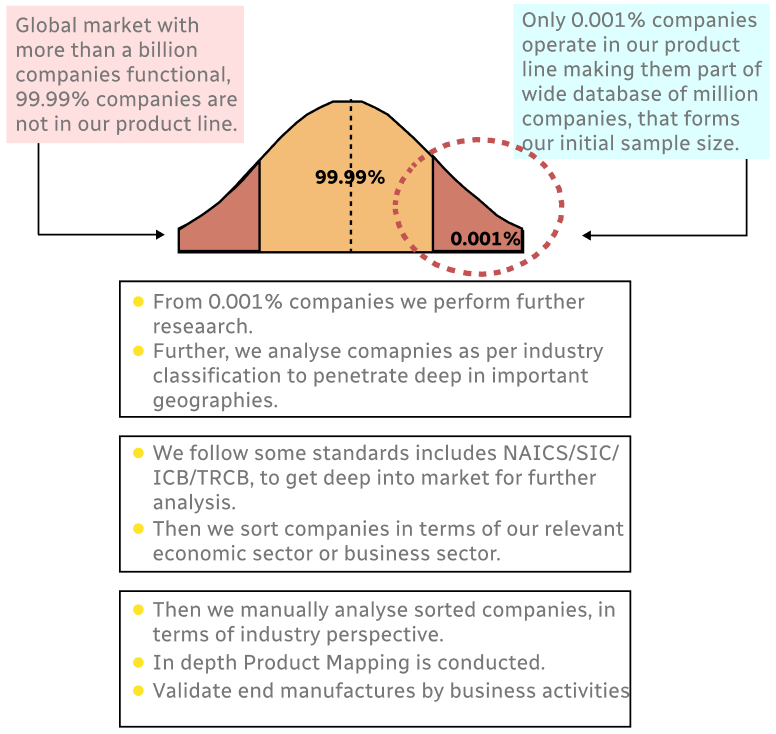
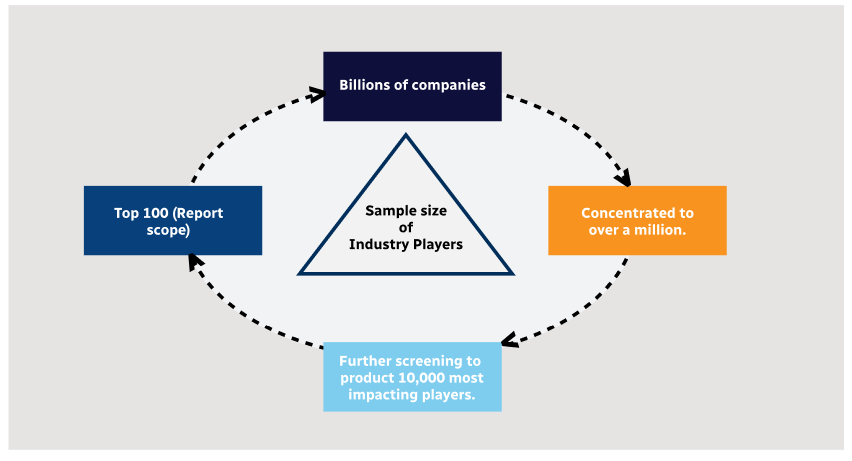
Step 1 - Identification of Relevant Samples Size from Population Database
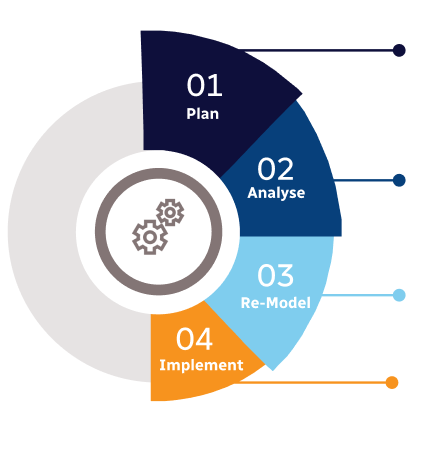
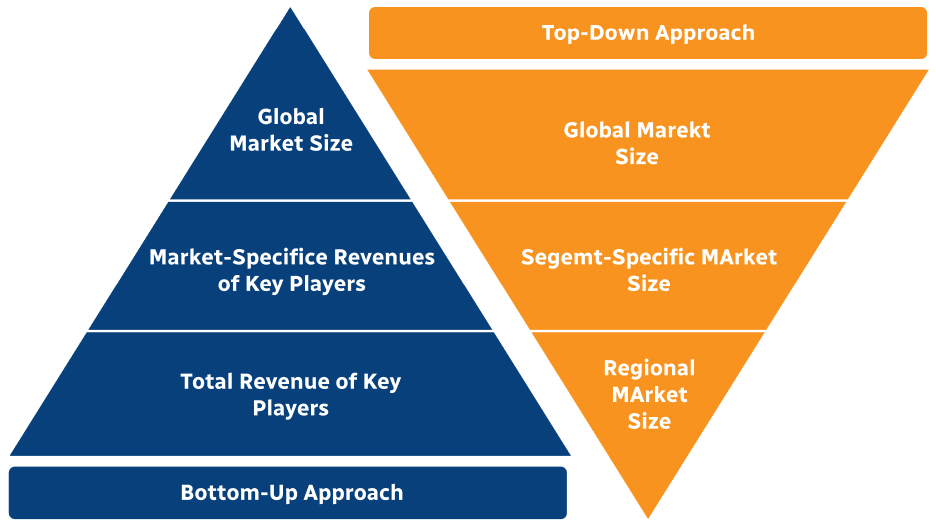
Step 2 - Approaches for Defining Global Market Size (Value, Volume* & Price*)
Note*: In applicable scenarios
Step 3 - Data Sources
Primary Research
- Web Analytics
- Survey Reports
- Research Institute
- Latest Research Reports
- Opinion Leaders
Secondary Research
- Annual Reports
- White Paper
- Latest Press Release
- Industry Association
- Paid Database
- Investor Presentations

Step 4 - Data Triangulation
Involves using different sources of information in order to increase the validity of a study
These sources are likely to be stakeholders in a program - participants, other researchers, program staff, other community members, and so on.
Then we put all data in single framework & apply various statistical tools to find out the dynamic on the market.
During the analysis stage, feedback from the stakeholder groups would be compared to determine areas of agreement as well as areas of divergence