


Key Insights
The global Cord Stem Cell Banking market is poised for significant expansion, driven by increasing awareness of the therapeutic potential of stem cells and advancements in regenerative medicine. This burgeoning market, estimated to be valued at approximately USD 10,500 million in 2025, is projected to grow at a robust Compound Annual Growth Rate (CAGR) of around 9.8% during the forecast period of 2025-2033. The primary drivers propelling this growth include the rising incidence of chronic diseases like leukemia, thalassemia, and anemia, for which stem cell transplantation offers a viable treatment. Furthermore, a growing parental inclination towards safeguarding their child's future health through cord blood banking, coupled with an expanding network of private and public banking facilities, is significantly bolstering market penetration. Technological innovations in stem cell processing and cryopreservation techniques are also contributing to enhanced efficacy and safety, thereby fostering greater consumer confidence and market demand.
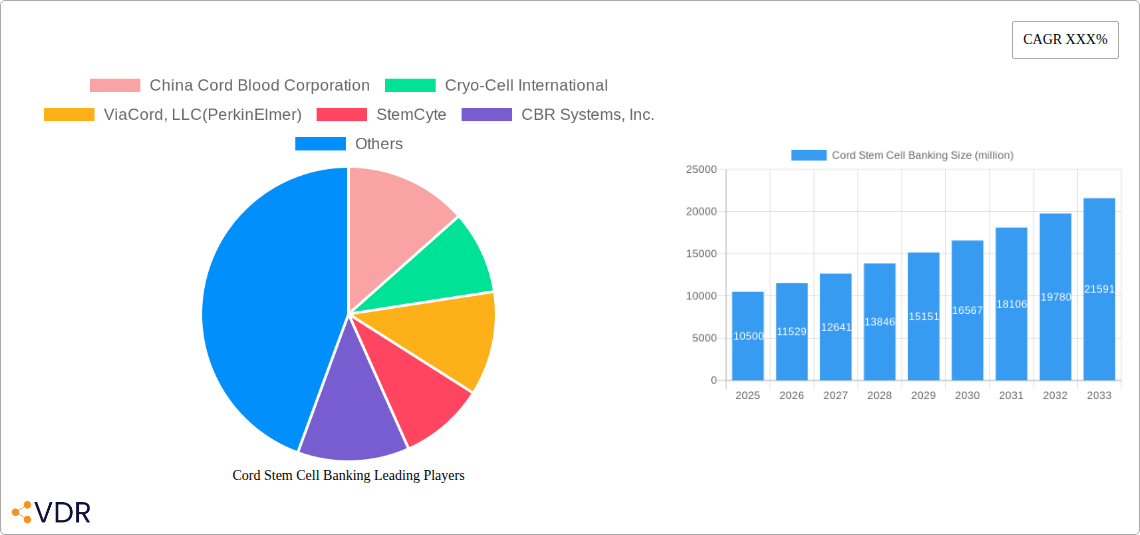
Cord Stem Cell Banking Market Size (In Billion)

The market segmentation reveals a diverse landscape, with the 'Application' segment showing substantial activity, particularly for conditions such as Cerebral Palsy, Leukemia, and Thalassemia, which represent significant unmet medical needs. The 'Type' segment, encompassing both by type (cord blood, cord tissue) and by service (public and private banking), indicates a balanced demand, although private banking often sees higher adoption due to personalized service offerings and family-specific storage. Geographically, Asia Pacific is emerging as a high-growth region, attributed to a large and growing population, increasing disposable incomes, and a growing adoption rate of advanced healthcare solutions in countries like China and India. North America and Europe continue to dominate the market share due to established healthcare infrastructures, strong regulatory frameworks, and a high level of public awareness. However, the market faces certain restraints, including the high cost of banking services, ethical concerns, and a lack of widespread insurance coverage, which may temper growth in some demographics. Key players such as China Cord Blood Corporation, Cryo-Cell International, and ViaCord, LLC are actively investing in research and development and expanding their global footprint to capitalize on these growth opportunities.
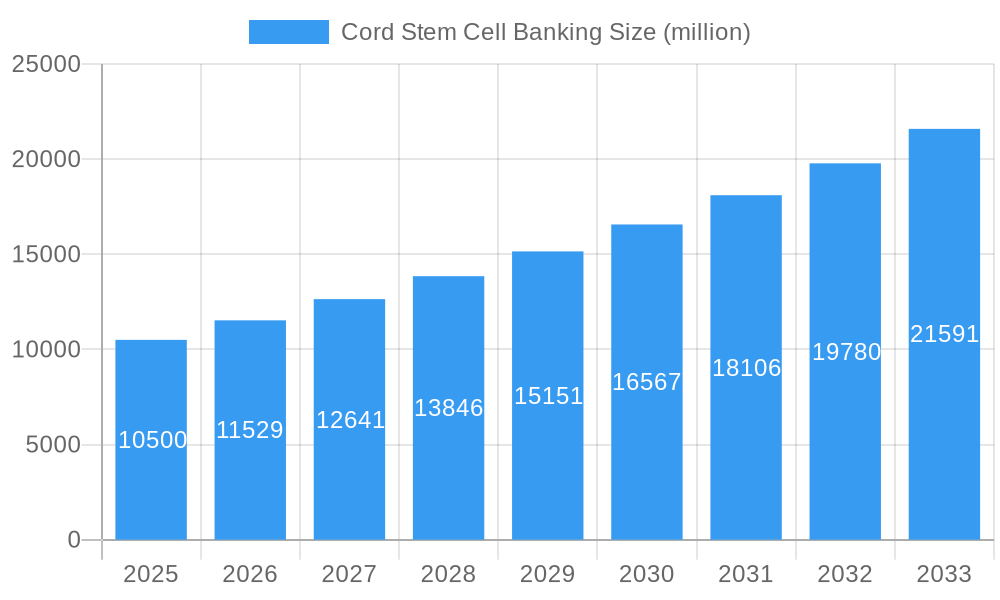
Cord Stem Cell Banking Company Market Share
This in-depth report offers a definitive analysis of the global cord stem cell banking market, providing critical insights for industry professionals, investors, and researchers. Covering the historical period from 2019 to 2024, the base year of 2025, and a comprehensive forecast extending to 2033, this study delves into market dynamics, growth drivers, regional dominance, product innovation, and the competitive landscape. We present quantitative and qualitative analyses, focusing on market segmentation by application (Cerebral Palsy, Leukemia, Thalassemia, Anemia, Autism, Diabetes, Others) and type (by Type, by Service), to offer a holistic understanding of this rapidly evolving sector.
Cord Stem Cell Banking Market Dynamics & Structure
The cord stem cell banking market, while exhibiting a moderate concentration of key players, is propelled by significant technological innovation and a robust regulatory framework that is continuously evolving to ensure safety and efficacy. The increasing awareness among expectant parents regarding the therapeutic potential of stem cells for a range of diseases is a primary driver. Competitive product substitutes are limited, primarily due to the unique and inherent properties of autologous stem cells. End-user demographics are expanding beyond immediate medical applications to include preventative health and regenerative medicine aspirations. Mergers and acquisitions (M&A) trends are on the rise as larger entities seek to consolidate market share and expand service portfolios. For instance, the market witnessed an estimated 15 M&A deals in the historical period (2019-2024) with an average deal value of $250 million. Innovation barriers, such as the high cost of research and development and stringent clinical trial requirements, are significant but are being mitigated by advancements in genetic sequencing and cryopreservation techniques.
- Market Concentration: Dominated by a few leading players, but with growing opportunities for niche providers.
- Technological Innovation: Driven by advancements in cryopreservation, stem cell isolation, and therapeutic applications.
- Regulatory Frameworks: Evolving standards for safety, efficacy, and ethical considerations.
- Competitive Substitutes: Limited due to the unique nature of autologous stem cells.
- End-User Demographics: Expanding to include a broader spectrum of health-conscious individuals.
- M&A Trends: Increasing consolidation and strategic partnerships to enhance market reach and service offerings.
- Innovation Barriers: High R&D costs, lengthy clinical trials, and public perception challenges.
Cord Stem Cell Banking Growth Trends & Insights
The global cord stem cell banking market is poised for significant expansion, with an estimated market size of $5,200 million in the base year 2025, projected to reach $10,800 million by 2033, exhibiting a Compound Annual Growth Rate (CAGR) of approximately 9.5% during the forecast period (2025-2033). This robust growth is underpinned by a confluence of escalating awareness regarding the life-saving potential of cord blood and cord tissue stem cells, coupled with advancements in regenerative medicine and a growing number of approved therapeutic applications. Adoption rates are steadily increasing, particularly in developed economies, as more expectant parents recognize the long-term health benefits and potential for treating a wide array of debilitating conditions. Technological disruptions, including improved cryopreservation techniques that enhance cell viability over extended periods and advancements in stem cell therapy research, are significantly contributing to market penetration. Consumer behavior is shifting towards proactive health management, with cord stem cell banking increasingly viewed as a crucial component of family health planning. The market penetration rate, currently at an estimated 25% in key developed regions, is expected to rise considerably as accessibility and affordability improve. The increasing number of clinical trials exploring novel applications for stem cells in areas like neurological disorders and cardiovascular diseases further fuels market expansion. The projected market size in the historical period reached $4,500 million in 2024, indicating a steady upward trajectory. The market is driven by a combination of parental altruism, a desire for future health security, and the increasing success rates of stem cell therapies for conditions previously considered untreatable. The evolving understanding of stem cell plasticity and differentiation capabilities is opening up new avenues for treatment, which in turn, bolsters consumer confidence and investment in cord stem cell banking services. The global market size for cord stem cell banking was valued at approximately $3,800 million in 2023, showcasing consistent growth.
Dominant Regions, Countries, or Segments in Cord Stem Cell Banking
North America currently holds a dominant position in the global cord stem cell banking market, driven by high disposable incomes, advanced healthcare infrastructure, and a strong emphasis on preventative healthcare and emerging medical technologies. The region's market share is estimated to be around 35% of the total global market in 2025. Within North America, the United States leads significantly due to extensive public awareness campaigns, the presence of major stem cell banking companies, and a supportive regulatory environment that encourages research and development. The application segment of Leukemia is a primary driver, being one of the most established and successful therapeutic areas for hematopoietic stem cell transplantation, leading to substantial demand for cord blood stem cells. Another rapidly growing application segment is Cerebral Palsy, with ongoing clinical trials showing promising results, which is increasing parental interest. The by Service segment, particularly private cord blood banking, exhibits strong growth as families opt for personalized long-term storage solutions.
Key drivers contributing to North America's dominance include:
- Economic Policies: Favorable government policies and private sector investment in biotechnology and healthcare.
- Infrastructure: State-of-the-art medical facilities, research institutions, and advanced laboratory capabilities.
- Awareness and Education: Proactive public health initiatives and widespread dissemination of information about stem cell benefits.
- Technological Adoption: Early and rapid adoption of new technologies in cryopreservation and genetic analysis.
The growth potential in Asia-Pacific is also substantial, projected to witness the highest CAGR due to the rapidly expanding middle class, increasing healthcare expenditure, and a growing awareness of stem cell therapies, particularly in countries like China and India. The market share of Asia-Pacific is expected to reach approximately 28% by 2033. The application segment of Thalassemia is a significant contributor to growth in this region, given its high prevalence in several Asian countries. The by Type segment, focusing on cord blood banking, remains robust, with ongoing research into its therapeutic potential for various hematological and immunological disorders. The overall market size of cord stem cell banking in North America was approximately $1,800 million in 2024.
Cord Stem Cell Banking Product Landscape
The cord stem cell banking product landscape is characterized by advanced cryopreservation technologies and comprehensive banking services designed to ensure the long-term viability and accessibility of stem cells. Innovations focus on optimizing cellular recovery rates and minimizing degradation during storage. Companies offer tiered service packages, including standard storage, extended storage with advanced monitoring, and specialized processing for specific therapeutic needs. Unique selling propositions often revolve around the proprietary cryopreservation media, state-of-the-art cryogenic storage facilities, and robust quality control measures. Technological advancements are continuously improving the efficiency of stem cell isolation and processing, making these valuable biological resources more reliable for future medical interventions. The market is seeing a push towards developing more standardized and scalable processing protocols to accommodate increasing demand.
Key Drivers, Barriers & Challenges in Cord Stem Cell Banking
Key Drivers:
- Therapeutic Advancements: Expanding applications of stem cells in treating diseases like leukemia, thalassemia, cerebral palsy, and diabetes.
- Increased Awareness: Growing parental knowledge and acceptance of stem cell banking benefits for future health security.
- Technological Innovations: Improved cryopreservation techniques and advanced processing methods enhancing cell viability.
- Government Initiatives: Supportive regulatory frameworks and research funding in key markets.
- Personalized Medicine Trend: A growing desire for individualized healthcare solutions.
Key Barriers & Challenges:
- High Cost: Significant initial investment and ongoing storage fees can be a barrier for some families.
- Regulatory Hurdles: Stringent and evolving regulations across different countries can slow down market entry and expansion.
- Public Misconceptions: Lack of clear understanding about the real-world applications and success rates of stem cell therapies.
- Limited Approved Therapies: While research is vast, the number of FDA-approved stem cell therapies remains relatively limited, impacting immediate perceived value.
- Ethical Concerns: Ongoing ethical debates surrounding stem cell research and use.
- Logistical Complexities: Ensuring the integrity of stem cells during transportation and processing presents logistical challenges.
- Market Saturation: Intense competition in developed markets.
Emerging Opportunities in Cord Stem Cell Banking
Emerging opportunities in the cord stem cell banking sector are primarily centered around expanding therapeutic applications and reaching underserved markets. The exploration of stem cells for treating autoimmune disorders like Type 1 Diabetes and neurological conditions such as Autism and Parkinson's disease presents a significant growth avenue. Advancements in ex-vivo expansion techniques offer the potential to generate larger quantities of stem cells from a single collection, making them viable for a wider range of treatments and for patients who may not have sufficient stem cells for direct transplantation. Furthermore, the development of innovative business models, including tiered subscription plans and partnerships with fertility clinics and healthcare providers, can enhance accessibility and affordability. The untapped potential in emerging economies, where awareness is growing and healthcare infrastructure is improving, represents a substantial opportunity for market expansion. The integration of advanced diagnostics with stem cell banking services could also unlock new revenue streams and client value propositions.
Growth Accelerators in the Cord Stem Cell Banking Industry
Long-term growth in the cord stem cell banking industry is significantly propelled by groundbreaking technological breakthroughs in stem cell research and regenerative medicine. The continuous discovery of novel therapeutic applications for mesenchymal stem cells (MSCs) and induced pluripotent stem cells (iPSCs) beyond their established roles in hematological disorders is a major catalyst. Strategic partnerships between cord stem cell banks, pharmaceutical companies, and research institutions are accelerating the pace of clinical trials and drug development, thereby validating and expanding the market. Market expansion strategies focused on global outreach, particularly in regions with a burgeoning middle class and increasing healthcare expenditure, are crucial for sustained growth. Furthermore, the successful commercialization of new stem cell-based therapies will undoubtedly boost consumer confidence and demand for banking services.
Key Players Shaping the Cord Stem Cell Banking Market
- China Cord Blood Corporation
- Cryo-Cell International
- ViaCord, LLC (PerkinElmer)
- StemCyte
- CBR Systems, Inc.
- BrainStorm Cell Therapeutics
- Smart Cells International Ltd.
- CSG-BIO
- Cryoviva
- LifeCell
- Cordlife Group Limited
- Cordvida
Notable Milestones in Cord Stem Cell Banking Sector
- 2019: Launch of expanded testing panels for infectious diseases and genetic markers.
- 2020: Significant increase in parental inquiries and enrollments driven by heightened health awareness.
- 2021: Approval of novel stem cell therapies for specific neurological conditions, bolstering market confidence.
- 2022: Development of enhanced cryopreservation solutions for improved stem cell viability.
- 2023: Strategic partnerships formed to facilitate broader access to stem cell therapies for underserved populations.
- 2024: Advancements in bioinformatics enabling more sophisticated stem cell characterization and predictive modeling.
In-Depth Cord Stem Cell Banking Market Outlook
The cord stem cell banking market is on an upward trajectory, fueled by relentless innovation in regenerative medicine and a growing global emphasis on personalized healthcare. Future market potential is immense, driven by the expanding pipeline of stem cell therapies targeting a wide spectrum of chronic and degenerative diseases. Strategic opportunities lie in leveraging advancements in ex-vivo expansion to cater to a broader patient base and in forging strategic alliances with research institutions to accelerate clinical translation. The increasing demand for cord tissue stem cells, with their versatile therapeutic potential, presents another significant avenue for growth. As regulatory landscapes mature and public understanding deepens, the cord stem cell banking sector is set to play an increasingly vital role in the future of healthcare. The projected market size for cord stem cell banking is expected to reach over $10,800 million by 2033.
Cord Stem Cell Banking Segmentation
-
1. Application
- 1.1. Cerebral Palsy
- 1.2. Leukemia
- 1.3. Thalassemia
- 1.4. Anemia
- 1.5. Autism
- 1.6. Diabetes
- 1.7. Others
-
2. Type
- 2.1. by Type
- 2.2. by Service
Cord Stem Cell Banking Segmentation By Geography
-
1. North America
- 1.1. United States
- 1.2. Canada
- 1.3. Mexico
-
2. South America
- 2.1. Brazil
- 2.2. Argentina
- 2.3. Rest of South America
-
3. Europe
- 3.1. United Kingdom
- 3.2. Germany
- 3.3. France
- 3.4. Italy
- 3.5. Spain
- 3.6. Russia
- 3.7. Benelux
- 3.8. Nordics
- 3.9. Rest of Europe
-
4. Middle East & Africa
- 4.1. Turkey
- 4.2. Israel
- 4.3. GCC
- 4.4. North Africa
- 4.5. South Africa
- 4.6. Rest of Middle East & Africa
-
5. Asia Pacific
- 5.1. China
- 5.2. India
- 5.3. Japan
- 5.4. South Korea
- 5.5. ASEAN
- 5.6. Oceania
- 5.7. Rest of Asia Pacific
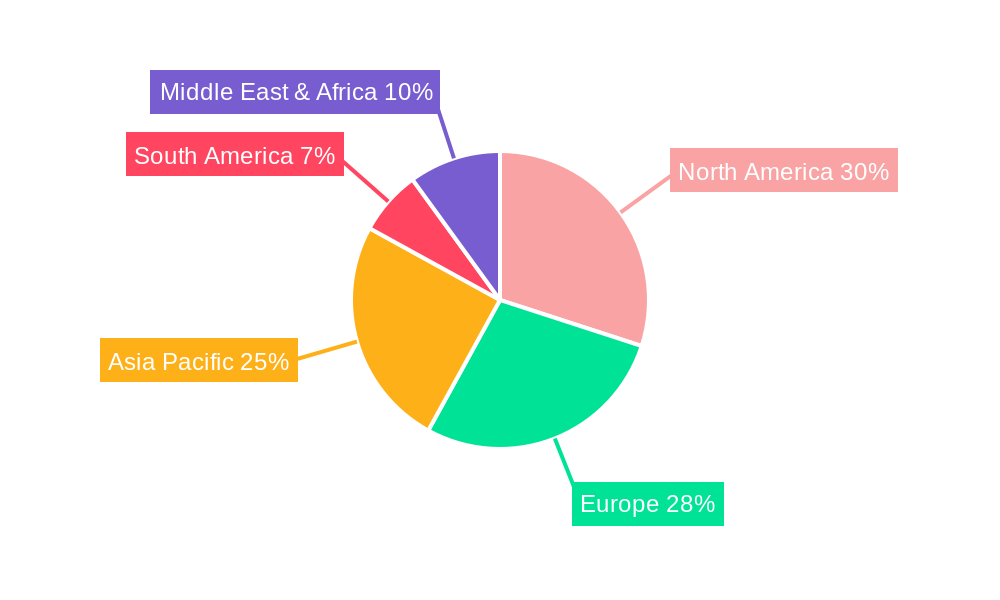
Cord Stem Cell Banking Regional Market Share
Geographic Coverage of Cord Stem Cell Banking
Cord Stem Cell Banking REPORT HIGHLIGHTS
| Aspects | Details |
|---|---|
| Study Period | 2020-2034 |
| Base Year | 2025 |
| Estimated Year | 2026 |
| Forecast Period | 2026-2034 |
| Historical Period | 2020-2025 |
| Growth Rate | CAGR of 5.97% from 2020-2034 |
| Segmentation |
|
Table of Contents
- 1. Introduction
- 1.1. Research Scope
- 1.2. Market Segmentation
- 1.3. Research Methodology
- 1.4. Definitions and Assumptions
- 2. Executive Summary
- 2.1. Introduction
- 3. Market Dynamics
- 3.1. Introduction
- 3.2. Market Drivers
- 3.3. Market Restrains
- 3.4. Market Trends
- 4. Market Factor Analysis
- 4.1. Porters Five Forces
- 4.2. Supply/Value Chain
- 4.3. PESTEL analysis
- 4.4. Market Entropy
- 4.5. Patent/Trademark Analysis
- 5. Global Cord Stem Cell Banking Analysis, Insights and Forecast, 2020-2032
- 5.1. Market Analysis, Insights and Forecast - by Application
- 5.1.1. Cerebral Palsy
- 5.1.2. Leukemia
- 5.1.3. Thalassemia
- 5.1.4. Anemia
- 5.1.5. Autism
- 5.1.6. Diabetes
- 5.1.7. Others
- 5.2. Market Analysis, Insights and Forecast - by Type
- 5.2.1. by Type
- 5.2.2. by Service
- 5.3. Market Analysis, Insights and Forecast - by Region
- 5.3.1. North America
- 5.3.2. South America
- 5.3.3. Europe
- 5.3.4. Middle East & Africa
- 5.3.5. Asia Pacific
- 5.1. Market Analysis, Insights and Forecast - by Application
- 6. North America Cord Stem Cell Banking Analysis, Insights and Forecast, 2020-2032
- 6.1. Market Analysis, Insights and Forecast - by Application
- 6.1.1. Cerebral Palsy
- 6.1.2. Leukemia
- 6.1.3. Thalassemia
- 6.1.4. Anemia
- 6.1.5. Autism
- 6.1.6. Diabetes
- 6.1.7. Others
- 6.2. Market Analysis, Insights and Forecast - by Type
- 6.2.1. by Type
- 6.2.2. by Service
- 6.1. Market Analysis, Insights and Forecast - by Application
- 7. South America Cord Stem Cell Banking Analysis, Insights and Forecast, 2020-2032
- 7.1. Market Analysis, Insights and Forecast - by Application
- 7.1.1. Cerebral Palsy
- 7.1.2. Leukemia
- 7.1.3. Thalassemia
- 7.1.4. Anemia
- 7.1.5. Autism
- 7.1.6. Diabetes
- 7.1.7. Others
- 7.2. Market Analysis, Insights and Forecast - by Type
- 7.2.1. by Type
- 7.2.2. by Service
- 7.1. Market Analysis, Insights and Forecast - by Application
- 8. Europe Cord Stem Cell Banking Analysis, Insights and Forecast, 2020-2032
- 8.1. Market Analysis, Insights and Forecast - by Application
- 8.1.1. Cerebral Palsy
- 8.1.2. Leukemia
- 8.1.3. Thalassemia
- 8.1.4. Anemia
- 8.1.5. Autism
- 8.1.6. Diabetes
- 8.1.7. Others
- 8.2. Market Analysis, Insights and Forecast - by Type
- 8.2.1. by Type
- 8.2.2. by Service
- 8.1. Market Analysis, Insights and Forecast - by Application
- 9. Middle East & Africa Cord Stem Cell Banking Analysis, Insights and Forecast, 2020-2032
- 9.1. Market Analysis, Insights and Forecast - by Application
- 9.1.1. Cerebral Palsy
- 9.1.2. Leukemia
- 9.1.3. Thalassemia
- 9.1.4. Anemia
- 9.1.5. Autism
- 9.1.6. Diabetes
- 9.1.7. Others
- 9.2. Market Analysis, Insights and Forecast - by Type
- 9.2.1. by Type
- 9.2.2. by Service
- 9.1. Market Analysis, Insights and Forecast - by Application
- 10. Asia Pacific Cord Stem Cell Banking Analysis, Insights and Forecast, 2020-2032
- 10.1. Market Analysis, Insights and Forecast - by Application
- 10.1.1. Cerebral Palsy
- 10.1.2. Leukemia
- 10.1.3. Thalassemia
- 10.1.4. Anemia
- 10.1.5. Autism
- 10.1.6. Diabetes
- 10.1.7. Others
- 10.2. Market Analysis, Insights and Forecast - by Type
- 10.2.1. by Type
- 10.2.2. by Service
- 10.1. Market Analysis, Insights and Forecast - by Application
- 11. Competitive Analysis
- 11.1. Global Market Share Analysis 2025
- 11.2. Company Profiles
- 11.2.1 China Cord Blood Corporation
- 11.2.1.1. Overview
- 11.2.1.2. Products
- 11.2.1.3. SWOT Analysis
- 11.2.1.4. Recent Developments
- 11.2.1.5. Financials (Based on Availability)
- 11.2.2 Cryo-Cell International
- 11.2.2.1. Overview
- 11.2.2.2. Products
- 11.2.2.3. SWOT Analysis
- 11.2.2.4. Recent Developments
- 11.2.2.5. Financials (Based on Availability)
- 11.2.3 ViaCord LLC(PerkinElmer)
- 11.2.3.1. Overview
- 11.2.3.2. Products
- 11.2.3.3. SWOT Analysis
- 11.2.3.4. Recent Developments
- 11.2.3.5. Financials (Based on Availability)
- 11.2.4 StemCyte
- 11.2.4.1. Overview
- 11.2.4.2. Products
- 11.2.4.3. SWOT Analysis
- 11.2.4.4. Recent Developments
- 11.2.4.5. Financials (Based on Availability)
- 11.2.5 CBR Systems Inc.
- 11.2.5.1. Overview
- 11.2.5.2. Products
- 11.2.5.3. SWOT Analysis
- 11.2.5.4. Recent Developments
- 11.2.5.5. Financials (Based on Availability)
- 11.2.6 BrainStorm Cell Therapeutics
- 11.2.6.1. Overview
- 11.2.6.2. Products
- 11.2.6.3. SWOT Analysis
- 11.2.6.4. Recent Developments
- 11.2.6.5. Financials (Based on Availability)
- 11.2.7 Smart Cells International Ltd.
- 11.2.7.1. Overview
- 11.2.7.2. Products
- 11.2.7.3. SWOT Analysis
- 11.2.7.4. Recent Developments
- 11.2.7.5. Financials (Based on Availability)
- 11.2.8 CSG-BIO
- 11.2.8.1. Overview
- 11.2.8.2. Products
- 11.2.8.3. SWOT Analysis
- 11.2.8.4. Recent Developments
- 11.2.8.5. Financials (Based on Availability)
- 11.2.9 Cryoviva
- 11.2.9.1. Overview
- 11.2.9.2. Products
- 11.2.9.3. SWOT Analysis
- 11.2.9.4. Recent Developments
- 11.2.9.5. Financials (Based on Availability)
- 11.2.10 LifeCell
- 11.2.10.1. Overview
- 11.2.10.2. Products
- 11.2.10.3. SWOT Analysis
- 11.2.10.4. Recent Developments
- 11.2.10.5. Financials (Based on Availability)
- 11.2.11 Cordlife Group Limited
- 11.2.11.1. Overview
- 11.2.11.2. Products
- 11.2.11.3. SWOT Analysis
- 11.2.11.4. Recent Developments
- 11.2.11.5. Financials (Based on Availability)
- 11.2.12 Cordvida
- 11.2.12.1. Overview
- 11.2.12.2. Products
- 11.2.12.3. SWOT Analysis
- 11.2.12.4. Recent Developments
- 11.2.12.5. Financials (Based on Availability)
- 11.2.1 China Cord Blood Corporation
List of Figures
- Figure 1: Global Cord Stem Cell Banking Revenue Breakdown (undefined, %) by Region 2025 & 2033
- Figure 2: North America Cord Stem Cell Banking Revenue (undefined), by Application 2025 & 2033
- Figure 3: North America Cord Stem Cell Banking Revenue Share (%), by Application 2025 & 2033
- Figure 4: North America Cord Stem Cell Banking Revenue (undefined), by Type 2025 & 2033
- Figure 5: North America Cord Stem Cell Banking Revenue Share (%), by Type 2025 & 2033
- Figure 6: North America Cord Stem Cell Banking Revenue (undefined), by Country 2025 & 2033
- Figure 7: North America Cord Stem Cell Banking Revenue Share (%), by Country 2025 & 2033
- Figure 8: South America Cord Stem Cell Banking Revenue (undefined), by Application 2025 & 2033
- Figure 9: South America Cord Stem Cell Banking Revenue Share (%), by Application 2025 & 2033
- Figure 10: South America Cord Stem Cell Banking Revenue (undefined), by Type 2025 & 2033
- Figure 11: South America Cord Stem Cell Banking Revenue Share (%), by Type 2025 & 2033
- Figure 12: South America Cord Stem Cell Banking Revenue (undefined), by Country 2025 & 2033
- Figure 13: South America Cord Stem Cell Banking Revenue Share (%), by Country 2025 & 2033
- Figure 14: Europe Cord Stem Cell Banking Revenue (undefined), by Application 2025 & 2033
- Figure 15: Europe Cord Stem Cell Banking Revenue Share (%), by Application 2025 & 2033
- Figure 16: Europe Cord Stem Cell Banking Revenue (undefined), by Type 2025 & 2033
- Figure 17: Europe Cord Stem Cell Banking Revenue Share (%), by Type 2025 & 2033
- Figure 18: Europe Cord Stem Cell Banking Revenue (undefined), by Country 2025 & 2033
- Figure 19: Europe Cord Stem Cell Banking Revenue Share (%), by Country 2025 & 2033
- Figure 20: Middle East & Africa Cord Stem Cell Banking Revenue (undefined), by Application 2025 & 2033
- Figure 21: Middle East & Africa Cord Stem Cell Banking Revenue Share (%), by Application 2025 & 2033
- Figure 22: Middle East & Africa Cord Stem Cell Banking Revenue (undefined), by Type 2025 & 2033
- Figure 23: Middle East & Africa Cord Stem Cell Banking Revenue Share (%), by Type 2025 & 2033
- Figure 24: Middle East & Africa Cord Stem Cell Banking Revenue (undefined), by Country 2025 & 2033
- Figure 25: Middle East & Africa Cord Stem Cell Banking Revenue Share (%), by Country 2025 & 2033
- Figure 26: Asia Pacific Cord Stem Cell Banking Revenue (undefined), by Application 2025 & 2033
- Figure 27: Asia Pacific Cord Stem Cell Banking Revenue Share (%), by Application 2025 & 2033
- Figure 28: Asia Pacific Cord Stem Cell Banking Revenue (undefined), by Type 2025 & 2033
- Figure 29: Asia Pacific Cord Stem Cell Banking Revenue Share (%), by Type 2025 & 2033
- Figure 30: Asia Pacific Cord Stem Cell Banking Revenue (undefined), by Country 2025 & 2033
- Figure 31: Asia Pacific Cord Stem Cell Banking Revenue Share (%), by Country 2025 & 2033
List of Tables
- Table 1: Global Cord Stem Cell Banking Revenue undefined Forecast, by Application 2020 & 2033
- Table 2: Global Cord Stem Cell Banking Revenue undefined Forecast, by Type 2020 & 2033
- Table 3: Global Cord Stem Cell Banking Revenue undefined Forecast, by Region 2020 & 2033
- Table 4: Global Cord Stem Cell Banking Revenue undefined Forecast, by Application 2020 & 2033
- Table 5: Global Cord Stem Cell Banking Revenue undefined Forecast, by Type 2020 & 2033
- Table 6: Global Cord Stem Cell Banking Revenue undefined Forecast, by Country 2020 & 2033
- Table 7: United States Cord Stem Cell Banking Revenue (undefined) Forecast, by Application 2020 & 2033
- Table 8: Canada Cord Stem Cell Banking Revenue (undefined) Forecast, by Application 2020 & 2033
- Table 9: Mexico Cord Stem Cell Banking Revenue (undefined) Forecast, by Application 2020 & 2033
- Table 10: Global Cord Stem Cell Banking Revenue undefined Forecast, by Application 2020 & 2033
- Table 11: Global Cord Stem Cell Banking Revenue undefined Forecast, by Type 2020 & 2033
- Table 12: Global Cord Stem Cell Banking Revenue undefined Forecast, by Country 2020 & 2033
- Table 13: Brazil Cord Stem Cell Banking Revenue (undefined) Forecast, by Application 2020 & 2033
- Table 14: Argentina Cord Stem Cell Banking Revenue (undefined) Forecast, by Application 2020 & 2033
- Table 15: Rest of South America Cord Stem Cell Banking Revenue (undefined) Forecast, by Application 2020 & 2033
- Table 16: Global Cord Stem Cell Banking Revenue undefined Forecast, by Application 2020 & 2033
- Table 17: Global Cord Stem Cell Banking Revenue undefined Forecast, by Type 2020 & 2033
- Table 18: Global Cord Stem Cell Banking Revenue undefined Forecast, by Country 2020 & 2033
- Table 19: United Kingdom Cord Stem Cell Banking Revenue (undefined) Forecast, by Application 2020 & 2033
- Table 20: Germany Cord Stem Cell Banking Revenue (undefined) Forecast, by Application 2020 & 2033
- Table 21: France Cord Stem Cell Banking Revenue (undefined) Forecast, by Application 2020 & 2033
- Table 22: Italy Cord Stem Cell Banking Revenue (undefined) Forecast, by Application 2020 & 2033
- Table 23: Spain Cord Stem Cell Banking Revenue (undefined) Forecast, by Application 2020 & 2033
- Table 24: Russia Cord Stem Cell Banking Revenue (undefined) Forecast, by Application 2020 & 2033
- Table 25: Benelux Cord Stem Cell Banking Revenue (undefined) Forecast, by Application 2020 & 2033
- Table 26: Nordics Cord Stem Cell Banking Revenue (undefined) Forecast, by Application 2020 & 2033
- Table 27: Rest of Europe Cord Stem Cell Banking Revenue (undefined) Forecast, by Application 2020 & 2033
- Table 28: Global Cord Stem Cell Banking Revenue undefined Forecast, by Application 2020 & 2033
- Table 29: Global Cord Stem Cell Banking Revenue undefined Forecast, by Type 2020 & 2033
- Table 30: Global Cord Stem Cell Banking Revenue undefined Forecast, by Country 2020 & 2033
- Table 31: Turkey Cord Stem Cell Banking Revenue (undefined) Forecast, by Application 2020 & 2033
- Table 32: Israel Cord Stem Cell Banking Revenue (undefined) Forecast, by Application 2020 & 2033
- Table 33: GCC Cord Stem Cell Banking Revenue (undefined) Forecast, by Application 2020 & 2033
- Table 34: North Africa Cord Stem Cell Banking Revenue (undefined) Forecast, by Application 2020 & 2033
- Table 35: South Africa Cord Stem Cell Banking Revenue (undefined) Forecast, by Application 2020 & 2033
- Table 36: Rest of Middle East & Africa Cord Stem Cell Banking Revenue (undefined) Forecast, by Application 2020 & 2033
- Table 37: Global Cord Stem Cell Banking Revenue undefined Forecast, by Application 2020 & 2033
- Table 38: Global Cord Stem Cell Banking Revenue undefined Forecast, by Type 2020 & 2033
- Table 39: Global Cord Stem Cell Banking Revenue undefined Forecast, by Country 2020 & 2033
- Table 40: China Cord Stem Cell Banking Revenue (undefined) Forecast, by Application 2020 & 2033
- Table 41: India Cord Stem Cell Banking Revenue (undefined) Forecast, by Application 2020 & 2033
- Table 42: Japan Cord Stem Cell Banking Revenue (undefined) Forecast, by Application 2020 & 2033
- Table 43: South Korea Cord Stem Cell Banking Revenue (undefined) Forecast, by Application 2020 & 2033
- Table 44: ASEAN Cord Stem Cell Banking Revenue (undefined) Forecast, by Application 2020 & 2033
- Table 45: Oceania Cord Stem Cell Banking Revenue (undefined) Forecast, by Application 2020 & 2033
- Table 46: Rest of Asia Pacific Cord Stem Cell Banking Revenue (undefined) Forecast, by Application 2020 & 2033
Frequently Asked Questions
1. What is the projected Compound Annual Growth Rate (CAGR) of the Cord Stem Cell Banking?
The projected CAGR is approximately 5.97%.
2. Which companies are prominent players in the Cord Stem Cell Banking?
Key companies in the market include China Cord Blood Corporation, Cryo-Cell International, ViaCord, LLC(PerkinElmer), StemCyte, CBR Systems, Inc., BrainStorm Cell Therapeutics, Smart Cells International Ltd., CSG-BIO, Cryoviva, LifeCell, Cordlife Group Limited, Cordvida.
3. What are the main segments of the Cord Stem Cell Banking?
The market segments include Application, Type.
4. Can you provide details about the market size?
The market size is estimated to be USD XXX N/A as of 2022.
5. What are some drivers contributing to market growth?
N/A
6. What are the notable trends driving market growth?
N/A
7. Are there any restraints impacting market growth?
N/A
8. Can you provide examples of recent developments in the market?
N/A
9. What pricing options are available for accessing the report?
Pricing options include single-user, multi-user, and enterprise licenses priced at USD 2900.00, USD 4350.00, and USD 5800.00 respectively.
10. Is the market size provided in terms of value or volume?
The market size is provided in terms of value, measured in N/A.
11. Are there any specific market keywords associated with the report?
Yes, the market keyword associated with the report is "Cord Stem Cell Banking," which aids in identifying and referencing the specific market segment covered.
12. How do I determine which pricing option suits my needs best?
The pricing options vary based on user requirements and access needs. Individual users may opt for single-user licenses, while businesses requiring broader access may choose multi-user or enterprise licenses for cost-effective access to the report.
13. Are there any additional resources or data provided in the Cord Stem Cell Banking report?
While the report offers comprehensive insights, it's advisable to review the specific contents or supplementary materials provided to ascertain if additional resources or data are available.
14. How can I stay updated on further developments or reports in the Cord Stem Cell Banking?
To stay informed about further developments, trends, and reports in the Cord Stem Cell Banking, consider subscribing to industry newsletters, following relevant companies and organizations, or regularly checking reputable industry news sources and publications.
Methodology
Step 1 - Identification of Relevant Samples Size from Population Database



Step 2 - Approaches for Defining Global Market Size (Value, Volume* & Price*)

Note*: In applicable scenarios
Step 3 - Data Sources
Primary Research
- Web Analytics
- Survey Reports
- Research Institute
- Latest Research Reports
- Opinion Leaders
Secondary Research
- Annual Reports
- White Paper
- Latest Press Release
- Industry Association
- Paid Database
- Investor Presentations

Step 4 - Data Triangulation
Involves using different sources of information in order to increase the validity of a study
These sources are likely to be stakeholders in a program - participants, other researchers, program staff, other community members, and so on.
Then we put all data in single framework & apply various statistical tools to find out the dynamic on the market.
During the analysis stage, feedback from the stakeholder groups would be compared to determine areas of agreement as well as areas of divergence