


Key Insights
The global Construction Pozzolan market is poised for significant expansion, projected to reach approximately $912 million in 2025, with an impressive Compound Annual Growth Rate (CAGR) of 5.5% through 2033. This robust growth is primarily propelled by the increasing demand for sustainable and high-performance construction materials. Pozzolans, acting as supplementary cementitious materials (SCMs), significantly enhance concrete durability, reduce permeability, and improve workability, making them indispensable in modern infrastructure projects and building construction. The escalating focus on green building initiatives and stricter environmental regulations worldwide are further accelerating the adoption of pozzolanic materials to reduce the carbon footprint associated with traditional cement production. Key applications span residential, commercial, industrial buildings, and extensive infrastructure development, all contributing to the market's upward trajectory.
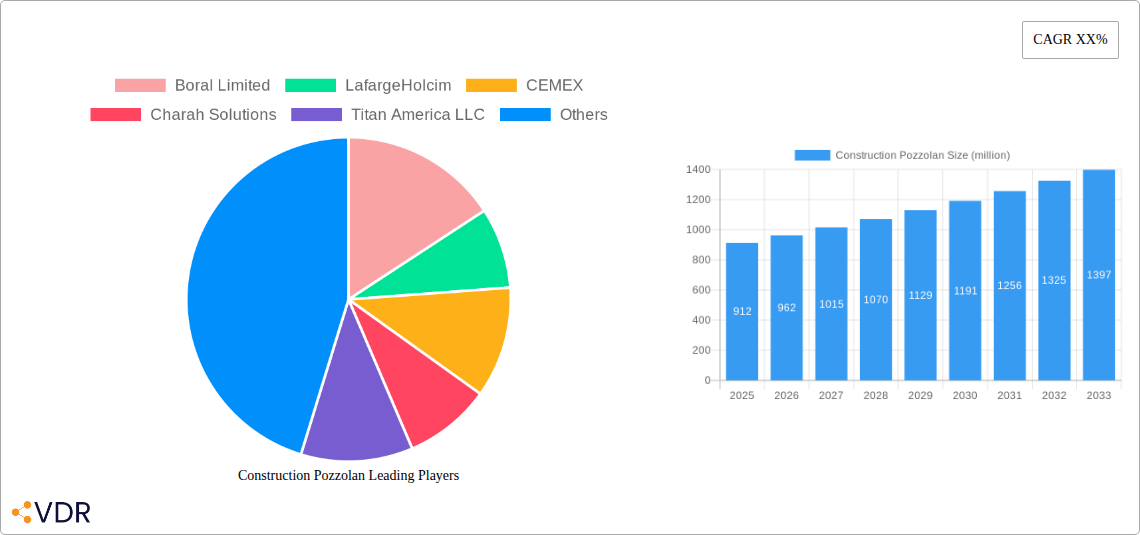
Construction Pozzolan Market Size (In Million)

The market's dynamism is shaped by the dual segment of Artificial Pozzolans, such as fly ash and silica fume, and Natural Pozzolans, including volcanic ash and calcined clays. While fly ash has historically dominated due to its widespread availability as a byproduct of coal combustion, concerns regarding its declining supply in some regions are paving the way for the growth of other artificial and natural pozzolans. The market is characterized by a fragmented competitive landscape featuring a mix of global cement giants, specialized pozzolan suppliers, and mining companies. Strategic collaborations, mergers and acquisitions, and technological advancements in processing and utilization are key strategies employed by these companies to capture market share and meet the evolving needs of the construction industry, particularly in rapidly urbanizing regions across Asia Pacific and emerging economies in other continents.

Construction Pozzolan Company Market Share
Construction Pozzolan Market Dynamics & Structure
The global construction pozzolan market exhibits a moderately concentrated structure, driven by a blend of large multinational corporations and specialized regional players. Technological innovation, particularly in the development of advanced artificial pozzolans with enhanced performance characteristics, acts as a significant growth driver. Regulatory frameworks promoting sustainable construction practices and the use of supplementary cementitious materials (SCMs) further bolster market expansion. Competitive product substitutes, such as fly ash and slag, exert pressure, but the unique durability and strength benefits of pozzolans maintain their distinct market position. End-user demographics are increasingly sophisticated, demanding eco-friendly and cost-effective construction solutions. Mergers and acquisitions (M&A) are a notable trend, with companies consolidating to gain market share, leverage economies of scale, and expand their product portfolios. The market size is estimated to be USD 3,500 million in 2025, with an anticipated CAGR of 6.5% from 2025 to 2033.
- Market Concentration: Dominated by a mix of large cement manufacturers (e.g., LafargeHolcim, CEMEX, Boral Limited) and specialized pozzolan producers (e.g., Charah Solutions, Salt River Materials Group).
- Technological Innovation: Focus on developing novel artificial pozzolans, optimizing production processes, and improving SCM integration in concrete mixes.
- Regulatory Frameworks: Government incentives for green building and stringent emission standards are pushing demand for pozzolanic materials.
- Competitive Product Substitutes: Ongoing competition from fly ash and ground granulated blast-furnace slag (GGBS), necessitating continuous innovation and cost optimization.
- End-User Demographics: Growing demand from infrastructure projects and large-scale commercial developments in emerging economies.
- M&A Trends: Strategic acquisitions aimed at vertical integration and expanding geographical reach. Expected M&A deal volume of approximately 15 deals annually from 2025-2033.
Construction Pozzolan Growth Trends & Insights
The construction pozzolan market is poised for robust expansion, fueled by an escalating global demand for sustainable and high-performance construction materials. The market size, projected to reach USD 3,500 million in 2025, is expected to witness a significant Compound Annual Growth Rate (CAGR) of approximately 6.5% over the forecast period of 2025–2033. This upward trajectory is underpinned by several key factors. Firstly, the increasing adoption of pozzolans as a partial replacement for Portland cement is driven by their ability to enhance concrete durability, reduce permeability, and improve resistance to chemical attacks, thereby extending the lifespan of infrastructure and buildings. This translates into substantial long-term cost savings for owners and developers, a factor that resonates strongly with project stakeholders.
Secondly, a heightened global awareness of environmental sustainability and the push for reducing the carbon footprint of the construction industry are critical accelerators. Pozzolanic materials, particularly those derived from industrial by-products like volcanic ash and certain types of processed clays, offer a significant reduction in the embodied energy and CO2 emissions associated with cement production. This aligns perfectly with international climate agreements and national environmental policies, creating a favorable regulatory environment for pozzolan utilization. The market penetration of pozzolans, currently around 15% in developed regions, is anticipated to grow to 25% by 2033, indicating a significant opportunity for market expansion.
Technological disruptions, including advancements in the processing of artificial pozzolans and the development of specialized blends for specific applications, are further enhancing the value proposition of these materials. These innovations allow for tailored performance characteristics, meeting the evolving demands of complex construction projects, from high-rise buildings to resilient infrastructure. Consumer behavior is also shifting towards embracing materials that offer both economic and environmental benefits. Developers and contractors are increasingly recognizing that the initial investment in pozzolan-enhanced concrete leads to superior long-term performance and reduced maintenance costs, making it an economically sound choice. The market size is forecasted to reach an estimated USD 5,700 million by 2033, reflecting the cumulative impact of these growth drivers.
Dominant Regions, Countries, or Segments in Construction Pozzolan
The Infrastructure application segment, encompassing roads, bridges, dams, and other large-scale public works, is emerging as the most dominant force in the global construction pozzolan market. This dominance is driven by a confluence of factors, including massive government investments in infrastructure development worldwide, the inherent need for durable and long-lasting materials in such projects, and increasingly stringent performance requirements for new infrastructure. The utilization of pozzolans in infrastructure projects significantly enhances the strength, durability, and resistance to environmental degradation of concrete, thereby extending the service life of critical assets and reducing long-term maintenance costs. The market share of the infrastructure segment is projected to account for approximately 40% of the total construction pozzolan market by 2033.
Key drivers for the dominance of the infrastructure segment include:
- Global Infrastructure Spending: Governments across North America, Europe, and Asia-Pacific are channeling substantial funds into modernizing and expanding their infrastructure. For instance, the U.S. Infrastructure Investment and Jobs Act, along with similar initiatives in China and India, are creating immense demand for construction materials, including pozzolans.
- Durability and Longevity Requirements: Infrastructure projects demand concrete that can withstand extreme weather conditions, heavy loads, and chemical attacks. Pozzolans significantly improve these properties, making them an indispensable component.
- Sustainability Mandates: Many infrastructure projects are now subject to sustainability regulations that favor the use of SCMs to reduce the carbon footprint of concrete.
- Economic Growth and Urbanization: Rapid urbanization in developing economies necessitates the construction of new and improved transportation networks, utilities, and public facilities, all of which rely heavily on durable concrete.
Within this dominant segment, the Artificial Pozzolan type is gaining significant traction due to its consistent quality and customizable properties. While natural pozzolans have their place, artificial variants, such as calcined clays and processed volcanic ash, offer greater control over reactivity and performance, making them ideal for demanding infrastructure applications. The market share of artificial pozzolans is expected to reach 60% of the total pozzolan market by 2033, driven by innovation in production technologies and their proven performance in critical infrastructure.
The country-level analysis reveals that China currently leads the global construction pozzolan market, primarily due to its extensive infrastructure development programs and significant domestic production of both artificial and natural pozzolans. The sheer scale of its construction activities, coupled with supportive government policies and a growing focus on sustainable building practices, positions China as a key growth engine. Following closely are the United States, driven by significant infrastructure investments and a mature market for SCMs, and India, with its burgeoning construction sector and increasing adoption of advanced building materials. These regions collectively represent over 65% of the global construction pozzolan market value.
Construction Pozzolan Product Landscape
The construction pozzolan product landscape is characterized by continuous innovation aimed at enhancing performance and sustainability. Key product developments include the refinement of artificial pozzolan manufacturing processes, such as calcined clays and metakaolin, to achieve greater reactivity and consistency. These advanced artificial pozzolans offer superior strength development, reduced permeability, and improved resistance to sulfate and alkali-silica reaction (ASR) when incorporated into concrete mixes. Applications are expanding beyond traditional concrete admixtures to specialized uses in high-performance concrete for bridges, tunnels, and precast elements. Unique selling propositions revolve around the ability to tailor pozzolanic properties to specific project requirements, offering customized solutions that optimize durability and reduce environmental impact. Technological advancements are also focusing on improving the grindability and blendability of pozzolans, ensuring seamless integration into existing concrete production systems.
Key Drivers, Barriers & Challenges in Construction Pozzolan
Key Drivers:
- Growing demand for sustainable construction: Pozzolans, especially industrial by-products, offer a greener alternative to traditional cement, reducing CO2 emissions and embodied energy.
- Enhanced concrete durability and performance: Pozzolans improve concrete strength, reduce permeability, and increase resistance to chemical attacks, leading to longer-lasting structures.
- Government initiatives and regulations: Policies promoting the use of SCMs and stringent environmental standards are driving adoption.
- Cost-effectiveness in the long term: While initial costs can vary, the enhanced durability and reduced maintenance of pozzolan-infused concrete lead to significant lifecycle savings.
Barriers & Challenges:
- Supply chain volatility and availability: Reliance on specific natural sources or by-product streams can lead to supply inconsistencies. The availability of fly ash, for instance, is increasingly tied to coal power plant operations.
- Variability in natural pozzolan quality: The chemical composition and reactivity of natural pozzolans can vary significantly, requiring extensive testing and quality control.
- Perception and awareness: Limited understanding of pozzolan benefits among some construction professionals can hinder adoption.
- Competition from established SCMs: Fly ash and GGBS are widely available and have established market presence, posing a competitive challenge.
- Regulatory hurdles in some regions: While many regions promote SCM use, specific certifications or acceptance criteria can sometimes be a barrier.
- Potential for slower early strength development: Some pozzolanic reactions are slower than Portland cement hydration, requiring careful mix design for projects with aggressive early strength requirements. The estimated impact of these challenges could lead to a 1-2% reduction in projected market growth if not effectively managed.
Emerging Opportunities in Construction Pozzolan
Emerging opportunities in the construction pozzolan market lie in the development of advanced processing techniques for underutilized or novel pozzolanic materials, such as rice husk ash and certain types of volcanic ash. Innovations in nanotechnology are also opening avenues for creating nano-pozzolans with significantly enhanced reactivity and binding properties, promising superior concrete performance. The growing trend of circular economy principles within the construction industry presents a significant opportunity for sourcing and utilizing industrial by-products as pozzolans, aligning with sustainability goals. Furthermore, the increasing demand for self-healing concrete and materials resistant to extreme environmental conditions (e.g., in marine or geologically active areas) creates a niche for high-performance pozzolanic formulations. Untapped markets in developing nations with significant infrastructure needs and a growing focus on sustainable building practices also represent a substantial growth potential.
Growth Accelerators in the Construction Pozzolan Industry
Several catalysts are accelerating growth in the construction pozzolan industry. Technological breakthroughs in beneficiation and activation of pozzolanic materials are enhancing their efficiency and applicability. Strategic partnerships between pozzolan producers, cement manufacturers, and research institutions are fostering innovation and market penetration. For instance, collaborations aimed at developing standardized pozzolanic blends for specific concrete applications are streamlining adoption. Market expansion strategies, including educating specifiers and contractors on the benefits of pozzolans and advocating for supportive regulatory frameworks, are also crucial. The increasing focus on lifecycle cost analysis by project owners, highlighting the long-term economic advantages of durable, pozzolan-enhanced concrete, is a significant growth accelerator.
Key Players Shaping the Construction Pozzolan Market
- Boral Limited
- LafargeHolcim
- CEMEX
- Charah Solutions
- Titan America LLC
- Salt River Materials Group
- SEFA Group
- Nebraska Ash
- ArcelorMittal
- Nippon Steel
- China Baowu Steel
- POSCO
- Hesteel Group
- JFE Steel
- Tata Steel
- Nucor Corporation
- Hyundai Steel
- Jiangsu Shagang
- Ansteel Group
- NLMK Group
- Gerdau
- Shougang Group
- US Steel
- Sunrise Resources
- Kirkland Mining
- I-Minerals Inc
- Imerys
- Hess Pumice Incorporated
- CR Minerals
- Vulcan Ceramics
- BASF
- SCR-Sibelco
- Thiele Kaolin
- Nevada Cement Company
- Burgess Pigment Company
Notable Milestones in Construction Pozzolan Sector
- 2019: Increased focus on research and development for advanced artificial pozzolans.
- 2020: Growing adoption of pozzolans in large-scale infrastructure projects in Asia.
- 2021: Enhanced regulatory support for supplementary cementitious materials in North America and Europe.
- 2022: Innovations in processing volcanic ash for higher pozzolanic reactivity.
- 2023: Strategic partnerships formed between industrial by-product suppliers and pozzolan manufacturers.
- 2024: Growing market interest in pozzolans for carbon capture and utilization (CCU) applications.
- 2025: Expected significant increase in market size due to infrastructure spending and sustainability trends.
- 2026-2033: Continued growth driven by technological advancements, market education, and policy support.
In-Depth Construction Pozzolan Market Outlook
The future outlook for the construction pozzolan market is exceptionally bright, characterized by sustained growth and increasing integration into mainstream construction practices. Growth accelerators such as advancements in artificial pozzolan production, leading to more consistent and tailored material properties, will be pivotal. Strategic partnerships will continue to streamline supply chains and foster collaborative innovation. The increasing emphasis on lifecycle cost analysis by developers and government bodies will further solidify the economic case for pozzolans, driving adoption beyond niche applications. The market is poised for significant expansion, with emerging opportunities in high-performance concrete formulations and the development of pozzolanic materials for resilient infrastructure designed to withstand climate change impacts. The projected market value of USD 5,700 million by 2033 reflects the strong underlying demand and the industry's capacity for innovation and adaptation.
Construction Pozzolan Segmentation
-
1. Application
- 1.1. Residential Building
- 1.2. Commercial Building
- 1.3. Industrial Building
- 1.4. Infrastructure
-
2. Types
- 2.1. Artificial Pozzolan
- 2.2. Nautral Pozzolan
Construction Pozzolan Segmentation By Geography
-
1. North America
- 1.1. United States
- 1.2. Canada
- 1.3. Mexico
-
2. South America
- 2.1. Brazil
- 2.2. Argentina
- 2.3. Rest of South America
-
3. Europe
- 3.1. United Kingdom
- 3.2. Germany
- 3.3. France
- 3.4. Italy
- 3.5. Spain
- 3.6. Russia
- 3.7. Benelux
- 3.8. Nordics
- 3.9. Rest of Europe
-
4. Middle East & Africa
- 4.1. Turkey
- 4.2. Israel
- 4.3. GCC
- 4.4. North Africa
- 4.5. South Africa
- 4.6. Rest of Middle East & Africa
-
5. Asia Pacific
- 5.1. China
- 5.2. India
- 5.3. Japan
- 5.4. South Korea
- 5.5. ASEAN
- 5.6. Oceania
- 5.7. Rest of Asia Pacific
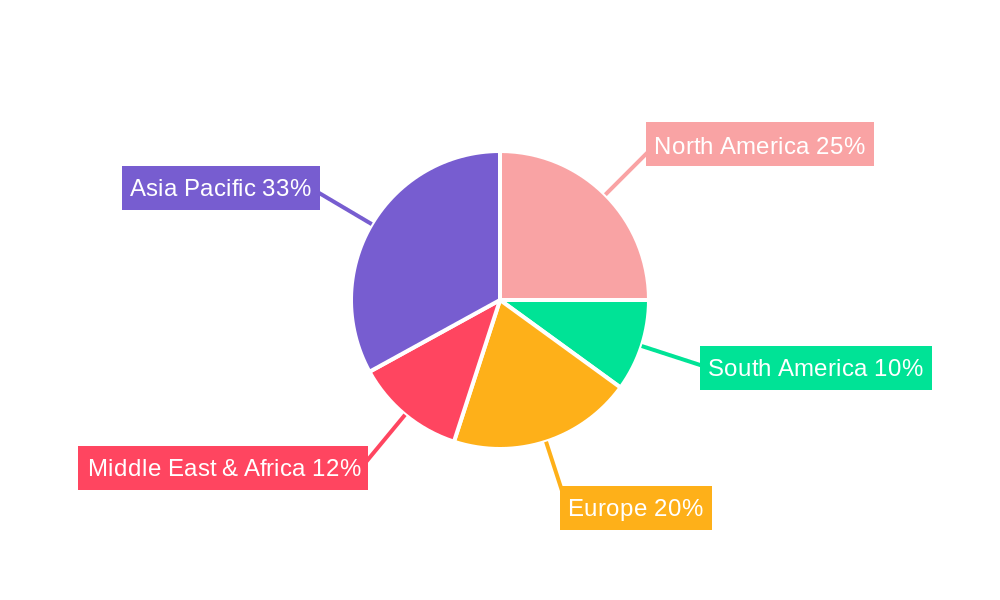
Construction Pozzolan Regional Market Share
Geographic Coverage of Construction Pozzolan
Construction Pozzolan REPORT HIGHLIGHTS
| Aspects | Details |
|---|---|
| Study Period | 2020-2034 |
| Base Year | 2025 |
| Estimated Year | 2026 |
| Forecast Period | 2026-2034 |
| Historical Period | 2020-2025 |
| Growth Rate | CAGR of 5.5% from 2020-2034 |
| Segmentation |
|
Table of Contents
- 1. Introduction
- 1.1. Research Scope
- 1.2. Market Segmentation
- 1.3. Research Methodology
- 1.4. Definitions and Assumptions
- 2. Executive Summary
- 2.1. Introduction
- 3. Market Dynamics
- 3.1. Introduction
- 3.2. Market Drivers
- 3.3. Market Restrains
- 3.4. Market Trends
- 4. Market Factor Analysis
- 4.1. Porters Five Forces
- 4.2. Supply/Value Chain
- 4.3. PESTEL analysis
- 4.4. Market Entropy
- 4.5. Patent/Trademark Analysis
- 5. Global Construction Pozzolan Analysis, Insights and Forecast, 2020-2032
- 5.1. Market Analysis, Insights and Forecast - by Application
- 5.1.1. Residential Building
- 5.1.2. Commercial Building
- 5.1.3. Industrial Building
- 5.1.4. Infrastructure
- 5.2. Market Analysis, Insights and Forecast - by Types
- 5.2.1. Artificial Pozzolan
- 5.2.2. Nautral Pozzolan
- 5.3. Market Analysis, Insights and Forecast - by Region
- 5.3.1. North America
- 5.3.2. South America
- 5.3.3. Europe
- 5.3.4. Middle East & Africa
- 5.3.5. Asia Pacific
- 5.1. Market Analysis, Insights and Forecast - by Application
- 6. North America Construction Pozzolan Analysis, Insights and Forecast, 2020-2032
- 6.1. Market Analysis, Insights and Forecast - by Application
- 6.1.1. Residential Building
- 6.1.2. Commercial Building
- 6.1.3. Industrial Building
- 6.1.4. Infrastructure
- 6.2. Market Analysis, Insights and Forecast - by Types
- 6.2.1. Artificial Pozzolan
- 6.2.2. Nautral Pozzolan
- 6.1. Market Analysis, Insights and Forecast - by Application
- 7. South America Construction Pozzolan Analysis, Insights and Forecast, 2020-2032
- 7.1. Market Analysis, Insights and Forecast - by Application
- 7.1.1. Residential Building
- 7.1.2. Commercial Building
- 7.1.3. Industrial Building
- 7.1.4. Infrastructure
- 7.2. Market Analysis, Insights and Forecast - by Types
- 7.2.1. Artificial Pozzolan
- 7.2.2. Nautral Pozzolan
- 7.1. Market Analysis, Insights and Forecast - by Application
- 8. Europe Construction Pozzolan Analysis, Insights and Forecast, 2020-2032
- 8.1. Market Analysis, Insights and Forecast - by Application
- 8.1.1. Residential Building
- 8.1.2. Commercial Building
- 8.1.3. Industrial Building
- 8.1.4. Infrastructure
- 8.2. Market Analysis, Insights and Forecast - by Types
- 8.2.1. Artificial Pozzolan
- 8.2.2. Nautral Pozzolan
- 8.1. Market Analysis, Insights and Forecast - by Application
- 9. Middle East & Africa Construction Pozzolan Analysis, Insights and Forecast, 2020-2032
- 9.1. Market Analysis, Insights and Forecast - by Application
- 9.1.1. Residential Building
- 9.1.2. Commercial Building
- 9.1.3. Industrial Building
- 9.1.4. Infrastructure
- 9.2. Market Analysis, Insights and Forecast - by Types
- 9.2.1. Artificial Pozzolan
- 9.2.2. Nautral Pozzolan
- 9.1. Market Analysis, Insights and Forecast - by Application
- 10. Asia Pacific Construction Pozzolan Analysis, Insights and Forecast, 2020-2032
- 10.1. Market Analysis, Insights and Forecast - by Application
- 10.1.1. Residential Building
- 10.1.2. Commercial Building
- 10.1.3. Industrial Building
- 10.1.4. Infrastructure
- 10.2. Market Analysis, Insights and Forecast - by Types
- 10.2.1. Artificial Pozzolan
- 10.2.2. Nautral Pozzolan
- 10.1. Market Analysis, Insights and Forecast - by Application
- 11. Competitive Analysis
- 11.1. Global Market Share Analysis 2025
- 11.2. Company Profiles
- 11.2.1 Boral Limited
- 11.2.1.1. Overview
- 11.2.1.2. Products
- 11.2.1.3. SWOT Analysis
- 11.2.1.4. Recent Developments
- 11.2.1.5. Financials (Based on Availability)
- 11.2.2 LafargeHolcim
- 11.2.2.1. Overview
- 11.2.2.2. Products
- 11.2.2.3. SWOT Analysis
- 11.2.2.4. Recent Developments
- 11.2.2.5. Financials (Based on Availability)
- 11.2.3 CEMEX
- 11.2.3.1. Overview
- 11.2.3.2. Products
- 11.2.3.3. SWOT Analysis
- 11.2.3.4. Recent Developments
- 11.2.3.5. Financials (Based on Availability)
- 11.2.4 Charah Solutions
- 11.2.4.1. Overview
- 11.2.4.2. Products
- 11.2.4.3. SWOT Analysis
- 11.2.4.4. Recent Developments
- 11.2.4.5. Financials (Based on Availability)
- 11.2.5 Titan America LLC
- 11.2.5.1. Overview
- 11.2.5.2. Products
- 11.2.5.3. SWOT Analysis
- 11.2.5.4. Recent Developments
- 11.2.5.5. Financials (Based on Availability)
- 11.2.6 Salt River Materials Group
- 11.2.6.1. Overview
- 11.2.6.2. Products
- 11.2.6.3. SWOT Analysis
- 11.2.6.4. Recent Developments
- 11.2.6.5. Financials (Based on Availability)
- 11.2.7 SEFA Group
- 11.2.7.1. Overview
- 11.2.7.2. Products
- 11.2.7.3. SWOT Analysis
- 11.2.7.4. Recent Developments
- 11.2.7.5. Financials (Based on Availability)
- 11.2.8 Nebraska Ash
- 11.2.8.1. Overview
- 11.2.8.2. Products
- 11.2.8.3. SWOT Analysis
- 11.2.8.4. Recent Developments
- 11.2.8.5. Financials (Based on Availability)
- 11.2.9 ArcelorMittal
- 11.2.9.1. Overview
- 11.2.9.2. Products
- 11.2.9.3. SWOT Analysis
- 11.2.9.4. Recent Developments
- 11.2.9.5. Financials (Based on Availability)
- 11.2.10 Nippon Steel
- 11.2.10.1. Overview
- 11.2.10.2. Products
- 11.2.10.3. SWOT Analysis
- 11.2.10.4. Recent Developments
- 11.2.10.5. Financials (Based on Availability)
- 11.2.11 China Baowu Steel
- 11.2.11.1. Overview
- 11.2.11.2. Products
- 11.2.11.3. SWOT Analysis
- 11.2.11.4. Recent Developments
- 11.2.11.5. Financials (Based on Availability)
- 11.2.12 POSCO
- 11.2.12.1. Overview
- 11.2.12.2. Products
- 11.2.12.3. SWOT Analysis
- 11.2.12.4. Recent Developments
- 11.2.12.5. Financials (Based on Availability)
- 11.2.13 Hesteel Group
- 11.2.13.1. Overview
- 11.2.13.2. Products
- 11.2.13.3. SWOT Analysis
- 11.2.13.4. Recent Developments
- 11.2.13.5. Financials (Based on Availability)
- 11.2.14 JFE Steel
- 11.2.14.1. Overview
- 11.2.14.2. Products
- 11.2.14.3. SWOT Analysis
- 11.2.14.4. Recent Developments
- 11.2.14.5. Financials (Based on Availability)
- 11.2.15 Tata Steel
- 11.2.15.1. Overview
- 11.2.15.2. Products
- 11.2.15.3. SWOT Analysis
- 11.2.15.4. Recent Developments
- 11.2.15.5. Financials (Based on Availability)
- 11.2.16 Nucor Corporation
- 11.2.16.1. Overview
- 11.2.16.2. Products
- 11.2.16.3. SWOT Analysis
- 11.2.16.4. Recent Developments
- 11.2.16.5. Financials (Based on Availability)
- 11.2.17 Hyundai Steel
- 11.2.17.1. Overview
- 11.2.17.2. Products
- 11.2.17.3. SWOT Analysis
- 11.2.17.4. Recent Developments
- 11.2.17.5. Financials (Based on Availability)
- 11.2.18 Jiangsu Shagang
- 11.2.18.1. Overview
- 11.2.18.2. Products
- 11.2.18.3. SWOT Analysis
- 11.2.18.4. Recent Developments
- 11.2.18.5. Financials (Based on Availability)
- 11.2.19 Ansteel Group
- 11.2.19.1. Overview
- 11.2.19.2. Products
- 11.2.19.3. SWOT Analysis
- 11.2.19.4. Recent Developments
- 11.2.19.5. Financials (Based on Availability)
- 11.2.20 NLMK Group
- 11.2.20.1. Overview
- 11.2.20.2. Products
- 11.2.20.3. SWOT Analysis
- 11.2.20.4. Recent Developments
- 11.2.20.5. Financials (Based on Availability)
- 11.2.21 Gerdau
- 11.2.21.1. Overview
- 11.2.21.2. Products
- 11.2.21.3. SWOT Analysis
- 11.2.21.4. Recent Developments
- 11.2.21.5. Financials (Based on Availability)
- 11.2.22 Shougang Group
- 11.2.22.1. Overview
- 11.2.22.2. Products
- 11.2.22.3. SWOT Analysis
- 11.2.22.4. Recent Developments
- 11.2.22.5. Financials (Based on Availability)
- 11.2.23 US Steel
- 11.2.23.1. Overview
- 11.2.23.2. Products
- 11.2.23.3. SWOT Analysis
- 11.2.23.4. Recent Developments
- 11.2.23.5. Financials (Based on Availability)
- 11.2.24 Sunrise Resources
- 11.2.24.1. Overview
- 11.2.24.2. Products
- 11.2.24.3. SWOT Analysis
- 11.2.24.4. Recent Developments
- 11.2.24.5. Financials (Based on Availability)
- 11.2.25 Kirkland Mining
- 11.2.25.1. Overview
- 11.2.25.2. Products
- 11.2.25.3. SWOT Analysis
- 11.2.25.4. Recent Developments
- 11.2.25.5. Financials (Based on Availability)
- 11.2.26 I-Minerals Inc
- 11.2.26.1. Overview
- 11.2.26.2. Products
- 11.2.26.3. SWOT Analysis
- 11.2.26.4. Recent Developments
- 11.2.26.5. Financials (Based on Availability)
- 11.2.27 Imerys
- 11.2.27.1. Overview
- 11.2.27.2. Products
- 11.2.27.3. SWOT Analysis
- 11.2.27.4. Recent Developments
- 11.2.27.5. Financials (Based on Availability)
- 11.2.28 Hess Pumice Incorporated
- 11.2.28.1. Overview
- 11.2.28.2. Products
- 11.2.28.3. SWOT Analysis
- 11.2.28.4. Recent Developments
- 11.2.28.5. Financials (Based on Availability)
- 11.2.29 CR Minerals
- 11.2.29.1. Overview
- 11.2.29.2. Products
- 11.2.29.3. SWOT Analysis
- 11.2.29.4. Recent Developments
- 11.2.29.5. Financials (Based on Availability)
- 11.2.30 Vulcan Ceramics
- 11.2.30.1. Overview
- 11.2.30.2. Products
- 11.2.30.3. SWOT Analysis
- 11.2.30.4. Recent Developments
- 11.2.30.5. Financials (Based on Availability)
- 11.2.31 BASF
- 11.2.31.1. Overview
- 11.2.31.2. Products
- 11.2.31.3. SWOT Analysis
- 11.2.31.4. Recent Developments
- 11.2.31.5. Financials (Based on Availability)
- 11.2.32 SCR-Sibelco
- 11.2.32.1. Overview
- 11.2.32.2. Products
- 11.2.32.3. SWOT Analysis
- 11.2.32.4. Recent Developments
- 11.2.32.5. Financials (Based on Availability)
- 11.2.33 Thiele Kaolin
- 11.2.33.1. Overview
- 11.2.33.2. Products
- 11.2.33.3. SWOT Analysis
- 11.2.33.4. Recent Developments
- 11.2.33.5. Financials (Based on Availability)
- 11.2.34 Nevada Cement Company
- 11.2.34.1. Overview
- 11.2.34.2. Products
- 11.2.34.3. SWOT Analysis
- 11.2.34.4. Recent Developments
- 11.2.34.5. Financials (Based on Availability)
- 11.2.35 Burgess Pigment Company
- 11.2.35.1. Overview
- 11.2.35.2. Products
- 11.2.35.3. SWOT Analysis
- 11.2.35.4. Recent Developments
- 11.2.35.5. Financials (Based on Availability)
- 11.2.1 Boral Limited
List of Figures
- Figure 1: Global Construction Pozzolan Revenue Breakdown (undefined, %) by Region 2025 & 2033
- Figure 2: Global Construction Pozzolan Volume Breakdown (K, %) by Region 2025 & 2033
- Figure 3: North America Construction Pozzolan Revenue (undefined), by Application 2025 & 2033
- Figure 4: North America Construction Pozzolan Volume (K), by Application 2025 & 2033
- Figure 5: North America Construction Pozzolan Revenue Share (%), by Application 2025 & 2033
- Figure 6: North America Construction Pozzolan Volume Share (%), by Application 2025 & 2033
- Figure 7: North America Construction Pozzolan Revenue (undefined), by Types 2025 & 2033
- Figure 8: North America Construction Pozzolan Volume (K), by Types 2025 & 2033
- Figure 9: North America Construction Pozzolan Revenue Share (%), by Types 2025 & 2033
- Figure 10: North America Construction Pozzolan Volume Share (%), by Types 2025 & 2033
- Figure 11: North America Construction Pozzolan Revenue (undefined), by Country 2025 & 2033
- Figure 12: North America Construction Pozzolan Volume (K), by Country 2025 & 2033
- Figure 13: North America Construction Pozzolan Revenue Share (%), by Country 2025 & 2033
- Figure 14: North America Construction Pozzolan Volume Share (%), by Country 2025 & 2033
- Figure 15: South America Construction Pozzolan Revenue (undefined), by Application 2025 & 2033
- Figure 16: South America Construction Pozzolan Volume (K), by Application 2025 & 2033
- Figure 17: South America Construction Pozzolan Revenue Share (%), by Application 2025 & 2033
- Figure 18: South America Construction Pozzolan Volume Share (%), by Application 2025 & 2033
- Figure 19: South America Construction Pozzolan Revenue (undefined), by Types 2025 & 2033
- Figure 20: South America Construction Pozzolan Volume (K), by Types 2025 & 2033
- Figure 21: South America Construction Pozzolan Revenue Share (%), by Types 2025 & 2033
- Figure 22: South America Construction Pozzolan Volume Share (%), by Types 2025 & 2033
- Figure 23: South America Construction Pozzolan Revenue (undefined), by Country 2025 & 2033
- Figure 24: South America Construction Pozzolan Volume (K), by Country 2025 & 2033
- Figure 25: South America Construction Pozzolan Revenue Share (%), by Country 2025 & 2033
- Figure 26: South America Construction Pozzolan Volume Share (%), by Country 2025 & 2033
- Figure 27: Europe Construction Pozzolan Revenue (undefined), by Application 2025 & 2033
- Figure 28: Europe Construction Pozzolan Volume (K), by Application 2025 & 2033
- Figure 29: Europe Construction Pozzolan Revenue Share (%), by Application 2025 & 2033
- Figure 30: Europe Construction Pozzolan Volume Share (%), by Application 2025 & 2033
- Figure 31: Europe Construction Pozzolan Revenue (undefined), by Types 2025 & 2033
- Figure 32: Europe Construction Pozzolan Volume (K), by Types 2025 & 2033
- Figure 33: Europe Construction Pozzolan Revenue Share (%), by Types 2025 & 2033
- Figure 34: Europe Construction Pozzolan Volume Share (%), by Types 2025 & 2033
- Figure 35: Europe Construction Pozzolan Revenue (undefined), by Country 2025 & 2033
- Figure 36: Europe Construction Pozzolan Volume (K), by Country 2025 & 2033
- Figure 37: Europe Construction Pozzolan Revenue Share (%), by Country 2025 & 2033
- Figure 38: Europe Construction Pozzolan Volume Share (%), by Country 2025 & 2033
- Figure 39: Middle East & Africa Construction Pozzolan Revenue (undefined), by Application 2025 & 2033
- Figure 40: Middle East & Africa Construction Pozzolan Volume (K), by Application 2025 & 2033
- Figure 41: Middle East & Africa Construction Pozzolan Revenue Share (%), by Application 2025 & 2033
- Figure 42: Middle East & Africa Construction Pozzolan Volume Share (%), by Application 2025 & 2033
- Figure 43: Middle East & Africa Construction Pozzolan Revenue (undefined), by Types 2025 & 2033
- Figure 44: Middle East & Africa Construction Pozzolan Volume (K), by Types 2025 & 2033
- Figure 45: Middle East & Africa Construction Pozzolan Revenue Share (%), by Types 2025 & 2033
- Figure 46: Middle East & Africa Construction Pozzolan Volume Share (%), by Types 2025 & 2033
- Figure 47: Middle East & Africa Construction Pozzolan Revenue (undefined), by Country 2025 & 2033
- Figure 48: Middle East & Africa Construction Pozzolan Volume (K), by Country 2025 & 2033
- Figure 49: Middle East & Africa Construction Pozzolan Revenue Share (%), by Country 2025 & 2033
- Figure 50: Middle East & Africa Construction Pozzolan Volume Share (%), by Country 2025 & 2033
- Figure 51: Asia Pacific Construction Pozzolan Revenue (undefined), by Application 2025 & 2033
- Figure 52: Asia Pacific Construction Pozzolan Volume (K), by Application 2025 & 2033
- Figure 53: Asia Pacific Construction Pozzolan Revenue Share (%), by Application 2025 & 2033
- Figure 54: Asia Pacific Construction Pozzolan Volume Share (%), by Application 2025 & 2033
- Figure 55: Asia Pacific Construction Pozzolan Revenue (undefined), by Types 2025 & 2033
- Figure 56: Asia Pacific Construction Pozzolan Volume (K), by Types 2025 & 2033
- Figure 57: Asia Pacific Construction Pozzolan Revenue Share (%), by Types 2025 & 2033
- Figure 58: Asia Pacific Construction Pozzolan Volume Share (%), by Types 2025 & 2033
- Figure 59: Asia Pacific Construction Pozzolan Revenue (undefined), by Country 2025 & 2033
- Figure 60: Asia Pacific Construction Pozzolan Volume (K), by Country 2025 & 2033
- Figure 61: Asia Pacific Construction Pozzolan Revenue Share (%), by Country 2025 & 2033
- Figure 62: Asia Pacific Construction Pozzolan Volume Share (%), by Country 2025 & 2033
List of Tables
- Table 1: Global Construction Pozzolan Revenue undefined Forecast, by Application 2020 & 2033
- Table 2: Global Construction Pozzolan Volume K Forecast, by Application 2020 & 2033
- Table 3: Global Construction Pozzolan Revenue undefined Forecast, by Types 2020 & 2033
- Table 4: Global Construction Pozzolan Volume K Forecast, by Types 2020 & 2033
- Table 5: Global Construction Pozzolan Revenue undefined Forecast, by Region 2020 & 2033
- Table 6: Global Construction Pozzolan Volume K Forecast, by Region 2020 & 2033
- Table 7: Global Construction Pozzolan Revenue undefined Forecast, by Application 2020 & 2033
- Table 8: Global Construction Pozzolan Volume K Forecast, by Application 2020 & 2033
- Table 9: Global Construction Pozzolan Revenue undefined Forecast, by Types 2020 & 2033
- Table 10: Global Construction Pozzolan Volume K Forecast, by Types 2020 & 2033
- Table 11: Global Construction Pozzolan Revenue undefined Forecast, by Country 2020 & 2033
- Table 12: Global Construction Pozzolan Volume K Forecast, by Country 2020 & 2033
- Table 13: United States Construction Pozzolan Revenue (undefined) Forecast, by Application 2020 & 2033
- Table 14: United States Construction Pozzolan Volume (K) Forecast, by Application 2020 & 2033
- Table 15: Canada Construction Pozzolan Revenue (undefined) Forecast, by Application 2020 & 2033
- Table 16: Canada Construction Pozzolan Volume (K) Forecast, by Application 2020 & 2033
- Table 17: Mexico Construction Pozzolan Revenue (undefined) Forecast, by Application 2020 & 2033
- Table 18: Mexico Construction Pozzolan Volume (K) Forecast, by Application 2020 & 2033
- Table 19: Global Construction Pozzolan Revenue undefined Forecast, by Application 2020 & 2033
- Table 20: Global Construction Pozzolan Volume K Forecast, by Application 2020 & 2033
- Table 21: Global Construction Pozzolan Revenue undefined Forecast, by Types 2020 & 2033
- Table 22: Global Construction Pozzolan Volume K Forecast, by Types 2020 & 2033
- Table 23: Global Construction Pozzolan Revenue undefined Forecast, by Country 2020 & 2033
- Table 24: Global Construction Pozzolan Volume K Forecast, by Country 2020 & 2033
- Table 25: Brazil Construction Pozzolan Revenue (undefined) Forecast, by Application 2020 & 2033
- Table 26: Brazil Construction Pozzolan Volume (K) Forecast, by Application 2020 & 2033
- Table 27: Argentina Construction Pozzolan Revenue (undefined) Forecast, by Application 2020 & 2033
- Table 28: Argentina Construction Pozzolan Volume (K) Forecast, by Application 2020 & 2033
- Table 29: Rest of South America Construction Pozzolan Revenue (undefined) Forecast, by Application 2020 & 2033
- Table 30: Rest of South America Construction Pozzolan Volume (K) Forecast, by Application 2020 & 2033
- Table 31: Global Construction Pozzolan Revenue undefined Forecast, by Application 2020 & 2033
- Table 32: Global Construction Pozzolan Volume K Forecast, by Application 2020 & 2033
- Table 33: Global Construction Pozzolan Revenue undefined Forecast, by Types 2020 & 2033
- Table 34: Global Construction Pozzolan Volume K Forecast, by Types 2020 & 2033
- Table 35: Global Construction Pozzolan Revenue undefined Forecast, by Country 2020 & 2033
- Table 36: Global Construction Pozzolan Volume K Forecast, by Country 2020 & 2033
- Table 37: United Kingdom Construction Pozzolan Revenue (undefined) Forecast, by Application 2020 & 2033
- Table 38: United Kingdom Construction Pozzolan Volume (K) Forecast, by Application 2020 & 2033
- Table 39: Germany Construction Pozzolan Revenue (undefined) Forecast, by Application 2020 & 2033
- Table 40: Germany Construction Pozzolan Volume (K) Forecast, by Application 2020 & 2033
- Table 41: France Construction Pozzolan Revenue (undefined) Forecast, by Application 2020 & 2033
- Table 42: France Construction Pozzolan Volume (K) Forecast, by Application 2020 & 2033
- Table 43: Italy Construction Pozzolan Revenue (undefined) Forecast, by Application 2020 & 2033
- Table 44: Italy Construction Pozzolan Volume (K) Forecast, by Application 2020 & 2033
- Table 45: Spain Construction Pozzolan Revenue (undefined) Forecast, by Application 2020 & 2033
- Table 46: Spain Construction Pozzolan Volume (K) Forecast, by Application 2020 & 2033
- Table 47: Russia Construction Pozzolan Revenue (undefined) Forecast, by Application 2020 & 2033
- Table 48: Russia Construction Pozzolan Volume (K) Forecast, by Application 2020 & 2033
- Table 49: Benelux Construction Pozzolan Revenue (undefined) Forecast, by Application 2020 & 2033
- Table 50: Benelux Construction Pozzolan Volume (K) Forecast, by Application 2020 & 2033
- Table 51: Nordics Construction Pozzolan Revenue (undefined) Forecast, by Application 2020 & 2033
- Table 52: Nordics Construction Pozzolan Volume (K) Forecast, by Application 2020 & 2033
- Table 53: Rest of Europe Construction Pozzolan Revenue (undefined) Forecast, by Application 2020 & 2033
- Table 54: Rest of Europe Construction Pozzolan Volume (K) Forecast, by Application 2020 & 2033
- Table 55: Global Construction Pozzolan Revenue undefined Forecast, by Application 2020 & 2033
- Table 56: Global Construction Pozzolan Volume K Forecast, by Application 2020 & 2033
- Table 57: Global Construction Pozzolan Revenue undefined Forecast, by Types 2020 & 2033
- Table 58: Global Construction Pozzolan Volume K Forecast, by Types 2020 & 2033
- Table 59: Global Construction Pozzolan Revenue undefined Forecast, by Country 2020 & 2033
- Table 60: Global Construction Pozzolan Volume K Forecast, by Country 2020 & 2033
- Table 61: Turkey Construction Pozzolan Revenue (undefined) Forecast, by Application 2020 & 2033
- Table 62: Turkey Construction Pozzolan Volume (K) Forecast, by Application 2020 & 2033
- Table 63: Israel Construction Pozzolan Revenue (undefined) Forecast, by Application 2020 & 2033
- Table 64: Israel Construction Pozzolan Volume (K) Forecast, by Application 2020 & 2033
- Table 65: GCC Construction Pozzolan Revenue (undefined) Forecast, by Application 2020 & 2033
- Table 66: GCC Construction Pozzolan Volume (K) Forecast, by Application 2020 & 2033
- Table 67: North Africa Construction Pozzolan Revenue (undefined) Forecast, by Application 2020 & 2033
- Table 68: North Africa Construction Pozzolan Volume (K) Forecast, by Application 2020 & 2033
- Table 69: South Africa Construction Pozzolan Revenue (undefined) Forecast, by Application 2020 & 2033
- Table 70: South Africa Construction Pozzolan Volume (K) Forecast, by Application 2020 & 2033
- Table 71: Rest of Middle East & Africa Construction Pozzolan Revenue (undefined) Forecast, by Application 2020 & 2033
- Table 72: Rest of Middle East & Africa Construction Pozzolan Volume (K) Forecast, by Application 2020 & 2033
- Table 73: Global Construction Pozzolan Revenue undefined Forecast, by Application 2020 & 2033
- Table 74: Global Construction Pozzolan Volume K Forecast, by Application 2020 & 2033
- Table 75: Global Construction Pozzolan Revenue undefined Forecast, by Types 2020 & 2033
- Table 76: Global Construction Pozzolan Volume K Forecast, by Types 2020 & 2033
- Table 77: Global Construction Pozzolan Revenue undefined Forecast, by Country 2020 & 2033
- Table 78: Global Construction Pozzolan Volume K Forecast, by Country 2020 & 2033
- Table 79: China Construction Pozzolan Revenue (undefined) Forecast, by Application 2020 & 2033
- Table 80: China Construction Pozzolan Volume (K) Forecast, by Application 2020 & 2033
- Table 81: India Construction Pozzolan Revenue (undefined) Forecast, by Application 2020 & 2033
- Table 82: India Construction Pozzolan Volume (K) Forecast, by Application 2020 & 2033
- Table 83: Japan Construction Pozzolan Revenue (undefined) Forecast, by Application 2020 & 2033
- Table 84: Japan Construction Pozzolan Volume (K) Forecast, by Application 2020 & 2033
- Table 85: South Korea Construction Pozzolan Revenue (undefined) Forecast, by Application 2020 & 2033
- Table 86: South Korea Construction Pozzolan Volume (K) Forecast, by Application 2020 & 2033
- Table 87: ASEAN Construction Pozzolan Revenue (undefined) Forecast, by Application 2020 & 2033
- Table 88: ASEAN Construction Pozzolan Volume (K) Forecast, by Application 2020 & 2033
- Table 89: Oceania Construction Pozzolan Revenue (undefined) Forecast, by Application 2020 & 2033
- Table 90: Oceania Construction Pozzolan Volume (K) Forecast, by Application 2020 & 2033
- Table 91: Rest of Asia Pacific Construction Pozzolan Revenue (undefined) Forecast, by Application 2020 & 2033
- Table 92: Rest of Asia Pacific Construction Pozzolan Volume (K) Forecast, by Application 2020 & 2033
Frequently Asked Questions
1. What is the projected Compound Annual Growth Rate (CAGR) of the Construction Pozzolan?
The projected CAGR is approximately 5.5%.
2. Which companies are prominent players in the Construction Pozzolan?
Key companies in the market include Boral Limited, LafargeHolcim, CEMEX, Charah Solutions, Titan America LLC, Salt River Materials Group, SEFA Group, Nebraska Ash, ArcelorMittal, Nippon Steel, China Baowu Steel, POSCO, Hesteel Group, JFE Steel, Tata Steel, Nucor Corporation, Hyundai Steel, Jiangsu Shagang, Ansteel Group, NLMK Group, Gerdau, Shougang Group, US Steel, Sunrise Resources, Kirkland Mining, I-Minerals Inc, Imerys, Hess Pumice Incorporated, CR Minerals, Vulcan Ceramics, BASF, SCR-Sibelco, Thiele Kaolin, Nevada Cement Company, Burgess Pigment Company.
3. What are the main segments of the Construction Pozzolan?
The market segments include Application, Types.
4. Can you provide details about the market size?
The market size is estimated to be USD XXX N/A as of 2022.
5. What are some drivers contributing to market growth?
N/A
6. What are the notable trends driving market growth?
N/A
7. Are there any restraints impacting market growth?
N/A
8. Can you provide examples of recent developments in the market?
N/A
9. What pricing options are available for accessing the report?
Pricing options include single-user, multi-user, and enterprise licenses priced at USD 3950.00, USD 5925.00, and USD 7900.00 respectively.
10. Is the market size provided in terms of value or volume?
The market size is provided in terms of value, measured in N/A and volume, measured in K.
11. Are there any specific market keywords associated with the report?
Yes, the market keyword associated with the report is "Construction Pozzolan," which aids in identifying and referencing the specific market segment covered.
12. How do I determine which pricing option suits my needs best?
The pricing options vary based on user requirements and access needs. Individual users may opt for single-user licenses, while businesses requiring broader access may choose multi-user or enterprise licenses for cost-effective access to the report.
13. Are there any additional resources or data provided in the Construction Pozzolan report?
While the report offers comprehensive insights, it's advisable to review the specific contents or supplementary materials provided to ascertain if additional resources or data are available.
14. How can I stay updated on further developments or reports in the Construction Pozzolan?
To stay informed about further developments, trends, and reports in the Construction Pozzolan, consider subscribing to industry newsletters, following relevant companies and organizations, or regularly checking reputable industry news sources and publications.
Methodology
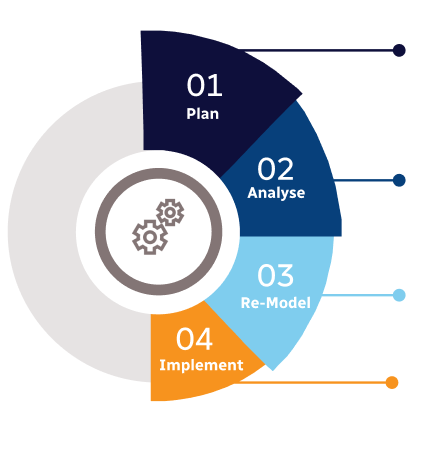
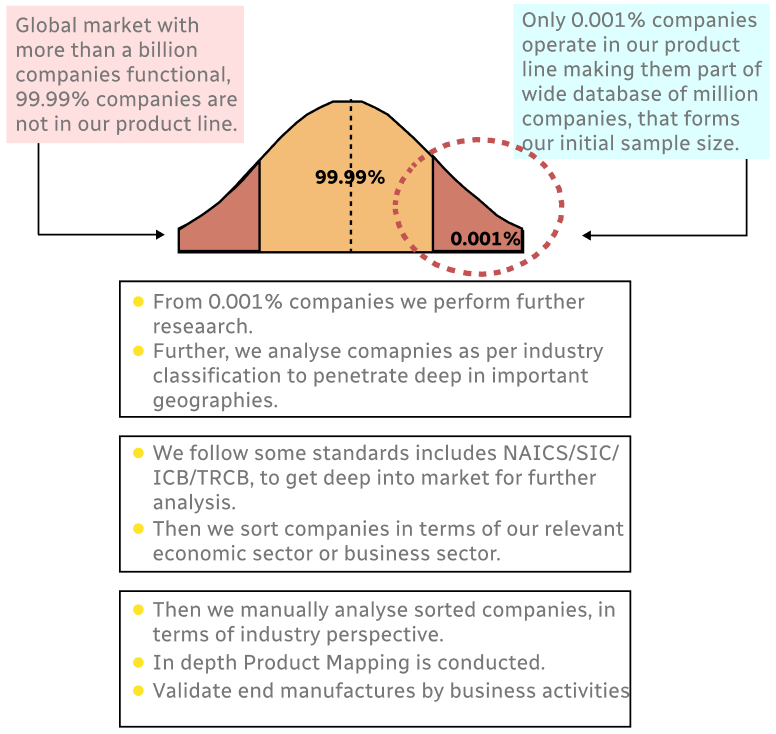
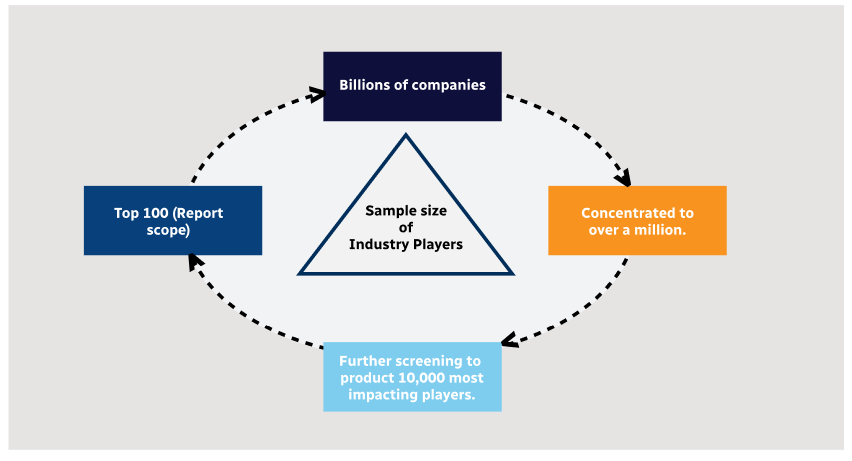
Step 1 - Identification of Relevant Samples Size from Population Database
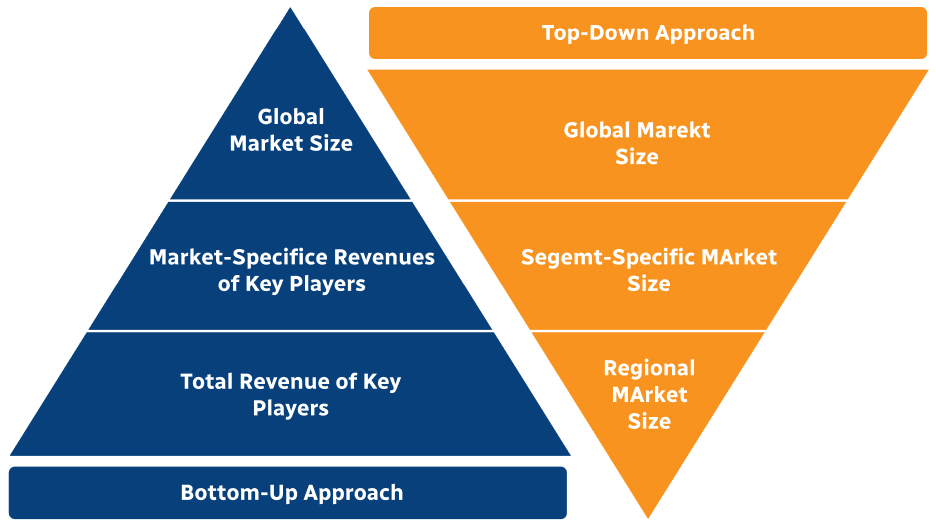
Step 2 - Approaches for Defining Global Market Size (Value, Volume* & Price*)
Note*: In applicable scenarios
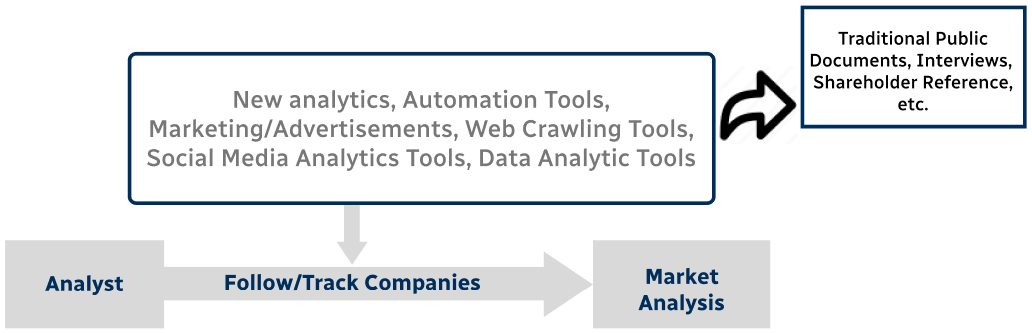
Step 3 - Data Sources
Primary Research
- Web Analytics
- Survey Reports
- Research Institute
- Latest Research Reports
- Opinion Leaders
Secondary Research
- Annual Reports
- White Paper
- Latest Press Release
- Industry Association
- Paid Database
- Investor Presentations
Step 4 - Data Triangulation
Involves using different sources of information in order to increase the validity of a study
These sources are likely to be stakeholders in a program - participants, other researchers, program staff, other community members, and so on.
Then we put all data in single framework & apply various statistical tools to find out the dynamic on the market.
During the analysis stage, feedback from the stakeholder groups would be compared to determine areas of agreement as well as areas of divergence