
Key Insights
The global Build Automation Tools market is poised for significant expansion, projected to reach an estimated market size of $2,200 million in 2025. This robust growth is driven by the increasing demand for efficient software development and deployment cycles across organizations of all sizes. As businesses increasingly adopt agile methodologies and DevOps practices, the need for tools that automate the building, testing, and deployment of software has become paramount. The market is expected to witness a Compound Annual Growth Rate (CAGR) of approximately 15% during the forecast period of 2025-2033, indicating a dynamic and rapidly evolving landscape. This surge is fueled by the inherent benefits of build automation, including reduced manual errors, accelerated release cycles, improved code quality, and enhanced collaboration between development and operations teams. The increasing complexity of software projects and the continuous integration/continuous delivery (CI/CD) paradigm further solidify the importance of these tools.
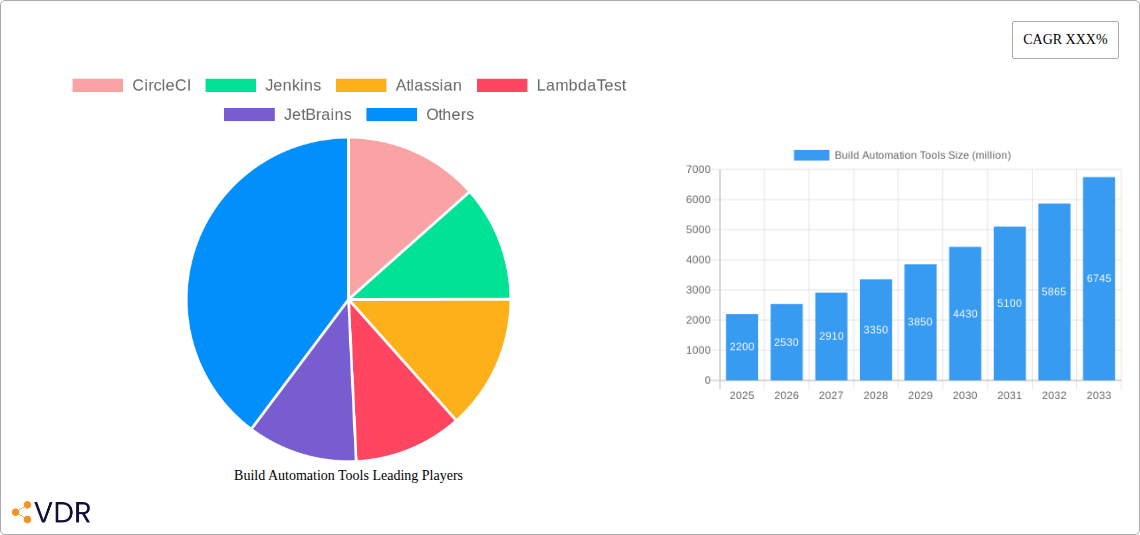
Build Automation Tools Market Size (In Billion)

The market segmentation reveals a strong inclination towards cloud-based solutions, driven by their scalability, flexibility, and cost-effectiveness, particularly for Small and Medium-sized Enterprises (SMEs) seeking to leverage advanced automation capabilities without substantial upfront infrastructure investment. Large enterprises, while also adopting cloud solutions, continue to utilize on-premises deployments for specific security and control requirements. Geographically, North America is expected to lead the market, followed closely by Asia Pacific and Europe, owing to the presence of a strong technology ecosystem, a high concentration of software development companies, and early adoption of advanced development practices. Key players such as CircleCI, Jenkins, and Atlassian are continuously innovating, offering advanced features and integrations to cater to the diverse needs of the global market, addressing restraints like the initial cost of implementation and the need for skilled personnel.
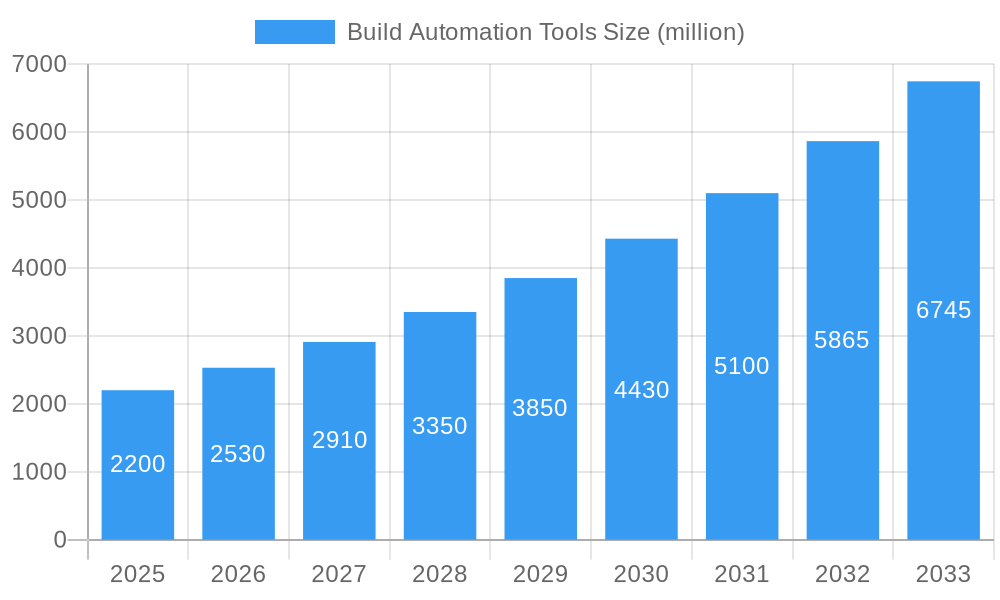
Build Automation Tools Company Market Share
Build Automation Tools Market Dynamics & Structure
The global build automation tools market exhibits a moderately concentrated structure, with key players like Jenkins, CircleCI, and Atlassian dominating significant market share. Technological innovation remains a primary driver, fueled by the increasing demand for faster software development cycles, enhanced code quality, and seamless CI/CD (Continuous Integration/Continuous Delivery) pipelines. The adoption of agile methodologies and DevOps practices across industries further accelerates this trend. Regulatory frameworks are generally permissive, focusing on data security and compliance, which indirectly influences tool selection by mandating certain integration capabilities. Competitive product substitutes include manual build processes and simpler scripting solutions, but their efficiency and scalability are increasingly outmatched by specialized automation tools. End-user demographics span across Large Enterprises, seeking robust, scalable solutions for complex projects, and SMEs, prioritizing cost-effectiveness and ease of implementation. Mergers & Acquisitions (M&A) activity is present, with larger players acquiring smaller, innovative startups to expand their feature sets and market reach. For instance, the acquisition of Codeship by CloudBees in 2017 significantly bolstered the latter's cloud-native CI/CD offerings. Innovation barriers include the high cost of advanced feature development and the need for continuous updates to keep pace with evolving programming languages and development environments.
- Market Concentration: Moderately concentrated with leading players holding substantial market share.
- Innovation Drivers: Demand for faster development, CI/CD, agile/DevOps adoption.
- Regulatory Impact: Focus on data security and compliance.
- Competitive Landscape: Manual processes and scripting as lower-tier alternatives.
- End-User Segments: Large Enterprises and SMEs with differing needs.
- M&A Trends: Strategic acquisitions to expand capabilities.
- Innovation Barriers: Development costs and need for continuous updates.
Build Automation Tools Growth Trends & Insights
The build automation tools market is poised for robust expansion, with a projected market size of approximately $15,000 million in 2025, expected to grow to $30,000 million by 2033, exhibiting a Compound Annual Growth Rate (CAGR) of 9.2%. This impressive growth is underpinned by a significant evolution in software development paradigms and a corresponding surge in adoption rates for automated solutions. The historical period from 2019–2024 witnessed a steady increase in market penetration, driven by the foundational benefits of build automation, such as reduced errors, improved consistency, and accelerated time-to-market. The base year of 2025 marks a pivotal point where cloud-based solutions are increasingly becoming the default choice, accounting for an estimated 65% of the market share, with on-premises solutions still holding a significant, albeit shrinking, presence.
Technological disruptions are continuously reshaping the landscape. The integration of AI and Machine Learning (ML) into build automation tools, enabling intelligent error detection, predictive analytics for build failures, and automated test optimization, is a key emerging trend. Furthermore, the rise of containerization technologies like Docker and orchestration platforms such as Kubernetes has necessitated and fostered the development of build automation tools that are natively compatible and optimized for these environments. Consumer behavior shifts are also playing a crucial role. Developers and IT professionals are increasingly seeking integrated platforms that offer a comprehensive suite of tools for the entire software development lifecycle, rather than standalone build solutions. This preference for unified platforms, which often include source code management, testing, deployment, and monitoring capabilities, is driving strategic partnerships and acquisitions within the industry.
The increasing complexity of software applications, the proliferation of microservices architectures, and the growing emphasis on DevSecOps, which integrates security practices early in the development lifecycle, are further contributing to the sustained demand for advanced build automation. Organizations are recognizing that efficient build automation is no longer a luxury but a critical enabler of business agility and competitive advantage. The market penetration is expected to climb from approximately 70% in 2025 to over 85% by 2033, reflecting the indispensable nature of these tools across almost all software development endeavors. The shift towards cloud-based solutions is not only about cost savings and scalability but also about faster access to the latest features and updates, further accelerating adoption.
- Projected Market Size: Reaching $15,000 million in 2025, growing to $30,000 million by 2033.
- CAGR: 9.2% during the forecast period 2025–2033.
- Adoption Rates: Steadily increasing, with projected penetration exceeding 85% by 2033.
- Technological Disruptions: AI/ML integration, containerization (Docker), Kubernetes compatibility.
- Consumer Behavior: Preference for integrated lifecycle management platforms.
- Key Enablers: Microservices, DevSecOps adoption.
- Cloud vs. On-Premises: Cloud-based solutions dominate, estimated 65% market share in 2025.
Dominant Regions, Countries, or Segments in Build Automation Tools
The North America region stands as the dominant force in the global build automation tools market, driven by a confluence of factors including a mature technology ecosystem, a high concentration of software development companies, and early adoption of DevOps and agile methodologies. In 2025, North America is estimated to hold a market share of approximately 35% of the total market value, projected to reach $5,250 million. This dominance is further amplified by significant investments in research and development by leading technology firms and a robust venture capital landscape that fuels innovation. The United States, in particular, spearheads this growth, owing to the presence of major tech hubs and a vast enterprise sector actively seeking to optimize their software delivery pipelines.
Within the application segment, Large Enterprises are the primary drivers of market growth, accounting for an estimated 55% of the market in 2025, valued at $8,250 million. These organizations leverage build automation tools for managing complex projects, ensuring compliance across numerous development teams, and achieving the agility required to compete in rapidly evolving markets. Their substantial budgets and the critical nature of their software applications make them willing adopters of sophisticated and comprehensive automation solutions. The scalability and security offered by enterprise-grade tools are paramount for their operational needs.
The Cloud-based type segment is also a significant growth engine, projected to capture 65% of the market in 2025, equating to $9,750 million. The inherent advantages of cloud solutions, such as lower upfront costs, easier scalability, and faster deployment of new features, align perfectly with the evolving demands of modern software development. This segment is expected to experience a higher CAGR than on-premises solutions. The proliferation of cloud infrastructure and the increasing adoption of hybrid cloud strategies further solidify the dominance of cloud-based build automation.
Key drivers contributing to North America's supremacy include supportive government policies that encourage technological innovation and digital transformation, alongside a highly skilled workforce adept at implementing and managing these advanced tools. The presence of major cloud providers like Amazon Web Services (AWS), Microsoft Azure, and Google Cloud Platform (GCP) in the region also creates a synergistic effect, fostering the growth of cloud-native build automation solutions.
- Dominant Region: North America, estimated 35% market share in 2025.
- Leading Country: United States.
- Dominant Application Segment: Large Enterprises, estimated 55% market share in 2025.
- Dominant Type Segment: Cloud-based, estimated 65% market share in 2025.
- North American Drivers: Mature tech ecosystem, DevOps adoption, R&D investment.
- Enterprise Drivers: Project complexity, compliance, agility needs.
- Cloud Drivers: Cost-effectiveness, scalability, rapid feature deployment.
Build Automation Tools Product Landscape
The build automation tools product landscape is characterized by a continuous stream of innovations focused on enhancing developer productivity and streamlining the software delivery pipeline. Key advancements include the integration of AI-powered predictive analytics for build failures, enabling proactive issue resolution and reducing debugging time. Many platforms now offer sophisticated plugin architectures, allowing for seamless integration with a vast array of development tools, including IDEs, source code repositories, testing frameworks, and deployment platforms. Performance metrics are increasingly centered around build times, test coverage, deployment frequency, and mean time to recovery (MTTR), with leading tools demonstrating build times measured in minutes for complex projects. Unique selling propositions often revolve around ease of use, robust security features (DevSecOps integration), and advanced scalability for enterprise-level deployments.
Key Drivers, Barriers & Challenges in Build Automation Tools
Key Drivers:
- Accelerated Software Development: The imperative for faster release cycles and quicker time-to-market.
- DevOps and Agile Adoption: The widespread embrace of these methodologies necessitates efficient automation.
- Code Quality and Consistency: Reducing human error and ensuring reproducible builds.
- Cost Optimization: Automating repetitive tasks leads to reduced labor costs and resource utilization.
- Technological Advancements: Integration of AI/ML for smarter automation and support for containerization.
Barriers & Challenges:
- Integration Complexity: Integrating new tools into existing, complex IT infrastructures can be challenging and time-consuming.
- Skills Gap: A shortage of skilled professionals proficient in implementing and managing advanced build automation tools.
- Security Concerns: Ensuring the security of the build pipeline and protecting sensitive code and intellectual property.
- Vendor Lock-in: Dependence on specific vendors can limit flexibility and increase costs.
- Initial Investment Costs: For some advanced solutions, the upfront cost of implementation and training can be a barrier, particularly for SMEs.
- Legacy Systems: The difficulty in automating builds for older, legacy applications.
Emerging Opportunities in Build Automation Tools
Emerging opportunities lie in the continued integration of AI and machine learning to provide more intelligent, self-optimizing build pipelines, including predictive maintenance for development environments. The growing adoption of serverless computing and edge computing presents new frontiers for build automation, requiring specialized tools that can manage distributed deployments and ephemeral environments. Furthermore, the increasing focus on sustainability in technology (“GreenOps”) is creating a demand for build automation tools that can optimize resource utilization and minimize energy consumption during the build and deployment processes. The expansion of build automation into areas like IoT device provisioning and embedded systems development also represents a significant untapped market.
Growth Accelerators in the Build Automation Tools Industry
Growth accelerators for the build automation tools industry are multi-faceted. Technological breakthroughs, particularly in AI and cloud-native architectures, are continuously pushing the boundaries of what is possible, leading to more efficient and intelligent automation. Strategic partnerships between tool vendors and cloud service providers, as well as with other development lifecycle tool providers, are expanding market reach and creating more integrated ecosystems. Market expansion strategies, including targeting new industries that are undergoing digital transformation (e.g., healthcare, manufacturing) and offering tiered pricing models to cater to the diverse needs of SMEs and large enterprises, are also crucial growth catalysts. The increasing global adoption of remote work models further emphasizes the need for robust, cloud-enabled build automation solutions.
Key Players Shaping the Build Automation Tools Market
- CircleCI
- Jenkins
- Atlassian
- LambdaTest
- JetBrains
- Apache Maven
- SaltStack
- Gradle
- Codeship
- JRebel
Notable Milestones in Build Automation Tools Sector
- 2019: Widespread adoption of GitOps principles begins to influence CI/CD pipeline design.
- 2020: Increased focus on security integration (DevSecOps) within build automation tools.
- 2021: Significant advancements in AI-powered build optimization and predictive failure analysis emerge.
- 2022: Cloud-native build automation solutions gain substantial market traction, with an emphasis on Kubernetes integration.
- 2023: Emergence of specialized build automation tools for serverless and edge computing environments.
- 2024: Growing industry discussion and initial implementations of AI copilots for build script generation and optimization.
In-Depth Build Automation Tools Market Outlook
The future of the build automation tools market is exceptionally bright, propelled by ongoing digital transformation initiatives across all sectors and the relentless pursuit of software development efficiency. The market's trajectory is strongly influenced by the continued evolution of cloud-native technologies, the increasing sophistication of AI and ML applications in development workflows, and the imperative for robust DevSecOps practices. Strategic partnerships and the development of more comprehensive, integrated platforms will continue to be key growth accelerators. The growing demand for automation in emerging areas like IoT, edge computing, and specialized software development will unlock new market segments and revenue streams, ensuring sustained and robust growth for the build automation tools industry.
Build Automation Tools Segmentation
-
1. Application
- 1.1. Large Enterprises
- 1.2. SMEs
-
2. Type
- 2.1. Cloud-based
- 2.2. On Premises
Build Automation Tools Segmentation By Geography
-
1. North America
- 1.1. United States
- 1.2. Canada
- 1.3. Mexico
-
2. South America
- 2.1. Brazil
- 2.2. Argentina
- 2.3. Rest of South America
-
3. Europe
- 3.1. United Kingdom
- 3.2. Germany
- 3.3. France
- 3.4. Italy
- 3.5. Spain
- 3.6. Russia
- 3.7. Benelux
- 3.8. Nordics
- 3.9. Rest of Europe
-
4. Middle East & Africa
- 4.1. Turkey
- 4.2. Israel
- 4.3. GCC
- 4.4. North Africa
- 4.5. South Africa
- 4.6. Rest of Middle East & Africa
-
5. Asia Pacific
- 5.1. China
- 5.2. India
- 5.3. Japan
- 5.4. South Korea
- 5.5. ASEAN
- 5.6. Oceania
- 5.7. Rest of Asia Pacific
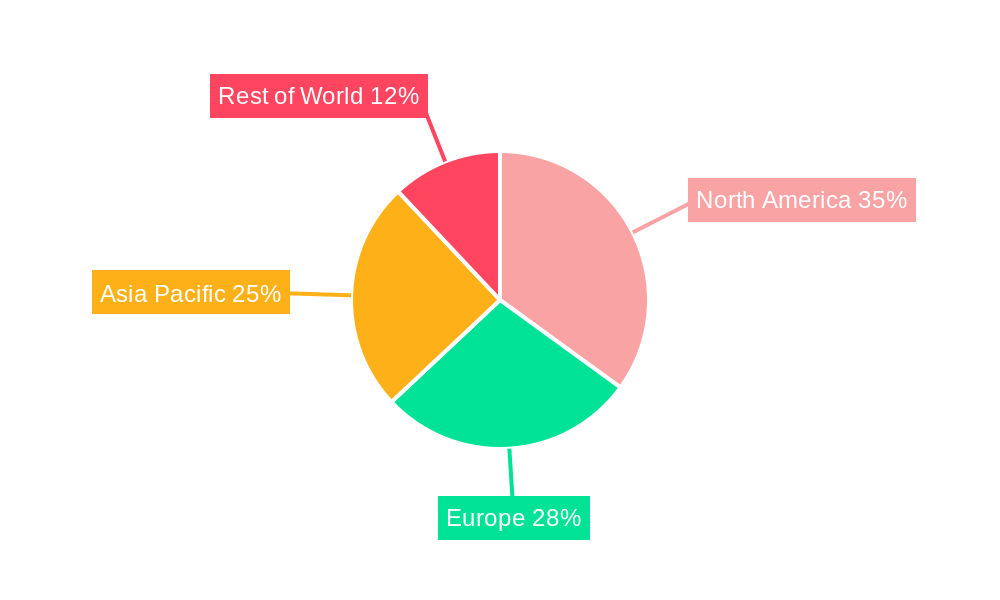
Build Automation Tools Regional Market Share
Geographic Coverage of Build Automation Tools
Build Automation Tools REPORT HIGHLIGHTS
| Aspects | Details |
|---|---|
| Study Period | 2020-2034 |
| Base Year | 2025 |
| Estimated Year | 2026 |
| Forecast Period | 2026-2034 |
| Historical Period | 2020-2025 |
| Growth Rate | CAGR of XXX% from 2020-2034 |
| Segmentation |
|
Table of Contents
- 1. Introduction
- 1.1. Research Scope
- 1.2. Market Segmentation
- 1.3. Research Methodology
- 1.4. Definitions and Assumptions
- 2. Executive Summary
- 2.1. Introduction
- 3. Market Dynamics
- 3.1. Introduction
- 3.2. Market Drivers
- 3.3. Market Restrains
- 3.4. Market Trends
- 4. Market Factor Analysis
- 4.1. Porters Five Forces
- 4.2. Supply/Value Chain
- 4.3. PESTEL analysis
- 4.4. Market Entropy
- 4.5. Patent/Trademark Analysis
- 5. Global Build Automation Tools Analysis, Insights and Forecast, 2020-2032
- 5.1. Market Analysis, Insights and Forecast - by Application
- 5.1.1. Large Enterprises
- 5.1.2. SMEs
- 5.2. Market Analysis, Insights and Forecast - by Type
- 5.2.1. Cloud-based
- 5.2.2. On Premises
- 5.3. Market Analysis, Insights and Forecast - by Region
- 5.3.1. North America
- 5.3.2. South America
- 5.3.3. Europe
- 5.3.4. Middle East & Africa
- 5.3.5. Asia Pacific
- 5.1. Market Analysis, Insights and Forecast - by Application
- 6. North America Build Automation Tools Analysis, Insights and Forecast, 2020-2032
- 6.1. Market Analysis, Insights and Forecast - by Application
- 6.1.1. Large Enterprises
- 6.1.2. SMEs
- 6.2. Market Analysis, Insights and Forecast - by Type
- 6.2.1. Cloud-based
- 6.2.2. On Premises
- 6.1. Market Analysis, Insights and Forecast - by Application
- 7. South America Build Automation Tools Analysis, Insights and Forecast, 2020-2032
- 7.1. Market Analysis, Insights and Forecast - by Application
- 7.1.1. Large Enterprises
- 7.1.2. SMEs
- 7.2. Market Analysis, Insights and Forecast - by Type
- 7.2.1. Cloud-based
- 7.2.2. On Premises
- 7.1. Market Analysis, Insights and Forecast - by Application
- 8. Europe Build Automation Tools Analysis, Insights and Forecast, 2020-2032
- 8.1. Market Analysis, Insights and Forecast - by Application
- 8.1.1. Large Enterprises
- 8.1.2. SMEs
- 8.2. Market Analysis, Insights and Forecast - by Type
- 8.2.1. Cloud-based
- 8.2.2. On Premises
- 8.1. Market Analysis, Insights and Forecast - by Application
- 9. Middle East & Africa Build Automation Tools Analysis, Insights and Forecast, 2020-2032
- 9.1. Market Analysis, Insights and Forecast - by Application
- 9.1.1. Large Enterprises
- 9.1.2. SMEs
- 9.2. Market Analysis, Insights and Forecast - by Type
- 9.2.1. Cloud-based
- 9.2.2. On Premises
- 9.1. Market Analysis, Insights and Forecast - by Application
- 10. Asia Pacific Build Automation Tools Analysis, Insights and Forecast, 2020-2032
- 10.1. Market Analysis, Insights and Forecast - by Application
- 10.1.1. Large Enterprises
- 10.1.2. SMEs
- 10.2. Market Analysis, Insights and Forecast - by Type
- 10.2.1. Cloud-based
- 10.2.2. On Premises
- 10.1. Market Analysis, Insights and Forecast - by Application
- 11. Competitive Analysis
- 11.1. Global Market Share Analysis 2025
- 11.2. Company Profiles
- 11.2.1 CircleCI
- 11.2.1.1. Overview
- 11.2.1.2. Products
- 11.2.1.3. SWOT Analysis
- 11.2.1.4. Recent Developments
- 11.2.1.5. Financials (Based on Availability)
- 11.2.2 Jenkins
- 11.2.2.1. Overview
- 11.2.2.2. Products
- 11.2.2.3. SWOT Analysis
- 11.2.2.4. Recent Developments
- 11.2.2.5. Financials (Based on Availability)
- 11.2.3 Atlassian
- 11.2.3.1. Overview
- 11.2.3.2. Products
- 11.2.3.3. SWOT Analysis
- 11.2.3.4. Recent Developments
- 11.2.3.5. Financials (Based on Availability)
- 11.2.4 LambdaTest
- 11.2.4.1. Overview
- 11.2.4.2. Products
- 11.2.4.3. SWOT Analysis
- 11.2.4.4. Recent Developments
- 11.2.4.5. Financials (Based on Availability)
- 11.2.5 JetBrains
- 11.2.5.1. Overview
- 11.2.5.2. Products
- 11.2.5.3. SWOT Analysis
- 11.2.5.4. Recent Developments
- 11.2.5.5. Financials (Based on Availability)
- 11.2.6 Apache Maven
- 11.2.6.1. Overview
- 11.2.6.2. Products
- 11.2.6.3. SWOT Analysis
- 11.2.6.4. Recent Developments
- 11.2.6.5. Financials (Based on Availability)
- 11.2.7 SaltStack
- 11.2.7.1. Overview
- 11.2.7.2. Products
- 11.2.7.3. SWOT Analysis
- 11.2.7.4. Recent Developments
- 11.2.7.5. Financials (Based on Availability)
- 11.2.8 Gradle
- 11.2.8.1. Overview
- 11.2.8.2. Products
- 11.2.8.3. SWOT Analysis
- 11.2.8.4. Recent Developments
- 11.2.8.5. Financials (Based on Availability)
- 11.2.9 Codeship
- 11.2.9.1. Overview
- 11.2.9.2. Products
- 11.2.9.3. SWOT Analysis
- 11.2.9.4. Recent Developments
- 11.2.9.5. Financials (Based on Availability)
- 11.2.10 JRebel
- 11.2.10.1. Overview
- 11.2.10.2. Products
- 11.2.10.3. SWOT Analysis
- 11.2.10.4. Recent Developments
- 11.2.10.5. Financials (Based on Availability)
- 11.2.1 CircleCI
List of Figures
- Figure 1: Global Build Automation Tools Revenue Breakdown (million, %) by Region 2025 & 2033
- Figure 2: North America Build Automation Tools Revenue (million), by Application 2025 & 2033
- Figure 3: North America Build Automation Tools Revenue Share (%), by Application 2025 & 2033
- Figure 4: North America Build Automation Tools Revenue (million), by Type 2025 & 2033
- Figure 5: North America Build Automation Tools Revenue Share (%), by Type 2025 & 2033
- Figure 6: North America Build Automation Tools Revenue (million), by Country 2025 & 2033
- Figure 7: North America Build Automation Tools Revenue Share (%), by Country 2025 & 2033
- Figure 8: South America Build Automation Tools Revenue (million), by Application 2025 & 2033
- Figure 9: South America Build Automation Tools Revenue Share (%), by Application 2025 & 2033
- Figure 10: South America Build Automation Tools Revenue (million), by Type 2025 & 2033
- Figure 11: South America Build Automation Tools Revenue Share (%), by Type 2025 & 2033
- Figure 12: South America Build Automation Tools Revenue (million), by Country 2025 & 2033
- Figure 13: South America Build Automation Tools Revenue Share (%), by Country 2025 & 2033
- Figure 14: Europe Build Automation Tools Revenue (million), by Application 2025 & 2033
- Figure 15: Europe Build Automation Tools Revenue Share (%), by Application 2025 & 2033
- Figure 16: Europe Build Automation Tools Revenue (million), by Type 2025 & 2033
- Figure 17: Europe Build Automation Tools Revenue Share (%), by Type 2025 & 2033
- Figure 18: Europe Build Automation Tools Revenue (million), by Country 2025 & 2033
- Figure 19: Europe Build Automation Tools Revenue Share (%), by Country 2025 & 2033
- Figure 20: Middle East & Africa Build Automation Tools Revenue (million), by Application 2025 & 2033
- Figure 21: Middle East & Africa Build Automation Tools Revenue Share (%), by Application 2025 & 2033
- Figure 22: Middle East & Africa Build Automation Tools Revenue (million), by Type 2025 & 2033
- Figure 23: Middle East & Africa Build Automation Tools Revenue Share (%), by Type 2025 & 2033
- Figure 24: Middle East & Africa Build Automation Tools Revenue (million), by Country 2025 & 2033
- Figure 25: Middle East & Africa Build Automation Tools Revenue Share (%), by Country 2025 & 2033
- Figure 26: Asia Pacific Build Automation Tools Revenue (million), by Application 2025 & 2033
- Figure 27: Asia Pacific Build Automation Tools Revenue Share (%), by Application 2025 & 2033
- Figure 28: Asia Pacific Build Automation Tools Revenue (million), by Type 2025 & 2033
- Figure 29: Asia Pacific Build Automation Tools Revenue Share (%), by Type 2025 & 2033
- Figure 30: Asia Pacific Build Automation Tools Revenue (million), by Country 2025 & 2033
- Figure 31: Asia Pacific Build Automation Tools Revenue Share (%), by Country 2025 & 2033
List of Tables
- Table 1: Global Build Automation Tools Revenue million Forecast, by Application 2020 & 2033
- Table 2: Global Build Automation Tools Revenue million Forecast, by Type 2020 & 2033
- Table 3: Global Build Automation Tools Revenue million Forecast, by Region 2020 & 2033
- Table 4: Global Build Automation Tools Revenue million Forecast, by Application 2020 & 2033
- Table 5: Global Build Automation Tools Revenue million Forecast, by Type 2020 & 2033
- Table 6: Global Build Automation Tools Revenue million Forecast, by Country 2020 & 2033
- Table 7: United States Build Automation Tools Revenue (million) Forecast, by Application 2020 & 2033
- Table 8: Canada Build Automation Tools Revenue (million) Forecast, by Application 2020 & 2033
- Table 9: Mexico Build Automation Tools Revenue (million) Forecast, by Application 2020 & 2033
- Table 10: Global Build Automation Tools Revenue million Forecast, by Application 2020 & 2033
- Table 11: Global Build Automation Tools Revenue million Forecast, by Type 2020 & 2033
- Table 12: Global Build Automation Tools Revenue million Forecast, by Country 2020 & 2033
- Table 13: Brazil Build Automation Tools Revenue (million) Forecast, by Application 2020 & 2033
- Table 14: Argentina Build Automation Tools Revenue (million) Forecast, by Application 2020 & 2033
- Table 15: Rest of South America Build Automation Tools Revenue (million) Forecast, by Application 2020 & 2033
- Table 16: Global Build Automation Tools Revenue million Forecast, by Application 2020 & 2033
- Table 17: Global Build Automation Tools Revenue million Forecast, by Type 2020 & 2033
- Table 18: Global Build Automation Tools Revenue million Forecast, by Country 2020 & 2033
- Table 19: United Kingdom Build Automation Tools Revenue (million) Forecast, by Application 2020 & 2033
- Table 20: Germany Build Automation Tools Revenue (million) Forecast, by Application 2020 & 2033
- Table 21: France Build Automation Tools Revenue (million) Forecast, by Application 2020 & 2033
- Table 22: Italy Build Automation Tools Revenue (million) Forecast, by Application 2020 & 2033
- Table 23: Spain Build Automation Tools Revenue (million) Forecast, by Application 2020 & 2033
- Table 24: Russia Build Automation Tools Revenue (million) Forecast, by Application 2020 & 2033
- Table 25: Benelux Build Automation Tools Revenue (million) Forecast, by Application 2020 & 2033
- Table 26: Nordics Build Automation Tools Revenue (million) Forecast, by Application 2020 & 2033
- Table 27: Rest of Europe Build Automation Tools Revenue (million) Forecast, by Application 2020 & 2033
- Table 28: Global Build Automation Tools Revenue million Forecast, by Application 2020 & 2033
- Table 29: Global Build Automation Tools Revenue million Forecast, by Type 2020 & 2033
- Table 30: Global Build Automation Tools Revenue million Forecast, by Country 2020 & 2033
- Table 31: Turkey Build Automation Tools Revenue (million) Forecast, by Application 2020 & 2033
- Table 32: Israel Build Automation Tools Revenue (million) Forecast, by Application 2020 & 2033
- Table 33: GCC Build Automation Tools Revenue (million) Forecast, by Application 2020 & 2033
- Table 34: North Africa Build Automation Tools Revenue (million) Forecast, by Application 2020 & 2033
- Table 35: South Africa Build Automation Tools Revenue (million) Forecast, by Application 2020 & 2033
- Table 36: Rest of Middle East & Africa Build Automation Tools Revenue (million) Forecast, by Application 2020 & 2033
- Table 37: Global Build Automation Tools Revenue million Forecast, by Application 2020 & 2033
- Table 38: Global Build Automation Tools Revenue million Forecast, by Type 2020 & 2033
- Table 39: Global Build Automation Tools Revenue million Forecast, by Country 2020 & 2033
- Table 40: China Build Automation Tools Revenue (million) Forecast, by Application 2020 & 2033
- Table 41: India Build Automation Tools Revenue (million) Forecast, by Application 2020 & 2033
- Table 42: Japan Build Automation Tools Revenue (million) Forecast, by Application 2020 & 2033
- Table 43: South Korea Build Automation Tools Revenue (million) Forecast, by Application 2020 & 2033
- Table 44: ASEAN Build Automation Tools Revenue (million) Forecast, by Application 2020 & 2033
- Table 45: Oceania Build Automation Tools Revenue (million) Forecast, by Application 2020 & 2033
- Table 46: Rest of Asia Pacific Build Automation Tools Revenue (million) Forecast, by Application 2020 & 2033
Frequently Asked Questions
1. What is the projected Compound Annual Growth Rate (CAGR) of the Build Automation Tools?
The projected CAGR is approximately XXX%.
2. Which companies are prominent players in the Build Automation Tools?
Key companies in the market include CircleCI, Jenkins, Atlassian, LambdaTest, JetBrains, Apache Maven, SaltStack, Gradle, Codeship, JRebel.
3. What are the main segments of the Build Automation Tools?
The market segments include Application, Type.
4. Can you provide details about the market size?
The market size is estimated to be USD XXX million as of 2022.
5. What are some drivers contributing to market growth?
N/A
6. What are the notable trends driving market growth?
N/A
7. Are there any restraints impacting market growth?
N/A
8. Can you provide examples of recent developments in the market?
N/A
9. What pricing options are available for accessing the report?
Pricing options include single-user, multi-user, and enterprise licenses priced at USD 4250.00, USD 6375.00, and USD 8500.00 respectively.
10. Is the market size provided in terms of value or volume?
The market size is provided in terms of value, measured in million.
11. Are there any specific market keywords associated with the report?
Yes, the market keyword associated with the report is "Build Automation Tools," which aids in identifying and referencing the specific market segment covered.
12. How do I determine which pricing option suits my needs best?
The pricing options vary based on user requirements and access needs. Individual users may opt for single-user licenses, while businesses requiring broader access may choose multi-user or enterprise licenses for cost-effective access to the report.
13. Are there any additional resources or data provided in the Build Automation Tools report?
While the report offers comprehensive insights, it's advisable to review the specific contents or supplementary materials provided to ascertain if additional resources or data are available.
14. How can I stay updated on further developments or reports in the Build Automation Tools?
To stay informed about further developments, trends, and reports in the Build Automation Tools, consider subscribing to industry newsletters, following relevant companies and organizations, or regularly checking reputable industry news sources and publications.
Methodology
Step 1 - Identification of Relevant Samples Size from Population Database



Step 2 - Approaches for Defining Global Market Size (Value, Volume* & Price*)

Note*: In applicable scenarios
Step 3 - Data Sources
Primary Research
- Web Analytics
- Survey Reports
- Research Institute
- Latest Research Reports
- Opinion Leaders
Secondary Research
- Annual Reports
- White Paper
- Latest Press Release
- Industry Association
- Paid Database
- Investor Presentations

Step 4 - Data Triangulation
Involves using different sources of information in order to increase the validity of a study
These sources are likely to be stakeholders in a program - participants, other researchers, program staff, other community members, and so on.
Then we put all data in single framework & apply various statistical tools to find out the dynamic on the market.
During the analysis stage, feedback from the stakeholder groups would be compared to determine areas of agreement as well as areas of divergence

