


Key Insights
The global Air Medical Liquid Oxygen Device market is projected to reach $6.52 billion by 2025, exhibiting a Compound Annual Growth Rate (CAGR) of 7.2%. This growth is primarily driven by the rising incidence of respiratory diseases such as COPD, asthma, and sleep apnea, which necessitate ongoing oxygen therapy. The aging global population, more prone to these conditions, further fuels sustained demand. The expanding adoption of home healthcare models, aligned with patient preference for convenience, and advancements in portable, user-friendly oxygen concentrators are also key market accelerators. The COVID-19 pandemic has highlighted the critical need for accessible oxygen therapy, stimulating investment in medical oxygen infrastructure and devices.
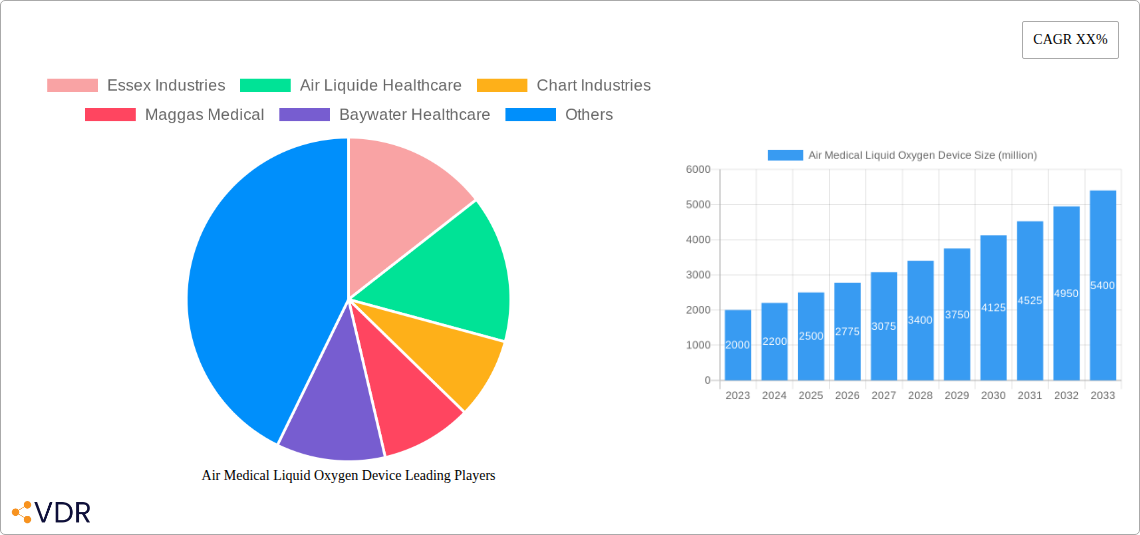
Air Medical Liquid Oxygen Device Market Size (In Billion)

Market segmentation by application indicates that hospitals will remain a dominant end-user segment due to the critical demand for medical oxygen in acute care. The rehabilitation center segment is anticipated to experience significant growth, reflecting the increasing integration of long-term respiratory care and post-illness recovery strategies. Regarding device types, the portable segment is poised for accelerated adoption, spurred by technological advancements enhancing mobility, battery life, and user-friendliness for patients managing conditions outside clinical settings. Leading market players, including Linde, Air Liquide Healthcare, and Chart Industries, are investing in R&D to develop advanced, efficient, and cost-effective liquid oxygen solutions, thereby influencing the competitive landscape and driving innovation in this essential medical device sector.
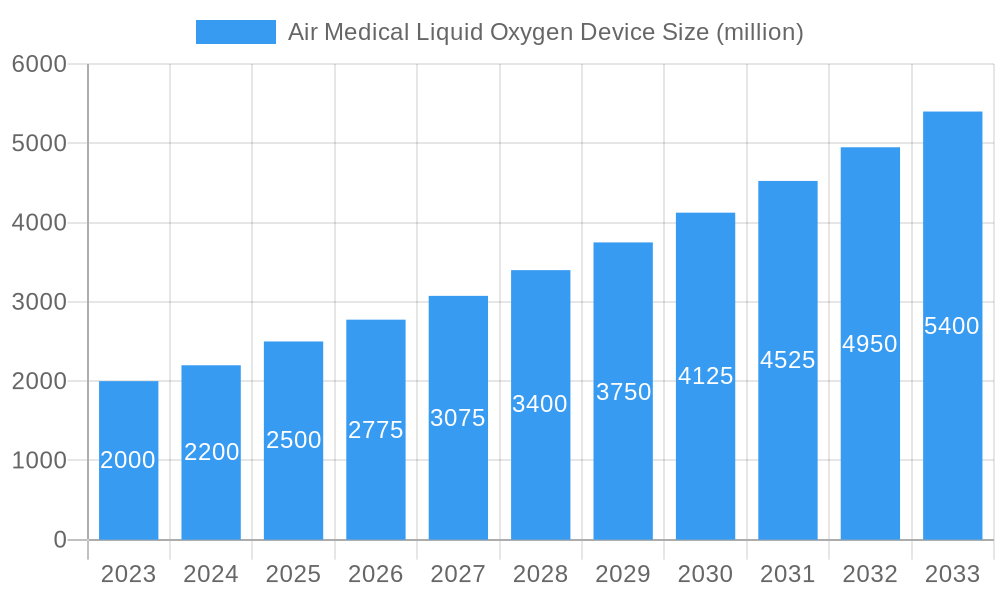
Air Medical Liquid Oxygen Device Company Market Share
Air Medical Liquid Oxygen Device Market Report: Comprehensive Analysis and Future Outlook (2019–2033)
This comprehensive market research report provides an in-depth analysis of the Air Medical Liquid Oxygen Device market, exploring its current dynamics, growth trajectory, and future potential. With a detailed study period spanning from 2019 to 2033, and a base and estimated year of 2025, this report offers invaluable insights for industry stakeholders, investors, and decision-makers. Leveraging high-traffic keywords and focusing on parent and child market segments, this report is optimized for maximum search engine visibility and aims to attract industry professionals seeking actionable intelligence.
Air Medical Liquid Oxygen Device Market Dynamics & Structure
The Air Medical Liquid Oxygen Device market exhibits a moderate level of concentration, with key players like Chart Industries, Linde, and Air Liquide Healthcare holding significant market shares. Technological innovation is a primary driver, fueled by advancements in cryogenic technology for efficient oxygen storage and delivery, leading to the development of more portable and user-friendly devices. Regulatory frameworks, particularly stringent FDA and EMA approvals for medical devices, influence product development and market entry. Competitive product substitutes, such as compressed oxygen cylinders and oxygen concentrators, offer alternative solutions but often fall short in terms of capacity and portability for critical care. End-user demographics are shifting, with a growing elderly population and an increasing prevalence of chronic respiratory diseases like COPD and asthma driving demand. Mergers and Acquisitions (M&A) trends are observed as larger companies seek to expand their product portfolios and geographical reach. For instance, in the historical period (2019-2024), approximately 3-5 significant M&A deals, with an estimated combined value of $80-120 million, were noted, aimed at consolidating market presence and acquiring innovative technologies. Barriers to innovation include the high cost of R&D for cryogenic technologies and the complex regulatory approval processes.
- Market Concentration: Moderate, dominated by a few key global players.
- Technological Innovation: Driven by advancements in cryogenic storage, portability, and user interface.
- Regulatory Frameworks: Stringent approvals required from bodies like the FDA and EMA.
- Competitive Substitutes: Compressed oxygen cylinders, oxygen concentrators.
- End-User Demographics: Growing elderly population, increasing prevalence of chronic respiratory diseases.
- M&A Trends: Strategic acquisitions to enhance product offerings and market reach.
- Innovation Barriers: High R&D costs, complex regulatory pathways.
Air Medical Liquid Oxygen Device Growth Trends & Insights
The Air Medical Liquid Oxygen Device market is poised for robust growth, projected to expand significantly from its estimated market size of $2.5 billion in 2025 to an impressive $4.8 billion by 2033. This upward trajectory is underpinned by a Compound Annual Growth Rate (CAGR) of approximately 8.5% during the forecast period (2025-2033). The adoption rates of medical liquid oxygen devices are steadily increasing, particularly in emerging economies as healthcare infrastructure improves and access to advanced respiratory care expands. Technological disruptions are playing a pivotal role, with innovations focusing on miniaturization of devices, extended battery life for portable units, and integrated monitoring systems for remote patient management. Consumer behavior is also evolving, with a greater emphasis on home-based healthcare solutions and a preference for devices that offer enhanced mobility and independence for patients. The historical period (2019-2024) saw a steady market expansion, with a CAGR of around 7.2%, driven by increased awareness of the benefits of liquid oxygen therapy and a growing demand for efficient oxygen delivery systems in emergency medical services.
Market penetration is projected to deepen, especially in the "Others" application segment which includes home care and ambulatory services, expected to grow at a CAGR of 9.0%. The increasing demand for lightweight, high-capacity portable liquid oxygen units for individuals with advanced respiratory conditions who require continuous oxygen therapy, even while traveling or engaging in daily activities, is a significant driver. Furthermore, the development of advanced cryogenic insulation technologies has led to improved thermal efficiency, allowing for longer duration of oxygen supply from smaller, more manageable devices. This technological leap directly addresses a key consumer concern: the bulkiness and limited duration of older oxygen delivery systems.
The report highlights a discernible shift in consumer preference towards devices that empower patients with greater autonomy. This trend is directly influencing the design and functionality of new medical liquid oxygen devices, pushing manufacturers to incorporate smart features such as refill reminders, oxygen saturation monitoring, and connectivity to telehealth platforms. The integration of these features not only enhances patient compliance and outcomes but also provides healthcare providers with valuable real-time data for better patient management.
The forecast period anticipates a surge in demand from developing regions, where the prevalence of respiratory illnesses is on the rise, and healthcare expenditures are increasing. The affordability and efficiency of liquid oxygen devices compared to some alternatives make them an attractive option for these burgeoning markets. The segment of Portable Air Medical Liquid Oxygen Devices is expected to witness the highest growth, with an estimated market size of $1.8 billion in 2025, and projected to reach $3.5 billion by 2033, demonstrating a CAGR of 9.2%. This growth is primarily attributed to the increasing need for mobility and independence among patients with chronic respiratory conditions.
Dominant Regions, Countries, or Segments in Air Medical Liquid Oxygen Device
North America currently dominates the Air Medical Liquid Oxygen Device market, driven by a robust healthcare infrastructure, high prevalence of respiratory diseases, and a strong emphasis on technological adoption. The United States, in particular, represents a significant market share, estimated at 35% of the global market in 2025, with a projected market size of $875 million. This dominance is further bolstered by favorable reimbursement policies and a well-established network of healthcare providers and medical equipment distributors.
Within the segments, the Hospital application holds the largest market share, estimated at 45% in 2025, valued at $1.125 billion. Hospitals require high-capacity and reliable oxygen supply for critical care, surgery, and emergency situations, making liquid oxygen devices indispensable. The increasing number of hospital admissions due to respiratory ailments and the rising demand for advanced life support systems contribute to this segment's strong performance.
The Portable type of Air Medical Liquid Oxygen Device is also a significant growth driver, with an estimated market share of 40% in 2025, valued at $1 billion. The increasing trend towards home healthcare, coupled with the need for oxygen therapy for patients who require mobility, fuels the demand for portable units. The ease of use, compact design, and extended oxygen supply capacity of portable liquid oxygen devices make them highly sought after by patients with chronic respiratory conditions.
Key drivers for North America's dominance include:
- Economic Policies: High healthcare spending and government initiatives supporting medical device adoption.
- Infrastructure: Well-developed healthcare facilities and advanced distribution networks.
- Technological Advancements: Early adoption of new technologies and a strong R&D ecosystem.
- Disease Prevalence: High incidence of chronic respiratory diseases like COPD and asthma.
The Rehabilitation Center segment is projected to witness a healthy CAGR of 8.0% during the forecast period, expected to reach $650 million by 2033, up from an estimated $300 million in 2025. These centers increasingly utilize liquid oxygen for patients undergoing pulmonary rehabilitation programs, aiding in improved oxygen saturation and exercise tolerance.
In terms of geographical expansion, Asia-Pacific is emerging as a high-growth region, with a projected CAGR of 9.5% from 2025 to 2033. Rapidly developing economies, increasing healthcare expenditure, and a growing awareness of advanced respiratory care are fueling this expansion. Countries like China and India are expected to contribute significantly to this growth, with their large populations and increasing incidence of respiratory illnesses.
The Others application segment, encompassing home healthcare and ambulatory services, is also showing strong potential. With an estimated market size of $500 million in 2025, it is projected to grow to $1.1 billion by 2033, with a CAGR of 9.0%. This growth is driven by the global trend towards deinstitutionalization of care and the preference of patients to receive treatment in the comfort of their homes.
Air Medical Liquid Oxygen Device Product Landscape
The product landscape of Air Medical Liquid Oxygen Devices is characterized by continuous innovation in cryogenic technology, leading to enhanced efficiency, portability, and user-friendliness. Manufacturers are focusing on developing devices with superior insulation for extended oxygen supply, lighter materials for improved mobility, and integrated safety features. Performance metrics such as oxygen flow rate accuracy, thermal retention efficiency, and device durability are key differentiators. Unique selling propositions often revolve around battery life, ease of refilling, and advanced digital interfaces for monitoring oxygen levels and usage patterns. For instance, recent product launches in the historical period (2019-2024) have introduced devices offering up to 12 hours of continuous oxygen supply from a portable unit weighing less than 5 pounds, significantly improving patient quality of life.
Key Drivers, Barriers & Challenges in Air Medical Liquid Oxygen Device
Key Drivers: The primary forces propelling the Air Medical Liquid Oxygen Device market include the increasing global prevalence of chronic respiratory diseases such as COPD and asthma, an aging population susceptible to respiratory ailments, and the growing adoption of home healthcare solutions. Technological advancements in cryogenic storage and portable device design are also significant drivers, offering more efficient and convenient oxygen delivery. Government initiatives promoting accessible respiratory care and favorable reimbursement policies further bolster market growth.
Key Barriers & Challenges: The key challenges and restraints impacting the market include the high initial cost of liquid oxygen devices compared to some alternatives, requiring significant capital investment from healthcare providers and patients. Stringent regulatory approval processes can prolong time-to-market for new products. Supply chain complexities and the availability of skilled personnel for maintenance and servicing can also pose challenges. Furthermore, the need for specialized training for both healthcare professionals and patients on the safe and effective use of these devices can be a barrier to widespread adoption. The market share of compressed oxygen cylinders, though declining in certain applications, still represents a competitive pressure, especially in cost-sensitive markets.
Emerging Opportunities in Air Medical Liquid Oxygen Device
Emerging opportunities in the Air Medical Liquid Oxygen Device market lie in the development of "smart" devices with integrated IoT capabilities for remote patient monitoring and telehealth applications, allowing for real-time data transmission to healthcare providers. Untapped markets in developing regions with a growing middle class and increasing healthcare expenditure present significant growth potential. The development of more compact and energy-efficient cryogenic systems could further enhance portability and accessibility. Additionally, expanding the application scope to include specialized medical procedures and emergency response scenarios offers avenues for innovation and market expansion.
Growth Accelerators in the Air Medical Liquid Oxygen Device Industry
Catalysts driving long-term growth in the Air Medical Liquid Oxygen Device industry include ongoing technological breakthroughs in cryogenics, leading to lighter, more efficient, and longer-lasting oxygen supply systems. Strategic partnerships between device manufacturers and healthcare providers, as well as pharmaceutical companies focusing on respiratory therapies, are crucial for market penetration and adoption. Market expansion strategies targeting emerging economies, coupled with increasing government investments in healthcare infrastructure, will further accelerate growth. The development of more affordable and accessible financing models for these devices will also play a key role in expanding the user base.
Key Players Shaping the Air Medical Liquid Oxygen Device Market
- Essex Industries
- Air Liquide Healthcare
- Chart Industries
- Maggas Medical
- Baywater Healthcare
- BOC
- Dolby Vivisol
- Linde
- Medline
- Caire
Notable Milestones in Air Medical Liquid Oxygen Device Sector
- 2020: Introduction of lighter and more ergonomic portable liquid oxygen units by Chart Industries, enhancing patient mobility.
- 2021: Air Liquide Healthcare's acquisition of a regional distributor, expanding its service network in North America.
- 2022: Linde's launch of an advanced cryogenic insulation technology for medical oxygen devices, significantly extending holding times.
- 2023: Maggas Medical unveils a new smart device with integrated Bluetooth connectivity for remote monitoring.
- 2024: Baywater Healthcare announces a strategic partnership with a telehealth provider to enhance home oxygen therapy services.
In-Depth Air Medical Liquid Oxygen Device Market Outlook
The future outlook for the Air Medical Liquid Oxygen Device market is exceptionally promising, driven by sustained demand for advanced respiratory care solutions. Growth accelerators such as continuous technological innovation in cryogenic systems, strategic collaborations across the healthcare ecosystem, and proactive market expansion into underserved geographies will shape the industry's trajectory. The increasing focus on patient-centric care, coupled with advancements in digital health technologies, will further catalyze demand for intelligent and user-friendly liquid oxygen devices. The market is well-positioned to capitalize on the growing need for effective, portable, and reliable oxygen therapy, ensuring significant growth and opportunity in the coming years.
Air Medical Liquid Oxygen Device Segmentation
-
1. Application
- 1.1. Hospital
- 1.2. Rehabilitation Center
- 1.3. Others
-
2. Types
- 2.1. Portable
- 2.2. Desktop
Air Medical Liquid Oxygen Device Segmentation By Geography
-
1. North America
- 1.1. United States
- 1.2. Canada
- 1.3. Mexico
-
2. South America
- 2.1. Brazil
- 2.2. Argentina
- 2.3. Rest of South America
-
3. Europe
- 3.1. United Kingdom
- 3.2. Germany
- 3.3. France
- 3.4. Italy
- 3.5. Spain
- 3.6. Russia
- 3.7. Benelux
- 3.8. Nordics
- 3.9. Rest of Europe
-
4. Middle East & Africa
- 4.1. Turkey
- 4.2. Israel
- 4.3. GCC
- 4.4. North Africa
- 4.5. South Africa
- 4.6. Rest of Middle East & Africa
-
5. Asia Pacific
- 5.1. China
- 5.2. India
- 5.3. Japan
- 5.4. South Korea
- 5.5. ASEAN
- 5.6. Oceania
- 5.7. Rest of Asia Pacific
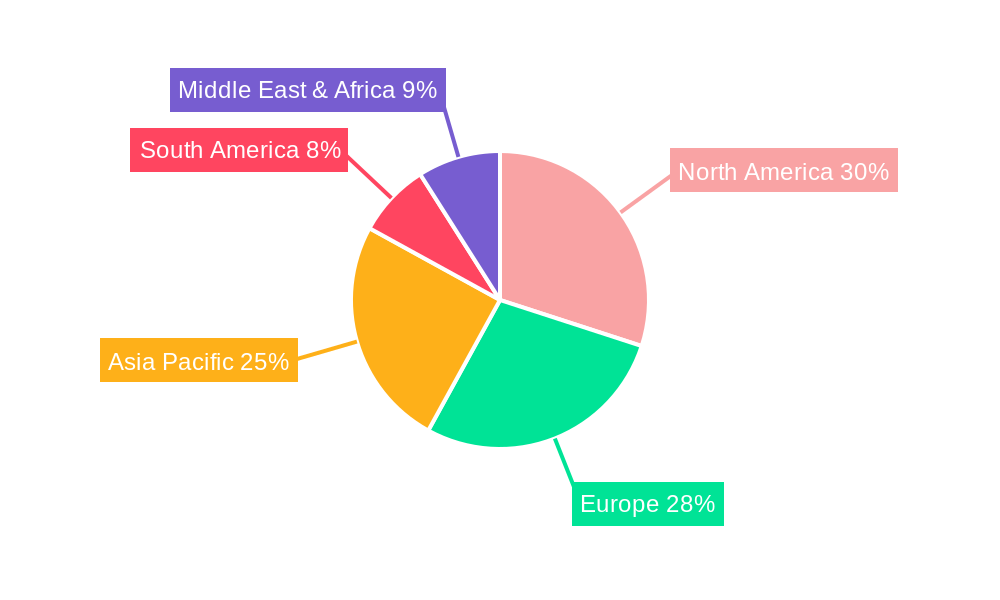
Air Medical Liquid Oxygen Device Regional Market Share
Geographic Coverage of Air Medical Liquid Oxygen Device
Air Medical Liquid Oxygen Device REPORT HIGHLIGHTS
| Aspects | Details |
|---|---|
| Study Period | 2020-2034 |
| Base Year | 2025 |
| Estimated Year | 2026 |
| Forecast Period | 2026-2034 |
| Historical Period | 2020-2025 |
| Growth Rate | CAGR of 7.2% from 2020-2034 |
| Segmentation |
|
Table of Contents
- 1. Introduction
- 1.1. Research Scope
- 1.2. Market Segmentation
- 1.3. Research Methodology
- 1.4. Definitions and Assumptions
- 2. Executive Summary
- 2.1. Introduction
- 3. Market Dynamics
- 3.1. Introduction
- 3.2. Market Drivers
- 3.3. Market Restrains
- 3.4. Market Trends
- 4. Market Factor Analysis
- 4.1. Porters Five Forces
- 4.2. Supply/Value Chain
- 4.3. PESTEL analysis
- 4.4. Market Entropy
- 4.5. Patent/Trademark Analysis
- 5. Global Air Medical Liquid Oxygen Device Analysis, Insights and Forecast, 2020-2032
- 5.1. Market Analysis, Insights and Forecast - by Application
- 5.1.1. Hospital
- 5.1.2. Rehabilitation Center
- 5.1.3. Others
- 5.2. Market Analysis, Insights and Forecast - by Types
- 5.2.1. Portable
- 5.2.2. Desktop
- 5.3. Market Analysis, Insights and Forecast - by Region
- 5.3.1. North America
- 5.3.2. South America
- 5.3.3. Europe
- 5.3.4. Middle East & Africa
- 5.3.5. Asia Pacific
- 5.1. Market Analysis, Insights and Forecast - by Application
- 6. North America Air Medical Liquid Oxygen Device Analysis, Insights and Forecast, 2020-2032
- 6.1. Market Analysis, Insights and Forecast - by Application
- 6.1.1. Hospital
- 6.1.2. Rehabilitation Center
- 6.1.3. Others
- 6.2. Market Analysis, Insights and Forecast - by Types
- 6.2.1. Portable
- 6.2.2. Desktop
- 6.1. Market Analysis, Insights and Forecast - by Application
- 7. South America Air Medical Liquid Oxygen Device Analysis, Insights and Forecast, 2020-2032
- 7.1. Market Analysis, Insights and Forecast - by Application
- 7.1.1. Hospital
- 7.1.2. Rehabilitation Center
- 7.1.3. Others
- 7.2. Market Analysis, Insights and Forecast - by Types
- 7.2.1. Portable
- 7.2.2. Desktop
- 7.1. Market Analysis, Insights and Forecast - by Application
- 8. Europe Air Medical Liquid Oxygen Device Analysis, Insights and Forecast, 2020-2032
- 8.1. Market Analysis, Insights and Forecast - by Application
- 8.1.1. Hospital
- 8.1.2. Rehabilitation Center
- 8.1.3. Others
- 8.2. Market Analysis, Insights and Forecast - by Types
- 8.2.1. Portable
- 8.2.2. Desktop
- 8.1. Market Analysis, Insights and Forecast - by Application
- 9. Middle East & Africa Air Medical Liquid Oxygen Device Analysis, Insights and Forecast, 2020-2032
- 9.1. Market Analysis, Insights and Forecast - by Application
- 9.1.1. Hospital
- 9.1.2. Rehabilitation Center
- 9.1.3. Others
- 9.2. Market Analysis, Insights and Forecast - by Types
- 9.2.1. Portable
- 9.2.2. Desktop
- 9.1. Market Analysis, Insights and Forecast - by Application
- 10. Asia Pacific Air Medical Liquid Oxygen Device Analysis, Insights and Forecast, 2020-2032
- 10.1. Market Analysis, Insights and Forecast - by Application
- 10.1.1. Hospital
- 10.1.2. Rehabilitation Center
- 10.1.3. Others
- 10.2. Market Analysis, Insights and Forecast - by Types
- 10.2.1. Portable
- 10.2.2. Desktop
- 10.1. Market Analysis, Insights and Forecast - by Application
- 11. Competitive Analysis
- 11.1. Global Market Share Analysis 2025
- 11.2. Company Profiles
- 11.2.1 Essex Industries
- 11.2.1.1. Overview
- 11.2.1.2. Products
- 11.2.1.3. SWOT Analysis
- 11.2.1.4. Recent Developments
- 11.2.1.5. Financials (Based on Availability)
- 11.2.2 Air Liquide Healthcare
- 11.2.2.1. Overview
- 11.2.2.2. Products
- 11.2.2.3. SWOT Analysis
- 11.2.2.4. Recent Developments
- 11.2.2.5. Financials (Based on Availability)
- 11.2.3 Chart Industries
- 11.2.3.1. Overview
- 11.2.3.2. Products
- 11.2.3.3. SWOT Analysis
- 11.2.3.4. Recent Developments
- 11.2.3.5. Financials (Based on Availability)
- 11.2.4 Maggas Medical
- 11.2.4.1. Overview
- 11.2.4.2. Products
- 11.2.4.3. SWOT Analysis
- 11.2.4.4. Recent Developments
- 11.2.4.5. Financials (Based on Availability)
- 11.2.5 Baywater Healthcare
- 11.2.5.1. Overview
- 11.2.5.2. Products
- 11.2.5.3. SWOT Analysis
- 11.2.5.4. Recent Developments
- 11.2.5.5. Financials (Based on Availability)
- 11.2.6 BOC
- 11.2.6.1. Overview
- 11.2.6.2. Products
- 11.2.6.3. SWOT Analysis
- 11.2.6.4. Recent Developments
- 11.2.6.5. Financials (Based on Availability)
- 11.2.7 Dolby Vivisol
- 11.2.7.1. Overview
- 11.2.7.2. Products
- 11.2.7.3. SWOT Analysis
- 11.2.7.4. Recent Developments
- 11.2.7.5. Financials (Based on Availability)
- 11.2.8 Linde
- 11.2.8.1. Overview
- 11.2.8.2. Products
- 11.2.8.3. SWOT Analysis
- 11.2.8.4. Recent Developments
- 11.2.8.5. Financials (Based on Availability)
- 11.2.9 Medline
- 11.2.9.1. Overview
- 11.2.9.2. Products
- 11.2.9.3. SWOT Analysis
- 11.2.9.4. Recent Developments
- 11.2.9.5. Financials (Based on Availability)
- 11.2.10 Caire
- 11.2.10.1. Overview
- 11.2.10.2. Products
- 11.2.10.3. SWOT Analysis
- 11.2.10.4. Recent Developments
- 11.2.10.5. Financials (Based on Availability)
- 11.2.1 Essex Industries
List of Figures
- Figure 1: Global Air Medical Liquid Oxygen Device Revenue Breakdown (billion, %) by Region 2025 & 2033
- Figure 2: North America Air Medical Liquid Oxygen Device Revenue (billion), by Application 2025 & 2033
- Figure 3: North America Air Medical Liquid Oxygen Device Revenue Share (%), by Application 2025 & 2033
- Figure 4: North America Air Medical Liquid Oxygen Device Revenue (billion), by Types 2025 & 2033
- Figure 5: North America Air Medical Liquid Oxygen Device Revenue Share (%), by Types 2025 & 2033
- Figure 6: North America Air Medical Liquid Oxygen Device Revenue (billion), by Country 2025 & 2033
- Figure 7: North America Air Medical Liquid Oxygen Device Revenue Share (%), by Country 2025 & 2033
- Figure 8: South America Air Medical Liquid Oxygen Device Revenue (billion), by Application 2025 & 2033
- Figure 9: South America Air Medical Liquid Oxygen Device Revenue Share (%), by Application 2025 & 2033
- Figure 10: South America Air Medical Liquid Oxygen Device Revenue (billion), by Types 2025 & 2033
- Figure 11: South America Air Medical Liquid Oxygen Device Revenue Share (%), by Types 2025 & 2033
- Figure 12: South America Air Medical Liquid Oxygen Device Revenue (billion), by Country 2025 & 2033
- Figure 13: South America Air Medical Liquid Oxygen Device Revenue Share (%), by Country 2025 & 2033
- Figure 14: Europe Air Medical Liquid Oxygen Device Revenue (billion), by Application 2025 & 2033
- Figure 15: Europe Air Medical Liquid Oxygen Device Revenue Share (%), by Application 2025 & 2033
- Figure 16: Europe Air Medical Liquid Oxygen Device Revenue (billion), by Types 2025 & 2033
- Figure 17: Europe Air Medical Liquid Oxygen Device Revenue Share (%), by Types 2025 & 2033
- Figure 18: Europe Air Medical Liquid Oxygen Device Revenue (billion), by Country 2025 & 2033
- Figure 19: Europe Air Medical Liquid Oxygen Device Revenue Share (%), by Country 2025 & 2033
- Figure 20: Middle East & Africa Air Medical Liquid Oxygen Device Revenue (billion), by Application 2025 & 2033
- Figure 21: Middle East & Africa Air Medical Liquid Oxygen Device Revenue Share (%), by Application 2025 & 2033
- Figure 22: Middle East & Africa Air Medical Liquid Oxygen Device Revenue (billion), by Types 2025 & 2033
- Figure 23: Middle East & Africa Air Medical Liquid Oxygen Device Revenue Share (%), by Types 2025 & 2033
- Figure 24: Middle East & Africa Air Medical Liquid Oxygen Device Revenue (billion), by Country 2025 & 2033
- Figure 25: Middle East & Africa Air Medical Liquid Oxygen Device Revenue Share (%), by Country 2025 & 2033
- Figure 26: Asia Pacific Air Medical Liquid Oxygen Device Revenue (billion), by Application 2025 & 2033
- Figure 27: Asia Pacific Air Medical Liquid Oxygen Device Revenue Share (%), by Application 2025 & 2033
- Figure 28: Asia Pacific Air Medical Liquid Oxygen Device Revenue (billion), by Types 2025 & 2033
- Figure 29: Asia Pacific Air Medical Liquid Oxygen Device Revenue Share (%), by Types 2025 & 2033
- Figure 30: Asia Pacific Air Medical Liquid Oxygen Device Revenue (billion), by Country 2025 & 2033
- Figure 31: Asia Pacific Air Medical Liquid Oxygen Device Revenue Share (%), by Country 2025 & 2033
List of Tables
- Table 1: Global Air Medical Liquid Oxygen Device Revenue billion Forecast, by Application 2020 & 2033
- Table 2: Global Air Medical Liquid Oxygen Device Revenue billion Forecast, by Types 2020 & 2033
- Table 3: Global Air Medical Liquid Oxygen Device Revenue billion Forecast, by Region 2020 & 2033
- Table 4: Global Air Medical Liquid Oxygen Device Revenue billion Forecast, by Application 2020 & 2033
- Table 5: Global Air Medical Liquid Oxygen Device Revenue billion Forecast, by Types 2020 & 2033
- Table 6: Global Air Medical Liquid Oxygen Device Revenue billion Forecast, by Country 2020 & 2033
- Table 7: United States Air Medical Liquid Oxygen Device Revenue (billion) Forecast, by Application 2020 & 2033
- Table 8: Canada Air Medical Liquid Oxygen Device Revenue (billion) Forecast, by Application 2020 & 2033
- Table 9: Mexico Air Medical Liquid Oxygen Device Revenue (billion) Forecast, by Application 2020 & 2033
- Table 10: Global Air Medical Liquid Oxygen Device Revenue billion Forecast, by Application 2020 & 2033
- Table 11: Global Air Medical Liquid Oxygen Device Revenue billion Forecast, by Types 2020 & 2033
- Table 12: Global Air Medical Liquid Oxygen Device Revenue billion Forecast, by Country 2020 & 2033
- Table 13: Brazil Air Medical Liquid Oxygen Device Revenue (billion) Forecast, by Application 2020 & 2033
- Table 14: Argentina Air Medical Liquid Oxygen Device Revenue (billion) Forecast, by Application 2020 & 2033
- Table 15: Rest of South America Air Medical Liquid Oxygen Device Revenue (billion) Forecast, by Application 2020 & 2033
- Table 16: Global Air Medical Liquid Oxygen Device Revenue billion Forecast, by Application 2020 & 2033
- Table 17: Global Air Medical Liquid Oxygen Device Revenue billion Forecast, by Types 2020 & 2033
- Table 18: Global Air Medical Liquid Oxygen Device Revenue billion Forecast, by Country 2020 & 2033
- Table 19: United Kingdom Air Medical Liquid Oxygen Device Revenue (billion) Forecast, by Application 2020 & 2033
- Table 20: Germany Air Medical Liquid Oxygen Device Revenue (billion) Forecast, by Application 2020 & 2033
- Table 21: France Air Medical Liquid Oxygen Device Revenue (billion) Forecast, by Application 2020 & 2033
- Table 22: Italy Air Medical Liquid Oxygen Device Revenue (billion) Forecast, by Application 2020 & 2033
- Table 23: Spain Air Medical Liquid Oxygen Device Revenue (billion) Forecast, by Application 2020 & 2033
- Table 24: Russia Air Medical Liquid Oxygen Device Revenue (billion) Forecast, by Application 2020 & 2033
- Table 25: Benelux Air Medical Liquid Oxygen Device Revenue (billion) Forecast, by Application 2020 & 2033
- Table 26: Nordics Air Medical Liquid Oxygen Device Revenue (billion) Forecast, by Application 2020 & 2033
- Table 27: Rest of Europe Air Medical Liquid Oxygen Device Revenue (billion) Forecast, by Application 2020 & 2033
- Table 28: Global Air Medical Liquid Oxygen Device Revenue billion Forecast, by Application 2020 & 2033
- Table 29: Global Air Medical Liquid Oxygen Device Revenue billion Forecast, by Types 2020 & 2033
- Table 30: Global Air Medical Liquid Oxygen Device Revenue billion Forecast, by Country 2020 & 2033
- Table 31: Turkey Air Medical Liquid Oxygen Device Revenue (billion) Forecast, by Application 2020 & 2033
- Table 32: Israel Air Medical Liquid Oxygen Device Revenue (billion) Forecast, by Application 2020 & 2033
- Table 33: GCC Air Medical Liquid Oxygen Device Revenue (billion) Forecast, by Application 2020 & 2033
- Table 34: North Africa Air Medical Liquid Oxygen Device Revenue (billion) Forecast, by Application 2020 & 2033
- Table 35: South Africa Air Medical Liquid Oxygen Device Revenue (billion) Forecast, by Application 2020 & 2033
- Table 36: Rest of Middle East & Africa Air Medical Liquid Oxygen Device Revenue (billion) Forecast, by Application 2020 & 2033
- Table 37: Global Air Medical Liquid Oxygen Device Revenue billion Forecast, by Application 2020 & 2033
- Table 38: Global Air Medical Liquid Oxygen Device Revenue billion Forecast, by Types 2020 & 2033
- Table 39: Global Air Medical Liquid Oxygen Device Revenue billion Forecast, by Country 2020 & 2033
- Table 40: China Air Medical Liquid Oxygen Device Revenue (billion) Forecast, by Application 2020 & 2033
- Table 41: India Air Medical Liquid Oxygen Device Revenue (billion) Forecast, by Application 2020 & 2033
- Table 42: Japan Air Medical Liquid Oxygen Device Revenue (billion) Forecast, by Application 2020 & 2033
- Table 43: South Korea Air Medical Liquid Oxygen Device Revenue (billion) Forecast, by Application 2020 & 2033
- Table 44: ASEAN Air Medical Liquid Oxygen Device Revenue (billion) Forecast, by Application 2020 & 2033
- Table 45: Oceania Air Medical Liquid Oxygen Device Revenue (billion) Forecast, by Application 2020 & 2033
- Table 46: Rest of Asia Pacific Air Medical Liquid Oxygen Device Revenue (billion) Forecast, by Application 2020 & 2033
Frequently Asked Questions
1. What is the projected Compound Annual Growth Rate (CAGR) of the Air Medical Liquid Oxygen Device?
The projected CAGR is approximately 7.2%.
2. Which companies are prominent players in the Air Medical Liquid Oxygen Device?
Key companies in the market include Essex Industries, Air Liquide Healthcare, Chart Industries, Maggas Medical, Baywater Healthcare, BOC, Dolby Vivisol, Linde, Medline, Caire.
3. What are the main segments of the Air Medical Liquid Oxygen Device?
The market segments include Application, Types.
4. Can you provide details about the market size?
The market size is estimated to be USD 6.52 billion as of 2022.
5. What are some drivers contributing to market growth?
N/A
6. What are the notable trends driving market growth?
N/A
7. Are there any restraints impacting market growth?
N/A
8. Can you provide examples of recent developments in the market?
N/A
9. What pricing options are available for accessing the report?
Pricing options include single-user, multi-user, and enterprise licenses priced at USD 2900.00, USD 4350.00, and USD 5800.00 respectively.
10. Is the market size provided in terms of value or volume?
The market size is provided in terms of value, measured in billion.
11. Are there any specific market keywords associated with the report?
Yes, the market keyword associated with the report is "Air Medical Liquid Oxygen Device," which aids in identifying and referencing the specific market segment covered.
12. How do I determine which pricing option suits my needs best?
The pricing options vary based on user requirements and access needs. Individual users may opt for single-user licenses, while businesses requiring broader access may choose multi-user or enterprise licenses for cost-effective access to the report.
13. Are there any additional resources or data provided in the Air Medical Liquid Oxygen Device report?
While the report offers comprehensive insights, it's advisable to review the specific contents or supplementary materials provided to ascertain if additional resources or data are available.
14. How can I stay updated on further developments or reports in the Air Medical Liquid Oxygen Device?
To stay informed about further developments, trends, and reports in the Air Medical Liquid Oxygen Device, consider subscribing to industry newsletters, following relevant companies and organizations, or regularly checking reputable industry news sources and publications.
Methodology
Step 1 - Identification of Relevant Samples Size from Population Database



Step 2 - Approaches for Defining Global Market Size (Value, Volume* & Price*)

Note*: In applicable scenarios
Step 3 - Data Sources
Primary Research
- Web Analytics
- Survey Reports
- Research Institute
- Latest Research Reports
- Opinion Leaders
Secondary Research
- Annual Reports
- White Paper
- Latest Press Release
- Industry Association
- Paid Database
- Investor Presentations

Step 4 - Data Triangulation
Involves using different sources of information in order to increase the validity of a study
These sources are likely to be stakeholders in a program - participants, other researchers, program staff, other community members, and so on.
Then we put all data in single framework & apply various statistical tools to find out the dynamic on the market.
During the analysis stage, feedback from the stakeholder groups would be compared to determine areas of agreement as well as areas of divergence