


Key Insights
The Thapsigargin market is projected for substantial growth, with an estimated market size of 9.67 billion by 2025, driven by a CAGR of 13.83%. This expansion is primarily fueled by increasing demand from the medical and pharmaceutical sectors, spurred by ongoing research into Thapsigargin's potent SERCA pump inhibitory capabilities. Its crucial role in studying calcium homeostasis supports its adoption in drug discovery, therapeutic strategy development for cardiovascular diseases, neurodegenerative disorders, and oncology, and advanced biomedical research. Enhanced life sciences R&D investments globally further bolster this market.
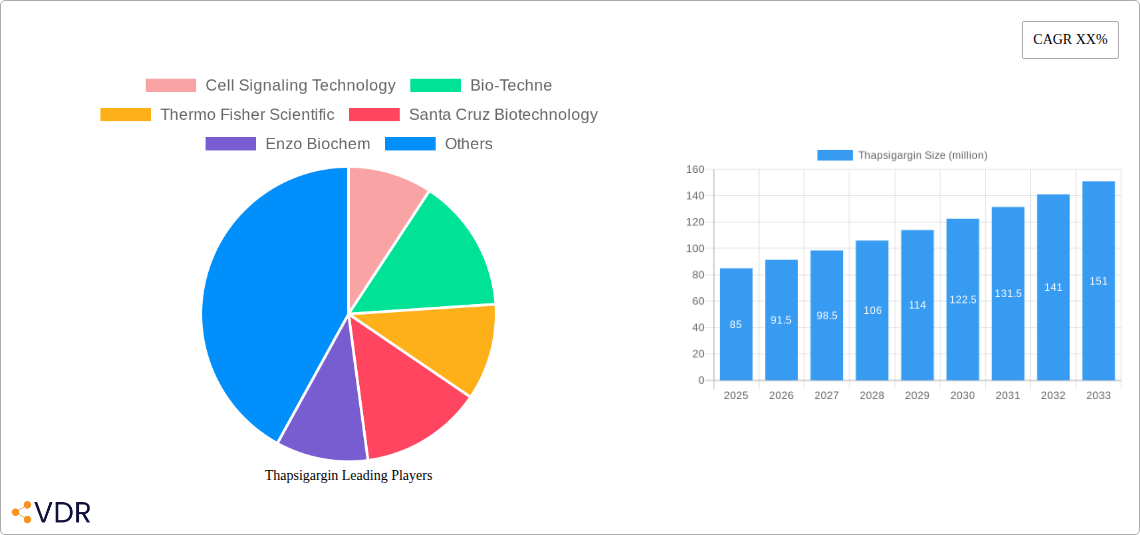
Thapsigargin Market Size (In Billion)

The increasing availability of high-purity Thapsigargin grades supports precise experimental outcomes and therapeutic applications. While research applications remain prevalent, emerging therapeutic uses in specific patient populations are a significant trend, necessitating stringent quality control and regulatory adherence. Advancements in chemical synthesis and an expanding network of specialized suppliers are addressing challenges related to complex synthesis and handling. North America and Europe currently lead the market due to mature research and pharmaceutical infrastructures, with the Asia Pacific region emerging as a key growth hub driven by rising R&D investments and a developing biotechnology sector.
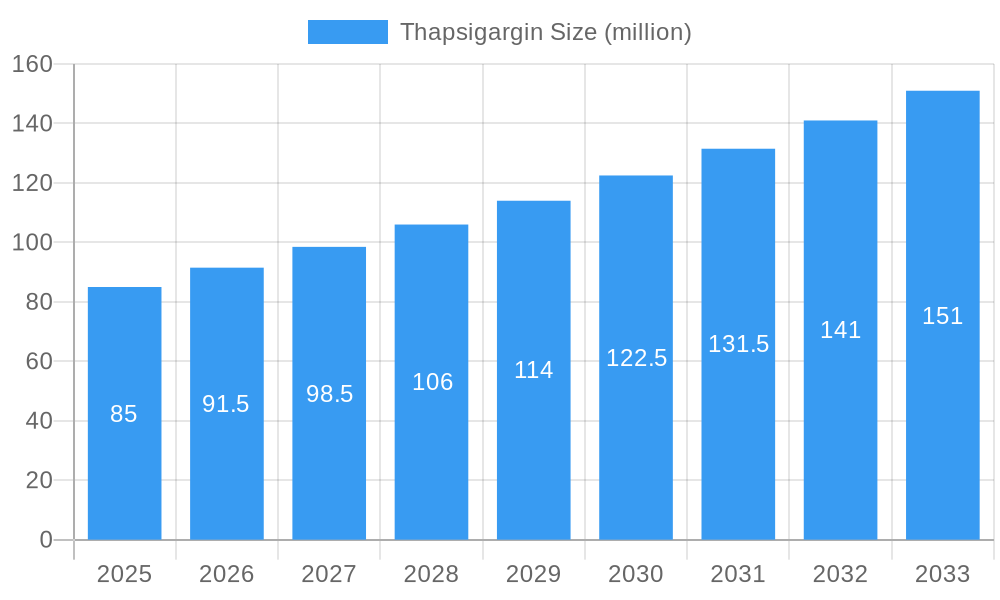
Thapsigargin Company Market Share
Thapsigargin Market Dynamics & Structure
The global Thapsigargin market is characterized by a moderately concentrated landscape, with key players like Thermo Fisher Scientific, Bio-Techne, and Cell Signaling Technology holding significant influence. Technological innovation in assay development and drug discovery continues to be a primary driver, fueled by advancements in understanding sarcoplasmic/endoplasmic reticulum calcium ATPases (SERCA) pumps and their therapeutic potential. Regulatory frameworks, primarily overseen by agencies like the FDA and EMA, focus on purity standards and efficacy for research and potential therapeutic applications. Competitive product substitutes, while limited in their direct mechanism of action, exist in the form of other SERCA inhibitors or calcium modulators used in research settings. End-user demographics predominantly consist of academic research institutions, pharmaceutical companies, and biotechnology firms engaged in cancer research, neuroscience, and cardiovascular studies. Merger and acquisition (M&A) trends are moderate, with strategic acquisitions aimed at expanding product portfolios or enhancing research capabilities. For instance, a recent trend indicates a focus on acquiring specialized SERCA inhibitor expertise.
- Market Concentration: Moderate, with a few key global players dominating.
- Technological Innovation: Driven by advancements in molecular biology, drug discovery platforms, and increased understanding of calcium signaling pathways.
- Regulatory Frameworks: Primarily focused on quality control, purity standards, and adherence to research ethics.
- Competitive Product Substitutes: Other calcium modulators and SERCA inhibitors used in specific research contexts.
- End-User Demographics: Academic researchers, pharmaceutical R&D departments, and biotechnology companies.
- M&A Trends: Strategic acquisitions for portfolio enhancement and R&D capability expansion.
Thapsigargin Growth Trends & Insights
The Thapsigargin market is poised for substantial growth, projected to evolve from $XX million units in the historical period (2019-2024) to an estimated $XX million units by the base year 2025, and is expected to witness a Compound Annual Growth Rate (CAGR) of XX% during the forecast period of 2025–2033. This robust expansion is underpinned by increasing investment in life sciences research and a growing appreciation for Thapsigargin's utility as a potent SERCA pump inhibitor in various biological investigations. The adoption rate of Thapsigargin in research laboratories globally is steadily increasing, driven by its critical role in cellular calcium homeostasis studies, particularly in understanding conditions like cancer, neurodegenerative diseases, and cardiovascular disorders. Technological disruptions, such as the development of more sensitive detection methods and advanced cell imaging techniques, are enhancing the application scope and precision of Thapsigargin research. Consumer behavior shifts reflect a growing demand for high-purity Thapsigargin products (98%-99% and >99%) for critical experimental outcomes. The market penetration of Thapsigargin in the broader pharmaceutical R&D sector is expanding, as more researchers recognize its value in screening compounds and elucidating disease mechanisms. Furthermore, the increasing prevalence of research into sarcoplasmic/endoplasmic reticulum calcium ATPase (SERCA) mediated diseases is creating new avenues for Thapsigargin’s application. The growing emphasis on precision medicine and targeted therapies further necessitates detailed understanding of cellular pathways, where Thapsigargin plays a pivotal role in unraveling calcium signaling complexities. The historical data indicates a consistent upward trajectory, with the market size growing from $XX million units in 2019 to $XX million units in 2024, setting a strong foundation for future growth. The estimated market size for 2025 stands at $XX million units, highlighting its current significance and immediate growth potential.
Dominant Regions, Countries, or Segments in Thapsigargin
The Research application segment is unequivocally the dominant force driving the Thapsigargin market, projected to continue its lead throughout the forecast period. This dominance stems from Thapsigargin's indispensable role as a research tool for dissecting cellular calcium signaling pathways, a fundamental aspect of biological investigation. Within this segment, high-purity Thapsigargin (Min Purity More Than 99%) is experiencing the highest demand, as researchers require meticulously characterized compounds to ensure the reliability and reproducibility of their experimental results. The United States emerges as the leading country, boasting a robust research infrastructure, significant investment in pharmaceutical R&D, and a high concentration of leading academic institutions and biotechnology companies. Key drivers for this regional dominance include substantial government funding for scientific research, a supportive ecosystem for innovation, and a strong pipeline of novel drug discovery initiatives. The Medical application segment, while currently smaller, shows promising growth potential as research translates into therapeutic insights.
- Dominant Segment (Application): Research
- Key Drivers: Essential tool for understanding cellular calcium homeostasis, cancer research, neurobiology, and cardiovascular studies.
- Market Share: Holds the largest share of the global Thapsigargin market.
- Growth Potential: Continuous demand from academic and industrial research labs.
- Dominant Segment (Type): Min Purity More Than 99%
- Key Drivers: Critical for experimental accuracy and reproducibility in sensitive research applications.
- Market Share: Significant and growing share due to the need for high-quality reagents.
- Growth Potential: Driven by advancements in analytical techniques and stringent research quality standards.
- Dominant Region: North America (specifically the United States)
- Key Drivers: High R&D expenditure, presence of leading pharmaceutical and biotech companies, strong academic research base.
- Market Share: Substantial global market share.
- Growth Potential: Continued innovation and investment in life sciences.
Thapsigargin Product Landscape
The Thapsigargin product landscape is characterized by the availability of various purity grades, catering to the stringent requirements of scientific research. Manufacturers are increasingly focusing on delivering high-purity Thapsigargin, with options exceeding 99%, to ensure maximum experimental accuracy. Innovations in purification techniques and analytical validation methods are enhancing the quality and reliability of these products. Thapsigargin's primary application remains as a research chemical, invaluable for studying SERCA pump inhibition, calcium signaling, and its implications in cellular processes and diseases. Unique selling propositions include its potent and specific mechanism of action, making it a benchmark compound in calcium research. Technological advancements are leading to improved formulation and stability of Thapsigargin products.
Key Drivers, Barriers & Challenges in Thapsigargin
Key Drivers:
- Increasing R&D Investment: Global surge in funding for life sciences, particularly in cancer, neuroscience, and cardiovascular research, fuels demand for Thapsigargin as a critical research tool.
- Advancements in Molecular Biology Techniques: Sophisticated cellular imaging and assay development platforms amplify the utility and necessity of precise molecular probes like Thapsigargin.
- Growing Understanding of Calcium Signaling: Research continues to uncover the intricate roles of calcium in various physiological and pathological processes, highlighting Thapsigargin's importance in elucidating these mechanisms.
Barriers & Challenges:
- Regulatory Scrutiny for Therapeutic Use: While primarily a research chemical, any progression towards therapeutic applications faces significant regulatory hurdles regarding safety and efficacy.
- High Cost of High-Purity Grades: The production of ultra-pure Thapsigargin involves complex purification processes, leading to higher costs that can limit accessibility for some research budgets.
- Availability of Specific Product Formulations: While generally available, specific formulations or bulk quantities might face occasional supply chain disruptions from niche manufacturers.
- Competition from Emerging Research Tools: While Thapsigargin has a well-established role, novel tools and techniques for studying calcium signaling could emerge, presenting indirect competition.
Emerging Opportunities in Thapsigargin
Emerging opportunities for Thapsigargin lie in its expanded use in pre-clinical drug discovery pipelines for rare diseases and neglected tropical diseases where calcium dysregulation plays a significant role. Further exploration of Thapsigargin analogs with modulated pharmacokinetic properties presents a niche but potentially lucrative area. The development of Thapsigargin-conjugated probes for targeted drug delivery or advanced diagnostic imaging represents another untapped frontier. Increased research into its role in autophagy and ER stress pathways is also expected to uncover new applications and drive demand.
Growth Accelerators in the Thapsigargin Industry
The Thapsigargin industry is significantly propelled by strategic collaborations between research institutions and chemical suppliers, leading to enhanced product development and wider accessibility. Technological breakthroughs in biochemical assay development and high-throughput screening platforms are creating new demand by enabling more efficient utilization of Thapsigargin in drug discovery. Furthermore, market expansion initiatives by key players into emerging economies with growing research sectors are acting as significant growth accelerators, broadening the geographical reach and customer base. The increasing focus on personalized medicine also indirectly fuels the need for foundational research tools like Thapsigargin to understand disease mechanisms at a cellular level.
Key Players Shaping the Thapsigargin Market
- Cell Signaling Technology
- Bio-Techne
- Thermo Fisher Scientific
- Santa Cruz Biotechnology
- Enzo Biochem
- AG Scientific
- Cayman Chemical
- Merck
- Hello Bio
- Selleck Chemicals
- Abcam
- Focus Biomolecules
- PromoCell
- Aladdin
- Beyotime
Notable Milestones in Thapsigargin Sector
- 2019: Increased academic publications detailing Thapsigargin's role in ER stress-related diseases.
- 2020: Development of novel assay kits incorporating Thapsigargin for enhanced cellular calcium imaging.
- 2021: Key suppliers expand their product lines to include higher purity grades (>99%) of Thapsigargin.
- 2022: Emerging research on Thapsigargin's potential in modulating immune responses.
- 2023: Increased partnerships between research institutions and chemical suppliers for custom Thapsigargin synthesis.
- 2024: Growing interest in Thapsigargin's application in studying rare genetic disorders involving calcium homeostasis.
In-Depth Thapsigargin Market Outlook
The future of the Thapsigargin market is exceptionally promising, driven by ongoing advancements in molecular biology and a persistent need for high-quality research reagents. The continuous evolution of research methodologies, particularly in genomics, proteomics, and advanced cellular imaging, will further solidify Thapsigargin's indispensable role. Strategic partnerships and collaborations between chemical manufacturers and leading research institutions are expected to foster innovation and ensure a steady supply of superior-grade products. Market expansion into burgeoning research hubs globally presents a significant avenue for growth. Ultimately, the Thapsigargin market is set to benefit from its fundamental importance in unraveling complex biological pathways, paving the way for novel therapeutic discoveries.
Thapsigargin Segmentation
-
1. Application
- 1.1. Research
- 1.2. Medical
-
2. Types
- 2.1. Min Purity Less Than 98%
- 2.2. Min Purity 98%-99%
- 2.3. Min Purity More Than 99%
Thapsigargin Segmentation By Geography
-
1. North America
- 1.1. United States
- 1.2. Canada
- 1.3. Mexico
-
2. South America
- 2.1. Brazil
- 2.2. Argentina
- 2.3. Rest of South America
-
3. Europe
- 3.1. United Kingdom
- 3.2. Germany
- 3.3. France
- 3.4. Italy
- 3.5. Spain
- 3.6. Russia
- 3.7. Benelux
- 3.8. Nordics
- 3.9. Rest of Europe
-
4. Middle East & Africa
- 4.1. Turkey
- 4.2. Israel
- 4.3. GCC
- 4.4. North Africa
- 4.5. South Africa
- 4.6. Rest of Middle East & Africa
-
5. Asia Pacific
- 5.1. China
- 5.2. India
- 5.3. Japan
- 5.4. South Korea
- 5.5. ASEAN
- 5.6. Oceania
- 5.7. Rest of Asia Pacific
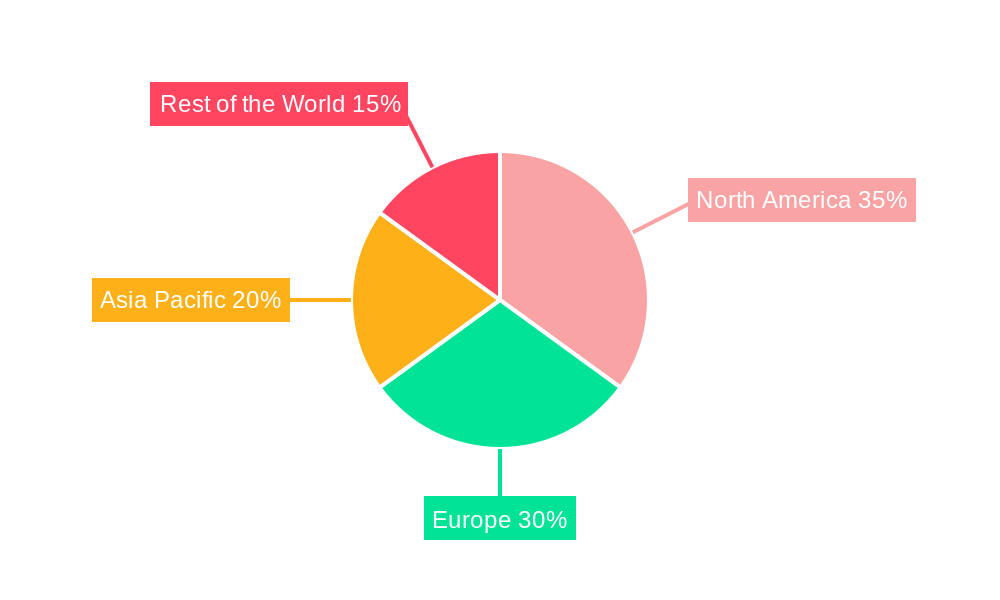
Thapsigargin Regional Market Share
Geographic Coverage of Thapsigargin
Thapsigargin REPORT HIGHLIGHTS
| Aspects | Details |
|---|---|
| Study Period | 2020-2034 |
| Base Year | 2025 |
| Estimated Year | 2026 |
| Forecast Period | 2026-2034 |
| Historical Period | 2020-2025 |
| Growth Rate | CAGR of 13.83% from 2020-2034 |
| Segmentation |
|
Table of Contents
- 1. Introduction
- 1.1. Research Scope
- 1.2. Market Segmentation
- 1.3. Research Methodology
- 1.4. Definitions and Assumptions
- 2. Executive Summary
- 2.1. Introduction
- 3. Market Dynamics
- 3.1. Introduction
- 3.2. Market Drivers
- 3.3. Market Restrains
- 3.4. Market Trends
- 4. Market Factor Analysis
- 4.1. Porters Five Forces
- 4.2. Supply/Value Chain
- 4.3. PESTEL analysis
- 4.4. Market Entropy
- 4.5. Patent/Trademark Analysis
- 5. Global Thapsigargin Analysis, Insights and Forecast, 2020-2032
- 5.1. Market Analysis, Insights and Forecast - by Application
- 5.1.1. Research
- 5.1.2. Medical
- 5.2. Market Analysis, Insights and Forecast - by Types
- 5.2.1. Min Purity Less Than 98%
- 5.2.2. Min Purity 98%-99%
- 5.2.3. Min Purity More Than 99%
- 5.3. Market Analysis, Insights and Forecast - by Region
- 5.3.1. North America
- 5.3.2. South America
- 5.3.3. Europe
- 5.3.4. Middle East & Africa
- 5.3.5. Asia Pacific
- 5.1. Market Analysis, Insights and Forecast - by Application
- 6. North America Thapsigargin Analysis, Insights and Forecast, 2020-2032
- 6.1. Market Analysis, Insights and Forecast - by Application
- 6.1.1. Research
- 6.1.2. Medical
- 6.2. Market Analysis, Insights and Forecast - by Types
- 6.2.1. Min Purity Less Than 98%
- 6.2.2. Min Purity 98%-99%
- 6.2.3. Min Purity More Than 99%
- 6.1. Market Analysis, Insights and Forecast - by Application
- 7. South America Thapsigargin Analysis, Insights and Forecast, 2020-2032
- 7.1. Market Analysis, Insights and Forecast - by Application
- 7.1.1. Research
- 7.1.2. Medical
- 7.2. Market Analysis, Insights and Forecast - by Types
- 7.2.1. Min Purity Less Than 98%
- 7.2.2. Min Purity 98%-99%
- 7.2.3. Min Purity More Than 99%
- 7.1. Market Analysis, Insights and Forecast - by Application
- 8. Europe Thapsigargin Analysis, Insights and Forecast, 2020-2032
- 8.1. Market Analysis, Insights and Forecast - by Application
- 8.1.1. Research
- 8.1.2. Medical
- 8.2. Market Analysis, Insights and Forecast - by Types
- 8.2.1. Min Purity Less Than 98%
- 8.2.2. Min Purity 98%-99%
- 8.2.3. Min Purity More Than 99%
- 8.1. Market Analysis, Insights and Forecast - by Application
- 9. Middle East & Africa Thapsigargin Analysis, Insights and Forecast, 2020-2032
- 9.1. Market Analysis, Insights and Forecast - by Application
- 9.1.1. Research
- 9.1.2. Medical
- 9.2. Market Analysis, Insights and Forecast - by Types
- 9.2.1. Min Purity Less Than 98%
- 9.2.2. Min Purity 98%-99%
- 9.2.3. Min Purity More Than 99%
- 9.1. Market Analysis, Insights and Forecast - by Application
- 10. Asia Pacific Thapsigargin Analysis, Insights and Forecast, 2020-2032
- 10.1. Market Analysis, Insights and Forecast - by Application
- 10.1.1. Research
- 10.1.2. Medical
- 10.2. Market Analysis, Insights and Forecast - by Types
- 10.2.1. Min Purity Less Than 98%
- 10.2.2. Min Purity 98%-99%
- 10.2.3. Min Purity More Than 99%
- 10.1. Market Analysis, Insights and Forecast - by Application
- 11. Competitive Analysis
- 11.1. Global Market Share Analysis 2025
- 11.2. Company Profiles
- 11.2.1 Cell Signaling Technology
- 11.2.1.1. Overview
- 11.2.1.2. Products
- 11.2.1.3. SWOT Analysis
- 11.2.1.4. Recent Developments
- 11.2.1.5. Financials (Based on Availability)
- 11.2.2 Bio-Techne
- 11.2.2.1. Overview
- 11.2.2.2. Products
- 11.2.2.3. SWOT Analysis
- 11.2.2.4. Recent Developments
- 11.2.2.5. Financials (Based on Availability)
- 11.2.3 Thermo Fisher Scientific
- 11.2.3.1. Overview
- 11.2.3.2. Products
- 11.2.3.3. SWOT Analysis
- 11.2.3.4. Recent Developments
- 11.2.3.5. Financials (Based on Availability)
- 11.2.4 Santa Cruz Biotechnology
- 11.2.4.1. Overview
- 11.2.4.2. Products
- 11.2.4.3. SWOT Analysis
- 11.2.4.4. Recent Developments
- 11.2.4.5. Financials (Based on Availability)
- 11.2.5 Enzo Biochem
- 11.2.5.1. Overview
- 11.2.5.2. Products
- 11.2.5.3. SWOT Analysis
- 11.2.5.4. Recent Developments
- 11.2.5.5. Financials (Based on Availability)
- 11.2.6 AG Scientific
- 11.2.6.1. Overview
- 11.2.6.2. Products
- 11.2.6.3. SWOT Analysis
- 11.2.6.4. Recent Developments
- 11.2.6.5. Financials (Based on Availability)
- 11.2.7 Cayman Chemical
- 11.2.7.1. Overview
- 11.2.7.2. Products
- 11.2.7.3. SWOT Analysis
- 11.2.7.4. Recent Developments
- 11.2.7.5. Financials (Based on Availability)
- 11.2.8 Merck
- 11.2.8.1. Overview
- 11.2.8.2. Products
- 11.2.8.3. SWOT Analysis
- 11.2.8.4. Recent Developments
- 11.2.8.5. Financials (Based on Availability)
- 11.2.9 Hello Bio
- 11.2.9.1. Overview
- 11.2.9.2. Products
- 11.2.9.3. SWOT Analysis
- 11.2.9.4. Recent Developments
- 11.2.9.5. Financials (Based on Availability)
- 11.2.10 Selleck Chemicals
- 11.2.10.1. Overview
- 11.2.10.2. Products
- 11.2.10.3. SWOT Analysis
- 11.2.10.4. Recent Developments
- 11.2.10.5. Financials (Based on Availability)
- 11.2.11 Abcam
- 11.2.11.1. Overview
- 11.2.11.2. Products
- 11.2.11.3. SWOT Analysis
- 11.2.11.4. Recent Developments
- 11.2.11.5. Financials (Based on Availability)
- 11.2.12 Focus Biomolecules
- 11.2.12.1. Overview
- 11.2.12.2. Products
- 11.2.12.3. SWOT Analysis
- 11.2.12.4. Recent Developments
- 11.2.12.5. Financials (Based on Availability)
- 11.2.13 PromoCell
- 11.2.13.1. Overview
- 11.2.13.2. Products
- 11.2.13.3. SWOT Analysis
- 11.2.13.4. Recent Developments
- 11.2.13.5. Financials (Based on Availability)
- 11.2.14 Aladdin
- 11.2.14.1. Overview
- 11.2.14.2. Products
- 11.2.14.3. SWOT Analysis
- 11.2.14.4. Recent Developments
- 11.2.14.5. Financials (Based on Availability)
- 11.2.15 Beyotime
- 11.2.15.1. Overview
- 11.2.15.2. Products
- 11.2.15.3. SWOT Analysis
- 11.2.15.4. Recent Developments
- 11.2.15.5. Financials (Based on Availability)
- 11.2.1 Cell Signaling Technology
List of Figures
- Figure 1: Global Thapsigargin Revenue Breakdown (billion, %) by Region 2025 & 2033
- Figure 2: North America Thapsigargin Revenue (billion), by Application 2025 & 2033
- Figure 3: North America Thapsigargin Revenue Share (%), by Application 2025 & 2033
- Figure 4: North America Thapsigargin Revenue (billion), by Types 2025 & 2033
- Figure 5: North America Thapsigargin Revenue Share (%), by Types 2025 & 2033
- Figure 6: North America Thapsigargin Revenue (billion), by Country 2025 & 2033
- Figure 7: North America Thapsigargin Revenue Share (%), by Country 2025 & 2033
- Figure 8: South America Thapsigargin Revenue (billion), by Application 2025 & 2033
- Figure 9: South America Thapsigargin Revenue Share (%), by Application 2025 & 2033
- Figure 10: South America Thapsigargin Revenue (billion), by Types 2025 & 2033
- Figure 11: South America Thapsigargin Revenue Share (%), by Types 2025 & 2033
- Figure 12: South America Thapsigargin Revenue (billion), by Country 2025 & 2033
- Figure 13: South America Thapsigargin Revenue Share (%), by Country 2025 & 2033
- Figure 14: Europe Thapsigargin Revenue (billion), by Application 2025 & 2033
- Figure 15: Europe Thapsigargin Revenue Share (%), by Application 2025 & 2033
- Figure 16: Europe Thapsigargin Revenue (billion), by Types 2025 & 2033
- Figure 17: Europe Thapsigargin Revenue Share (%), by Types 2025 & 2033
- Figure 18: Europe Thapsigargin Revenue (billion), by Country 2025 & 2033
- Figure 19: Europe Thapsigargin Revenue Share (%), by Country 2025 & 2033
- Figure 20: Middle East & Africa Thapsigargin Revenue (billion), by Application 2025 & 2033
- Figure 21: Middle East & Africa Thapsigargin Revenue Share (%), by Application 2025 & 2033
- Figure 22: Middle East & Africa Thapsigargin Revenue (billion), by Types 2025 & 2033
- Figure 23: Middle East & Africa Thapsigargin Revenue Share (%), by Types 2025 & 2033
- Figure 24: Middle East & Africa Thapsigargin Revenue (billion), by Country 2025 & 2033
- Figure 25: Middle East & Africa Thapsigargin Revenue Share (%), by Country 2025 & 2033
- Figure 26: Asia Pacific Thapsigargin Revenue (billion), by Application 2025 & 2033
- Figure 27: Asia Pacific Thapsigargin Revenue Share (%), by Application 2025 & 2033
- Figure 28: Asia Pacific Thapsigargin Revenue (billion), by Types 2025 & 2033
- Figure 29: Asia Pacific Thapsigargin Revenue Share (%), by Types 2025 & 2033
- Figure 30: Asia Pacific Thapsigargin Revenue (billion), by Country 2025 & 2033
- Figure 31: Asia Pacific Thapsigargin Revenue Share (%), by Country 2025 & 2033
List of Tables
- Table 1: Global Thapsigargin Revenue billion Forecast, by Application 2020 & 2033
- Table 2: Global Thapsigargin Revenue billion Forecast, by Types 2020 & 2033
- Table 3: Global Thapsigargin Revenue billion Forecast, by Region 2020 & 2033
- Table 4: Global Thapsigargin Revenue billion Forecast, by Application 2020 & 2033
- Table 5: Global Thapsigargin Revenue billion Forecast, by Types 2020 & 2033
- Table 6: Global Thapsigargin Revenue billion Forecast, by Country 2020 & 2033
- Table 7: United States Thapsigargin Revenue (billion) Forecast, by Application 2020 & 2033
- Table 8: Canada Thapsigargin Revenue (billion) Forecast, by Application 2020 & 2033
- Table 9: Mexico Thapsigargin Revenue (billion) Forecast, by Application 2020 & 2033
- Table 10: Global Thapsigargin Revenue billion Forecast, by Application 2020 & 2033
- Table 11: Global Thapsigargin Revenue billion Forecast, by Types 2020 & 2033
- Table 12: Global Thapsigargin Revenue billion Forecast, by Country 2020 & 2033
- Table 13: Brazil Thapsigargin Revenue (billion) Forecast, by Application 2020 & 2033
- Table 14: Argentina Thapsigargin Revenue (billion) Forecast, by Application 2020 & 2033
- Table 15: Rest of South America Thapsigargin Revenue (billion) Forecast, by Application 2020 & 2033
- Table 16: Global Thapsigargin Revenue billion Forecast, by Application 2020 & 2033
- Table 17: Global Thapsigargin Revenue billion Forecast, by Types 2020 & 2033
- Table 18: Global Thapsigargin Revenue billion Forecast, by Country 2020 & 2033
- Table 19: United Kingdom Thapsigargin Revenue (billion) Forecast, by Application 2020 & 2033
- Table 20: Germany Thapsigargin Revenue (billion) Forecast, by Application 2020 & 2033
- Table 21: France Thapsigargin Revenue (billion) Forecast, by Application 2020 & 2033
- Table 22: Italy Thapsigargin Revenue (billion) Forecast, by Application 2020 & 2033
- Table 23: Spain Thapsigargin Revenue (billion) Forecast, by Application 2020 & 2033
- Table 24: Russia Thapsigargin Revenue (billion) Forecast, by Application 2020 & 2033
- Table 25: Benelux Thapsigargin Revenue (billion) Forecast, by Application 2020 & 2033
- Table 26: Nordics Thapsigargin Revenue (billion) Forecast, by Application 2020 & 2033
- Table 27: Rest of Europe Thapsigargin Revenue (billion) Forecast, by Application 2020 & 2033
- Table 28: Global Thapsigargin Revenue billion Forecast, by Application 2020 & 2033
- Table 29: Global Thapsigargin Revenue billion Forecast, by Types 2020 & 2033
- Table 30: Global Thapsigargin Revenue billion Forecast, by Country 2020 & 2033
- Table 31: Turkey Thapsigargin Revenue (billion) Forecast, by Application 2020 & 2033
- Table 32: Israel Thapsigargin Revenue (billion) Forecast, by Application 2020 & 2033
- Table 33: GCC Thapsigargin Revenue (billion) Forecast, by Application 2020 & 2033
- Table 34: North Africa Thapsigargin Revenue (billion) Forecast, by Application 2020 & 2033
- Table 35: South Africa Thapsigargin Revenue (billion) Forecast, by Application 2020 & 2033
- Table 36: Rest of Middle East & Africa Thapsigargin Revenue (billion) Forecast, by Application 2020 & 2033
- Table 37: Global Thapsigargin Revenue billion Forecast, by Application 2020 & 2033
- Table 38: Global Thapsigargin Revenue billion Forecast, by Types 2020 & 2033
- Table 39: Global Thapsigargin Revenue billion Forecast, by Country 2020 & 2033
- Table 40: China Thapsigargin Revenue (billion) Forecast, by Application 2020 & 2033
- Table 41: India Thapsigargin Revenue (billion) Forecast, by Application 2020 & 2033
- Table 42: Japan Thapsigargin Revenue (billion) Forecast, by Application 2020 & 2033
- Table 43: South Korea Thapsigargin Revenue (billion) Forecast, by Application 2020 & 2033
- Table 44: ASEAN Thapsigargin Revenue (billion) Forecast, by Application 2020 & 2033
- Table 45: Oceania Thapsigargin Revenue (billion) Forecast, by Application 2020 & 2033
- Table 46: Rest of Asia Pacific Thapsigargin Revenue (billion) Forecast, by Application 2020 & 2033
Frequently Asked Questions
1. What is the projected Compound Annual Growth Rate (CAGR) of the Thapsigargin?
The projected CAGR is approximately 13.83%.
2. Which companies are prominent players in the Thapsigargin?
Key companies in the market include Cell Signaling Technology, Bio-Techne, Thermo Fisher Scientific, Santa Cruz Biotechnology, Enzo Biochem, AG Scientific, Cayman Chemical, Merck, Hello Bio, Selleck Chemicals, Abcam, Focus Biomolecules, PromoCell, Aladdin, Beyotime.
3. What are the main segments of the Thapsigargin?
The market segments include Application, Types.
4. Can you provide details about the market size?
The market size is estimated to be USD 9.67 billion as of 2022.
5. What are some drivers contributing to market growth?
N/A
6. What are the notable trends driving market growth?
N/A
7. Are there any restraints impacting market growth?
N/A
8. Can you provide examples of recent developments in the market?
N/A
9. What pricing options are available for accessing the report?
Pricing options include single-user, multi-user, and enterprise licenses priced at USD 4900.00, USD 7350.00, and USD 9800.00 respectively.
10. Is the market size provided in terms of value or volume?
The market size is provided in terms of value, measured in billion.
11. Are there any specific market keywords associated with the report?
Yes, the market keyword associated with the report is "Thapsigargin," which aids in identifying and referencing the specific market segment covered.
12. How do I determine which pricing option suits my needs best?
The pricing options vary based on user requirements and access needs. Individual users may opt for single-user licenses, while businesses requiring broader access may choose multi-user or enterprise licenses for cost-effective access to the report.
13. Are there any additional resources or data provided in the Thapsigargin report?
While the report offers comprehensive insights, it's advisable to review the specific contents or supplementary materials provided to ascertain if additional resources or data are available.
14. How can I stay updated on further developments or reports in the Thapsigargin?
To stay informed about further developments, trends, and reports in the Thapsigargin, consider subscribing to industry newsletters, following relevant companies and organizations, or regularly checking reputable industry news sources and publications.
Methodology
Step 1 - Identification of Relevant Samples Size from Population Database



Step 2 - Approaches for Defining Global Market Size (Value, Volume* & Price*)

Note*: In applicable scenarios
Step 3 - Data Sources
Primary Research
- Web Analytics
- Survey Reports
- Research Institute
- Latest Research Reports
- Opinion Leaders
Secondary Research
- Annual Reports
- White Paper
- Latest Press Release
- Industry Association
- Paid Database
- Investor Presentations

Step 4 - Data Triangulation
Involves using different sources of information in order to increase the validity of a study
These sources are likely to be stakeholders in a program - participants, other researchers, program staff, other community members, and so on.
Then we put all data in single framework & apply various statistical tools to find out the dynamic on the market.
During the analysis stage, feedback from the stakeholder groups would be compared to determine areas of agreement as well as areas of divergence