


Key Insights
The global Fiber To The X market is poised for substantial growth, driven by the ever-increasing demand for high-speed, reliable internet connectivity across residential, commercial, and industrial sectors. With an estimated market size of USD 120 billion in 2025, projected to reach USD 200 billion by 2033, the market is experiencing a Compound Annual Growth Rate (CAGR) of approximately 6.5%. This robust expansion is fueled by critical drivers such as the proliferation of 5G networks, the burgeoning Internet of Things (IoT) ecosystem, the rise of cloud computing, and the escalating need for enhanced bandwidth to support video streaming, online gaming, and remote work. The increasing government initiatives and investments in broadband infrastructure development, particularly in emerging economies, further bolster market penetration and adoption rates.
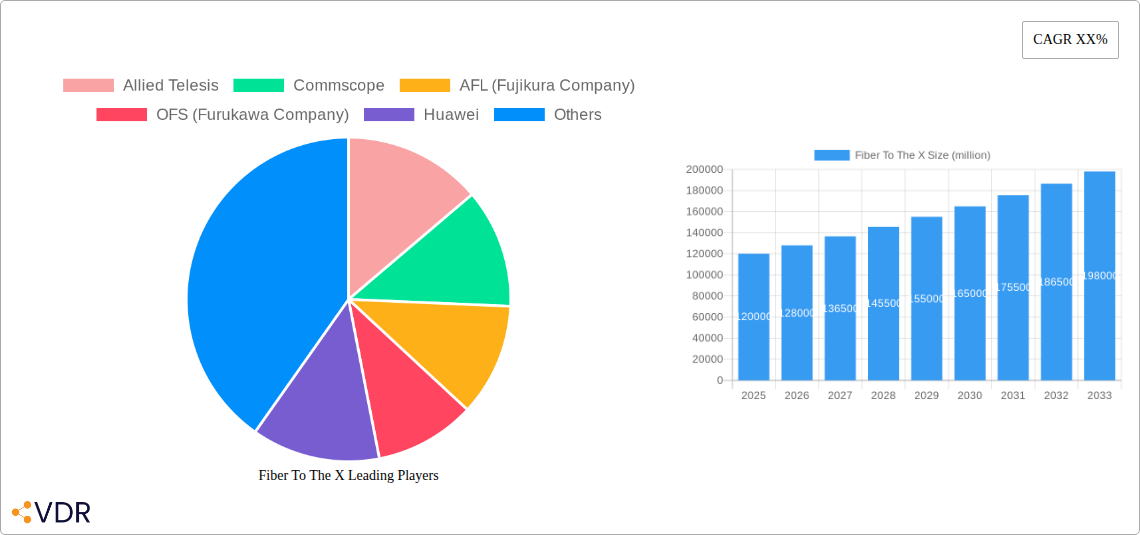
Fiber To The X Market Size (In Billion)

The market landscape is characterized by key trends including the growing adoption of Fiber to the Home/Premises/Building (FTTH/P/B) for superior last-mile connectivity, offering unparalleled speeds and lower latency compared to traditional copper networks. Advancements in fiber optic technology, leading to improved performance and cost-effectiveness, are also playing a pivotal role. However, significant restraints remain, primarily the high initial deployment costs associated with laying fiber optic cables and the availability of skilled labor for installation and maintenance. Regulatory hurdles and the existence of legacy infrastructure in certain regions also present challenges. Despite these obstacles, the continuous innovation in fiber optic technology and strategic partnerships among key players, including prominent companies like Huawei, Corning, and ZTE, are expected to drive market evolution and overcome these limitations, paving the way for widespread fiber optic network deployment globally.
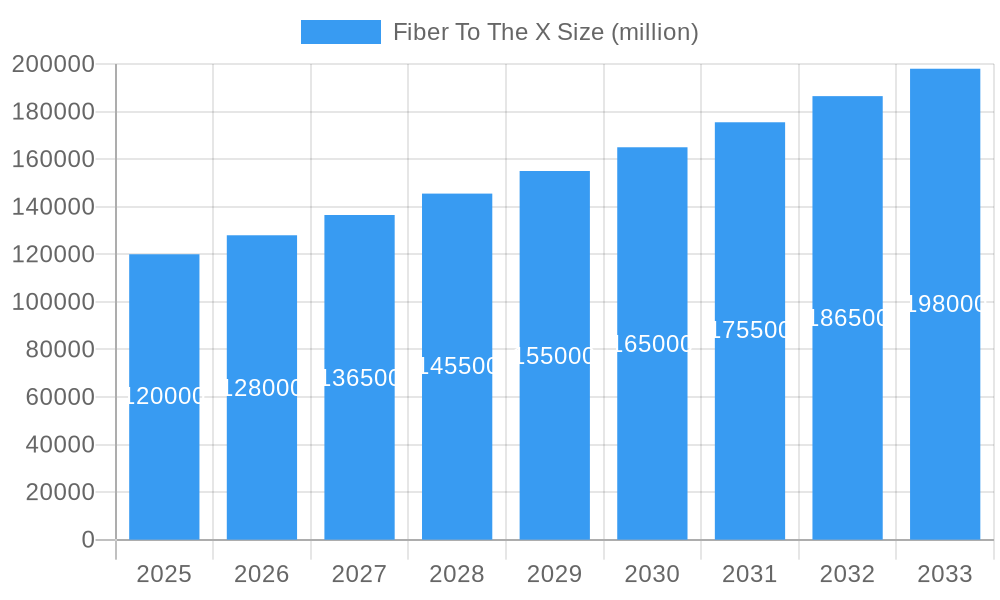
Fiber To The X Company Market Share
Fiber To The X Market: Comprehensive Growth Analysis & Future Outlook (2019–2033)
This in-depth report offers a critical analysis of the global Fiber To The X (FTTx) market, encompassing Fiber to the Home (FTTH), Fiber to the Premises (FTTP), Fiber to the Building (FTTB), Fiber to the Node (FTTN), Fiber to the Curb (FTTC), and Fiber to the Antenna (FTTa) segments. Spanning a study period from 2019 to 2033, with a base and estimated year of 2025, this report provides unparalleled insights into market dynamics, growth trends, regional dominance, product innovations, and key player strategies. With a forecast period from 2025 to 2033, it is an indispensable resource for industry professionals seeking to capitalize on the rapidly expanding fiber optic network deployment and broadband connectivity evolution. The report quantifies market size in millions of units, offering precise data for strategic decision-making.
Fiber To The X Market Dynamics & Structure
The global Fiber To The X market exhibits a moderate to high degree of concentration, with key players like Corning, Huawei, ZTE, and Commscope holding significant market shares. Technological innovation is the primary driver, fueled by the relentless demand for higher bandwidth, lower latency, and enhanced network reliability for applications ranging from immersive gaming and 4K streaming to industrial automation and the Internet of Things (IoT). Regulatory frameworks, particularly government initiatives promoting digital infrastructure and broadband expansion, play a crucial role in shaping market entry and deployment strategies. Competitive product substitutes, such as advanced coaxial cable technologies, are present but increasingly outpaced by the superior performance of fiber optics. End-user demographics are shifting towards a greater reliance on digital services, with a significant portion of residential and commercial users demanding high-speed internet. Mergers and acquisitions (M&A) activity, estimated at over $5,000 million in deal volumes during the historical period, continues to consolidate the market and foster innovation. Key M&A trends include acquisitions of smaller, specialized fiber optic component manufacturers by larger telecommunication infrastructure providers and the integration of network service companies to offer end-to-end solutions. The increasing adoption of FTTx in developing regions, supported by government subsidies and partnerships with private entities, signifies a growing global reach.
Fiber To The X Growth Trends & Insights
The Fiber To The X market is poised for exceptional growth, projected to expand from an estimated $75,000 million in 2025 to over $130,000 million by 2033, exhibiting a robust Compound Annual Growth Rate (CAGR) of approximately 7.5% during the forecast period. This expansion is primarily driven by the insatiable demand for high-speed broadband internet services, propelled by the proliferation of data-intensive applications, the rise of remote work and education, and the exponential growth of connected devices in the smart home and smart city ecosystems. Adoption rates for fiber optic connectivity are accelerating globally, particularly in developed economies, where network upgrades to support 5G mobile services and increasing residential broadband speeds are paramount. Emerging markets are also witnessing significant traction as governments prioritize the development of digital infrastructure to bridge the digital divide.
Technological disruptions are a constant theme, with advancements in fiber optic cable manufacturing, PON (Passive Optical Network) technologies, and optical network terminals (ONTs) continuously improving performance and reducing deployment costs. These innovations are crucial for extending fiber deeper into networks, enabling seamless FTTx deployments across diverse environments. Consumer behavior shifts are also a major catalyst; users are increasingly migrating away from slower legacy technologies towards the superior speed, reliability, and lower latency offered by fiber optics. This trend is further amplified by the growing adoption of cloud computing, virtual reality (VR), augmented reality (AR), and online gaming, all of which demand robust and high-capacity network infrastructure.
The parent market, encompassing the broader telecommunications infrastructure, is benefiting immensely from the FTTx surge. Within this, child markets like residential fiber deployments are leading the charge, followed closely by commercial and industrial applications. The increasing penetration of fiber in these segments, from individual homes to large enterprise networks, underscores its critical role in powering the digital economy. Specific metrics such as a projected market penetration of over 60% in developed residential markets by 2030 highlight the scale of this ongoing transition. The sustained investment in telecom infrastructure and the ongoing digital transformation across industries are expected to maintain this upward trajectory.
Dominant Regions, Countries, or Segments in Fiber To The X
The Fiber To The X market is currently experiencing its most significant growth and dominance within the Residential segment, particularly through Fiber to the Home/Premises/Building (FTTh/p/b) deployments. This segment is the primary engine driving global market expansion, propelled by escalating consumer demand for high-speed, reliable internet access to support a multitude of data-intensive applications. The increasing adoption of streaming services, online gaming, remote work, and advanced smart home technologies necessitates the superior bandwidth and low latency that fiber optics provide. The growth in this segment is further bolstered by government initiatives worldwide aimed at achieving universal broadband coverage and bridging the digital divide.
Several regions and countries are at the forefront of this FTTx revolution. Asia-Pacific, led by countries such as China and South Korea, has historically been a dominant force due to substantial government investment in fiber optic network infrastructure and a large, tech-savvy population. China Telecom Corporation Limited and Nippon Telegram and Telephone are key players in this region. North America, with major providers like AT&T and Verizon, is also witnessing rapid FTTH deployment driven by network upgrades and competition. In Europe, countries like Germany and the UK are making significant strides, with companies such as Vodafone Group and Altice investing heavily in fiber expansion.
The dominance of the Residential segment is underscored by substantial market share, estimated to account for over 65% of the total FTTx market in 2025. The growth potential in this segment remains exceptionally high as many regions still have significant room for fiber penetration. Key drivers include favorable economic policies promoting digital infrastructure development, subsidies for network deployment in underserved areas, and aggressive competition among telecom operators to attract and retain subscribers with premium internet packages. The continuous innovation in home networking equipment and the increasing affordability of fiber optic services further accelerate this trend. While Commercial and Industrial applications are also growing, and FTTa is gaining traction with the rollout of 5G, the sheer volume of residential connections solidifies the Residential segment's leading position in the current FTTx landscape.
Fiber To The X Product Landscape
The Fiber To The X product landscape is characterized by continuous innovation in components and systems designed for enhanced performance and cost-effectiveness. Key product categories include fiber optic cables (e.g., single-mode and multi-mode fibers), optical transceivers, Optical Network Terminals (ONTs), Optical Line Terminals (OLTs), and passive optical splitters. Innovations are focused on increasing data transmission speeds, reducing signal loss over longer distances, and simplifying installation processes. For instance, advancements in bend-insensitive fiber technology and high-density cabling solutions are crucial for efficient deployment in challenging urban environments and crowded buildings. Unique selling propositions revolve around ultra-high bandwidth capabilities (e.g., 10 Gbps and beyond), low latency for real-time applications, and robust reliability for mission-critical services. Technological advancements in areas like coherent optics and next-generation PON standards are pushing the boundaries of what is possible in fiber optic networks.
Key Drivers, Barriers & Challenges in Fiber To The X
Key Drivers:
- Surging Demand for High-Speed Broadband: The exponential growth in data consumption driven by video streaming, online gaming, remote work, and IoT applications is the primary driver.
- Government Initiatives & Subsidies: Many governments are actively promoting digital infrastructure development through favorable policies and financial incentives, accelerating FTTx deployment.
- Technological Advancements: Ongoing improvements in fiber optic technology, including higher bandwidth capabilities and reduced deployment costs, make FTTx increasingly attractive.
- 5G Network Rollout: The deployment of 5G mobile networks requires substantial fiber backhaul, driving FTTx expansion to support densified cell sites.
- Competitive Landscape: Intense competition among telecom operators to offer superior internet services incentivizes them to invest in fiber infrastructure.
Barriers & Challenges:
- High Initial Deployment Costs: The capital expenditure required for extensive fiber optic network deployment, including trenching and installation, remains a significant barrier.
- Regulatory Hurdles & Permitting Delays: Navigating complex permitting processes and securing rights-of-way can lead to project delays and increased costs.
- Skilled Workforce Shortage: A lack of trained technicians and engineers for fiber optic installation and maintenance can impede rapid deployment.
- Supply Chain Disruptions: Global supply chain issues for critical components can impact the availability and cost of FTTx deployment materials, with an estimated impact of over $1,000 million in increased costs during peak disruptions.
- Competition from Advanced Copper Technologies: While FTTx offers superior performance, advanced copper-based solutions still pose a competitive threat in certain price-sensitive markets.
Emerging Opportunities in Fiber To The X
Emerging opportunities in the Fiber To The X sector lie in the expansion of fiber networks into previously underserved rural areas, bridging the digital divide and unlocking new market potential. The growing adoption of industrial IoT (IIoT) and Industry 4.0 applications in manufacturing and logistics presents a significant avenue for FTTx deployment, requiring robust and low-latency connectivity. The increasing demand for advanced telepresence and virtual reality experiences in education, healthcare, and entertainment also offers substantial growth prospects. Furthermore, the development of smart city infrastructure, including connected transportation, public safety systems, and environmental monitoring, will heavily rely on extensive FTTx networks. The continuous evolution of PON technologies towards higher speeds and lower latency creates opportunities for service providers to offer premium, differentiated connectivity solutions.
Growth Accelerators in the Fiber To The X Industry
Several key catalysts are accelerating long-term growth in the Fiber To The X industry. Foremost among these is the relentless global push for digital transformation across all sectors, which necessitates robust and high-capacity connectivity. Strategic partnerships between telecom operators, infrastructure providers like AFL (Fujikura Company) and OFS (Furukawa Company), and technology giants are crucial for streamlining deployment and fostering innovation. Market expansion strategies, including aggressive build-outs in developing economies and the adoption of new deployment techniques like micro-trenching, are also significant growth accelerators. The increasing integration of fiber optic networks with other emerging technologies, such as edge computing and advanced analytics, further amplifies their value proposition and drives demand. The proactive approach by companies like Verizon and AT&T in expanding their fiber footprints is a testament to this accelerating growth.
Key Players Shaping the Fiber To The X Market
- Allied Telesis
- Commscope
- AFL (Fujikura Company)
- OFS (Furukawa Company)
- Huawei
- Shanghai Sun Telecommunication
- ZTT
- Fiber Optic Telecom
- ZTE
- Alfocom Technology
- Verizon
- Bharat Sanchar Nigam Limited (BSNL)
- AT&T
- China Telecom Corporation Limited
- Vodafone Group
- Mtn Group
- Telkom
- Altice
- America Movil
- Nippon Telegram and Telephone
- Corning
- Himachal Futuristic Communications
- Pactech
- Fibernet
- Tellabs
Notable Milestones in Fiber To The X Sector
- 2019: Widespread deployment of 10 Gbps PON technologies begins, significantly increasing residential broadband speeds.
- 2020: Increased demand for remote work and education accelerates FTTH deployments globally, with a reported 15% surge in new connections.
- 2021: Major telecom operators announce ambitious multi-year fiber build-out plans exceeding $100,000 million in combined investment.
- 2022: Government funding initiatives in numerous countries are launched to expand fiber access to rural and underserved areas.
- 2023: advancements in FTTx equipment and installation techniques contribute to an estimated 10% reduction in deployment costs per household.
- 2024: The first commercial deployments of multi-gigabit symmetrical speeds over FTTx networks become available in select markets.
In-Depth Fiber To The X Market Outlook
The future market outlook for Fiber To The X is exceptionally robust, driven by the ongoing digital transformation and an insatiable demand for higher bandwidth. Growth accelerators such as technological breakthroughs in optical networking, strategic partnerships between key industry players like Corning and Huawei, and aggressive market expansion strategies by leading telecommunication companies will continue to propel the market forward. Strategic opportunities lie in the untapped potential of emerging economies and the increasing adoption of FTTx for industrial automation and smart city initiatives. The industry is expected to witness sustained investment and innovation, ensuring that fiber optics remain the backbone of global connectivity for the foreseeable future. The projected growth signifies a continued upward trajectory, making FTTx an indispensable component of the modern digital infrastructure.
Fiber To The X Segmentation
-
1. Application
- 1.1. Industrial
- 1.2. Commercial
- 1.3. Residential
-
2. Types
- 2.1. Fiber to the Home/Premises/Building (FTTh/p/b)
- 2.2. Fiber to the Node/Curb (FTTn/c)
- 2.3. Fiber to the Antenna (FTTa)
Fiber To The X Segmentation By Geography
-
1. North America
- 1.1. United States
- 1.2. Canada
- 1.3. Mexico
-
2. South America
- 2.1. Brazil
- 2.2. Argentina
- 2.3. Rest of South America
-
3. Europe
- 3.1. United Kingdom
- 3.2. Germany
- 3.3. France
- 3.4. Italy
- 3.5. Spain
- 3.6. Russia
- 3.7. Benelux
- 3.8. Nordics
- 3.9. Rest of Europe
-
4. Middle East & Africa
- 4.1. Turkey
- 4.2. Israel
- 4.3. GCC
- 4.4. North Africa
- 4.5. South Africa
- 4.6. Rest of Middle East & Africa
-
5. Asia Pacific
- 5.1. China
- 5.2. India
- 5.3. Japan
- 5.4. South Korea
- 5.5. ASEAN
- 5.6. Oceania
- 5.7. Rest of Asia Pacific
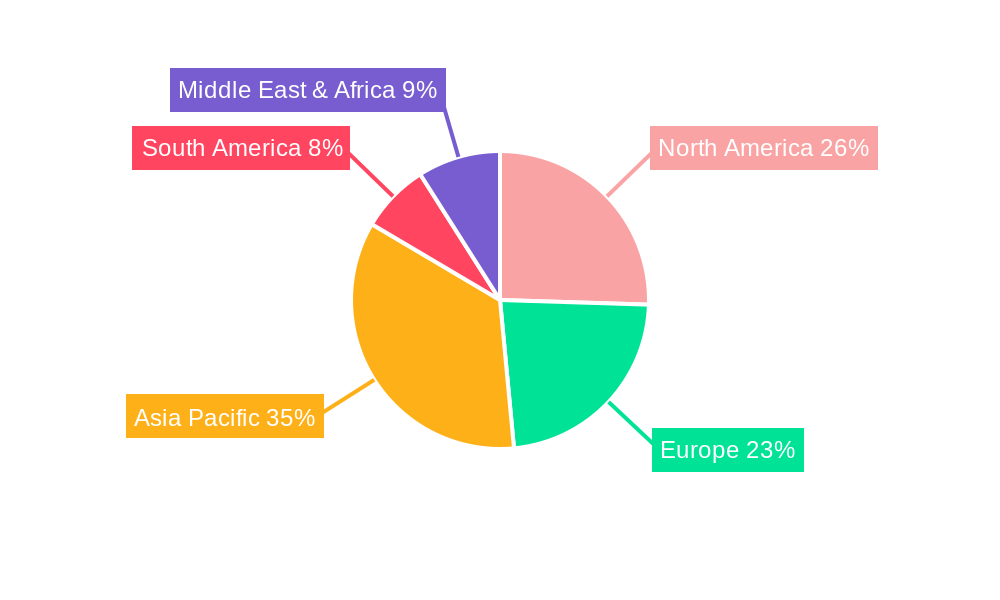
Fiber To The X Regional Market Share
Geographic Coverage of Fiber To The X
Fiber To The X REPORT HIGHLIGHTS
| Aspects | Details |
|---|---|
| Study Period | 2020-2034 |
| Base Year | 2025 |
| Estimated Year | 2026 |
| Forecast Period | 2026-2034 |
| Historical Period | 2020-2025 |
| Growth Rate | CAGR of XX% from 2020-2034 |
| Segmentation |
|
Table of Contents
- 1. Introduction
- 1.1. Research Scope
- 1.2. Market Segmentation
- 1.3. Research Methodology
- 1.4. Definitions and Assumptions
- 2. Executive Summary
- 2.1. Introduction
- 3. Market Dynamics
- 3.1. Introduction
- 3.2. Market Drivers
- 3.3. Market Restrains
- 3.4. Market Trends
- 4. Market Factor Analysis
- 4.1. Porters Five Forces
- 4.2. Supply/Value Chain
- 4.3. PESTEL analysis
- 4.4. Market Entropy
- 4.5. Patent/Trademark Analysis
- 5. Global Fiber To The X Analysis, Insights and Forecast, 2020-2032
- 5.1. Market Analysis, Insights and Forecast - by Application
- 5.1.1. Industrial
- 5.1.2. Commercial
- 5.1.3. Residential
- 5.2. Market Analysis, Insights and Forecast - by Types
- 5.2.1. Fiber to the Home/Premises/Building (FTTh/p/b)
- 5.2.2. Fiber to the Node/Curb (FTTn/c)
- 5.2.3. Fiber to the Antenna (FTTa)
- 5.3. Market Analysis, Insights and Forecast - by Region
- 5.3.1. North America
- 5.3.2. South America
- 5.3.3. Europe
- 5.3.4. Middle East & Africa
- 5.3.5. Asia Pacific
- 5.1. Market Analysis, Insights and Forecast - by Application
- 6. North America Fiber To The X Analysis, Insights and Forecast, 2020-2032
- 6.1. Market Analysis, Insights and Forecast - by Application
- 6.1.1. Industrial
- 6.1.2. Commercial
- 6.1.3. Residential
- 6.2. Market Analysis, Insights and Forecast - by Types
- 6.2.1. Fiber to the Home/Premises/Building (FTTh/p/b)
- 6.2.2. Fiber to the Node/Curb (FTTn/c)
- 6.2.3. Fiber to the Antenna (FTTa)
- 6.1. Market Analysis, Insights and Forecast - by Application
- 7. South America Fiber To The X Analysis, Insights and Forecast, 2020-2032
- 7.1. Market Analysis, Insights and Forecast - by Application
- 7.1.1. Industrial
- 7.1.2. Commercial
- 7.1.3. Residential
- 7.2. Market Analysis, Insights and Forecast - by Types
- 7.2.1. Fiber to the Home/Premises/Building (FTTh/p/b)
- 7.2.2. Fiber to the Node/Curb (FTTn/c)
- 7.2.3. Fiber to the Antenna (FTTa)
- 7.1. Market Analysis, Insights and Forecast - by Application
- 8. Europe Fiber To The X Analysis, Insights and Forecast, 2020-2032
- 8.1. Market Analysis, Insights and Forecast - by Application
- 8.1.1. Industrial
- 8.1.2. Commercial
- 8.1.3. Residential
- 8.2. Market Analysis, Insights and Forecast - by Types
- 8.2.1. Fiber to the Home/Premises/Building (FTTh/p/b)
- 8.2.2. Fiber to the Node/Curb (FTTn/c)
- 8.2.3. Fiber to the Antenna (FTTa)
- 8.1. Market Analysis, Insights and Forecast - by Application
- 9. Middle East & Africa Fiber To The X Analysis, Insights and Forecast, 2020-2032
- 9.1. Market Analysis, Insights and Forecast - by Application
- 9.1.1. Industrial
- 9.1.2. Commercial
- 9.1.3. Residential
- 9.2. Market Analysis, Insights and Forecast - by Types
- 9.2.1. Fiber to the Home/Premises/Building (FTTh/p/b)
- 9.2.2. Fiber to the Node/Curb (FTTn/c)
- 9.2.3. Fiber to the Antenna (FTTa)
- 9.1. Market Analysis, Insights and Forecast - by Application
- 10. Asia Pacific Fiber To The X Analysis, Insights and Forecast, 2020-2032
- 10.1. Market Analysis, Insights and Forecast - by Application
- 10.1.1. Industrial
- 10.1.2. Commercial
- 10.1.3. Residential
- 10.2. Market Analysis, Insights and Forecast - by Types
- 10.2.1. Fiber to the Home/Premises/Building (FTTh/p/b)
- 10.2.2. Fiber to the Node/Curb (FTTn/c)
- 10.2.3. Fiber to the Antenna (FTTa)
- 10.1. Market Analysis, Insights and Forecast - by Application
- 11. Competitive Analysis
- 11.1. Global Market Share Analysis 2025
- 11.2. Company Profiles
- 11.2.1 Allied Telesis
- 11.2.1.1. Overview
- 11.2.1.2. Products
- 11.2.1.3. SWOT Analysis
- 11.2.1.4. Recent Developments
- 11.2.1.5. Financials (Based on Availability)
- 11.2.2 Commscope
- 11.2.2.1. Overview
- 11.2.2.2. Products
- 11.2.2.3. SWOT Analysis
- 11.2.2.4. Recent Developments
- 11.2.2.5. Financials (Based on Availability)
- 11.2.3 AFL (Fujikura Company)
- 11.2.3.1. Overview
- 11.2.3.2. Products
- 11.2.3.3. SWOT Analysis
- 11.2.3.4. Recent Developments
- 11.2.3.5. Financials (Based on Availability)
- 11.2.4 OFS (Furukawa Company)
- 11.2.4.1. Overview
- 11.2.4.2. Products
- 11.2.4.3. SWOT Analysis
- 11.2.4.4. Recent Developments
- 11.2.4.5. Financials (Based on Availability)
- 11.2.5 Huawei
- 11.2.5.1. Overview
- 11.2.5.2. Products
- 11.2.5.3. SWOT Analysis
- 11.2.5.4. Recent Developments
- 11.2.5.5. Financials (Based on Availability)
- 11.2.6 Shanghai Sun Telecommunication
- 11.2.6.1. Overview
- 11.2.6.2. Products
- 11.2.6.3. SWOT Analysis
- 11.2.6.4. Recent Developments
- 11.2.6.5. Financials (Based on Availability)
- 11.2.7 ZTT
- 11.2.7.1. Overview
- 11.2.7.2. Products
- 11.2.7.3. SWOT Analysis
- 11.2.7.4. Recent Developments
- 11.2.7.5. Financials (Based on Availability)
- 11.2.8 Fiber Optic Telecom
- 11.2.8.1. Overview
- 11.2.8.2. Products
- 11.2.8.3. SWOT Analysis
- 11.2.8.4. Recent Developments
- 11.2.8.5. Financials (Based on Availability)
- 11.2.9 ZTE
- 11.2.9.1. Overview
- 11.2.9.2. Products
- 11.2.9.3. SWOT Analysis
- 11.2.9.4. Recent Developments
- 11.2.9.5. Financials (Based on Availability)
- 11.2.10 Alfocom Technology
- 11.2.10.1. Overview
- 11.2.10.2. Products
- 11.2.10.3. SWOT Analysis
- 11.2.10.4. Recent Developments
- 11.2.10.5. Financials (Based on Availability)
- 11.2.11 Verizon
- 11.2.11.1. Overview
- 11.2.11.2. Products
- 11.2.11.3. SWOT Analysis
- 11.2.11.4. Recent Developments
- 11.2.11.5. Financials (Based on Availability)
- 11.2.12 Bharat Sanchar Nigam Limited (BSNL)
- 11.2.12.1. Overview
- 11.2.12.2. Products
- 11.2.12.3. SWOT Analysis
- 11.2.12.4. Recent Developments
- 11.2.12.5. Financials (Based on Availability)
- 11.2.13 AT&T
- 11.2.13.1. Overview
- 11.2.13.2. Products
- 11.2.13.3. SWOT Analysis
- 11.2.13.4. Recent Developments
- 11.2.13.5. Financials (Based on Availability)
- 11.2.14 China Telecom Corporation Limited
- 11.2.14.1. Overview
- 11.2.14.2. Products
- 11.2.14.3. SWOT Analysis
- 11.2.14.4. Recent Developments
- 11.2.14.5. Financials (Based on Availability)
- 11.2.15 Vodafone Group
- 11.2.15.1. Overview
- 11.2.15.2. Products
- 11.2.15.3. SWOT Analysis
- 11.2.15.4. Recent Developments
- 11.2.15.5. Financials (Based on Availability)
- 11.2.16 Mtn Group
- 11.2.16.1. Overview
- 11.2.16.2. Products
- 11.2.16.3. SWOT Analysis
- 11.2.16.4. Recent Developments
- 11.2.16.5. Financials (Based on Availability)
- 11.2.17 Telkom
- 11.2.17.1. Overview
- 11.2.17.2. Products
- 11.2.17.3. SWOT Analysis
- 11.2.17.4. Recent Developments
- 11.2.17.5. Financials (Based on Availability)
- 11.2.18 Altice
- 11.2.18.1. Overview
- 11.2.18.2. Products
- 11.2.18.3. SWOT Analysis
- 11.2.18.4. Recent Developments
- 11.2.18.5. Financials (Based on Availability)
- 11.2.19 America Movil
- 11.2.19.1. Overview
- 11.2.19.2. Products
- 11.2.19.3. SWOT Analysis
- 11.2.19.4. Recent Developments
- 11.2.19.5. Financials (Based on Availability)
- 11.2.20 Nippon Telegram and Telephone
- 11.2.20.1. Overview
- 11.2.20.2. Products
- 11.2.20.3. SWOT Analysis
- 11.2.20.4. Recent Developments
- 11.2.20.5. Financials (Based on Availability)
- 11.2.21 Corning
- 11.2.21.1. Overview
- 11.2.21.2. Products
- 11.2.21.3. SWOT Analysis
- 11.2.21.4. Recent Developments
- 11.2.21.5. Financials (Based on Availability)
- 11.2.22 Himachal Futuristic Communications
- 11.2.22.1. Overview
- 11.2.22.2. Products
- 11.2.22.3. SWOT Analysis
- 11.2.22.4. Recent Developments
- 11.2.22.5. Financials (Based on Availability)
- 11.2.23 Pactech
- 11.2.23.1. Overview
- 11.2.23.2. Products
- 11.2.23.3. SWOT Analysis
- 11.2.23.4. Recent Developments
- 11.2.23.5. Financials (Based on Availability)
- 11.2.24 Fibernet
- 11.2.24.1. Overview
- 11.2.24.2. Products
- 11.2.24.3. SWOT Analysis
- 11.2.24.4. Recent Developments
- 11.2.24.5. Financials (Based on Availability)
- 11.2.25 Tellabs
- 11.2.25.1. Overview
- 11.2.25.2. Products
- 11.2.25.3. SWOT Analysis
- 11.2.25.4. Recent Developments
- 11.2.25.5. Financials (Based on Availability)
- 11.2.1 Allied Telesis
List of Figures
- Figure 1: Global Fiber To The X Revenue Breakdown (million, %) by Region 2025 & 2033
- Figure 2: North America Fiber To The X Revenue (million), by Application 2025 & 2033
- Figure 3: North America Fiber To The X Revenue Share (%), by Application 2025 & 2033
- Figure 4: North America Fiber To The X Revenue (million), by Types 2025 & 2033
- Figure 5: North America Fiber To The X Revenue Share (%), by Types 2025 & 2033
- Figure 6: North America Fiber To The X Revenue (million), by Country 2025 & 2033
- Figure 7: North America Fiber To The X Revenue Share (%), by Country 2025 & 2033
- Figure 8: South America Fiber To The X Revenue (million), by Application 2025 & 2033
- Figure 9: South America Fiber To The X Revenue Share (%), by Application 2025 & 2033
- Figure 10: South America Fiber To The X Revenue (million), by Types 2025 & 2033
- Figure 11: South America Fiber To The X Revenue Share (%), by Types 2025 & 2033
- Figure 12: South America Fiber To The X Revenue (million), by Country 2025 & 2033
- Figure 13: South America Fiber To The X Revenue Share (%), by Country 2025 & 2033
- Figure 14: Europe Fiber To The X Revenue (million), by Application 2025 & 2033
- Figure 15: Europe Fiber To The X Revenue Share (%), by Application 2025 & 2033
- Figure 16: Europe Fiber To The X Revenue (million), by Types 2025 & 2033
- Figure 17: Europe Fiber To The X Revenue Share (%), by Types 2025 & 2033
- Figure 18: Europe Fiber To The X Revenue (million), by Country 2025 & 2033
- Figure 19: Europe Fiber To The X Revenue Share (%), by Country 2025 & 2033
- Figure 20: Middle East & Africa Fiber To The X Revenue (million), by Application 2025 & 2033
- Figure 21: Middle East & Africa Fiber To The X Revenue Share (%), by Application 2025 & 2033
- Figure 22: Middle East & Africa Fiber To The X Revenue (million), by Types 2025 & 2033
- Figure 23: Middle East & Africa Fiber To The X Revenue Share (%), by Types 2025 & 2033
- Figure 24: Middle East & Africa Fiber To The X Revenue (million), by Country 2025 & 2033
- Figure 25: Middle East & Africa Fiber To The X Revenue Share (%), by Country 2025 & 2033
- Figure 26: Asia Pacific Fiber To The X Revenue (million), by Application 2025 & 2033
- Figure 27: Asia Pacific Fiber To The X Revenue Share (%), by Application 2025 & 2033
- Figure 28: Asia Pacific Fiber To The X Revenue (million), by Types 2025 & 2033
- Figure 29: Asia Pacific Fiber To The X Revenue Share (%), by Types 2025 & 2033
- Figure 30: Asia Pacific Fiber To The X Revenue (million), by Country 2025 & 2033
- Figure 31: Asia Pacific Fiber To The X Revenue Share (%), by Country 2025 & 2033
List of Tables
- Table 1: Global Fiber To The X Revenue million Forecast, by Application 2020 & 2033
- Table 2: Global Fiber To The X Revenue million Forecast, by Types 2020 & 2033
- Table 3: Global Fiber To The X Revenue million Forecast, by Region 2020 & 2033
- Table 4: Global Fiber To The X Revenue million Forecast, by Application 2020 & 2033
- Table 5: Global Fiber To The X Revenue million Forecast, by Types 2020 & 2033
- Table 6: Global Fiber To The X Revenue million Forecast, by Country 2020 & 2033
- Table 7: United States Fiber To The X Revenue (million) Forecast, by Application 2020 & 2033
- Table 8: Canada Fiber To The X Revenue (million) Forecast, by Application 2020 & 2033
- Table 9: Mexico Fiber To The X Revenue (million) Forecast, by Application 2020 & 2033
- Table 10: Global Fiber To The X Revenue million Forecast, by Application 2020 & 2033
- Table 11: Global Fiber To The X Revenue million Forecast, by Types 2020 & 2033
- Table 12: Global Fiber To The X Revenue million Forecast, by Country 2020 & 2033
- Table 13: Brazil Fiber To The X Revenue (million) Forecast, by Application 2020 & 2033
- Table 14: Argentina Fiber To The X Revenue (million) Forecast, by Application 2020 & 2033
- Table 15: Rest of South America Fiber To The X Revenue (million) Forecast, by Application 2020 & 2033
- Table 16: Global Fiber To The X Revenue million Forecast, by Application 2020 & 2033
- Table 17: Global Fiber To The X Revenue million Forecast, by Types 2020 & 2033
- Table 18: Global Fiber To The X Revenue million Forecast, by Country 2020 & 2033
- Table 19: United Kingdom Fiber To The X Revenue (million) Forecast, by Application 2020 & 2033
- Table 20: Germany Fiber To The X Revenue (million) Forecast, by Application 2020 & 2033
- Table 21: France Fiber To The X Revenue (million) Forecast, by Application 2020 & 2033
- Table 22: Italy Fiber To The X Revenue (million) Forecast, by Application 2020 & 2033
- Table 23: Spain Fiber To The X Revenue (million) Forecast, by Application 2020 & 2033
- Table 24: Russia Fiber To The X Revenue (million) Forecast, by Application 2020 & 2033
- Table 25: Benelux Fiber To The X Revenue (million) Forecast, by Application 2020 & 2033
- Table 26: Nordics Fiber To The X Revenue (million) Forecast, by Application 2020 & 2033
- Table 27: Rest of Europe Fiber To The X Revenue (million) Forecast, by Application 2020 & 2033
- Table 28: Global Fiber To The X Revenue million Forecast, by Application 2020 & 2033
- Table 29: Global Fiber To The X Revenue million Forecast, by Types 2020 & 2033
- Table 30: Global Fiber To The X Revenue million Forecast, by Country 2020 & 2033
- Table 31: Turkey Fiber To The X Revenue (million) Forecast, by Application 2020 & 2033
- Table 32: Israel Fiber To The X Revenue (million) Forecast, by Application 2020 & 2033
- Table 33: GCC Fiber To The X Revenue (million) Forecast, by Application 2020 & 2033
- Table 34: North Africa Fiber To The X Revenue (million) Forecast, by Application 2020 & 2033
- Table 35: South Africa Fiber To The X Revenue (million) Forecast, by Application 2020 & 2033
- Table 36: Rest of Middle East & Africa Fiber To The X Revenue (million) Forecast, by Application 2020 & 2033
- Table 37: Global Fiber To The X Revenue million Forecast, by Application 2020 & 2033
- Table 38: Global Fiber To The X Revenue million Forecast, by Types 2020 & 2033
- Table 39: Global Fiber To The X Revenue million Forecast, by Country 2020 & 2033
- Table 40: China Fiber To The X Revenue (million) Forecast, by Application 2020 & 2033
- Table 41: India Fiber To The X Revenue (million) Forecast, by Application 2020 & 2033
- Table 42: Japan Fiber To The X Revenue (million) Forecast, by Application 2020 & 2033
- Table 43: South Korea Fiber To The X Revenue (million) Forecast, by Application 2020 & 2033
- Table 44: ASEAN Fiber To The X Revenue (million) Forecast, by Application 2020 & 2033
- Table 45: Oceania Fiber To The X Revenue (million) Forecast, by Application 2020 & 2033
- Table 46: Rest of Asia Pacific Fiber To The X Revenue (million) Forecast, by Application 2020 & 2033
Frequently Asked Questions
1. What is the projected Compound Annual Growth Rate (CAGR) of the Fiber To The X?
The projected CAGR is approximately XX%.
2. Which companies are prominent players in the Fiber To The X?
Key companies in the market include Allied Telesis, Commscope, AFL (Fujikura Company), OFS (Furukawa Company), Huawei, Shanghai Sun Telecommunication, ZTT, Fiber Optic Telecom, ZTE, Alfocom Technology, Verizon, Bharat Sanchar Nigam Limited (BSNL), AT&T, China Telecom Corporation Limited, Vodafone Group, Mtn Group, Telkom, Altice, America Movil, Nippon Telegram and Telephone, Corning, Himachal Futuristic Communications, Pactech, Fibernet, Tellabs.
3. What are the main segments of the Fiber To The X?
The market segments include Application, Types.
4. Can you provide details about the market size?
The market size is estimated to be USD XXX million as of 2022.
5. What are some drivers contributing to market growth?
N/A
6. What are the notable trends driving market growth?
N/A
7. Are there any restraints impacting market growth?
N/A
8. Can you provide examples of recent developments in the market?
N/A
9. What pricing options are available for accessing the report?
Pricing options include single-user, multi-user, and enterprise licenses priced at USD 5600.00, USD 8400.00, and USD 11200.00 respectively.
10. Is the market size provided in terms of value or volume?
The market size is provided in terms of value, measured in million.
11. Are there any specific market keywords associated with the report?
Yes, the market keyword associated with the report is "Fiber To The X," which aids in identifying and referencing the specific market segment covered.
12. How do I determine which pricing option suits my needs best?
The pricing options vary based on user requirements and access needs. Individual users may opt for single-user licenses, while businesses requiring broader access may choose multi-user or enterprise licenses for cost-effective access to the report.
13. Are there any additional resources or data provided in the Fiber To The X report?
While the report offers comprehensive insights, it's advisable to review the specific contents or supplementary materials provided to ascertain if additional resources or data are available.
14. How can I stay updated on further developments or reports in the Fiber To The X?
To stay informed about further developments, trends, and reports in the Fiber To The X, consider subscribing to industry newsletters, following relevant companies and organizations, or regularly checking reputable industry news sources and publications.
Methodology
Step 1 - Identification of Relevant Samples Size from Population Database



Step 2 - Approaches for Defining Global Market Size (Value, Volume* & Price*)

Note*: In applicable scenarios
Step 3 - Data Sources
Primary Research
- Web Analytics
- Survey Reports
- Research Institute
- Latest Research Reports
- Opinion Leaders
Secondary Research
- Annual Reports
- White Paper
- Latest Press Release
- Industry Association
- Paid Database
- Investor Presentations

Step 4 - Data Triangulation
Involves using different sources of information in order to increase the validity of a study
These sources are likely to be stakeholders in a program - participants, other researchers, program staff, other community members, and so on.
Then we put all data in single framework & apply various statistical tools to find out the dynamic on the market.
During the analysis stage, feedback from the stakeholder groups would be compared to determine areas of agreement as well as areas of divergence