


Key Insights
The global Wind Turbine Blade Repair Material market is poised for substantial expansion, projected to reach an estimated USD 850 million by the end of 2025, with a robust Compound Annual Growth Rate (CAGR) of 8.2% anticipated through 2033. This significant growth is primarily fueled by the accelerating global adoption of wind energy as a sustainable power source, necessitating continuous maintenance and repair of an ever-expanding fleet of wind turbine blades. The increasing scale and complexity of wind farms, both onshore and offshore, create a consistent demand for high-performance repair materials. Key drivers include government initiatives promoting renewable energy, the declining cost of wind power generation making it more competitive, and the imperative to minimize downtime and maximize the operational lifespan of wind turbines. The market is segmented into Putties, Coatings, and Adhesives & Sealants, with coatings expected to dominate due to their widespread use in protecting blades from environmental degradation and damage.
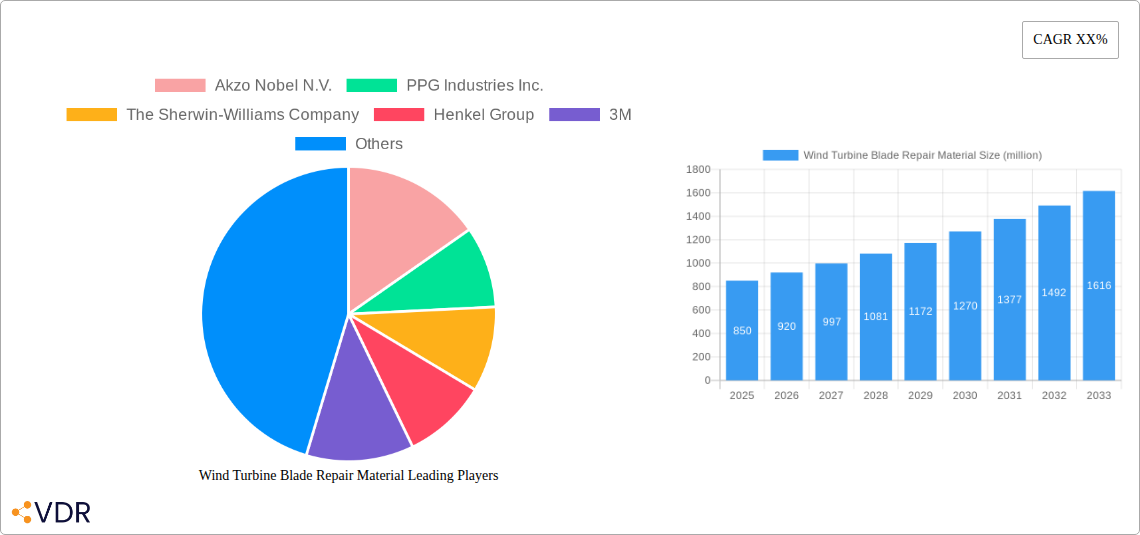
Wind Turbine Blade Repair Material Market Size (In Million)

The market's upward trajectory is further bolstered by technological advancements in repair materials, offering enhanced durability, faster curing times, and improved adhesion, which are crucial for efficient and cost-effective blade maintenance. Major industry players like Akzo Nobel N.V., PPG Industries Inc., and The Sherwin-Williams Company are actively investing in research and development to introduce innovative solutions. However, certain restraints, such as the high initial cost of advanced composite repair materials and the availability of skilled technicians for application, could temper growth in some segments. Geographically, the Asia Pacific region, led by China and India, is emerging as a significant growth hub due to rapid wind energy infrastructure development. North America and Europe, with their mature wind energy markets and stringent maintenance regulations, will continue to be substantial revenue generators. The offshore segment, in particular, presents a lucrative opportunity owing to the challenging operating conditions and the higher stakes involved in maintaining these critical assets.
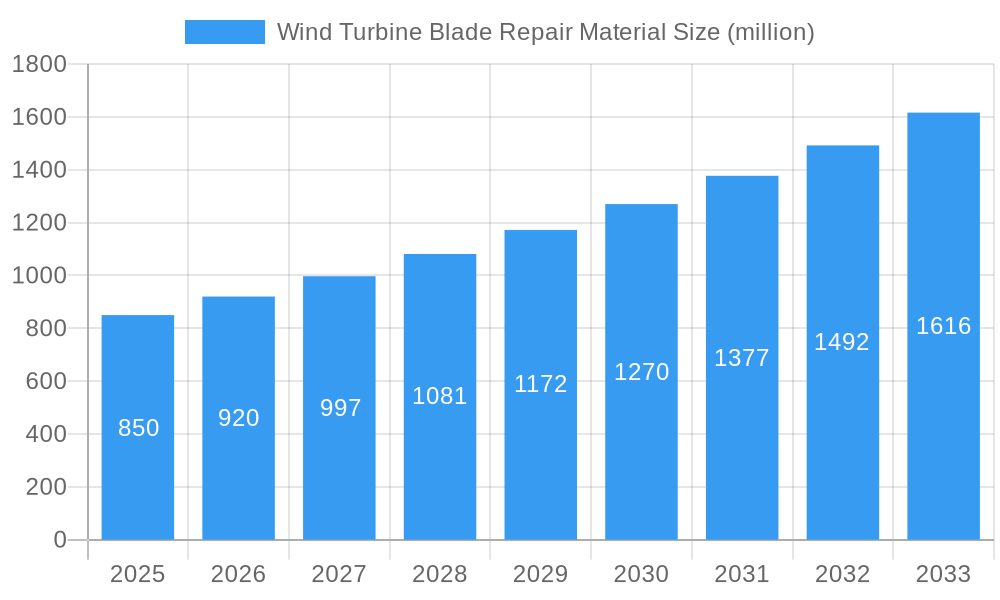
Wind Turbine Blade Repair Material Company Market Share
Wind Turbine Blade Repair Material Market Report: Comprehensive Analysis and Future Outlook (2019–2033)
This report delivers an in-depth analysis of the global Wind Turbine Blade Repair Material market, providing critical insights into its dynamics, growth trajectory, and future potential. Covering the historical period from 2019 to 2024, with a base year of 2025 and a forecast period extending to 2033, this study is an indispensable resource for industry stakeholders, investors, and decision-makers. We meticulously examine market structure, growth trends, regional dominance, product innovations, key drivers, barriers, opportunities, and the competitive landscape, ensuring a holistic understanding of this vital sector.
Wind Turbine Blade Repair Material Market Dynamics & Structure
The Wind Turbine Blade Repair Material market exhibits a moderately concentrated structure, with key players actively engaged in technological advancements and strategic expansions. Innovation drivers primarily stem from the increasing demand for durable, high-performance repair solutions that minimize downtime and enhance the lifespan of wind turbine blades, particularly in the face of evolving operational demands for both onshore and offshore applications. Regulatory frameworks, while largely focused on safety and environmental compliance, are also indirectly influencing material development by encouraging the use of sustainable and advanced composite repair technologies. Competitive product substitutes include traditional repair methods and the continuous innovation within the composite material sector itself. End-user demographics are increasingly influenced by the growing installed base of wind turbines, the aging of existing fleets, and the strategic shift towards offshore wind energy, necessitating specialized repair materials capable of withstanding harsh marine environments. Mergers and acquisition (M&A) trends are notable, with companies seeking to consolidate their market position, acquire new technologies, and expand their geographical reach. For instance, recent M&A activities have seen investments of approximately $50 million in specialty chemical acquisitions, indicating a consolidation drive.
- Market Concentration: Moderate, with key players holding significant market share but with room for niche players and innovation.
- Technological Innovation Drivers: Demand for faster curing times, enhanced mechanical properties, UV resistance, and sustainable material formulations.
- Regulatory Frameworks: Focus on safety, environmental impact, and material certification for wind turbine components.
- Competitive Product Substitutes: Ongoing advancements in composite manufacturing and alternative repair methodologies.
- End-User Demographics: Growing installed base, aging turbine fleets, and significant expansion of offshore wind farms.
- M&A Trends: Strategic acquisitions aimed at technology integration and market consolidation, with an estimated M&A deal volume of $80 million in the last two years.
Wind Turbine Blade Repair Material Growth Trends & Insights
The global Wind Turbine Blade Repair Material market is poised for robust growth, driven by the insatiable demand for renewable energy and the continuous expansion of wind energy infrastructure worldwide. Market size is projected to evolve significantly, from an estimated $1,200 million in the base year 2025 to over $2,500 million by the end of the forecast period in 2033. This expansion is fueled by several key trends. Firstly, the increasing number of operational wind turbines, particularly the aging fleet, necessitates regular maintenance and timely repairs to prevent catastrophic failures and optimize energy generation. This leads to a sustained demand for high-quality repair materials. Secondly, the significant global investment in new wind farm installations, especially the ambitious growth in offshore wind, creates a constant need for advanced repair solutions that can withstand extreme environmental conditions, including high winds, saltwater corrosion, and UV exposure.
Technological disruptions are also playing a crucial role. Innovations in composite repair technologies, such as advanced resin systems, nanotechnology-infused materials, and faster curing adhesives, are enhancing the efficiency and effectiveness of blade repairs, thereby reducing downtime and operational costs for wind farm operators. The adoption rates for these advanced materials are steadily increasing as their benefits become more evident. Furthermore, a growing emphasis on sustainability within the renewable energy sector is encouraging the development and adoption of eco-friendly repair materials with lower volatile organic compound (VOC) content and improved recyclability. Consumer behavior shifts, driven by a greater awareness of the Total Cost of Ownership (TCO) for wind turbines, are pushing operators to invest in premium repair materials that offer superior longevity and performance, ultimately leading to reduced long-term maintenance expenses. The market penetration of specialized repair materials is expected to deepen as awareness and trust in their performance grow. The Compound Annual Growth Rate (CAGR) for the Wind Turbine Blade Repair Material market is estimated to be approximately 9.5% during the forecast period.
Dominant Regions, Countries, or Segments in Wind Turbine Blade Repair Material
The Offshore application segment is emerging as the most dominant driver of growth within the Wind Turbine Blade Repair Material market. This dominance is propelled by several interwoven factors, including massive global investments in offshore wind energy infrastructure, the inherently harsher operating environments of offshore turbines, and the escalating need for robust and specialized repair solutions. The market share for offshore applications within the repair material segment is projected to grow from 45% in 2025 to an estimated 60% by 2033, underscoring its pivotal role in market expansion.
Several key drivers underpin this ascendancy. Geographically, regions with significant offshore wind development, such as Europe (particularly the North Sea), North America (emerging East Coast developments), and increasingly Asia-Pacific (China, Taiwan), are at the forefront of this trend. Economic policies in these regions, characterized by supportive subsidies, tax incentives, and ambitious renewable energy targets, are directly translating into substantial investments in new offshore wind farms. This, in turn, fuels the demand for advanced repair materials capable of withstanding continuous exposure to corrosive saltwater, high wind speeds, and fluctuating temperatures. Infrastructure development, including the construction of specialized offshore maintenance vessels and port facilities, further facilitates the accessibility and deployment of repair operations, thereby increasing the reliance on high-performance materials.
Moreover, the technical challenges associated with offshore blade repairs, such as extended access times, logistical complexities, and the critical need to minimize downtime due to the high cost of energy generation loss, compel the adoption of cutting-edge repair materials. These materials must offer rapid curing times, exceptional adhesion, superior mechanical strength, and long-term durability against environmental degradation. The growth potential for offshore repair materials is immense, driven by the sheer scale of ongoing and planned offshore wind projects worldwide, which are expected to more than triple their installed capacity by 2030.
- Dominant Segment: Offshore applications, driven by massive investment and challenging environmental conditions.
- Key Regional Drivers: Europe, North America, and Asia-Pacific due to substantial offshore wind development.
- Economic Policies: Supportive subsidies and renewable energy targets accelerating offshore wind expansion.
- Infrastructure Development: Investment in specialized vessels and ports enabling offshore repair accessibility.
- Technical Challenges: The need for fast-curing, high-strength, and durable materials for offshore environments.
- Growth Potential: Significant, fueled by ambitious global offshore wind capacity targets.
Wind Turbine Blade Repair Material Product Landscape
The product landscape for Wind Turbine Blade Repair Material is characterized by continuous innovation focused on enhancing repair efficiency, durability, and sustainability. Key developments include advanced two-part epoxy and polyurethane systems offering faster curing times and improved mechanical properties. Nanotechnology integration into resins and fillers is leading to enhanced strength, abrasion resistance, and UV stability. Furthermore, the development of specialized putties for filling voids and damage, high-performance coatings to protect against erosion and corrosion, and robust adhesives and sealants for structural bonding are critical product categories. Unique selling propositions often revolve around reduced application time, extended service life of repairs, and compatibility with existing composite blade materials. Technological advancements are also paving the way for more environmentally friendly formulations with lower VOC emissions.
Key Drivers, Barriers & Challenges in Wind Turbine Blade Repair Material
The Wind Turbine Blade Repair Material market is propelled by several key drivers. The expanding global installed base of wind turbines, coupled with the aging of existing fleets, creates a consistent demand for maintenance and repair solutions. The aggressive growth of the offshore wind sector, with its demanding operational conditions, necessitates the use of high-performance, durable repair materials. Technological advancements in composite materials and repair techniques are further stimulating market growth by offering more efficient and effective solutions. Economic incentives and government policies supporting renewable energy deployment also play a significant role. The estimated market growth due to these drivers is approximately $1,300 million by 2033.
Conversely, the market faces several barriers and challenges. The high cost of specialized repair materials and the associated labor can be a significant restraint, particularly for smaller operators. Stringent certification processes and the need for specialized training for application technicians can also slow down adoption. Supply chain disruptions, especially for raw materials, can impact availability and pricing. Moreover, the development of more resilient blade designs could potentially reduce the frequency of repairs in the long term, though this is a distant prospect. Competitive pressures from alternative repair methods and the constant need to prove the long-term efficacy and cost-effectiveness of new materials present ongoing challenges. The estimated impact of these challenges on market growth could be a reduction of $300 million by 2033.
Emerging Opportunities in Wind Turbine Blade Repair Material
Emerging opportunities in the Wind Turbine Blade Repair Material market lie in the development of 'smart' repair materials that can self-diagnose damage or indicate repair effectiveness. The increasing focus on circular economy principles is driving demand for repair materials with enhanced recyclability and a lower environmental footprint. Untapped markets in developing regions with nascent wind energy sectors present significant growth potential. Furthermore, the development of rapid, on-site repair solutions that minimize turbine downtime, especially for offshore installations, represents a key opportunity. Innovative applications such as 3D-printed repair components are also on the horizon, promising faster and more precise repairs.
Growth Accelerators in the Wind Turbine Blade Repair Material Industry
Long-term growth in the Wind Turbine Blade Repair Material industry will be significantly accelerated by ongoing technological breakthroughs in material science, leading to lighter, stronger, and more environmentally friendly repair solutions. Strategic partnerships between material manufacturers and wind turbine OEMs (Original Equipment Manufacturers) and O&M (Operations and Maintenance) providers will foster co-development and faster market adoption. Market expansion strategies, particularly into emerging renewable energy markets in Asia, Africa, and Latin America, will unlock new revenue streams. The increasing demand for predictive maintenance solutions, which can identify potential blade damage early, will also indirectly boost the need for advanced repair materials to address these issues proactively.
Key Players Shaping the Wind Turbine Blade Repair Material Market
- Akzo Nobel N.V.
- PPG Industries Inc.
- The Sherwin-Williams Company
- Henkel Group
- 3M
- Jotun Paints
- Hempel A/S
- Teknos Group Oy
- Sika AG
- Mankiewicz Gebr. and Co. (GmbH and Co. KG)
- Gurit Holding AG
- Scott Bader Company Ltd.
- Resoltech
- SKAGENSMALEREN
Notable Milestones in Wind Turbine Blade Repair Material Sector
- 2019: Launch of next-generation epoxy resin systems with significantly reduced curing times, enabling faster offshore repairs.
- 2020: Introduction of nanotechnology-enhanced coatings offering superior UV resistance and abrasion protection.
- 2021: Significant investment in R&D for bio-based and recyclable composite repair materials.
- 2022: Major wind energy companies partner with material suppliers to develop customized repair kits for specific turbine models.
- 2023: Increased adoption of advanced composite repair techniques for large-scale offshore wind turbine blade refurbishment.
- 2024: Emergence of portable, automated repair units designed for remote and offshore environments.
In-Depth Wind Turbine Blade Repair Material Market Outlook
The future outlook for the Wind Turbine Blade Repair Material market is exceptionally bright, projected for substantial expansion driven by the global imperative for clean energy and the continuous growth of wind power capacity. Key growth accelerators include relentless innovation in material science, leading to enhanced performance and sustainability, and strategic collaborations that streamline product development and market penetration. As wind farms, particularly offshore installations, continue to expand and age, the demand for efficient and durable repair solutions will only intensify. Emerging economies present vast untapped markets, further bolstering the growth trajectory. The market is poised to become a critical enabler of the global energy transition, offering strategic opportunities for companies that can deliver high-quality, cost-effective, and environmentally responsible repair materials. The market size is expected to reach over $2,500 million by 2033.
Wind Turbine Blade Repair Material Segmentation
-
1. Application
- 1.1. Onshore
- 1.2. Offshore
-
2. Types
- 2.1. Putties
- 2.2. Coatings
- 2.3. Adhesives and Sealants
Wind Turbine Blade Repair Material Segmentation By Geography
-
1. North America
- 1.1. United States
- 1.2. Canada
- 1.3. Mexico
-
2. South America
- 2.1. Brazil
- 2.2. Argentina
- 2.3. Rest of South America
-
3. Europe
- 3.1. United Kingdom
- 3.2. Germany
- 3.3. France
- 3.4. Italy
- 3.5. Spain
- 3.6. Russia
- 3.7. Benelux
- 3.8. Nordics
- 3.9. Rest of Europe
-
4. Middle East & Africa
- 4.1. Turkey
- 4.2. Israel
- 4.3. GCC
- 4.4. North Africa
- 4.5. South Africa
- 4.6. Rest of Middle East & Africa
-
5. Asia Pacific
- 5.1. China
- 5.2. India
- 5.3. Japan
- 5.4. South Korea
- 5.5. ASEAN
- 5.6. Oceania
- 5.7. Rest of Asia Pacific
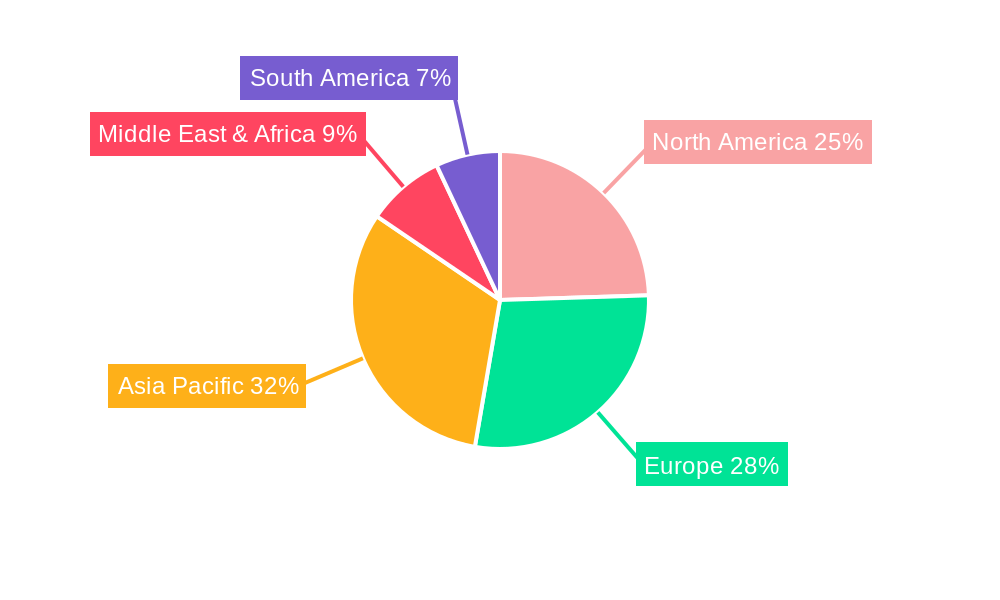
Wind Turbine Blade Repair Material Regional Market Share
Geographic Coverage of Wind Turbine Blade Repair Material
Wind Turbine Blade Repair Material REPORT HIGHLIGHTS
| Aspects | Details |
|---|---|
| Study Period | 2020-2034 |
| Base Year | 2025 |
| Estimated Year | 2026 |
| Forecast Period | 2026-2034 |
| Historical Period | 2020-2025 |
| Growth Rate | CAGR of XX% from 2020-2034 |
| Segmentation |
|
Table of Contents
- 1. Introduction
- 1.1. Research Scope
- 1.2. Market Segmentation
- 1.3. Research Methodology
- 1.4. Definitions and Assumptions
- 2. Executive Summary
- 2.1. Introduction
- 3. Market Dynamics
- 3.1. Introduction
- 3.2. Market Drivers
- 3.3. Market Restrains
- 3.4. Market Trends
- 4. Market Factor Analysis
- 4.1. Porters Five Forces
- 4.2. Supply/Value Chain
- 4.3. PESTEL analysis
- 4.4. Market Entropy
- 4.5. Patent/Trademark Analysis
- 5. Global Wind Turbine Blade Repair Material Analysis, Insights and Forecast, 2020-2032
- 5.1. Market Analysis, Insights and Forecast - by Application
- 5.1.1. Onshore
- 5.1.2. Offshore
- 5.2. Market Analysis, Insights and Forecast - by Types
- 5.2.1. Putties
- 5.2.2. Coatings
- 5.2.3. Adhesives and Sealants
- 5.3. Market Analysis, Insights and Forecast - by Region
- 5.3.1. North America
- 5.3.2. South America
- 5.3.3. Europe
- 5.3.4. Middle East & Africa
- 5.3.5. Asia Pacific
- 5.1. Market Analysis, Insights and Forecast - by Application
- 6. North America Wind Turbine Blade Repair Material Analysis, Insights and Forecast, 2020-2032
- 6.1. Market Analysis, Insights and Forecast - by Application
- 6.1.1. Onshore
- 6.1.2. Offshore
- 6.2. Market Analysis, Insights and Forecast - by Types
- 6.2.1. Putties
- 6.2.2. Coatings
- 6.2.3. Adhesives and Sealants
- 6.1. Market Analysis, Insights and Forecast - by Application
- 7. South America Wind Turbine Blade Repair Material Analysis, Insights and Forecast, 2020-2032
- 7.1. Market Analysis, Insights and Forecast - by Application
- 7.1.1. Onshore
- 7.1.2. Offshore
- 7.2. Market Analysis, Insights and Forecast - by Types
- 7.2.1. Putties
- 7.2.2. Coatings
- 7.2.3. Adhesives and Sealants
- 7.1. Market Analysis, Insights and Forecast - by Application
- 8. Europe Wind Turbine Blade Repair Material Analysis, Insights and Forecast, 2020-2032
- 8.1. Market Analysis, Insights and Forecast - by Application
- 8.1.1. Onshore
- 8.1.2. Offshore
- 8.2. Market Analysis, Insights and Forecast - by Types
- 8.2.1. Putties
- 8.2.2. Coatings
- 8.2.3. Adhesives and Sealants
- 8.1. Market Analysis, Insights and Forecast - by Application
- 9. Middle East & Africa Wind Turbine Blade Repair Material Analysis, Insights and Forecast, 2020-2032
- 9.1. Market Analysis, Insights and Forecast - by Application
- 9.1.1. Onshore
- 9.1.2. Offshore
- 9.2. Market Analysis, Insights and Forecast - by Types
- 9.2.1. Putties
- 9.2.2. Coatings
- 9.2.3. Adhesives and Sealants
- 9.1. Market Analysis, Insights and Forecast - by Application
- 10. Asia Pacific Wind Turbine Blade Repair Material Analysis, Insights and Forecast, 2020-2032
- 10.1. Market Analysis, Insights and Forecast - by Application
- 10.1.1. Onshore
- 10.1.2. Offshore
- 10.2. Market Analysis, Insights and Forecast - by Types
- 10.2.1. Putties
- 10.2.2. Coatings
- 10.2.3. Adhesives and Sealants
- 10.1. Market Analysis, Insights and Forecast - by Application
- 11. Competitive Analysis
- 11.1. Global Market Share Analysis 2025
- 11.2. Company Profiles
- 11.2.1 Akzo Nobel N.V.
- 11.2.1.1. Overview
- 11.2.1.2. Products
- 11.2.1.3. SWOT Analysis
- 11.2.1.4. Recent Developments
- 11.2.1.5. Financials (Based on Availability)
- 11.2.2 PPG Industries Inc.
- 11.2.2.1. Overview
- 11.2.2.2. Products
- 11.2.2.3. SWOT Analysis
- 11.2.2.4. Recent Developments
- 11.2.2.5. Financials (Based on Availability)
- 11.2.3 The Sherwin-Williams Company
- 11.2.3.1. Overview
- 11.2.3.2. Products
- 11.2.3.3. SWOT Analysis
- 11.2.3.4. Recent Developments
- 11.2.3.5. Financials (Based on Availability)
- 11.2.4 Henkel Group
- 11.2.4.1. Overview
- 11.2.4.2. Products
- 11.2.4.3. SWOT Analysis
- 11.2.4.4. Recent Developments
- 11.2.4.5. Financials (Based on Availability)
- 11.2.5 3M
- 11.2.5.1. Overview
- 11.2.5.2. Products
- 11.2.5.3. SWOT Analysis
- 11.2.5.4. Recent Developments
- 11.2.5.5. Financials (Based on Availability)
- 11.2.6 Jotun Paints
- 11.2.6.1. Overview
- 11.2.6.2. Products
- 11.2.6.3. SWOT Analysis
- 11.2.6.4. Recent Developments
- 11.2.6.5. Financials (Based on Availability)
- 11.2.7 Hempel A/S
- 11.2.7.1. Overview
- 11.2.7.2. Products
- 11.2.7.3. SWOT Analysis
- 11.2.7.4. Recent Developments
- 11.2.7.5. Financials (Based on Availability)
- 11.2.8 Teknos Group Oy
- 11.2.8.1. Overview
- 11.2.8.2. Products
- 11.2.8.3. SWOT Analysis
- 11.2.8.4. Recent Developments
- 11.2.8.5. Financials (Based on Availability)
- 11.2.9 Sika AG
- 11.2.9.1. Overview
- 11.2.9.2. Products
- 11.2.9.3. SWOT Analysis
- 11.2.9.4. Recent Developments
- 11.2.9.5. Financials (Based on Availability)
- 11.2.10 Mankiewicz Gebr. and Co. (GmbH and Co. KG)
- 11.2.10.1. Overview
- 11.2.10.2. Products
- 11.2.10.3. SWOT Analysis
- 11.2.10.4. Recent Developments
- 11.2.10.5. Financials (Based on Availability)
- 11.2.11 Gurit Holding AG
- 11.2.11.1. Overview
- 11.2.11.2. Products
- 11.2.11.3. SWOT Analysis
- 11.2.11.4. Recent Developments
- 11.2.11.5. Financials (Based on Availability)
- 11.2.12 Scott Bader Company Ltd.
- 11.2.12.1. Overview
- 11.2.12.2. Products
- 11.2.12.3. SWOT Analysis
- 11.2.12.4. Recent Developments
- 11.2.12.5. Financials (Based on Availability)
- 11.2.13 Resoltech
- 11.2.13.1. Overview
- 11.2.13.2. Products
- 11.2.13.3. SWOT Analysis
- 11.2.13.4. Recent Developments
- 11.2.13.5. Financials (Based on Availability)
- 11.2.14 SKAGENSMALEREN
- 11.2.14.1. Overview
- 11.2.14.2. Products
- 11.2.14.3. SWOT Analysis
- 11.2.14.4. Recent Developments
- 11.2.14.5. Financials (Based on Availability)
- 11.2.1 Akzo Nobel N.V.
List of Figures
- Figure 1: Global Wind Turbine Blade Repair Material Revenue Breakdown (million, %) by Region 2025 & 2033
- Figure 2: North America Wind Turbine Blade Repair Material Revenue (million), by Application 2025 & 2033
- Figure 3: North America Wind Turbine Blade Repair Material Revenue Share (%), by Application 2025 & 2033
- Figure 4: North America Wind Turbine Blade Repair Material Revenue (million), by Types 2025 & 2033
- Figure 5: North America Wind Turbine Blade Repair Material Revenue Share (%), by Types 2025 & 2033
- Figure 6: North America Wind Turbine Blade Repair Material Revenue (million), by Country 2025 & 2033
- Figure 7: North America Wind Turbine Blade Repair Material Revenue Share (%), by Country 2025 & 2033
- Figure 8: South America Wind Turbine Blade Repair Material Revenue (million), by Application 2025 & 2033
- Figure 9: South America Wind Turbine Blade Repair Material Revenue Share (%), by Application 2025 & 2033
- Figure 10: South America Wind Turbine Blade Repair Material Revenue (million), by Types 2025 & 2033
- Figure 11: South America Wind Turbine Blade Repair Material Revenue Share (%), by Types 2025 & 2033
- Figure 12: South America Wind Turbine Blade Repair Material Revenue (million), by Country 2025 & 2033
- Figure 13: South America Wind Turbine Blade Repair Material Revenue Share (%), by Country 2025 & 2033
- Figure 14: Europe Wind Turbine Blade Repair Material Revenue (million), by Application 2025 & 2033
- Figure 15: Europe Wind Turbine Blade Repair Material Revenue Share (%), by Application 2025 & 2033
- Figure 16: Europe Wind Turbine Blade Repair Material Revenue (million), by Types 2025 & 2033
- Figure 17: Europe Wind Turbine Blade Repair Material Revenue Share (%), by Types 2025 & 2033
- Figure 18: Europe Wind Turbine Blade Repair Material Revenue (million), by Country 2025 & 2033
- Figure 19: Europe Wind Turbine Blade Repair Material Revenue Share (%), by Country 2025 & 2033
- Figure 20: Middle East & Africa Wind Turbine Blade Repair Material Revenue (million), by Application 2025 & 2033
- Figure 21: Middle East & Africa Wind Turbine Blade Repair Material Revenue Share (%), by Application 2025 & 2033
- Figure 22: Middle East & Africa Wind Turbine Blade Repair Material Revenue (million), by Types 2025 & 2033
- Figure 23: Middle East & Africa Wind Turbine Blade Repair Material Revenue Share (%), by Types 2025 & 2033
- Figure 24: Middle East & Africa Wind Turbine Blade Repair Material Revenue (million), by Country 2025 & 2033
- Figure 25: Middle East & Africa Wind Turbine Blade Repair Material Revenue Share (%), by Country 2025 & 2033
- Figure 26: Asia Pacific Wind Turbine Blade Repair Material Revenue (million), by Application 2025 & 2033
- Figure 27: Asia Pacific Wind Turbine Blade Repair Material Revenue Share (%), by Application 2025 & 2033
- Figure 28: Asia Pacific Wind Turbine Blade Repair Material Revenue (million), by Types 2025 & 2033
- Figure 29: Asia Pacific Wind Turbine Blade Repair Material Revenue Share (%), by Types 2025 & 2033
- Figure 30: Asia Pacific Wind Turbine Blade Repair Material Revenue (million), by Country 2025 & 2033
- Figure 31: Asia Pacific Wind Turbine Blade Repair Material Revenue Share (%), by Country 2025 & 2033
List of Tables
- Table 1: Global Wind Turbine Blade Repair Material Revenue million Forecast, by Application 2020 & 2033
- Table 2: Global Wind Turbine Blade Repair Material Revenue million Forecast, by Types 2020 & 2033
- Table 3: Global Wind Turbine Blade Repair Material Revenue million Forecast, by Region 2020 & 2033
- Table 4: Global Wind Turbine Blade Repair Material Revenue million Forecast, by Application 2020 & 2033
- Table 5: Global Wind Turbine Blade Repair Material Revenue million Forecast, by Types 2020 & 2033
- Table 6: Global Wind Turbine Blade Repair Material Revenue million Forecast, by Country 2020 & 2033
- Table 7: United States Wind Turbine Blade Repair Material Revenue (million) Forecast, by Application 2020 & 2033
- Table 8: Canada Wind Turbine Blade Repair Material Revenue (million) Forecast, by Application 2020 & 2033
- Table 9: Mexico Wind Turbine Blade Repair Material Revenue (million) Forecast, by Application 2020 & 2033
- Table 10: Global Wind Turbine Blade Repair Material Revenue million Forecast, by Application 2020 & 2033
- Table 11: Global Wind Turbine Blade Repair Material Revenue million Forecast, by Types 2020 & 2033
- Table 12: Global Wind Turbine Blade Repair Material Revenue million Forecast, by Country 2020 & 2033
- Table 13: Brazil Wind Turbine Blade Repair Material Revenue (million) Forecast, by Application 2020 & 2033
- Table 14: Argentina Wind Turbine Blade Repair Material Revenue (million) Forecast, by Application 2020 & 2033
- Table 15: Rest of South America Wind Turbine Blade Repair Material Revenue (million) Forecast, by Application 2020 & 2033
- Table 16: Global Wind Turbine Blade Repair Material Revenue million Forecast, by Application 2020 & 2033
- Table 17: Global Wind Turbine Blade Repair Material Revenue million Forecast, by Types 2020 & 2033
- Table 18: Global Wind Turbine Blade Repair Material Revenue million Forecast, by Country 2020 & 2033
- Table 19: United Kingdom Wind Turbine Blade Repair Material Revenue (million) Forecast, by Application 2020 & 2033
- Table 20: Germany Wind Turbine Blade Repair Material Revenue (million) Forecast, by Application 2020 & 2033
- Table 21: France Wind Turbine Blade Repair Material Revenue (million) Forecast, by Application 2020 & 2033
- Table 22: Italy Wind Turbine Blade Repair Material Revenue (million) Forecast, by Application 2020 & 2033
- Table 23: Spain Wind Turbine Blade Repair Material Revenue (million) Forecast, by Application 2020 & 2033
- Table 24: Russia Wind Turbine Blade Repair Material Revenue (million) Forecast, by Application 2020 & 2033
- Table 25: Benelux Wind Turbine Blade Repair Material Revenue (million) Forecast, by Application 2020 & 2033
- Table 26: Nordics Wind Turbine Blade Repair Material Revenue (million) Forecast, by Application 2020 & 2033
- Table 27: Rest of Europe Wind Turbine Blade Repair Material Revenue (million) Forecast, by Application 2020 & 2033
- Table 28: Global Wind Turbine Blade Repair Material Revenue million Forecast, by Application 2020 & 2033
- Table 29: Global Wind Turbine Blade Repair Material Revenue million Forecast, by Types 2020 & 2033
- Table 30: Global Wind Turbine Blade Repair Material Revenue million Forecast, by Country 2020 & 2033
- Table 31: Turkey Wind Turbine Blade Repair Material Revenue (million) Forecast, by Application 2020 & 2033
- Table 32: Israel Wind Turbine Blade Repair Material Revenue (million) Forecast, by Application 2020 & 2033
- Table 33: GCC Wind Turbine Blade Repair Material Revenue (million) Forecast, by Application 2020 & 2033
- Table 34: North Africa Wind Turbine Blade Repair Material Revenue (million) Forecast, by Application 2020 & 2033
- Table 35: South Africa Wind Turbine Blade Repair Material Revenue (million) Forecast, by Application 2020 & 2033
- Table 36: Rest of Middle East & Africa Wind Turbine Blade Repair Material Revenue (million) Forecast, by Application 2020 & 2033
- Table 37: Global Wind Turbine Blade Repair Material Revenue million Forecast, by Application 2020 & 2033
- Table 38: Global Wind Turbine Blade Repair Material Revenue million Forecast, by Types 2020 & 2033
- Table 39: Global Wind Turbine Blade Repair Material Revenue million Forecast, by Country 2020 & 2033
- Table 40: China Wind Turbine Blade Repair Material Revenue (million) Forecast, by Application 2020 & 2033
- Table 41: India Wind Turbine Blade Repair Material Revenue (million) Forecast, by Application 2020 & 2033
- Table 42: Japan Wind Turbine Blade Repair Material Revenue (million) Forecast, by Application 2020 & 2033
- Table 43: South Korea Wind Turbine Blade Repair Material Revenue (million) Forecast, by Application 2020 & 2033
- Table 44: ASEAN Wind Turbine Blade Repair Material Revenue (million) Forecast, by Application 2020 & 2033
- Table 45: Oceania Wind Turbine Blade Repair Material Revenue (million) Forecast, by Application 2020 & 2033
- Table 46: Rest of Asia Pacific Wind Turbine Blade Repair Material Revenue (million) Forecast, by Application 2020 & 2033
Frequently Asked Questions
1. What is the projected Compound Annual Growth Rate (CAGR) of the Wind Turbine Blade Repair Material?
The projected CAGR is approximately XX%.
2. Which companies are prominent players in the Wind Turbine Blade Repair Material?
Key companies in the market include Akzo Nobel N.V., PPG Industries Inc., The Sherwin-Williams Company, Henkel Group, 3M, Jotun Paints, Hempel A/S, Teknos Group Oy, Sika AG, Mankiewicz Gebr. and Co. (GmbH and Co. KG), Gurit Holding AG, Scott Bader Company Ltd., Resoltech, SKAGENSMALEREN.
3. What are the main segments of the Wind Turbine Blade Repair Material?
The market segments include Application, Types.
4. Can you provide details about the market size?
The market size is estimated to be USD XXX million as of 2022.
5. What are some drivers contributing to market growth?
N/A
6. What are the notable trends driving market growth?
N/A
7. Are there any restraints impacting market growth?
N/A
8. Can you provide examples of recent developments in the market?
N/A
9. What pricing options are available for accessing the report?
Pricing options include single-user, multi-user, and enterprise licenses priced at USD 2900.00, USD 4350.00, and USD 5800.00 respectively.
10. Is the market size provided in terms of value or volume?
The market size is provided in terms of value, measured in million.
11. Are there any specific market keywords associated with the report?
Yes, the market keyword associated with the report is "Wind Turbine Blade Repair Material," which aids in identifying and referencing the specific market segment covered.
12. How do I determine which pricing option suits my needs best?
The pricing options vary based on user requirements and access needs. Individual users may opt for single-user licenses, while businesses requiring broader access may choose multi-user or enterprise licenses for cost-effective access to the report.
13. Are there any additional resources or data provided in the Wind Turbine Blade Repair Material report?
While the report offers comprehensive insights, it's advisable to review the specific contents or supplementary materials provided to ascertain if additional resources or data are available.
14. How can I stay updated on further developments or reports in the Wind Turbine Blade Repair Material?
To stay informed about further developments, trends, and reports in the Wind Turbine Blade Repair Material, consider subscribing to industry newsletters, following relevant companies and organizations, or regularly checking reputable industry news sources and publications.
Methodology
Step 1 - Identification of Relevant Samples Size from Population Database



Step 2 - Approaches for Defining Global Market Size (Value, Volume* & Price*)

Note*: In applicable scenarios
Step 3 - Data Sources
Primary Research
- Web Analytics
- Survey Reports
- Research Institute
- Latest Research Reports
- Opinion Leaders
Secondary Research
- Annual Reports
- White Paper
- Latest Press Release
- Industry Association
- Paid Database
- Investor Presentations

Step 4 - Data Triangulation
Involves using different sources of information in order to increase the validity of a study
These sources are likely to be stakeholders in a program - participants, other researchers, program staff, other community members, and so on.
Then we put all data in single framework & apply various statistical tools to find out the dynamic on the market.
During the analysis stage, feedback from the stakeholder groups would be compared to determine areas of agreement as well as areas of divergence