


Key Insights
The global Vacuum Pump Market is poised for robust expansion, projected to reach an estimated market size of approximately \$8,500 million by 2025, with a Compound Annual Growth Rate (CAGR) of 6.40% anticipated through 2033. This significant growth is propelled by a confluence of factors, primarily driven by the escalating demand from key end-user industries such as Oil and Gas, Electronics, and Chemical Processing. The increasing complexity of manufacturing processes in these sectors necessitates advanced vacuum solutions for critical operations like distillation, drying, and material handling. Furthermore, the burgeoning healthcare sector, with its growing reliance on sophisticated medical equipment for diagnostics and treatments, is also a substantial contributor to market expansion.
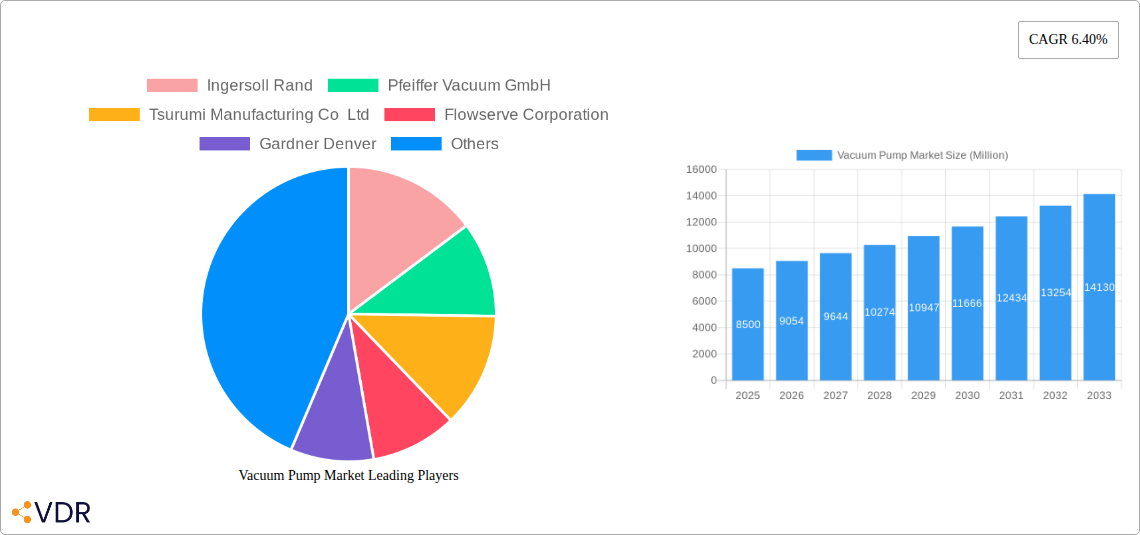
Vacuum Pump Market Market Size (In Billion)

Technological advancements and product innovation are shaping the market landscape. The introduction of energy-efficient and low-maintenance vacuum pump technologies, including advanced Rotary Vacuum Pumps and highly specialized Kinetic Vacuum Pumps, is addressing environmental concerns and operational cost pressures for end-users. Emerging trends like the adoption of smart vacuum systems with integrated monitoring and control capabilities are further enhancing efficiency and reliability. However, the market faces certain restraints, including the high initial investment cost for certain advanced vacuum pump technologies and the availability of alternative solutions in specific applications. Despite these challenges, the diversified application base and continuous innovation are expected to sustain a positive growth trajectory for the Vacuum Pump Market.
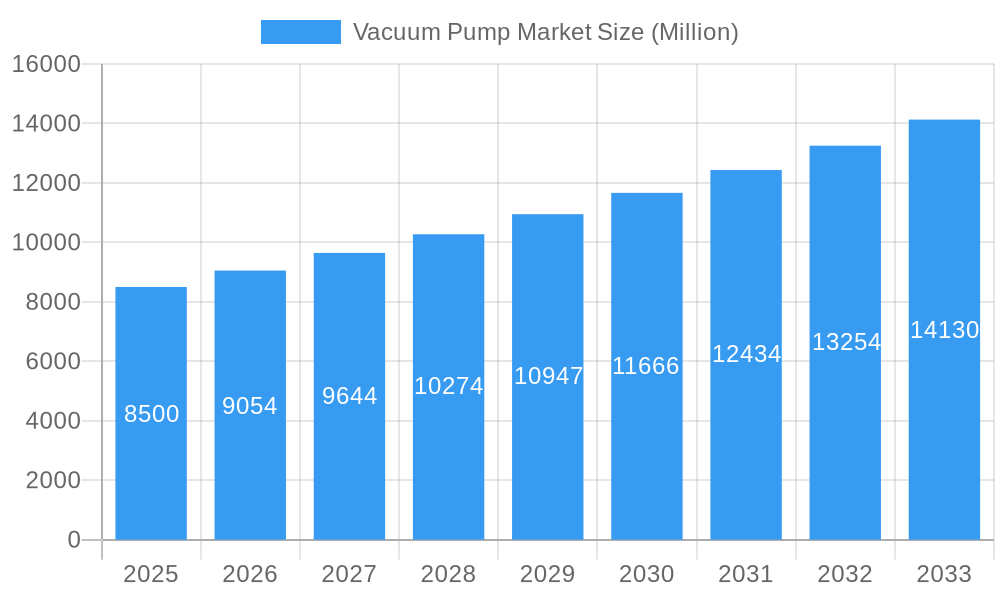
Vacuum Pump Market Company Market Share
Comprehensive Report: Vacuum Pump Market - Global Outlook and Forecast (2019-2033)
This in-depth report provides a comprehensive analysis of the global vacuum pump market, offering critical insights for industry professionals, investors, and decision-makers. Covering the period from 2019 to 2033, with a base year of 2025, the report dissects market dynamics, growth trends, regional dominance, product landscape, key drivers, barriers, opportunities, and the pivotal roles of leading companies. With a focus on vacuum technology advancements, industrial vacuum solutions, and process vacuum systems, this report is optimized for high search engine visibility, leveraging essential keywords for maximum reach. Discover the current state and future trajectory of the vacuum pump industry, including breakdowns by parent market and child market segments.
Vacuum Pump Market Market Dynamics & Structure
The global vacuum pump market is characterized by a dynamic interplay of technological innovation, stringent regulatory frameworks, and evolving end-user demands. Market concentration varies across different segments, with specialized applications often featuring more consolidated supplier bases. Technological innovation drivers are predominantly fueled by the pursuit of higher efficiency, lower energy consumption, and enhanced environmental compliance in industrial vacuum pumps. Regulatory frameworks, particularly concerning emissions and safety standards in sectors like oil and gas vacuum systems and chemical processing vacuum applications, significantly influence product development and adoption. Competitive product substitutes, such as alternative pumping technologies and advancements in existing ones, continuously challenge established players. End-user demographics are expanding, driven by the increasing adoption of advanced manufacturing processes in the electronics vacuum market and the growing need for reliable vacuum solutions in the medical vacuum equipment sector. Mergers and acquisitions (M&A) trends reflect a strategic consolidation to expand product portfolios, enhance market reach, and acquire innovative technologies.
- Market Concentration: Moderate to high in segments like Rotary Vacuum Pumps, with a broader distribution in emerging and niche applications.
- Technological Innovation Drivers: Energy efficiency, reduced footprint, IoT integration for smart control, and development of oil-free vacuum technologies.
- Regulatory Frameworks: Environmental regulations (e.g., emissions control), safety standards, and industry-specific compliance requirements.
- Competitive Product Substitutes: Advancements in diaphragm pumps, dry screw pumps, and novel pump designs offering comparable performance with lower operational costs.
- End-user Demographics: Growth driven by semiconductor manufacturing, pharmaceuticals, food packaging, and advanced research laboratories.
- M&A Trends: Strategic acquisitions for market expansion, technology integration, and portfolio diversification. For instance, the acquisition of specialized vacuum technology providers by larger industrial conglomerates.
Vacuum Pump Market Growth Trends & Insights
The vacuum pump market is poised for robust growth, driven by the increasing demand for sophisticated vacuum solutions across diverse industrial applications. The global market size is projected to witness significant expansion, fueled by advancements in process vacuum systems and the adoption of cutting-edge industrial vacuum technology. As industries worldwide embrace automation and enhance their manufacturing capabilities, the need for reliable and efficient vacuum pumps becomes paramount. Adoption rates are accelerating, particularly in emerging economies where industrialization is rapidly progressing. Technological disruptions, such as the development of variable speed drives (VSD) in screw vacuum pumps and improved turbo molecular pump designs, are enhancing performance and reducing operational costs, thereby encouraging wider adoption. Consumer behavior shifts are also playing a crucial role, with an increasing emphasis on sustainability, energy efficiency, and smart, connected vacuum systems. Manufacturers are responding by developing pumps with lower energy footprints and integrated intelligent control systems that allow for predictive maintenance and optimized performance, aligning with the broader trend towards Industry 4.0. The forecast period (2025–2033) is expected to see a Compound Annual Growth Rate (CAGR) of approximately 5.5%, reaching an estimated market value of $18.5 billion in 2025, and projected to reach $28.9 billion by 2033. Market penetration is deepening in sectors like semiconductor manufacturing, where ultra-high vacuum requirements are standard, and in the pharmaceutical industry for critical applications like freeze-drying and sterile processing. The historical period (2019–2024) laid the groundwork for this expansion, with steady growth influenced by technological advancements and the expanding industrial base. The increasing complexity of manufacturing processes, particularly in the electronics vacuum pump market, necessitates highly specialized and reliable vacuum generation, further propelling market growth.
Dominant Regions, Countries, or Segments in Vacuum Pump Market
The vacuum pump market is experiencing significant growth, with certain regions and segments demonstrating exceptional dominance. Asia Pacific stands out as the leading region, driven by its robust manufacturing sector, particularly in China, South Korea, and Japan, which are major hubs for electronics manufacturing and automotive production. The burgeoning oil and gas industry in the Middle East also contributes substantially to regional demand for specialized vacuum pumps.
- Dominant Region: Asia Pacific
- Key Drivers: Rapid industrialization, significant investments in manufacturing infrastructure, a strong presence of electronics and semiconductor industries, and growing demand from the automotive sector.
- Market Share: Estimated to hold over 40% of the global vacuum pump market share in the base year 2025.
- Growth Potential: Continued expansion driven by government initiatives supporting advanced manufacturing and the increasing adoption of sophisticated industrial processes.
Among the different types of vacuum pumps, Rotary Vacuum Pumps represent the largest and most dominant segment. Within this broad category, Screw and Claw Pumps and Rotary Vane Pumps are particularly instrumental in driving market growth due to their versatility, efficiency, and wide range of applications.
- Dominant Segment (Type): Rotary Vacuum Pumps
- Sub-segments:
- Screw and Claw Pumps: Dominant in demanding applications requiring high throughput and reliability, such as semiconductor manufacturing and general industrial processes. Their oil-free operation in many configurations addresses critical clean vacuum requirements.
- Rotary Vane Pumps: Widely adopted for their cost-effectiveness and reliability in medium to high vacuum applications across various industries like food and beverage, packaging, and medical devices.
- Market Share: Rotary Vacuum Pumps are estimated to account for approximately 35% of the total vacuum pump market value in 2025.
- Growth Factors: Continuous innovation in design for improved efficiency, reduced maintenance, and suitability for specific challenging environments.
- Sub-segments:
In terms of end-user applications, the Electronics sector is a major growth engine for the vacuum pump market. The ever-increasing demand for smaller, more powerful, and complex electronic devices necessitates ultra-high vacuum environments for manufacturing processes like semiconductor fabrication, thin-film deposition, and advanced packaging.
- Dominant Segment (End-user Application): Electronics
- Key Applications: Semiconductor fabrication (wafer processing, etching, deposition), flat-panel display manufacturing, solar cell production, and advanced packaging.
- Market Share: The electronics sector is projected to command nearly 25% of the global vacuum pump market revenue in 2025.
- Growth Drivers: The relentless pace of innovation in the semiconductor industry, the growing demand for advanced displays, and the expansion of the renewable energy sector (solar).
The Chemical Processing industry also remains a significant contributor, utilizing vacuum pumps for distillation, drying, filtration, and material transfer in a variety of chemical manufacturing processes. The Oil and Gas sector's demand for vacuum pumps for applications like degassing, evaporation, and solvent recovery further solidifies these segments' importance.
Vacuum Pump Market Product Landscape
The vacuum pump market is defined by a diverse and evolving product landscape, driven by continuous innovation. Key product developments include the introduction of highly efficient, oil-free Rotary Vane Pumps and Screw Pumps designed for minimal maintenance and extended operational life. Advancements in Turbomolecular Pumps offer ultra-high vacuum capabilities essential for semiconductor manufacturing and scientific research. The integration of variable speed drives (VSD) across various pump types, notably in Atlas Copco's GHS VSD+ range, enhances energy efficiency and allows for precise process control. Pfeiffer Vacuum's ACP 90 multi-stage roots pumps represent a significant innovation for oil- and particle-free applications, crucial for drying and sterilization. These product innovations focus on increasing pumping speeds, improving ultimate vacuum levels, reducing energy consumption, and enhancing reliability. Unique selling propositions include tailored solutions for specific hazardous environments, smart connectivity features for remote monitoring and diagnostics, and compact designs that minimize footprint.
Key Drivers, Barriers & Challenges in Vacuum Pump Market
The vacuum pump market is propelled by several key drivers. Technological advancements in efficiency, reliability, and specialized functionalities are paramount. The increasing industrialization and adoption of advanced manufacturing across emerging economies, particularly in Asia Pacific, create significant demand. Stringent environmental regulations are pushing for the adoption of energy-efficient and low-emission vacuum solutions. Growth in sectors like electronics, pharmaceuticals, and oil and gas directly translates to increased demand for vacuum pumps.
However, the market also faces significant barriers and challenges. High initial capital investment for sophisticated vacuum systems can be a restraint for small and medium-sized enterprises. Supply chain disruptions, particularly for specialized components, can impact production timelines and costs. Intense competition among established players and the emergence of new entrants lead to price pressures. Maintaining and servicing complex vacuum equipment requires skilled labor, which can be a challenge in certain regions. Furthermore, the energy consumption of older, less efficient vacuum pumps presents an ongoing challenge as industries strive for greater sustainability.
Emerging Opportunities in Vacuum Pump Market
Emerging opportunities in the vacuum pump market are abundant, driven by evolving industrial needs and technological breakthroughs. The growing demand for clean and precise vacuum applications in the pharmaceutical and biotechnology sectors for freeze-drying, sterile processing, and laboratory research presents a significant opportunity. The expansion of the semiconductor manufacturing industry, with its ever-increasing need for ultra-high vacuum solutions, continues to be a prime growth area. Furthermore, the development and adoption of Industry 4.0 technologies, including the integration of IoT sensors and advanced analytics into vacuum pump systems for predictive maintenance and optimized performance, offer substantial potential for value-added services and intelligent solutions. The increasing focus on sustainable manufacturing is also creating opportunities for energy-efficient and environmentally friendly vacuum pump designs. The development of smaller, more portable vacuum solutions for specialized applications in fields like additive manufacturing and advanced materials processing also represents an untapped market.
Growth Accelerators in the Vacuum Pump Market Industry
Long-term growth in the vacuum pump market is being accelerated by several factors. Continuous technological breakthroughs in pump design, materials science, and control systems are leading to more efficient, reliable, and cost-effective vacuum solutions. Strategic partnerships and collaborations between vacuum pump manufacturers and end-users are crucial for developing bespoke solutions tailored to specific industrial challenges. Market expansion strategies, including the penetration of emerging economies and the establishment of robust service networks, are also key growth accelerators. The increasing automation of manufacturing processes across industries necessitates reliable and high-performance vacuum systems, further fueling market expansion. Investments in research and development to create next-generation vacuum technologies, such as advanced dry pumps and compact high-capacity systems, are critical for sustained growth.
Key Players Shaping the Vacuum Pump Market Market
- Ingersoll Rand
- Pfeiffer Vacuum GmbH
- Tsurumi Manufacturing Co Ltd
- Flowserve Corporation
- Gardner Denver
- Atlas Copco AB
- Busch Group
- Becker Pumps
- Edwards Vacuum
- ULVAC
Notable Milestones in Vacuum Pump Market Sector
- August 2022: Pfeiffer Vacuum introduced new multi-stage roots pumps ACP 90 for oil- and particle-free applications. The multi-stage pumps prove beneficial for pumping large amounts of condensable gases in drying applications, high-humidity environments, or sizeable insulating volume pumping. These vacuum pumps meet the requirements where a clean and dry vacuum is needed, like drying, sterilization, coating, semiconductor, and research and development applications.
- May 2022: Building on the revolutionary GHS VSD+ range of variable speed-driven oil-injected screw vacuum pumps, Atlas Copco introduced the new GHS 1402-2002 VSD+ series vacuum pumps that offer intelligent networking of vacuum pumps and processes. These series of pumps have a new design for better performance, optimal oil separation, a smaller footprint, and an innovative new controller which puts the customer in gear for Industry 4.0. With the GHS 1402 - 2002 VSD+ series, Atlas Copco is launching a new model of speed-driven screw pumps in three pumping speed classes.
In-Depth Vacuum Pump Market Market Outlook
The vacuum pump market is set for a period of sustained and significant growth, driven by an accelerating global industrial landscape and relentless technological innovation. Future market potential is robust, with increasing demand for high-performance, energy-efficient, and intelligent vacuum solutions across a widening array of applications. Strategic opportunities lie in focusing on key growth sectors like electronics manufacturing, pharmaceutical production, and the burgeoning renewable energy sector. The continued development and adoption of advanced dry vacuum pumps and oil-free vacuum systems will be pivotal. Furthermore, leveraging the trends of Industry 4.0 to offer integrated, smart, and data-driven vacuum solutions will unlock new revenue streams and solidify market leadership. The geographical expansion into emerging markets and the continuous enhancement of product portfolios to meet evolving regulatory and operational demands are crucial for capturing future growth and maintaining a competitive edge in this dynamic industry.
Vacuum Pump Market Segmentation
-
1. Type
-
1.1. Rotary Vacuum Pumps
- 1.1.1. Rotary Vane Pumps
- 1.1.2. Screw and Claw Pumps
- 1.1.3. Roots Pumps
-
1.2. Reciprocating Vacuum Pumps
- 1.2.1. Diaphragm Pumps
- 1.2.2. Piston Pumps
-
1.3. Kinetic Vacuum Pumps
- 1.3.1. Ejector Pumps
- 1.3.2. Turbomolecular Pumps
- 1.3.3. Diffusion Pumps
-
1.4. Dynamic Pumps
- 1.4.1. Liquid Ring Pumps
- 1.4.2. Side Channel Pumps
-
1.5. Specialized Vacuum Pumps
- 1.5.1. Getter Pumps
- 1.5.2. Cryogenic Pumps
-
1.1. Rotary Vacuum Pumps
-
2. End-user Application
- 2.1. Oil and Gas
- 2.2. Electronics
- 2.3. Medicine
- 2.4. Chemical Processing
- 2.5. Food and Beverage
- 2.6. Power Generation
- 2.7. Other
Vacuum Pump Market Segmentation By Geography
-
1. North America
- 1.1. United States
- 1.2. Canada
- 1.3. Mexico
-
2. South America
- 2.1. Brazil
- 2.2. Argentina
- 2.3. Rest of South America
-
3. Europe
- 3.1. United Kingdom
- 3.2. Germany
- 3.3. France
- 3.4. Italy
- 3.5. Spain
- 3.6. Russia
- 3.7. Benelux
- 3.8. Nordics
- 3.9. Rest of Europe
-
4. Middle East & Africa
- 4.1. Turkey
- 4.2. Israel
- 4.3. GCC
- 4.4. North Africa
- 4.5. South Africa
- 4.6. Rest of Middle East & Africa
-
5. Asia Pacific
- 5.1. China
- 5.2. India
- 5.3. Japan
- 5.4. South Korea
- 5.5. ASEAN
- 5.6. Oceania
- 5.7. Rest of Asia Pacific
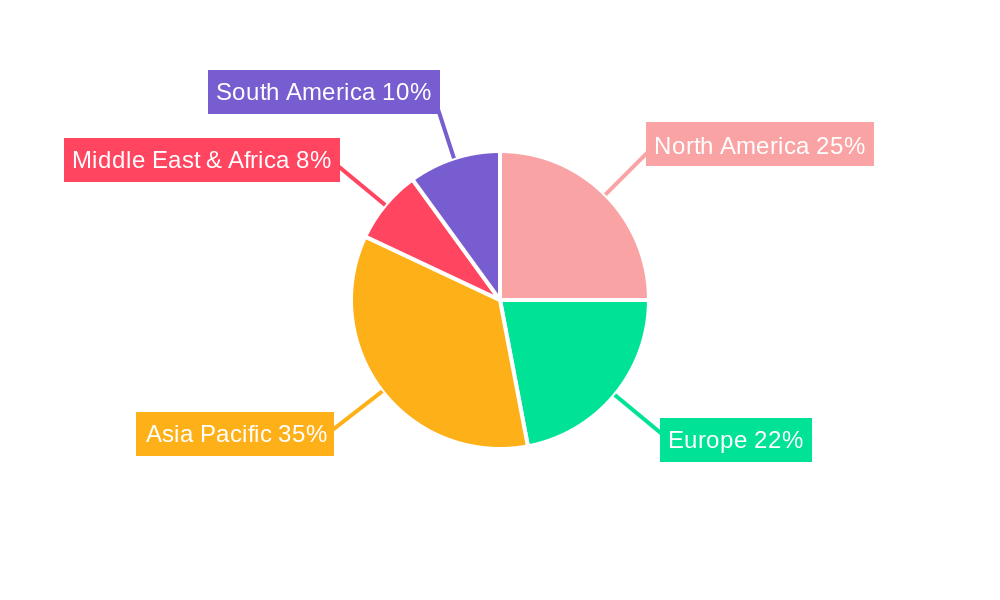
Vacuum Pump Market Regional Market Share
Geographic Coverage of Vacuum Pump Market
Vacuum Pump Market REPORT HIGHLIGHTS
| Aspects | Details |
|---|---|
| Study Period | 2020-2034 |
| Base Year | 2025 |
| Estimated Year | 2026 |
| Forecast Period | 2026-2034 |
| Historical Period | 2020-2025 |
| Growth Rate | CAGR of 6.40% from 2020-2034 |
| Segmentation |
|
Table of Contents
- 1. Introduction
- 1.1. Research Scope
- 1.2. Market Segmentation
- 1.3. Research Methodology
- 1.4. Definitions and Assumptions
- 2. Executive Summary
- 2.1. Introduction
- 3. Market Dynamics
- 3.1. Introduction
- 3.2. Market Drivers
- 3.2.1. Increasing Popularity of MEMS Technology; Increasing Demand for Dry Vacuum Pump
- 3.3. Market Restrains
- 3.3.1. ; Unstable Raw Material Prices; Complications in Installation
- 3.4. Market Trends
- 3.4.1. Rotary Vane Pumps to Witness Significant Growth
- 4. Market Factor Analysis
- 4.1. Porters Five Forces
- 4.2. Supply/Value Chain
- 4.3. PESTEL analysis
- 4.4. Market Entropy
- 4.5. Patent/Trademark Analysis
- 5. Global Vacuum Pump Market Analysis, Insights and Forecast, 2020-2032
- 5.1. Market Analysis, Insights and Forecast - by Type
- 5.1.1. Rotary Vacuum Pumps
- 5.1.1.1. Rotary Vane Pumps
- 5.1.1.2. Screw and Claw Pumps
- 5.1.1.3. Roots Pumps
- 5.1.2. Reciprocating Vacuum Pumps
- 5.1.2.1. Diaphragm Pumps
- 5.1.2.2. Piston Pumps
- 5.1.3. Kinetic Vacuum Pumps
- 5.1.3.1. Ejector Pumps
- 5.1.3.2. Turbomolecular Pumps
- 5.1.3.3. Diffusion Pumps
- 5.1.4. Dynamic Pumps
- 5.1.4.1. Liquid Ring Pumps
- 5.1.4.2. Side Channel Pumps
- 5.1.5. Specialized Vacuum Pumps
- 5.1.5.1. Getter Pumps
- 5.1.5.2. Cryogenic Pumps
- 5.1.1. Rotary Vacuum Pumps
- 5.2. Market Analysis, Insights and Forecast - by End-user Application
- 5.2.1. Oil and Gas
- 5.2.2. Electronics
- 5.2.3. Medicine
- 5.2.4. Chemical Processing
- 5.2.5. Food and Beverage
- 5.2.6. Power Generation
- 5.2.7. Other
- 5.3. Market Analysis, Insights and Forecast - by Region
- 5.3.1. North America
- 5.3.2. South America
- 5.3.3. Europe
- 5.3.4. Middle East & Africa
- 5.3.5. Asia Pacific
- 5.1. Market Analysis, Insights and Forecast - by Type
- 6. North America Vacuum Pump Market Analysis, Insights and Forecast, 2020-2032
- 6.1. Market Analysis, Insights and Forecast - by Type
- 6.1.1. Rotary Vacuum Pumps
- 6.1.1.1. Rotary Vane Pumps
- 6.1.1.2. Screw and Claw Pumps
- 6.1.1.3. Roots Pumps
- 6.1.2. Reciprocating Vacuum Pumps
- 6.1.2.1. Diaphragm Pumps
- 6.1.2.2. Piston Pumps
- 6.1.3. Kinetic Vacuum Pumps
- 6.1.3.1. Ejector Pumps
- 6.1.3.2. Turbomolecular Pumps
- 6.1.3.3. Diffusion Pumps
- 6.1.4. Dynamic Pumps
- 6.1.4.1. Liquid Ring Pumps
- 6.1.4.2. Side Channel Pumps
- 6.1.5. Specialized Vacuum Pumps
- 6.1.5.1. Getter Pumps
- 6.1.5.2. Cryogenic Pumps
- 6.1.1. Rotary Vacuum Pumps
- 6.2. Market Analysis, Insights and Forecast - by End-user Application
- 6.2.1. Oil and Gas
- 6.2.2. Electronics
- 6.2.3. Medicine
- 6.2.4. Chemical Processing
- 6.2.5. Food and Beverage
- 6.2.6. Power Generation
- 6.2.7. Other
- 6.1. Market Analysis, Insights and Forecast - by Type
- 7. South America Vacuum Pump Market Analysis, Insights and Forecast, 2020-2032
- 7.1. Market Analysis, Insights and Forecast - by Type
- 7.1.1. Rotary Vacuum Pumps
- 7.1.1.1. Rotary Vane Pumps
- 7.1.1.2. Screw and Claw Pumps
- 7.1.1.3. Roots Pumps
- 7.1.2. Reciprocating Vacuum Pumps
- 7.1.2.1. Diaphragm Pumps
- 7.1.2.2. Piston Pumps
- 7.1.3. Kinetic Vacuum Pumps
- 7.1.3.1. Ejector Pumps
- 7.1.3.2. Turbomolecular Pumps
- 7.1.3.3. Diffusion Pumps
- 7.1.4. Dynamic Pumps
- 7.1.4.1. Liquid Ring Pumps
- 7.1.4.2. Side Channel Pumps
- 7.1.5. Specialized Vacuum Pumps
- 7.1.5.1. Getter Pumps
- 7.1.5.2. Cryogenic Pumps
- 7.1.1. Rotary Vacuum Pumps
- 7.2. Market Analysis, Insights and Forecast - by End-user Application
- 7.2.1. Oil and Gas
- 7.2.2. Electronics
- 7.2.3. Medicine
- 7.2.4. Chemical Processing
- 7.2.5. Food and Beverage
- 7.2.6. Power Generation
- 7.2.7. Other
- 7.1. Market Analysis, Insights and Forecast - by Type
- 8. Europe Vacuum Pump Market Analysis, Insights and Forecast, 2020-2032
- 8.1. Market Analysis, Insights and Forecast - by Type
- 8.1.1. Rotary Vacuum Pumps
- 8.1.1.1. Rotary Vane Pumps
- 8.1.1.2. Screw and Claw Pumps
- 8.1.1.3. Roots Pumps
- 8.1.2. Reciprocating Vacuum Pumps
- 8.1.2.1. Diaphragm Pumps
- 8.1.2.2. Piston Pumps
- 8.1.3. Kinetic Vacuum Pumps
- 8.1.3.1. Ejector Pumps
- 8.1.3.2. Turbomolecular Pumps
- 8.1.3.3. Diffusion Pumps
- 8.1.4. Dynamic Pumps
- 8.1.4.1. Liquid Ring Pumps
- 8.1.4.2. Side Channel Pumps
- 8.1.5. Specialized Vacuum Pumps
- 8.1.5.1. Getter Pumps
- 8.1.5.2. Cryogenic Pumps
- 8.1.1. Rotary Vacuum Pumps
- 8.2. Market Analysis, Insights and Forecast - by End-user Application
- 8.2.1. Oil and Gas
- 8.2.2. Electronics
- 8.2.3. Medicine
- 8.2.4. Chemical Processing
- 8.2.5. Food and Beverage
- 8.2.6. Power Generation
- 8.2.7. Other
- 8.1. Market Analysis, Insights and Forecast - by Type
- 9. Middle East & Africa Vacuum Pump Market Analysis, Insights and Forecast, 2020-2032
- 9.1. Market Analysis, Insights and Forecast - by Type
- 9.1.1. Rotary Vacuum Pumps
- 9.1.1.1. Rotary Vane Pumps
- 9.1.1.2. Screw and Claw Pumps
- 9.1.1.3. Roots Pumps
- 9.1.2. Reciprocating Vacuum Pumps
- 9.1.2.1. Diaphragm Pumps
- 9.1.2.2. Piston Pumps
- 9.1.3. Kinetic Vacuum Pumps
- 9.1.3.1. Ejector Pumps
- 9.1.3.2. Turbomolecular Pumps
- 9.1.3.3. Diffusion Pumps
- 9.1.4. Dynamic Pumps
- 9.1.4.1. Liquid Ring Pumps
- 9.1.4.2. Side Channel Pumps
- 9.1.5. Specialized Vacuum Pumps
- 9.1.5.1. Getter Pumps
- 9.1.5.2. Cryogenic Pumps
- 9.1.1. Rotary Vacuum Pumps
- 9.2. Market Analysis, Insights and Forecast - by End-user Application
- 9.2.1. Oil and Gas
- 9.2.2. Electronics
- 9.2.3. Medicine
- 9.2.4. Chemical Processing
- 9.2.5. Food and Beverage
- 9.2.6. Power Generation
- 9.2.7. Other
- 9.1. Market Analysis, Insights and Forecast - by Type
- 10. Asia Pacific Vacuum Pump Market Analysis, Insights and Forecast, 2020-2032
- 10.1. Market Analysis, Insights and Forecast - by Type
- 10.1.1. Rotary Vacuum Pumps
- 10.1.1.1. Rotary Vane Pumps
- 10.1.1.2. Screw and Claw Pumps
- 10.1.1.3. Roots Pumps
- 10.1.2. Reciprocating Vacuum Pumps
- 10.1.2.1. Diaphragm Pumps
- 10.1.2.2. Piston Pumps
- 10.1.3. Kinetic Vacuum Pumps
- 10.1.3.1. Ejector Pumps
- 10.1.3.2. Turbomolecular Pumps
- 10.1.3.3. Diffusion Pumps
- 10.1.4. Dynamic Pumps
- 10.1.4.1. Liquid Ring Pumps
- 10.1.4.2. Side Channel Pumps
- 10.1.5. Specialized Vacuum Pumps
- 10.1.5.1. Getter Pumps
- 10.1.5.2. Cryogenic Pumps
- 10.1.1. Rotary Vacuum Pumps
- 10.2. Market Analysis, Insights and Forecast - by End-user Application
- 10.2.1. Oil and Gas
- 10.2.2. Electronics
- 10.2.3. Medicine
- 10.2.4. Chemical Processing
- 10.2.5. Food and Beverage
- 10.2.6. Power Generation
- 10.2.7. Other
- 10.1. Market Analysis, Insights and Forecast - by Type
- 11. Competitive Analysis
- 11.1. Global Market Share Analysis 2025
- 11.2. Company Profiles
- 11.2.1 Ingersoll Rand
- 11.2.1.1. Overview
- 11.2.1.2. Products
- 11.2.1.3. SWOT Analysis
- 11.2.1.4. Recent Developments
- 11.2.1.5. Financials (Based on Availability)
- 11.2.2 Pfeiffer Vacuum GmbH
- 11.2.2.1. Overview
- 11.2.2.2. Products
- 11.2.2.3. SWOT Analysis
- 11.2.2.4. Recent Developments
- 11.2.2.5. Financials (Based on Availability)
- 11.2.3 Tsurumi Manufacturing Co Ltd
- 11.2.3.1. Overview
- 11.2.3.2. Products
- 11.2.3.3. SWOT Analysis
- 11.2.3.4. Recent Developments
- 11.2.3.5. Financials (Based on Availability)
- 11.2.4 Flowserve Corporation
- 11.2.4.1. Overview
- 11.2.4.2. Products
- 11.2.4.3. SWOT Analysis
- 11.2.4.4. Recent Developments
- 11.2.4.5. Financials (Based on Availability)
- 11.2.5 Gardner Denver
- 11.2.5.1. Overview
- 11.2.5.2. Products
- 11.2.5.3. SWOT Analysis
- 11.2.5.4. Recent Developments
- 11.2.5.5. Financials (Based on Availability)
- 11.2.6 Atlas Copco AB
- 11.2.6.1. Overview
- 11.2.6.2. Products
- 11.2.6.3. SWOT Analysis
- 11.2.6.4. Recent Developments
- 11.2.6.5. Financials (Based on Availability)
- 11.2.7 Busch Group
- 11.2.7.1. Overview
- 11.2.7.2. Products
- 11.2.7.3. SWOT Analysis
- 11.2.7.4. Recent Developments
- 11.2.7.5. Financials (Based on Availability)
- 11.2.8 Becker Pumps
- 11.2.8.1. Overview
- 11.2.8.2. Products
- 11.2.8.3. SWOT Analysis
- 11.2.8.4. Recent Developments
- 11.2.8.5. Financials (Based on Availability)
- 11.2.9 Edwards Vacuum
- 11.2.9.1. Overview
- 11.2.9.2. Products
- 11.2.9.3. SWOT Analysis
- 11.2.9.4. Recent Developments
- 11.2.9.5. Financials (Based on Availability)
- 11.2.10 ULVAC
- 11.2.10.1. Overview
- 11.2.10.2. Products
- 11.2.10.3. SWOT Analysis
- 11.2.10.4. Recent Developments
- 11.2.10.5. Financials (Based on Availability)
- 11.2.1 Ingersoll Rand
List of Figures
- Figure 1: Global Vacuum Pump Market Revenue Breakdown (Million, %) by Region 2025 & 2033
- Figure 2: Global Vacuum Pump Market Volume Breakdown (K Unit, %) by Region 2025 & 2033
- Figure 3: North America Vacuum Pump Market Revenue (Million), by Type 2025 & 2033
- Figure 4: North America Vacuum Pump Market Volume (K Unit), by Type 2025 & 2033
- Figure 5: North America Vacuum Pump Market Revenue Share (%), by Type 2025 & 2033
- Figure 6: North America Vacuum Pump Market Volume Share (%), by Type 2025 & 2033
- Figure 7: North America Vacuum Pump Market Revenue (Million), by End-user Application 2025 & 2033
- Figure 8: North America Vacuum Pump Market Volume (K Unit), by End-user Application 2025 & 2033
- Figure 9: North America Vacuum Pump Market Revenue Share (%), by End-user Application 2025 & 2033
- Figure 10: North America Vacuum Pump Market Volume Share (%), by End-user Application 2025 & 2033
- Figure 11: North America Vacuum Pump Market Revenue (Million), by Country 2025 & 2033
- Figure 12: North America Vacuum Pump Market Volume (K Unit), by Country 2025 & 2033
- Figure 13: North America Vacuum Pump Market Revenue Share (%), by Country 2025 & 2033
- Figure 14: North America Vacuum Pump Market Volume Share (%), by Country 2025 & 2033
- Figure 15: South America Vacuum Pump Market Revenue (Million), by Type 2025 & 2033
- Figure 16: South America Vacuum Pump Market Volume (K Unit), by Type 2025 & 2033
- Figure 17: South America Vacuum Pump Market Revenue Share (%), by Type 2025 & 2033
- Figure 18: South America Vacuum Pump Market Volume Share (%), by Type 2025 & 2033
- Figure 19: South America Vacuum Pump Market Revenue (Million), by End-user Application 2025 & 2033
- Figure 20: South America Vacuum Pump Market Volume (K Unit), by End-user Application 2025 & 2033
- Figure 21: South America Vacuum Pump Market Revenue Share (%), by End-user Application 2025 & 2033
- Figure 22: South America Vacuum Pump Market Volume Share (%), by End-user Application 2025 & 2033
- Figure 23: South America Vacuum Pump Market Revenue (Million), by Country 2025 & 2033
- Figure 24: South America Vacuum Pump Market Volume (K Unit), by Country 2025 & 2033
- Figure 25: South America Vacuum Pump Market Revenue Share (%), by Country 2025 & 2033
- Figure 26: South America Vacuum Pump Market Volume Share (%), by Country 2025 & 2033
- Figure 27: Europe Vacuum Pump Market Revenue (Million), by Type 2025 & 2033
- Figure 28: Europe Vacuum Pump Market Volume (K Unit), by Type 2025 & 2033
- Figure 29: Europe Vacuum Pump Market Revenue Share (%), by Type 2025 & 2033
- Figure 30: Europe Vacuum Pump Market Volume Share (%), by Type 2025 & 2033
- Figure 31: Europe Vacuum Pump Market Revenue (Million), by End-user Application 2025 & 2033
- Figure 32: Europe Vacuum Pump Market Volume (K Unit), by End-user Application 2025 & 2033
- Figure 33: Europe Vacuum Pump Market Revenue Share (%), by End-user Application 2025 & 2033
- Figure 34: Europe Vacuum Pump Market Volume Share (%), by End-user Application 2025 & 2033
- Figure 35: Europe Vacuum Pump Market Revenue (Million), by Country 2025 & 2033
- Figure 36: Europe Vacuum Pump Market Volume (K Unit), by Country 2025 & 2033
- Figure 37: Europe Vacuum Pump Market Revenue Share (%), by Country 2025 & 2033
- Figure 38: Europe Vacuum Pump Market Volume Share (%), by Country 2025 & 2033
- Figure 39: Middle East & Africa Vacuum Pump Market Revenue (Million), by Type 2025 & 2033
- Figure 40: Middle East & Africa Vacuum Pump Market Volume (K Unit), by Type 2025 & 2033
- Figure 41: Middle East & Africa Vacuum Pump Market Revenue Share (%), by Type 2025 & 2033
- Figure 42: Middle East & Africa Vacuum Pump Market Volume Share (%), by Type 2025 & 2033
- Figure 43: Middle East & Africa Vacuum Pump Market Revenue (Million), by End-user Application 2025 & 2033
- Figure 44: Middle East & Africa Vacuum Pump Market Volume (K Unit), by End-user Application 2025 & 2033
- Figure 45: Middle East & Africa Vacuum Pump Market Revenue Share (%), by End-user Application 2025 & 2033
- Figure 46: Middle East & Africa Vacuum Pump Market Volume Share (%), by End-user Application 2025 & 2033
- Figure 47: Middle East & Africa Vacuum Pump Market Revenue (Million), by Country 2025 & 2033
- Figure 48: Middle East & Africa Vacuum Pump Market Volume (K Unit), by Country 2025 & 2033
- Figure 49: Middle East & Africa Vacuum Pump Market Revenue Share (%), by Country 2025 & 2033
- Figure 50: Middle East & Africa Vacuum Pump Market Volume Share (%), by Country 2025 & 2033
- Figure 51: Asia Pacific Vacuum Pump Market Revenue (Million), by Type 2025 & 2033
- Figure 52: Asia Pacific Vacuum Pump Market Volume (K Unit), by Type 2025 & 2033
- Figure 53: Asia Pacific Vacuum Pump Market Revenue Share (%), by Type 2025 & 2033
- Figure 54: Asia Pacific Vacuum Pump Market Volume Share (%), by Type 2025 & 2033
- Figure 55: Asia Pacific Vacuum Pump Market Revenue (Million), by End-user Application 2025 & 2033
- Figure 56: Asia Pacific Vacuum Pump Market Volume (K Unit), by End-user Application 2025 & 2033
- Figure 57: Asia Pacific Vacuum Pump Market Revenue Share (%), by End-user Application 2025 & 2033
- Figure 58: Asia Pacific Vacuum Pump Market Volume Share (%), by End-user Application 2025 & 2033
- Figure 59: Asia Pacific Vacuum Pump Market Revenue (Million), by Country 2025 & 2033
- Figure 60: Asia Pacific Vacuum Pump Market Volume (K Unit), by Country 2025 & 2033
- Figure 61: Asia Pacific Vacuum Pump Market Revenue Share (%), by Country 2025 & 2033
- Figure 62: Asia Pacific Vacuum Pump Market Volume Share (%), by Country 2025 & 2033
List of Tables
- Table 1: Global Vacuum Pump Market Revenue Million Forecast, by Type 2020 & 2033
- Table 2: Global Vacuum Pump Market Volume K Unit Forecast, by Type 2020 & 2033
- Table 3: Global Vacuum Pump Market Revenue Million Forecast, by End-user Application 2020 & 2033
- Table 4: Global Vacuum Pump Market Volume K Unit Forecast, by End-user Application 2020 & 2033
- Table 5: Global Vacuum Pump Market Revenue Million Forecast, by Region 2020 & 2033
- Table 6: Global Vacuum Pump Market Volume K Unit Forecast, by Region 2020 & 2033
- Table 7: Global Vacuum Pump Market Revenue Million Forecast, by Type 2020 & 2033
- Table 8: Global Vacuum Pump Market Volume K Unit Forecast, by Type 2020 & 2033
- Table 9: Global Vacuum Pump Market Revenue Million Forecast, by End-user Application 2020 & 2033
- Table 10: Global Vacuum Pump Market Volume K Unit Forecast, by End-user Application 2020 & 2033
- Table 11: Global Vacuum Pump Market Revenue Million Forecast, by Country 2020 & 2033
- Table 12: Global Vacuum Pump Market Volume K Unit Forecast, by Country 2020 & 2033
- Table 13: United States Vacuum Pump Market Revenue (Million) Forecast, by Application 2020 & 2033
- Table 14: United States Vacuum Pump Market Volume (K Unit) Forecast, by Application 2020 & 2033
- Table 15: Canada Vacuum Pump Market Revenue (Million) Forecast, by Application 2020 & 2033
- Table 16: Canada Vacuum Pump Market Volume (K Unit) Forecast, by Application 2020 & 2033
- Table 17: Mexico Vacuum Pump Market Revenue (Million) Forecast, by Application 2020 & 2033
- Table 18: Mexico Vacuum Pump Market Volume (K Unit) Forecast, by Application 2020 & 2033
- Table 19: Global Vacuum Pump Market Revenue Million Forecast, by Type 2020 & 2033
- Table 20: Global Vacuum Pump Market Volume K Unit Forecast, by Type 2020 & 2033
- Table 21: Global Vacuum Pump Market Revenue Million Forecast, by End-user Application 2020 & 2033
- Table 22: Global Vacuum Pump Market Volume K Unit Forecast, by End-user Application 2020 & 2033
- Table 23: Global Vacuum Pump Market Revenue Million Forecast, by Country 2020 & 2033
- Table 24: Global Vacuum Pump Market Volume K Unit Forecast, by Country 2020 & 2033
- Table 25: Brazil Vacuum Pump Market Revenue (Million) Forecast, by Application 2020 & 2033
- Table 26: Brazil Vacuum Pump Market Volume (K Unit) Forecast, by Application 2020 & 2033
- Table 27: Argentina Vacuum Pump Market Revenue (Million) Forecast, by Application 2020 & 2033
- Table 28: Argentina Vacuum Pump Market Volume (K Unit) Forecast, by Application 2020 & 2033
- Table 29: Rest of South America Vacuum Pump Market Revenue (Million) Forecast, by Application 2020 & 2033
- Table 30: Rest of South America Vacuum Pump Market Volume (K Unit) Forecast, by Application 2020 & 2033
- Table 31: Global Vacuum Pump Market Revenue Million Forecast, by Type 2020 & 2033
- Table 32: Global Vacuum Pump Market Volume K Unit Forecast, by Type 2020 & 2033
- Table 33: Global Vacuum Pump Market Revenue Million Forecast, by End-user Application 2020 & 2033
- Table 34: Global Vacuum Pump Market Volume K Unit Forecast, by End-user Application 2020 & 2033
- Table 35: Global Vacuum Pump Market Revenue Million Forecast, by Country 2020 & 2033
- Table 36: Global Vacuum Pump Market Volume K Unit Forecast, by Country 2020 & 2033
- Table 37: United Kingdom Vacuum Pump Market Revenue (Million) Forecast, by Application 2020 & 2033
- Table 38: United Kingdom Vacuum Pump Market Volume (K Unit) Forecast, by Application 2020 & 2033
- Table 39: Germany Vacuum Pump Market Revenue (Million) Forecast, by Application 2020 & 2033
- Table 40: Germany Vacuum Pump Market Volume (K Unit) Forecast, by Application 2020 & 2033
- Table 41: France Vacuum Pump Market Revenue (Million) Forecast, by Application 2020 & 2033
- Table 42: France Vacuum Pump Market Volume (K Unit) Forecast, by Application 2020 & 2033
- Table 43: Italy Vacuum Pump Market Revenue (Million) Forecast, by Application 2020 & 2033
- Table 44: Italy Vacuum Pump Market Volume (K Unit) Forecast, by Application 2020 & 2033
- Table 45: Spain Vacuum Pump Market Revenue (Million) Forecast, by Application 2020 & 2033
- Table 46: Spain Vacuum Pump Market Volume (K Unit) Forecast, by Application 2020 & 2033
- Table 47: Russia Vacuum Pump Market Revenue (Million) Forecast, by Application 2020 & 2033
- Table 48: Russia Vacuum Pump Market Volume (K Unit) Forecast, by Application 2020 & 2033
- Table 49: Benelux Vacuum Pump Market Revenue (Million) Forecast, by Application 2020 & 2033
- Table 50: Benelux Vacuum Pump Market Volume (K Unit) Forecast, by Application 2020 & 2033
- Table 51: Nordics Vacuum Pump Market Revenue (Million) Forecast, by Application 2020 & 2033
- Table 52: Nordics Vacuum Pump Market Volume (K Unit) Forecast, by Application 2020 & 2033
- Table 53: Rest of Europe Vacuum Pump Market Revenue (Million) Forecast, by Application 2020 & 2033
- Table 54: Rest of Europe Vacuum Pump Market Volume (K Unit) Forecast, by Application 2020 & 2033
- Table 55: Global Vacuum Pump Market Revenue Million Forecast, by Type 2020 & 2033
- Table 56: Global Vacuum Pump Market Volume K Unit Forecast, by Type 2020 & 2033
- Table 57: Global Vacuum Pump Market Revenue Million Forecast, by End-user Application 2020 & 2033
- Table 58: Global Vacuum Pump Market Volume K Unit Forecast, by End-user Application 2020 & 2033
- Table 59: Global Vacuum Pump Market Revenue Million Forecast, by Country 2020 & 2033
- Table 60: Global Vacuum Pump Market Volume K Unit Forecast, by Country 2020 & 2033
- Table 61: Turkey Vacuum Pump Market Revenue (Million) Forecast, by Application 2020 & 2033
- Table 62: Turkey Vacuum Pump Market Volume (K Unit) Forecast, by Application 2020 & 2033
- Table 63: Israel Vacuum Pump Market Revenue (Million) Forecast, by Application 2020 & 2033
- Table 64: Israel Vacuum Pump Market Volume (K Unit) Forecast, by Application 2020 & 2033
- Table 65: GCC Vacuum Pump Market Revenue (Million) Forecast, by Application 2020 & 2033
- Table 66: GCC Vacuum Pump Market Volume (K Unit) Forecast, by Application 2020 & 2033
- Table 67: North Africa Vacuum Pump Market Revenue (Million) Forecast, by Application 2020 & 2033
- Table 68: North Africa Vacuum Pump Market Volume (K Unit) Forecast, by Application 2020 & 2033
- Table 69: South Africa Vacuum Pump Market Revenue (Million) Forecast, by Application 2020 & 2033
- Table 70: South Africa Vacuum Pump Market Volume (K Unit) Forecast, by Application 2020 & 2033
- Table 71: Rest of Middle East & Africa Vacuum Pump Market Revenue (Million) Forecast, by Application 2020 & 2033
- Table 72: Rest of Middle East & Africa Vacuum Pump Market Volume (K Unit) Forecast, by Application 2020 & 2033
- Table 73: Global Vacuum Pump Market Revenue Million Forecast, by Type 2020 & 2033
- Table 74: Global Vacuum Pump Market Volume K Unit Forecast, by Type 2020 & 2033
- Table 75: Global Vacuum Pump Market Revenue Million Forecast, by End-user Application 2020 & 2033
- Table 76: Global Vacuum Pump Market Volume K Unit Forecast, by End-user Application 2020 & 2033
- Table 77: Global Vacuum Pump Market Revenue Million Forecast, by Country 2020 & 2033
- Table 78: Global Vacuum Pump Market Volume K Unit Forecast, by Country 2020 & 2033
- Table 79: China Vacuum Pump Market Revenue (Million) Forecast, by Application 2020 & 2033
- Table 80: China Vacuum Pump Market Volume (K Unit) Forecast, by Application 2020 & 2033
- Table 81: India Vacuum Pump Market Revenue (Million) Forecast, by Application 2020 & 2033
- Table 82: India Vacuum Pump Market Volume (K Unit) Forecast, by Application 2020 & 2033
- Table 83: Japan Vacuum Pump Market Revenue (Million) Forecast, by Application 2020 & 2033
- Table 84: Japan Vacuum Pump Market Volume (K Unit) Forecast, by Application 2020 & 2033
- Table 85: South Korea Vacuum Pump Market Revenue (Million) Forecast, by Application 2020 & 2033
- Table 86: South Korea Vacuum Pump Market Volume (K Unit) Forecast, by Application 2020 & 2033
- Table 87: ASEAN Vacuum Pump Market Revenue (Million) Forecast, by Application 2020 & 2033
- Table 88: ASEAN Vacuum Pump Market Volume (K Unit) Forecast, by Application 2020 & 2033
- Table 89: Oceania Vacuum Pump Market Revenue (Million) Forecast, by Application 2020 & 2033
- Table 90: Oceania Vacuum Pump Market Volume (K Unit) Forecast, by Application 2020 & 2033
- Table 91: Rest of Asia Pacific Vacuum Pump Market Revenue (Million) Forecast, by Application 2020 & 2033
- Table 92: Rest of Asia Pacific Vacuum Pump Market Volume (K Unit) Forecast, by Application 2020 & 2033
Frequently Asked Questions
1. What is the projected Compound Annual Growth Rate (CAGR) of the Vacuum Pump Market?
The projected CAGR is approximately 6.40%.
2. Which companies are prominent players in the Vacuum Pump Market?
Key companies in the market include Ingersoll Rand, Pfeiffer Vacuum GmbH, Tsurumi Manufacturing Co Ltd, Flowserve Corporation, Gardner Denver, Atlas Copco AB, Busch Group, Becker Pumps, Edwards Vacuum, ULVAC.
3. What are the main segments of the Vacuum Pump Market?
The market segments include Type, End-user Application.
4. Can you provide details about the market size?
The market size is estimated to be USD XX Million as of 2022.
5. What are some drivers contributing to market growth?
Increasing Popularity of MEMS Technology; Increasing Demand for Dry Vacuum Pump.
6. What are the notable trends driving market growth?
Rotary Vane Pumps to Witness Significant Growth.
7. Are there any restraints impacting market growth?
; Unstable Raw Material Prices; Complications in Installation.
8. Can you provide examples of recent developments in the market?
August 2022 - Pfeiffer Vacuum introduced new multi-stage roots pumps ACP 90 for oil- and particle-free applications. The multi-stage pumps prove beneficial for pumping large amounts of condensable gases in drying applications, high-humidity environments, or sizeable insulating volume pumping. These vacuum pumps meet the requirements where a clean and dry vacuum is needed, like drying, sterilization, coating, semiconductor, and research and development applications.
9. What pricing options are available for accessing the report?
Pricing options include single-user, multi-user, and enterprise licenses priced at USD 4750, USD 5250, and USD 8750 respectively.
10. Is the market size provided in terms of value or volume?
The market size is provided in terms of value, measured in Million and volume, measured in K Unit.
11. Are there any specific market keywords associated with the report?
Yes, the market keyword associated with the report is "Vacuum Pump Market," which aids in identifying and referencing the specific market segment covered.
12. How do I determine which pricing option suits my needs best?
The pricing options vary based on user requirements and access needs. Individual users may opt for single-user licenses, while businesses requiring broader access may choose multi-user or enterprise licenses for cost-effective access to the report.
13. Are there any additional resources or data provided in the Vacuum Pump Market report?
While the report offers comprehensive insights, it's advisable to review the specific contents or supplementary materials provided to ascertain if additional resources or data are available.
14. How can I stay updated on further developments or reports in the Vacuum Pump Market?
To stay informed about further developments, trends, and reports in the Vacuum Pump Market, consider subscribing to industry newsletters, following relevant companies and organizations, or regularly checking reputable industry news sources and publications.
Methodology
Step 1 - Identification of Relevant Samples Size from Population Database



Step 2 - Approaches for Defining Global Market Size (Value, Volume* & Price*)

Note*: In applicable scenarios
Step 3 - Data Sources
Primary Research
- Web Analytics
- Survey Reports
- Research Institute
- Latest Research Reports
- Opinion Leaders
Secondary Research
- Annual Reports
- White Paper
- Latest Press Release
- Industry Association
- Paid Database
- Investor Presentations

Step 4 - Data Triangulation
Involves using different sources of information in order to increase the validity of a study
These sources are likely to be stakeholders in a program - participants, other researchers, program staff, other community members, and so on.
Then we put all data in single framework & apply various statistical tools to find out the dynamic on the market.
During the analysis stage, feedback from the stakeholder groups would be compared to determine areas of agreement as well as areas of divergence