
Key Insights
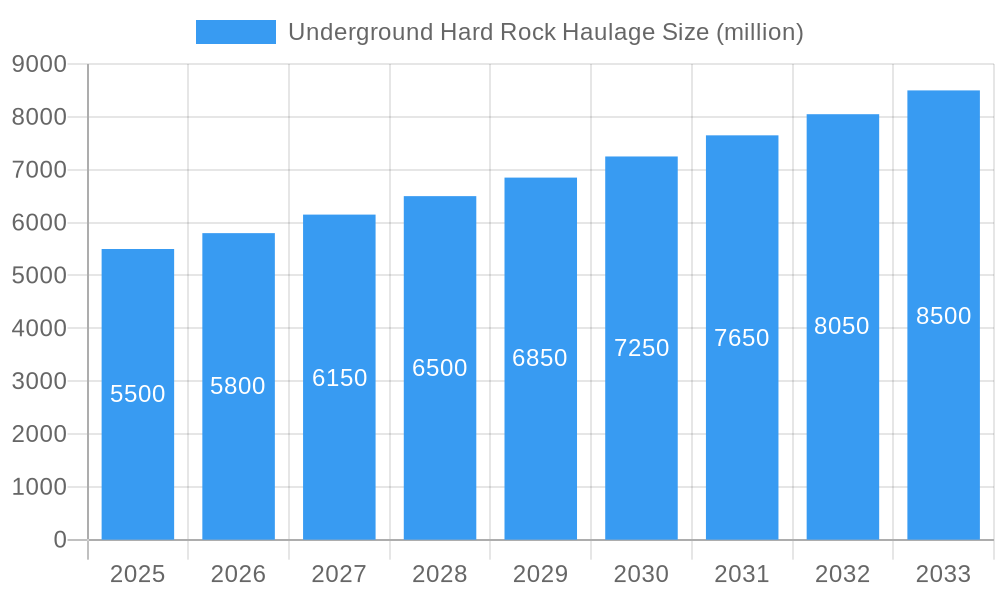
The global Underground Hard Rock Haulage market is projected for substantial growth, expected to reach $13.65 billion by 2025. This expansion is driven by a Compound Annual Growth Rate (CAGR) of 8.96% from 2025 to 2033. Key growth catalysts include rising demand for critical minerals and metals for global infrastructure and renewable energy initiatives. As surface mining faces increasing environmental and resource challenges, the industry is shifting towards deeper underground operations, escalating the need for advanced haulage solutions. Technological innovations in automation, tele-remote operation, and enhanced safety features are making underground mining more feasible, fostering market expansion. Increased investment in major mining projects, particularly in emerging economies, will further stimulate this growth.
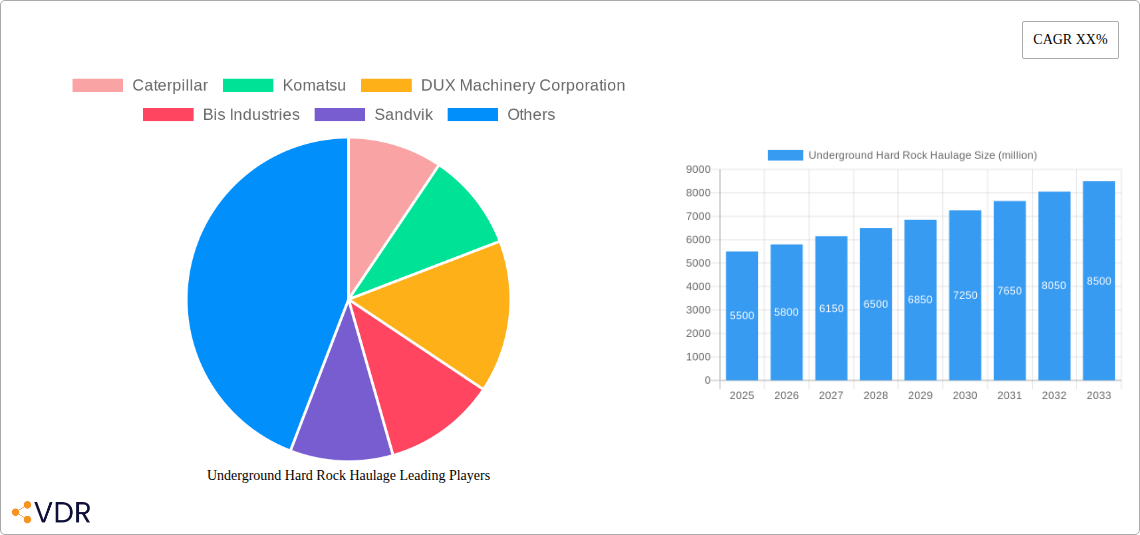
Underground Hard Rock Haulage Market Size (In Billion)

The market is segmented by application into Mining and Traffic Construction, with the Mining Industry being the primary driver due to its extensive reliance on these systems for resource extraction. Key equipment types include Underground Loaders and Underground Trucks, where design and functional innovations directly influence operational efficiency and cost savings. Leading companies such as Caterpillar, Komatsu, and Sandvik are investing in R&D for sustainable, powerful, and intelligent haulage equipment. While high capital investment, operational complexities, and stringent safety regulations may pose moderate challenges, the fundamental need for efficient resource extraction, coupled with continuous technological advancements and global infrastructure demands, ensures sustained market expansion.
Underground Hard Rock Haulage Company Market Share
Underground Hard Rock Haulage Market: Comprehensive Analysis and Future Outlook (2019-2033)
This in-depth report offers a definitive analysis of the global Underground Hard Rock Haulage market, encompassing market dynamics, growth trends, regional dominance, product landscape, key drivers, barriers, opportunities, and a strategic outlook for the period 2019–2033. Leveraging extensive data and expert insights, this report is an essential resource for industry stakeholders seeking to understand and capitalize on the evolving Underground Hard Rock Haulage sector. The study period spans from 2019 to 2033, with the base year and estimated year both set at 2025, and the forecast period from 2025 to 2033. Historical data covers 2019-2024. All quantitative values are presented in millions of units.
Underground Hard Rock Haulage Market Dynamics & Structure
The global Underground Hard Rock Haulage market is characterized by a moderate concentration, with leading players like Caterpillar, Komatsu, and Sandvik holding significant market shares. Technological innovation remains a primary driver, propelled by advancements in automation, electrification, and data analytics aimed at enhancing safety, efficiency, and sustainability in underground operations. Regulatory frameworks, particularly those focusing on environmental protection and worker safety, are increasingly influencing operational standards and equipment design.
- Market Concentration: Top 5 players estimated to hold XX% market share.
- Technological Innovation Drivers: Automation, AI-powered route optimization, electric vehicle (EV) adoption, advanced telematics for real-time monitoring.
- Regulatory Frameworks: Stringent safety regulations (e.g., methane detection, dust suppression), emissions standards driving electric and hybrid solutions.
- Competitive Product Substitutes: While direct substitutes are limited, advancements in surface mining techniques and alternative material sourcing pose indirect competition.
- End-User Demographics: Primarily mining companies (coal, metal, and mineral extraction) and large-scale infrastructure projects (tunnels, subway systems).
- M&A Trends: Strategic acquisitions and partnerships focused on acquiring innovative technologies or expanding geographical reach. Estimated XX M&A deals in the historical period.
Underground Hard Rock Haulage Growth Trends & Insights
The Underground Hard Rock Haulage market is projected to witness robust growth, driven by increasing global demand for essential minerals and metals, coupled with significant investments in infrastructure development. The mining industry, a primary end-user, is experiencing a resurgence due to rising commodity prices and the need to replenish depleted reserves. This surge necessitates efficient and advanced haulage solutions to extract resources from increasingly complex and deeper underground environments. Automation and electrification are pivotal in this evolution, promising reduced operational costs, enhanced safety, and minimized environmental impact. The traffic construction segment, particularly the development of subterranean transportation networks like subways and high-speed rail tunnels, also contributes substantially to market expansion. The adoption rates for advanced haulage equipment are accelerating, influenced by operational efficiency gains and the imperative to meet stricter environmental regulations. Technological disruptions, including the integration of IoT for predictive maintenance and autonomous driving capabilities, are reshaping the competitive landscape and consumer behavior, with clients increasingly prioritizing smart, sustainable, and cost-effective solutions.
- The global market size is projected to grow from an estimated $XX billion in 2025 to $YY billion by 2033, exhibiting a Compound Annual Growth Rate (CAGR) of ZZ% during the forecast period.
- Market penetration of electric and autonomous haulage systems is expected to surge from XX% in 2025 to YY% by 2033, indicating a strong shift towards advanced technologies.
- Consumer behavior is shifting towards solutions offering lower total cost of ownership, higher uptime, and improved environmental performance, influencing purchasing decisions.
Dominant Regions, Countries, or Segments in Underground Hard Rock Haulage
The Mining Industry segment, particularly for metal and mineral extraction, is the dominant force driving growth in the global Underground Hard Rock Haulage market. This dominance stems from the consistent global demand for vital resources like copper, gold, iron ore, and precious metals, which often necessitate deep underground mining operations. Countries with rich mineral reserves and significant investment in mining infrastructure are key contributors.
- Key Drivers in the Mining Industry Segment:
- Growing Global Demand for Metals and Minerals: Essential for renewable energy technologies (e.g., copper for wind turbines and EVs), electronics, and construction.
- Depletion of Surface Reserves: Forcing mining operations to move deeper underground, requiring specialized haulage equipment.
- Technological Advancements in Extraction: Enabling access to previously uneconomical or inaccessible ore bodies.
- Government Support and Investment Policies: Encouraging exploration and extraction activities through fiscal incentives and infrastructure development.
Asia Pacific, led by countries such as China and Australia, is emerging as a dominant region due to its substantial mining activities and increasing investments in both new mining projects and modernization of existing operations. North America, with its significant mining heritage and ongoing resource extraction, also plays a crucial role. The growth potential in these regions is further amplified by their proactive adoption of innovative haulage technologies.
- Market Share Analysis: The Mining Industry segment is estimated to account for XX% of the total market revenue in 2025, with an anticipated growth to YY% by 2033.
- Growth Potential: Regions with strong mining sectors and supportive government policies, such as the Asia Pacific and North America, are expected to exhibit above-average growth rates.
- Application Dominance: The application of Underground Loaders and Underground Trucks within the mining sector represents the largest share of the market.
Underground Hard Rock Haulage Product Landscape
The product landscape for Underground Hard Rock Haulage is characterized by continuous innovation focused on enhancing efficiency, safety, and sustainability. Key advancements include the development of battery-electric vehicles (BEVs) offering zero emissions and reduced noise pollution, alongside sophisticated automation systems for improved operational control and reduced human intervention.
- Product Innovations: Introduction of advanced autonomous navigation systems, high-capacity battery technologies for extended operational life, and integrated payload monitoring for optimized load management.
- Applications: Robust haulage solutions for ore and waste removal in diverse mining environments and efficient material transport in large-scale tunnel construction projects.
- Performance Metrics: Focus on increased hauling capacities, improved maneuverability in confined spaces, reduced energy consumption, and extended service intervals.
- Unique Selling Propositions: Manufacturers are emphasizing smart fleet management integration, enhanced operator comfort and safety features, and customizable solutions for specific mine conditions.
- Technological Advancements: Integration of AI for predictive maintenance, real-time data analytics for performance optimization, and advanced braking and suspension systems for challenging terrains.
Key Drivers, Barriers & Challenges in Underground Hard Rock Haulage
Key Drivers: The Underground Hard Rock Haulage market is propelled by escalating global demand for minerals and metals, driven by infrastructure expansion and the transition to green energy technologies. Increasing investments in deep-level mining operations and government initiatives supporting resource exploration further fuel demand. Technological advancements, particularly in automation and electrification, are crucial for enhancing operational efficiency and reducing environmental footprints.
Barriers & Challenges: High initial capital investment for advanced haulage equipment and infrastructure remains a significant barrier. The complex nature of underground environments presents operational challenges, including difficult terrain and ventilation requirements. Stringent safety regulations, while essential, can add to operational costs and complexity. Supply chain disruptions for critical components and skilled labor shortages for operating and maintaining sophisticated equipment also pose considerable challenges. Competitive pressures from established manufacturers and the slow adoption rate of new technologies in some regions can also hinder growth.
- Quantifiable Impacts: Supply chain issues can lead to delays of up to XX% in equipment delivery. Skilled labor shortages can increase operational costs by YY%.
Emerging Opportunities in Underground Hard Rock Haulage
Emerging opportunities in the Underground Hard Rock Haulage market lie in the increasing adoption of autonomous and electric haulage systems. The growing focus on sustainable mining practices presents a significant avenue for growth, with BEVs offering reduced emissions and a lower environmental impact. The development of intelligent fleet management software, leveraging AI and IoT, opens up possibilities for optimized operations, predictive maintenance, and enhanced safety. Furthermore, the expansion of underground infrastructure projects in developing economies and the exploration of new mineral deposits in challenging geological conditions offer untapped market potential.
- Untapped Markets: Emerging economies with developing mining sectors and significant infrastructure development plans.
- Innovative Applications: Integration of haulage systems with advanced geological surveying and remote sensing technologies.
- Evolving Consumer Preferences: Demand for integrated, data-driven solutions that offer real-time insights and predictive capabilities.
Growth Accelerators in the Underground Hard Rock Haulage Industry
Growth accelerators in the Underground Hard Rock Haulage industry are primarily driven by technological breakthroughs and strategic market expansion initiatives. The continuous evolution of battery technology is a significant catalyst, enabling longer operating hours for electric haulage equipment and reducing reliance on traditional diesel power. The development and refinement of autonomous driving systems are also accelerating adoption, promising enhanced safety and productivity gains. Strategic partnerships between equipment manufacturers, technology providers, and mining companies are fostering innovation and accelerating the deployment of advanced solutions. Furthermore, global infrastructure development projects, particularly in urban areas requiring extensive tunneling, are providing consistent demand for specialized haulage equipment.
- Technological Breakthroughs: Advancements in AI for autonomous operation, improved battery energy density, and lighter, more durable material science.
- Strategic Partnerships: Collaborations focused on developing and implementing integrated mining solutions and electrification strategies.
- Market Expansion Strategies: Targeting emerging markets with untapped potential and offering tailored solutions for specific operational needs.
Key Players Shaping the Underground Hard Rock Haulage Market
- Caterpillar
- Komatsu
- DUX Machinery Corporation
- Bis Industries
- Sandvik
- GHH-Fahrzeuge
- Fambition
- Xingye Machinery
- Anchises Technologies
- Derui
Notable Milestones in Underground Hard Rock Haulage Sector
- 2019: Sandvik launches its first battery-electric underground loader, marking a significant step towards sustainable haulage.
- 2020: Komatsu introduces its fully autonomous haulage system for underground mining, showcasing advanced robotics integration.
- 2021: DUX Machinery Corporation announces significant capacity upgrades for its underground trucks, addressing the need for higher payload efficiency.
- 2022: Caterpillar showcases its latest advancements in telematics and remote operation capabilities for its underground equipment fleet.
- 2023: Anchises Technologies demonstrates a new generation of smart sensors for real-time environmental monitoring in underground mining.
- 2024: GHH-Fahrzeuge expands its portfolio with a focus on modular and flexible haulage solutions designed for diverse underground applications.
In-Depth Underground Hard Rock Haulage Market Outlook
The future of the Underground Hard Rock Haulage market is exceptionally promising, driven by a confluence of sustained global demand for resources, aggressive infrastructure development, and transformative technological advancements. Growth accelerators, including the maturation of electric and autonomous haulage technologies, are poised to redefine operational paradigms, delivering enhanced safety, reduced environmental impact, and optimized cost efficiencies. Strategic partnerships and a focus on integrated, data-driven solutions will further fuel market expansion. The increasing imperative for sustainable mining practices and the exploration of new, deeper mineral deposits will continue to drive innovation and investment, creating substantial opportunities for stakeholders who can adapt to and capitalize on these evolving industry dynamics.
Underground Hard Rock Haulage Segmentation
-
1. Application
- 1.1. Mining Industry
- 1.2. Traffic Construction
- 1.3. Others
-
2. Types
- 2.1. Underground Loader
- 2.2. Underground Truck
- 2.3. Others
Underground Hard Rock Haulage Segmentation By Geography
-
1. North America
- 1.1. United States
- 1.2. Canada
- 1.3. Mexico
-
2. South America
- 2.1. Brazil
- 2.2. Argentina
- 2.3. Rest of South America
-
3. Europe
- 3.1. United Kingdom
- 3.2. Germany
- 3.3. France
- 3.4. Italy
- 3.5. Spain
- 3.6. Russia
- 3.7. Benelux
- 3.8. Nordics
- 3.9. Rest of Europe
-
4. Middle East & Africa
- 4.1. Turkey
- 4.2. Israel
- 4.3. GCC
- 4.4. North Africa
- 4.5. South Africa
- 4.6. Rest of Middle East & Africa
-
5. Asia Pacific
- 5.1. China
- 5.2. India
- 5.3. Japan
- 5.4. South Korea
- 5.5. ASEAN
- 5.6. Oceania
- 5.7. Rest of Asia Pacific
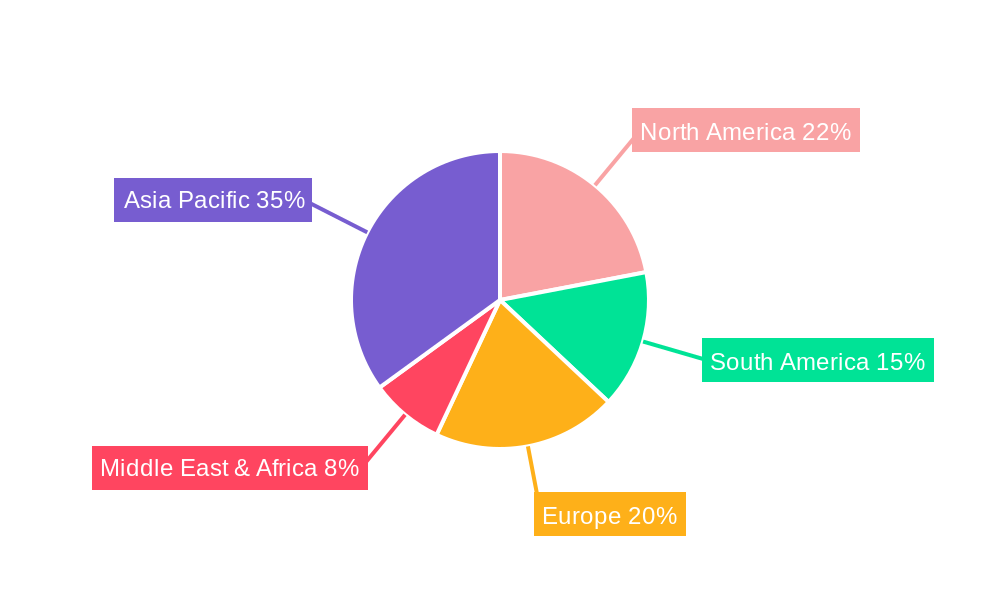
Underground Hard Rock Haulage Regional Market Share
Geographic Coverage of Underground Hard Rock Haulage
Underground Hard Rock Haulage REPORT HIGHLIGHTS
| Aspects | Details |
|---|---|
| Study Period | 2020-2034 |
| Base Year | 2025 |
| Estimated Year | 2026 |
| Forecast Period | 2026-2034 |
| Historical Period | 2020-2025 |
| Growth Rate | CAGR of 8.96% from 2020-2034 |
| Segmentation |
|
Table of Contents
- 1. Introduction
- 1.1. Research Scope
- 1.2. Market Segmentation
- 1.3. Research Methodology
- 1.4. Definitions and Assumptions
- 2. Executive Summary
- 2.1. Introduction
- 3. Market Dynamics
- 3.1. Introduction
- 3.2. Market Drivers
- 3.3. Market Restrains
- 3.4. Market Trends
- 4. Market Factor Analysis
- 4.1. Porters Five Forces
- 4.2. Supply/Value Chain
- 4.3. PESTEL analysis
- 4.4. Market Entropy
- 4.5. Patent/Trademark Analysis
- 5. Global Underground Hard Rock Haulage Analysis, Insights and Forecast, 2020-2032
- 5.1. Market Analysis, Insights and Forecast - by Application
- 5.1.1. Mining Industry
- 5.1.2. Traffic Construction
- 5.1.3. Others
- 5.2. Market Analysis, Insights and Forecast - by Types
- 5.2.1. Underground Loader
- 5.2.2. Underground Truck
- 5.2.3. Others
- 5.3. Market Analysis, Insights and Forecast - by Region
- 5.3.1. North America
- 5.3.2. South America
- 5.3.3. Europe
- 5.3.4. Middle East & Africa
- 5.3.5. Asia Pacific
- 5.1. Market Analysis, Insights and Forecast - by Application
- 6. North America Underground Hard Rock Haulage Analysis, Insights and Forecast, 2020-2032
- 6.1. Market Analysis, Insights and Forecast - by Application
- 6.1.1. Mining Industry
- 6.1.2. Traffic Construction
- 6.1.3. Others
- 6.2. Market Analysis, Insights and Forecast - by Types
- 6.2.1. Underground Loader
- 6.2.2. Underground Truck
- 6.2.3. Others
- 6.1. Market Analysis, Insights and Forecast - by Application
- 7. South America Underground Hard Rock Haulage Analysis, Insights and Forecast, 2020-2032
- 7.1. Market Analysis, Insights and Forecast - by Application
- 7.1.1. Mining Industry
- 7.1.2. Traffic Construction
- 7.1.3. Others
- 7.2. Market Analysis, Insights and Forecast - by Types
- 7.2.1. Underground Loader
- 7.2.2. Underground Truck
- 7.2.3. Others
- 7.1. Market Analysis, Insights and Forecast - by Application
- 8. Europe Underground Hard Rock Haulage Analysis, Insights and Forecast, 2020-2032
- 8.1. Market Analysis, Insights and Forecast - by Application
- 8.1.1. Mining Industry
- 8.1.2. Traffic Construction
- 8.1.3. Others
- 8.2. Market Analysis, Insights and Forecast - by Types
- 8.2.1. Underground Loader
- 8.2.2. Underground Truck
- 8.2.3. Others
- 8.1. Market Analysis, Insights and Forecast - by Application
- 9. Middle East & Africa Underground Hard Rock Haulage Analysis, Insights and Forecast, 2020-2032
- 9.1. Market Analysis, Insights and Forecast - by Application
- 9.1.1. Mining Industry
- 9.1.2. Traffic Construction
- 9.1.3. Others
- 9.2. Market Analysis, Insights and Forecast - by Types
- 9.2.1. Underground Loader
- 9.2.2. Underground Truck
- 9.2.3. Others
- 9.1. Market Analysis, Insights and Forecast - by Application
- 10. Asia Pacific Underground Hard Rock Haulage Analysis, Insights and Forecast, 2020-2032
- 10.1. Market Analysis, Insights and Forecast - by Application
- 10.1.1. Mining Industry
- 10.1.2. Traffic Construction
- 10.1.3. Others
- 10.2. Market Analysis, Insights and Forecast - by Types
- 10.2.1. Underground Loader
- 10.2.2. Underground Truck
- 10.2.3. Others
- 10.1. Market Analysis, Insights and Forecast - by Application
- 11. Competitive Analysis
- 11.1. Global Market Share Analysis 2025
- 11.2. Company Profiles
- 11.2.1 Caterpillar
- 11.2.1.1. Overview
- 11.2.1.2. Products
- 11.2.1.3. SWOT Analysis
- 11.2.1.4. Recent Developments
- 11.2.1.5. Financials (Based on Availability)
- 11.2.2 Komatsu
- 11.2.2.1. Overview
- 11.2.2.2. Products
- 11.2.2.3. SWOT Analysis
- 11.2.2.4. Recent Developments
- 11.2.2.5. Financials (Based on Availability)
- 11.2.3 DUX Machinery Corporation
- 11.2.3.1. Overview
- 11.2.3.2. Products
- 11.2.3.3. SWOT Analysis
- 11.2.3.4. Recent Developments
- 11.2.3.5. Financials (Based on Availability)
- 11.2.4 Bis Industries
- 11.2.4.1. Overview
- 11.2.4.2. Products
- 11.2.4.3. SWOT Analysis
- 11.2.4.4. Recent Developments
- 11.2.4.5. Financials (Based on Availability)
- 11.2.5 Sandvik
- 11.2.5.1. Overview
- 11.2.5.2. Products
- 11.2.5.3. SWOT Analysis
- 11.2.5.4. Recent Developments
- 11.2.5.5. Financials (Based on Availability)
- 11.2.6 GHH-Fahrzeuge
- 11.2.6.1. Overview
- 11.2.6.2. Products
- 11.2.6.3. SWOT Analysis
- 11.2.6.4. Recent Developments
- 11.2.6.5. Financials (Based on Availability)
- 11.2.7 Fambition
- 11.2.7.1. Overview
- 11.2.7.2. Products
- 11.2.7.3. SWOT Analysis
- 11.2.7.4. Recent Developments
- 11.2.7.5. Financials (Based on Availability)
- 11.2.8 Xingye Machinery
- 11.2.8.1. Overview
- 11.2.8.2. Products
- 11.2.8.3. SWOT Analysis
- 11.2.8.4. Recent Developments
- 11.2.8.5. Financials (Based on Availability)
- 11.2.9 Anchises Technologies
- 11.2.9.1. Overview
- 11.2.9.2. Products
- 11.2.9.3. SWOT Analysis
- 11.2.9.4. Recent Developments
- 11.2.9.5. Financials (Based on Availability)
- 11.2.10 Derui
- 11.2.10.1. Overview
- 11.2.10.2. Products
- 11.2.10.3. SWOT Analysis
- 11.2.10.4. Recent Developments
- 11.2.10.5. Financials (Based on Availability)
- 11.2.1 Caterpillar
List of Figures
- Figure 1: Global Underground Hard Rock Haulage Revenue Breakdown (billion, %) by Region 2025 & 2033
- Figure 2: North America Underground Hard Rock Haulage Revenue (billion), by Application 2025 & 2033
- Figure 3: North America Underground Hard Rock Haulage Revenue Share (%), by Application 2025 & 2033
- Figure 4: North America Underground Hard Rock Haulage Revenue (billion), by Types 2025 & 2033
- Figure 5: North America Underground Hard Rock Haulage Revenue Share (%), by Types 2025 & 2033
- Figure 6: North America Underground Hard Rock Haulage Revenue (billion), by Country 2025 & 2033
- Figure 7: North America Underground Hard Rock Haulage Revenue Share (%), by Country 2025 & 2033
- Figure 8: South America Underground Hard Rock Haulage Revenue (billion), by Application 2025 & 2033
- Figure 9: South America Underground Hard Rock Haulage Revenue Share (%), by Application 2025 & 2033
- Figure 10: South America Underground Hard Rock Haulage Revenue (billion), by Types 2025 & 2033
- Figure 11: South America Underground Hard Rock Haulage Revenue Share (%), by Types 2025 & 2033
- Figure 12: South America Underground Hard Rock Haulage Revenue (billion), by Country 2025 & 2033
- Figure 13: South America Underground Hard Rock Haulage Revenue Share (%), by Country 2025 & 2033
- Figure 14: Europe Underground Hard Rock Haulage Revenue (billion), by Application 2025 & 2033
- Figure 15: Europe Underground Hard Rock Haulage Revenue Share (%), by Application 2025 & 2033
- Figure 16: Europe Underground Hard Rock Haulage Revenue (billion), by Types 2025 & 2033
- Figure 17: Europe Underground Hard Rock Haulage Revenue Share (%), by Types 2025 & 2033
- Figure 18: Europe Underground Hard Rock Haulage Revenue (billion), by Country 2025 & 2033
- Figure 19: Europe Underground Hard Rock Haulage Revenue Share (%), by Country 2025 & 2033
- Figure 20: Middle East & Africa Underground Hard Rock Haulage Revenue (billion), by Application 2025 & 2033
- Figure 21: Middle East & Africa Underground Hard Rock Haulage Revenue Share (%), by Application 2025 & 2033
- Figure 22: Middle East & Africa Underground Hard Rock Haulage Revenue (billion), by Types 2025 & 2033
- Figure 23: Middle East & Africa Underground Hard Rock Haulage Revenue Share (%), by Types 2025 & 2033
- Figure 24: Middle East & Africa Underground Hard Rock Haulage Revenue (billion), by Country 2025 & 2033
- Figure 25: Middle East & Africa Underground Hard Rock Haulage Revenue Share (%), by Country 2025 & 2033
- Figure 26: Asia Pacific Underground Hard Rock Haulage Revenue (billion), by Application 2025 & 2033
- Figure 27: Asia Pacific Underground Hard Rock Haulage Revenue Share (%), by Application 2025 & 2033
- Figure 28: Asia Pacific Underground Hard Rock Haulage Revenue (billion), by Types 2025 & 2033
- Figure 29: Asia Pacific Underground Hard Rock Haulage Revenue Share (%), by Types 2025 & 2033
- Figure 30: Asia Pacific Underground Hard Rock Haulage Revenue (billion), by Country 2025 & 2033
- Figure 31: Asia Pacific Underground Hard Rock Haulage Revenue Share (%), by Country 2025 & 2033
List of Tables
- Table 1: Global Underground Hard Rock Haulage Revenue billion Forecast, by Application 2020 & 2033
- Table 2: Global Underground Hard Rock Haulage Revenue billion Forecast, by Types 2020 & 2033
- Table 3: Global Underground Hard Rock Haulage Revenue billion Forecast, by Region 2020 & 2033
- Table 4: Global Underground Hard Rock Haulage Revenue billion Forecast, by Application 2020 & 2033
- Table 5: Global Underground Hard Rock Haulage Revenue billion Forecast, by Types 2020 & 2033
- Table 6: Global Underground Hard Rock Haulage Revenue billion Forecast, by Country 2020 & 2033
- Table 7: United States Underground Hard Rock Haulage Revenue (billion) Forecast, by Application 2020 & 2033
- Table 8: Canada Underground Hard Rock Haulage Revenue (billion) Forecast, by Application 2020 & 2033
- Table 9: Mexico Underground Hard Rock Haulage Revenue (billion) Forecast, by Application 2020 & 2033
- Table 10: Global Underground Hard Rock Haulage Revenue billion Forecast, by Application 2020 & 2033
- Table 11: Global Underground Hard Rock Haulage Revenue billion Forecast, by Types 2020 & 2033
- Table 12: Global Underground Hard Rock Haulage Revenue billion Forecast, by Country 2020 & 2033
- Table 13: Brazil Underground Hard Rock Haulage Revenue (billion) Forecast, by Application 2020 & 2033
- Table 14: Argentina Underground Hard Rock Haulage Revenue (billion) Forecast, by Application 2020 & 2033
- Table 15: Rest of South America Underground Hard Rock Haulage Revenue (billion) Forecast, by Application 2020 & 2033
- Table 16: Global Underground Hard Rock Haulage Revenue billion Forecast, by Application 2020 & 2033
- Table 17: Global Underground Hard Rock Haulage Revenue billion Forecast, by Types 2020 & 2033
- Table 18: Global Underground Hard Rock Haulage Revenue billion Forecast, by Country 2020 & 2033
- Table 19: United Kingdom Underground Hard Rock Haulage Revenue (billion) Forecast, by Application 2020 & 2033
- Table 20: Germany Underground Hard Rock Haulage Revenue (billion) Forecast, by Application 2020 & 2033
- Table 21: France Underground Hard Rock Haulage Revenue (billion) Forecast, by Application 2020 & 2033
- Table 22: Italy Underground Hard Rock Haulage Revenue (billion) Forecast, by Application 2020 & 2033
- Table 23: Spain Underground Hard Rock Haulage Revenue (billion) Forecast, by Application 2020 & 2033
- Table 24: Russia Underground Hard Rock Haulage Revenue (billion) Forecast, by Application 2020 & 2033
- Table 25: Benelux Underground Hard Rock Haulage Revenue (billion) Forecast, by Application 2020 & 2033
- Table 26: Nordics Underground Hard Rock Haulage Revenue (billion) Forecast, by Application 2020 & 2033
- Table 27: Rest of Europe Underground Hard Rock Haulage Revenue (billion) Forecast, by Application 2020 & 2033
- Table 28: Global Underground Hard Rock Haulage Revenue billion Forecast, by Application 2020 & 2033
- Table 29: Global Underground Hard Rock Haulage Revenue billion Forecast, by Types 2020 & 2033
- Table 30: Global Underground Hard Rock Haulage Revenue billion Forecast, by Country 2020 & 2033
- Table 31: Turkey Underground Hard Rock Haulage Revenue (billion) Forecast, by Application 2020 & 2033
- Table 32: Israel Underground Hard Rock Haulage Revenue (billion) Forecast, by Application 2020 & 2033
- Table 33: GCC Underground Hard Rock Haulage Revenue (billion) Forecast, by Application 2020 & 2033
- Table 34: North Africa Underground Hard Rock Haulage Revenue (billion) Forecast, by Application 2020 & 2033
- Table 35: South Africa Underground Hard Rock Haulage Revenue (billion) Forecast, by Application 2020 & 2033
- Table 36: Rest of Middle East & Africa Underground Hard Rock Haulage Revenue (billion) Forecast, by Application 2020 & 2033
- Table 37: Global Underground Hard Rock Haulage Revenue billion Forecast, by Application 2020 & 2033
- Table 38: Global Underground Hard Rock Haulage Revenue billion Forecast, by Types 2020 & 2033
- Table 39: Global Underground Hard Rock Haulage Revenue billion Forecast, by Country 2020 & 2033
- Table 40: China Underground Hard Rock Haulage Revenue (billion) Forecast, by Application 2020 & 2033
- Table 41: India Underground Hard Rock Haulage Revenue (billion) Forecast, by Application 2020 & 2033
- Table 42: Japan Underground Hard Rock Haulage Revenue (billion) Forecast, by Application 2020 & 2033
- Table 43: South Korea Underground Hard Rock Haulage Revenue (billion) Forecast, by Application 2020 & 2033
- Table 44: ASEAN Underground Hard Rock Haulage Revenue (billion) Forecast, by Application 2020 & 2033
- Table 45: Oceania Underground Hard Rock Haulage Revenue (billion) Forecast, by Application 2020 & 2033
- Table 46: Rest of Asia Pacific Underground Hard Rock Haulage Revenue (billion) Forecast, by Application 2020 & 2033
Frequently Asked Questions
1. What is the projected Compound Annual Growth Rate (CAGR) of the Underground Hard Rock Haulage?
The projected CAGR is approximately 8.96%.
2. Which companies are prominent players in the Underground Hard Rock Haulage?
Key companies in the market include Caterpillar, Komatsu, DUX Machinery Corporation, Bis Industries, Sandvik, GHH-Fahrzeuge, Fambition, Xingye Machinery, Anchises Technologies, Derui.
3. What are the main segments of the Underground Hard Rock Haulage?
The market segments include Application, Types.
4. Can you provide details about the market size?
The market size is estimated to be USD 13.65 billion as of 2022.
5. What are some drivers contributing to market growth?
N/A
6. What are the notable trends driving market growth?
N/A
7. Are there any restraints impacting market growth?
N/A
8. Can you provide examples of recent developments in the market?
N/A
9. What pricing options are available for accessing the report?
Pricing options include single-user, multi-user, and enterprise licenses priced at USD 4900.00, USD 7350.00, and USD 9800.00 respectively.
10. Is the market size provided in terms of value or volume?
The market size is provided in terms of value, measured in billion.
11. Are there any specific market keywords associated with the report?
Yes, the market keyword associated with the report is "Underground Hard Rock Haulage," which aids in identifying and referencing the specific market segment covered.
12. How do I determine which pricing option suits my needs best?
The pricing options vary based on user requirements and access needs. Individual users may opt for single-user licenses, while businesses requiring broader access may choose multi-user or enterprise licenses for cost-effective access to the report.
13. Are there any additional resources or data provided in the Underground Hard Rock Haulage report?
While the report offers comprehensive insights, it's advisable to review the specific contents or supplementary materials provided to ascertain if additional resources or data are available.
14. How can I stay updated on further developments or reports in the Underground Hard Rock Haulage?
To stay informed about further developments, trends, and reports in the Underground Hard Rock Haulage, consider subscribing to industry newsletters, following relevant companies and organizations, or regularly checking reputable industry news sources and publications.
Methodology
Step 1 - Identification of Relevant Samples Size from Population Database



Step 2 - Approaches for Defining Global Market Size (Value, Volume* & Price*)

Note*: In applicable scenarios
Step 3 - Data Sources
Primary Research
- Web Analytics
- Survey Reports
- Research Institute
- Latest Research Reports
- Opinion Leaders
Secondary Research
- Annual Reports
- White Paper
- Latest Press Release
- Industry Association
- Paid Database
- Investor Presentations

Step 4 - Data Triangulation
Involves using different sources of information in order to increase the validity of a study
These sources are likely to be stakeholders in a program - participants, other researchers, program staff, other community members, and so on.
Then we put all data in single framework & apply various statistical tools to find out the dynamic on the market.
During the analysis stage, feedback from the stakeholder groups would be compared to determine areas of agreement as well as areas of divergence

