
Key Insights
The South Africa car lubricants market, valued at $420 million in 2024, is projected to achieve a Compound Annual Growth Rate (CAGR) of 4% through the forecast period. This expansion is driven by a growing vehicle fleet, a robust automotive industry, and increasing awareness of essential vehicle maintenance for optimal engine performance and longevity. The market is strategically segmented by vehicle type, including commercial, motorcycle, and passenger vehicles, and by product type, such as engine oils, greases, hydraulic fluids, and transmission & gear oils, presenting diverse opportunities for stakeholders. Potential market restraints include fluctuating oil prices and regional economic volatility.
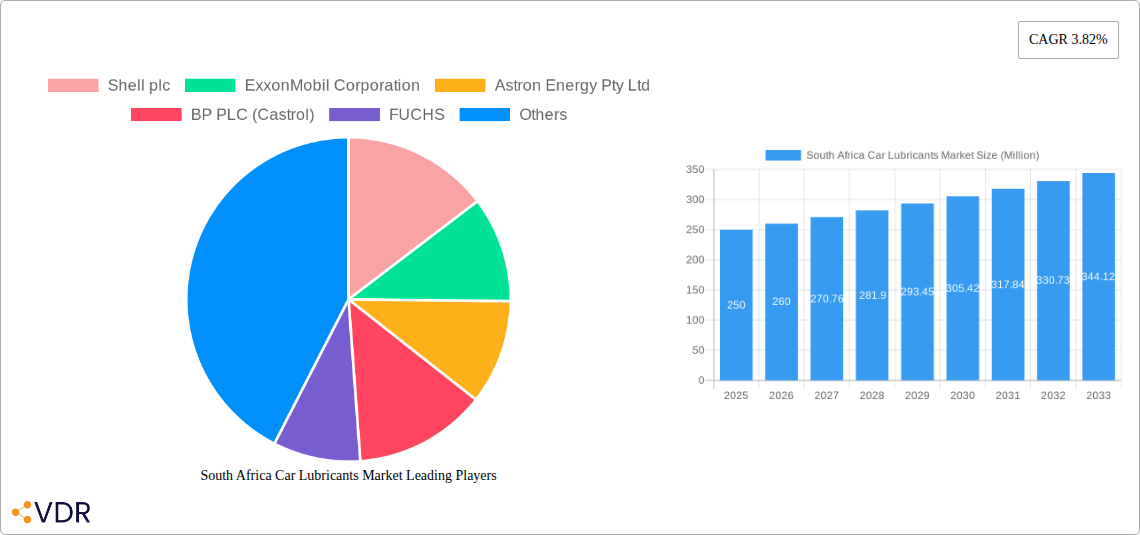
South Africa Car Lubricants Market Market Size (In Million)

Passenger vehicles represent the largest market segment, influenced by increasing vehicle affordability and a burgeoning middle class. However, the commercial vehicle segment is poised for significant growth, propelled by expanding logistics and transportation sectors. Engine oils currently lead product demand, though specialized lubricants are expected to gain traction with advancements in vehicle technology. Continuous innovation in fuel efficiency, emission reduction, and enhanced performance is crucial for market players to meet evolving consumer demands in South Africa. Key international players include Shell, ExxonMobil, and BP, alongside prominent regional entities like Astron Energy and Engen Petroleum, shaping a competitive market landscape.
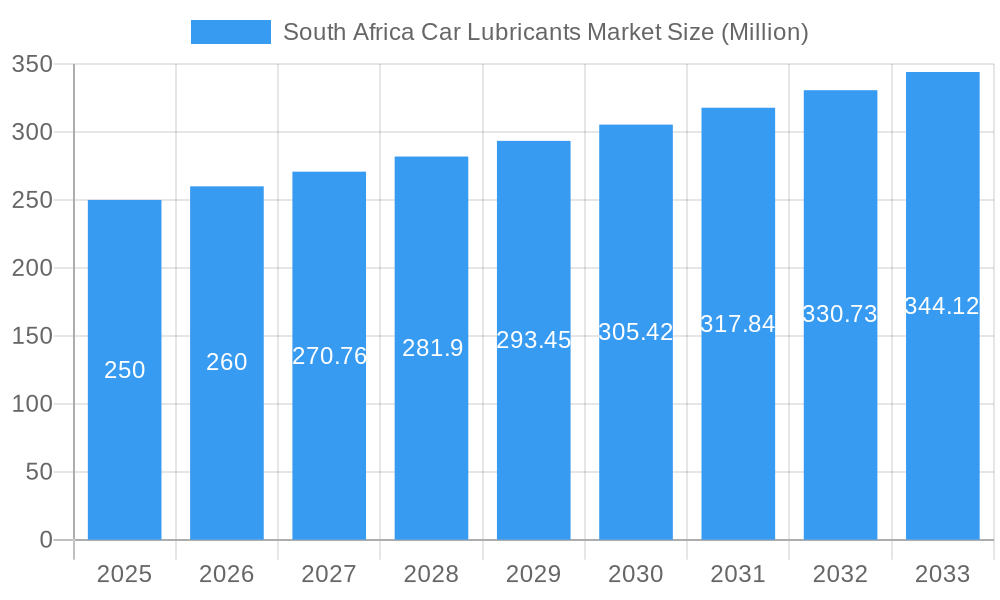
South Africa Car Lubricants Market Company Market Share
South Africa Car Lubricants Market: A Comprehensive Report (2019-2033)
This in-depth report provides a comprehensive analysis of the South Africa car lubricants market, encompassing market dynamics, growth trends, regional segmentation, product landscape, key players, and future outlook. The study period covers 2019-2033, with 2025 as the base year and forecast period extending to 2033. The report is essential for industry professionals, investors, and strategic decision-makers seeking a granular understanding of this dynamic market. The market is segmented by vehicle type (passenger vehicles, commercial vehicles, motorcycles) and product type (engine oils, greases, hydraulic fluids, transmission & gear oils). The report projects a xx Million units market value by 2025.
South Africa Car Lubricants Market Dynamics & Structure
This section delves into the intricate structure and dynamics of the South Africa car lubricants market. We analyze market concentration, revealing the dominance of key players like Shell plc, ExxonMobil Corporation, and Engen Petroleum Ltd, alongside the competitive landscape of regional players. The report quantifies market share percentages, highlighting the influence of M&A activities on market consolidation. Technological advancements, particularly in synthetic lubricants and eco-friendly formulations, are examined alongside their impact on market competition. Further analysis explores the regulatory landscape, including emission standards and environmental regulations impacting lubricant formulation and distribution. The influence of substitute products (e.g., bio-lubricants) and evolving end-user demographics (e.g., rising vehicle ownership) are also considered.
- Market Concentration: High, with top 5 players holding xx% market share in 2025.
- Technological Innovation: Significant focus on energy efficiency and emission reduction.
- Regulatory Framework: Stringent environmental regulations drive demand for eco-friendly lubricants.
- Competitive Substitutes: Bio-lubricants present a growing challenge.
- M&A Trends: Moderate activity, with a focus on consolidating market share. xx M&A deals recorded between 2019-2024.
South Africa Car Lubricants Market Growth Trends & Insights
This section presents a detailed analysis of the South Africa car lubricants market's growth trajectory from 2019 to 2033. We utilize comprehensive data to pinpoint growth drivers and highlight key trends influencing market expansion. The report pinpoints the Compound Annual Growth Rate (CAGR) during the historical (2019-2024) and forecast (2025-2033) periods, showing the evolving market size in Million units. Factors such as economic growth, rising vehicle sales, and evolving consumer preferences for high-performance lubricants are explored. The analysis delves into technological disruptions, assessing the impact of innovations such as advanced lubricant formulations on market dynamics. Additionally, we analyze shifts in consumer behavior, focusing on the increasing demand for premium lubricants and the growing adoption of online purchasing channels. The report also illustrates market penetration rates for different lubricant types across various vehicle segments.
Dominant Regions, Countries, or Segments in South Africa Car Lubricants Market
This section identifies the leading regions, countries, and segments within the South Africa car lubricants market driving overall growth. We analyze market share and growth potential of each segment (By Vehicle Type: Commercial Vehicles, Motorcycles, Passenger Vehicles; By Product Type: Engine Oils, Greases, Hydraulic Fluids, Transmission & Gear Oils). The analysis identifies the dominant segment—Passenger Vehicles—with a projected xx% market share in 2025, due to high passenger car sales. Key drivers for each dominant segment are detailed, considering economic policies, infrastructure development, and vehicle ownership trends. Geographic variations in market performance are also analyzed.
- Passenger Vehicles: Highest market share driven by rising vehicle ownership and demand for high-performance lubricants.
- Engine Oils: Largest product segment due to widespread use in various vehicle types.
- Gauteng Province: Strongest regional performance driven by high vehicle density and industrial activity.
South Africa Car Lubricants Market Product Landscape
This section details the innovative products within the South Africa car lubricants market. The report highlights key product features, applications, and performance metrics for each product category, including engine oils, transmission fluids, greases, and hydraulic fluids. We examine the unique selling propositions (USPs) of key players and outline the technological advancements driving product innovation. The emphasis is on energy efficiency, extended drain intervals, and environmentally friendly formulations.
Key Drivers, Barriers & Challenges in South Africa Car Lubricants Market
This section identifies the primary drivers and challenges affecting the South Africa car lubricants market.
Key Drivers:
- Increasing vehicle ownership and fleet sizes.
- Growing demand for high-performance lubricants.
- Stringent emission regulations pushing adoption of advanced lubricants.
Challenges:
- Fluctuations in crude oil prices impacting raw material costs.
- Intense competition from both international and local players.
- Economic downturns impacting consumer spending on automotive maintenance.
Emerging Opportunities in South Africa Car Lubricants Market
This section highlights potential opportunities in the South Africa car lubricants market. These opportunities include the growth of the electric vehicle market, which necessitates specialized lubricants. Furthermore, opportunities exist in expanding into underserved rural markets and developing innovative product offerings targeted at specific vehicle segments (e.g., specialized lubricants for off-road vehicles). The increasing adoption of digital marketing and online sales channels provides additional avenues for growth.
Growth Accelerators in the South Africa Car Lubricants Market Industry
Long-term growth will be significantly fueled by technological advancements in lubricant formulations, especially eco-friendly options. Strategic partnerships and collaborations between lubricant manufacturers and automotive companies will also play a crucial role. Expanding into new market segments and regions within South Africa, along with increased investment in research and development, will be critical for sustained growth.
Key Players Shaping the South Africa Car Lubricants Market Market
- Shell plc
- ExxonMobil Corporation
- Astron Energy Pty Ltd
- BP PLC (Castrol)
- FUCHS
- Sasol
- Puma Energy
- TotalEnergies
- Q8Oils
- Engen Petroleum Ltd
Notable Milestones in South Africa Car Lubricants Market Sector
- September 2021: Engen launched its mobile app, enhancing customer convenience and potentially boosting lubricant sales.
- January 2022: ExxonMobil reorganized its business lines, potentially influencing its lubricant product strategy.
- March 2022: FUCHS introduced new small-pack lubricants, targeting the automotive aftermarket.
In-Depth South Africa Car Lubricants Market Outlook
The South Africa car lubricants market exhibits strong growth potential, driven by ongoing vehicle sales growth and the increasing adoption of advanced lubricants. Strategic opportunities exist for players to capitalize on the demand for high-performance, eco-friendly products, especially with the growing focus on sustainability. Companies focusing on innovative product development, effective distribution strategies, and strong brand building will be best positioned to thrive in this competitive market.
South Africa Car Lubricants Market Segmentation
-
1. Vehicle Type
- 1.1. Commercial Vehicles
- 1.2. Motorcycles
- 1.3. Passenger Vehicles
-
2. Product Type
- 2.1. Engine Oils
- 2.2. Greases
- 2.3. Hydraulic Fluids
- 2.4. Transmission & Gear Oils
South Africa Car Lubricants Market Segmentation By Geography
- 1. South Africa
South Africa Car Lubricants Market Regional Market Share
Geographic Coverage of South Africa Car Lubricants Market
South Africa Car Lubricants Market REPORT HIGHLIGHTS
| Aspects | Details |
|---|---|
| Study Period | 2020-2034 |
| Base Year | 2025 |
| Estimated Year | 2026 |
| Forecast Period | 2026-2034 |
| Historical Period | 2020-2025 |
| Growth Rate | CAGR of 4% from 2020-2034 |
| Segmentation |
|
Table of Contents
- 1. Introduction
- 1.1. Research Scope
- 1.2. Market Segmentation
- 1.3. Research Methodology
- 1.4. Definitions and Assumptions
- 2. Executive Summary
- 2.1. Introduction
- 3. Market Dynamics
- 3.1. Introduction
- 3.2. Market Drivers
- 3.2.1. Growing Demand from the Construction Sector; Other Drivers
- 3.3. Market Restrains
- 3.3.1. Volatility in Crude Oil Prices; Increasing Counterfit Products
- 3.4. Market Trends
- 3.4.1. Largest Segment By Vehicle Type
- 4. Market Factor Analysis
- 4.1. Porters Five Forces
- 4.2. Supply/Value Chain
- 4.3. PESTEL analysis
- 4.4. Market Entropy
- 4.5. Patent/Trademark Analysis
- 5. South Africa Car Lubricants Market Analysis, Insights and Forecast, 2020-2032
- 5.1. Market Analysis, Insights and Forecast - by Vehicle Type
- 5.1.1. Commercial Vehicles
- 5.1.2. Motorcycles
- 5.1.3. Passenger Vehicles
- 5.2. Market Analysis, Insights and Forecast - by Product Type
- 5.2.1. Engine Oils
- 5.2.2. Greases
- 5.2.3. Hydraulic Fluids
- 5.2.4. Transmission & Gear Oils
- 5.3. Market Analysis, Insights and Forecast - by Region
- 5.3.1. South Africa
- 5.1. Market Analysis, Insights and Forecast - by Vehicle Type
- 6. Competitive Analysis
- 6.1. Market Share Analysis 2025
- 6.2. Company Profiles
- 6.2.1 Shell plc
- 6.2.1.1. Overview
- 6.2.1.2. Products
- 6.2.1.3. SWOT Analysis
- 6.2.1.4. Recent Developments
- 6.2.1.5. Financials (Based on Availability)
- 6.2.2 ExxonMobil Corporation
- 6.2.2.1. Overview
- 6.2.2.2. Products
- 6.2.2.3. SWOT Analysis
- 6.2.2.4. Recent Developments
- 6.2.2.5. Financials (Based on Availability)
- 6.2.3 Astron Energy Pty Ltd
- 6.2.3.1. Overview
- 6.2.3.2. Products
- 6.2.3.3. SWOT Analysis
- 6.2.3.4. Recent Developments
- 6.2.3.5. Financials (Based on Availability)
- 6.2.4 BP PLC (Castrol)
- 6.2.4.1. Overview
- 6.2.4.2. Products
- 6.2.4.3. SWOT Analysis
- 6.2.4.4. Recent Developments
- 6.2.4.5. Financials (Based on Availability)
- 6.2.5 FUCHS
- 6.2.5.1. Overview
- 6.2.5.2. Products
- 6.2.5.3. SWOT Analysis
- 6.2.5.4. Recent Developments
- 6.2.5.5. Financials (Based on Availability)
- 6.2.6 Sasol
- 6.2.6.1. Overview
- 6.2.6.2. Products
- 6.2.6.3. SWOT Analysis
- 6.2.6.4. Recent Developments
- 6.2.6.5. Financials (Based on Availability)
- 6.2.7 Puma Energy
- 6.2.7.1. Overview
- 6.2.7.2. Products
- 6.2.7.3. SWOT Analysis
- 6.2.7.4. Recent Developments
- 6.2.7.5. Financials (Based on Availability)
- 6.2.8 TotalEnergie
- 6.2.8.1. Overview
- 6.2.8.2. Products
- 6.2.8.3. SWOT Analysis
- 6.2.8.4. Recent Developments
- 6.2.8.5. Financials (Based on Availability)
- 6.2.9 Q8Oils
- 6.2.9.1. Overview
- 6.2.9.2. Products
- 6.2.9.3. SWOT Analysis
- 6.2.9.4. Recent Developments
- 6.2.9.5. Financials (Based on Availability)
- 6.2.10 Engen Petroleum Ltd
- 6.2.10.1. Overview
- 6.2.10.2. Products
- 6.2.10.3. SWOT Analysis
- 6.2.10.4. Recent Developments
- 6.2.10.5. Financials (Based on Availability)
- 6.2.1 Shell plc
List of Figures
- Figure 1: South Africa Car Lubricants Market Revenue Breakdown (million, %) by Product 2025 & 2033
- Figure 2: South Africa Car Lubricants Market Share (%) by Company 2025
List of Tables
- Table 1: South Africa Car Lubricants Market Revenue million Forecast, by Vehicle Type 2020 & 2033
- Table 2: South Africa Car Lubricants Market Volume K Tons Forecast, by Vehicle Type 2020 & 2033
- Table 3: South Africa Car Lubricants Market Revenue million Forecast, by Product Type 2020 & 2033
- Table 4: South Africa Car Lubricants Market Volume K Tons Forecast, by Product Type 2020 & 2033
- Table 5: South Africa Car Lubricants Market Revenue million Forecast, by Region 2020 & 2033
- Table 6: South Africa Car Lubricants Market Volume K Tons Forecast, by Region 2020 & 2033
- Table 7: South Africa Car Lubricants Market Revenue million Forecast, by Vehicle Type 2020 & 2033
- Table 8: South Africa Car Lubricants Market Volume K Tons Forecast, by Vehicle Type 2020 & 2033
- Table 9: South Africa Car Lubricants Market Revenue million Forecast, by Product Type 2020 & 2033
- Table 10: South Africa Car Lubricants Market Volume K Tons Forecast, by Product Type 2020 & 2033
- Table 11: South Africa Car Lubricants Market Revenue million Forecast, by Country 2020 & 2033
- Table 12: South Africa Car Lubricants Market Volume K Tons Forecast, by Country 2020 & 2033
Frequently Asked Questions
1. What is the projected Compound Annual Growth Rate (CAGR) of the South Africa Car Lubricants Market?
The projected CAGR is approximately 4%.
2. Which companies are prominent players in the South Africa Car Lubricants Market?
Key companies in the market include Shell plc, ExxonMobil Corporation, Astron Energy Pty Ltd, BP PLC (Castrol), FUCHS, Sasol, Puma Energy, TotalEnergie, Q8Oils, Engen Petroleum Ltd.
3. What are the main segments of the South Africa Car Lubricants Market?
The market segments include Vehicle Type, Product Type.
4. Can you provide details about the market size?
The market size is estimated to be USD 420 million as of 2022.
5. What are some drivers contributing to market growth?
Growing Demand from the Construction Sector; Other Drivers.
6. What are the notable trends driving market growth?
Largest Segment By Vehicle Type : <span style="font-family: 'regular_bold';color:#0e7db3;">Commercial Vehicles</span>.
7. Are there any restraints impacting market growth?
Volatility in Crude Oil Prices; Increasing Counterfit Products.
8. Can you provide examples of recent developments in the market?
March 2022: FUCHS company introduced Maintain Fricofin and Titan GT1 Flex small pack lubricants for automotive applications.January 2022: Effective April 1, ExxonMobil Corporation was organized along three business lines - ExxonMobil Upstream Company, ExxonMobil Product Solutions and ExxonMobil Low Carbon Solutions.September 2021: Engen has made a ground-breaking development by launching its Engen App for the convenience of its customers. Engen will offer all its products and services through this app, making it easier for the consumers. This is expected to increase the sales of its lubricants and gain brand recognition in the region.
9. What pricing options are available for accessing the report?
Pricing options include single-user, multi-user, and enterprise licenses priced at USD 3800, USD 4500, and USD 5800 respectively.
10. Is the market size provided in terms of value or volume?
The market size is provided in terms of value, measured in million and volume, measured in K Tons.
11. Are there any specific market keywords associated with the report?
Yes, the market keyword associated with the report is "South Africa Car Lubricants Market," which aids in identifying and referencing the specific market segment covered.
12. How do I determine which pricing option suits my needs best?
The pricing options vary based on user requirements and access needs. Individual users may opt for single-user licenses, while businesses requiring broader access may choose multi-user or enterprise licenses for cost-effective access to the report.
13. Are there any additional resources or data provided in the South Africa Car Lubricants Market report?
While the report offers comprehensive insights, it's advisable to review the specific contents or supplementary materials provided to ascertain if additional resources or data are available.
14. How can I stay updated on further developments or reports in the South Africa Car Lubricants Market?
To stay informed about further developments, trends, and reports in the South Africa Car Lubricants Market, consider subscribing to industry newsletters, following relevant companies and organizations, or regularly checking reputable industry news sources and publications.
Methodology
Step 1 - Identification of Relevant Samples Size from Population Database



Step 2 - Approaches for Defining Global Market Size (Value, Volume* & Price*)

Note*: In applicable scenarios
Step 3 - Data Sources
Primary Research
- Web Analytics
- Survey Reports
- Research Institute
- Latest Research Reports
- Opinion Leaders
Secondary Research
- Annual Reports
- White Paper
- Latest Press Release
- Industry Association
- Paid Database
- Investor Presentations

Step 4 - Data Triangulation
Involves using different sources of information in order to increase the validity of a study
These sources are likely to be stakeholders in a program - participants, other researchers, program staff, other community members, and so on.
Then we put all data in single framework & apply various statistical tools to find out the dynamic on the market.
During the analysis stage, feedback from the stakeholder groups would be compared to determine areas of agreement as well as areas of divergence

