


Key Insights
The Medical Device Brazing Service market is projected for substantial growth, expected to reach $650 million by 2025, with a robust Compound Annual Growth Rate (CAGR) of 6.5% from 2025 to 2033. This expansion is driven by escalating demand for advanced medical devices in orthopedics, cardiovascular, and dental sectors. Brazing is essential for achieving the precision, strength, and hermetic sealing required for implantable and critical medical components. Innovations in brazing materials and techniques, such as vacuum and hydrogen furnace brazing, enhance joint integrity and biocompatibility, prioritizing patient safety. Growing global healthcare infrastructure, increased healthcare expenditure, and an aging population further propel the demand for innovative medical equipment and specialized brazing services.
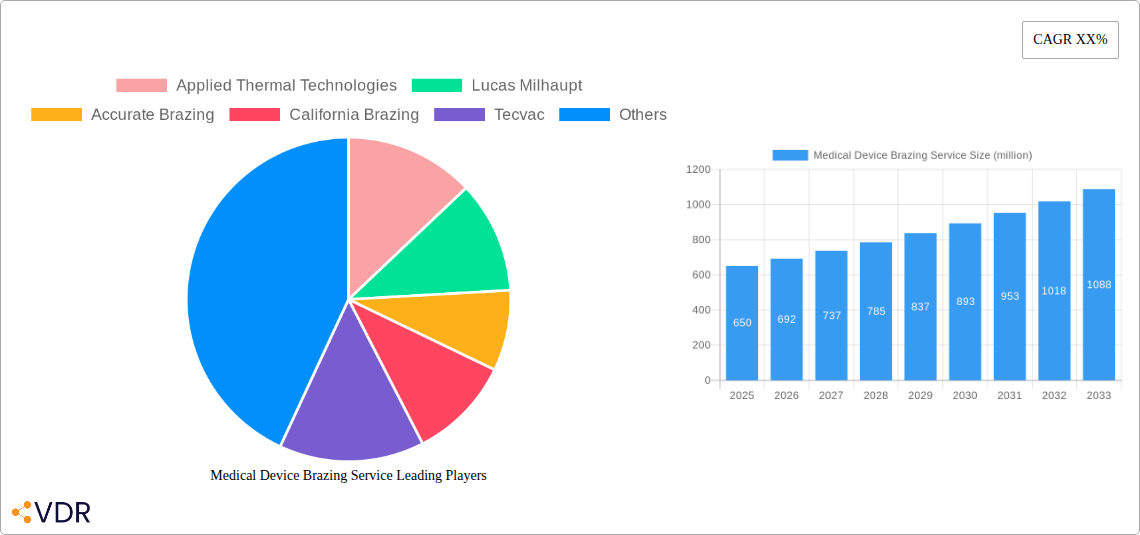
Medical Device Brazing Service Market Size (In Billion)

Key trends include the increasing use of brazing in reliable, complex implantable devices like pacemakers and neurostimulators, and the need for advanced processes to handle miniaturized components with intricate geometries. While stringent regulatory environments and initial investment costs for equipment and skilled labor present challenges, the persistent drive for enhanced product performance, miniaturization, and cost-effectiveness ensures a promising trajectory for the Medical Device Brazing Service market.
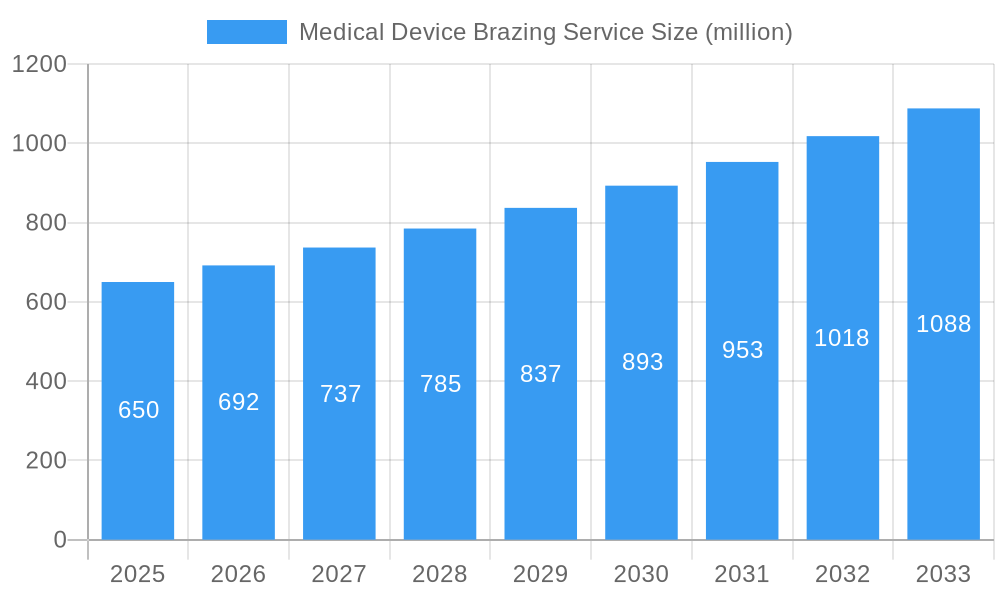
Medical Device Brazing Service Company Market Share
This comprehensive report offers an in-depth analysis of the global Medical Device Brazing Service market, focusing on market dynamics, growth drivers, and the competitive landscape. It covers the period from 2019 to 2033, with 2025 as the base and estimated year, providing crucial insights for industry stakeholders.
Report Title: Global Medical Device Brazing Service Market Analysis and Forecast: 2019–2033
Report Description:
Explore the significant opportunities within the global Medical Device Brazing Service market, a vital segment supporting the development of advanced medical technologies. This report provides a detailed analysis of market dynamics, growth trajectories, and the competitive environment for medical device brazing services, essential for intricate medical component assembly. Covering historical and projected periods from 2019 to 2033, with 2025 as the base and estimated year, this report is an indispensable resource for understanding market penetration, technological adoption, and future potential.
The Medical Device Brazing Service market is closely aligned with the expanding medical device industry, with a projected market size of $2.52 billion by 2025. This analysis meticulously examines key segments, including Orthopedic Devices, Dental Devices, Cardiovascular Devices, and Ophthalmic Devices, offering granular insights into their specific brazing needs and market contributions. It also categorizes prevalent brazing types such as Vacuum Brazing, Hydrogen Furnace Brazing, Induction Brazing, and Infrared (Quartz Lamp) Brazing, providing a clear view of technological preferences and their market share.
This analysis highlights innovations in Vacuum Brazing for high-precision implants and Hydrogen Furnace Brazing for complex internal structures. With a focus on key market players and their contributions, this report serves as a definitive guide to navigating the dynamic Medical Device Brazing Service market.
Medical Device Brazing Service Market Dynamics & Structure
The Medical Device Brazing Service market is characterized by a moderate to high level of concentration, with a few key players holding significant market share, particularly in specialized applications like cardiovascular and orthopedic device assembly. Technological innovation is a primary driver, fueled by the increasing complexity and miniaturization of medical devices, necessitating advanced brazing techniques for enhanced joint integrity and biocompatibility. Regulatory frameworks, such as those set by the FDA and EMA, play a crucial role in dictating material choices, process validation, and quality control, adding a layer of complexity and opportunity for specialized service providers. Competitive product substitutes are limited due to the unique demands of medical device assembly, where performance, reliability, and regulatory compliance are paramount. End-user demographics, including an aging global population and rising chronic disease prevalence, directly impact the demand for sophisticated medical devices, thus indirectly driving the need for advanced brazing services. Mergers and acquisitions (M&A) trends are observed as companies seek to expand their service offerings, gain access to new technologies, or consolidate their market positions. For instance, the acquisition of specialized brazing firms by larger contract manufacturers has been a notable trend, aiming to provide end-to-end solutions for medical device OEMs.
- Market Concentration: Dominated by specialized brazing providers and contract manufacturers with dedicated medical divisions.
- Technological Innovation Drivers: Miniaturization, demand for biocompatible materials, and increased device functionality requiring high-integrity joints.
- Regulatory Frameworks: Strict adherence to ISO 13485 and specific device regulations influences material selection and process validation.
- Competitive Product Substitutes: Limited due to the high-performance and reliability demands of medical applications.
- End-User Demographics: Aging population and rising incidence of chronic diseases drive demand for advanced medical devices.
- M&A Trends: Strategic acquisitions focused on expanding service portfolios and technological capabilities.
Medical Device Brazing Service Growth Trends & Insights
The Medical Device Brazing Service market is poised for robust growth, projected to expand at a compound annual growth rate (CAGR) of XX.X% from 2019 to 2033. This trajectory is underpinned by the continuous evolution of the global healthcare landscape and the relentless pursuit of innovative medical solutions. The base year of 2025 estimates the market size at $XXX.X million units, with significant expansion anticipated through the forecast period of 2025–2033. Adoption rates for advanced brazing techniques, such as Vacuum Brazing and Hydrogen Furnace Brazing, are on an upward trend, driven by their ability to create precise, contamination-free, and high-strength joints essential for critical medical components like pacemakers, stents, and surgical instruments. Technological disruptions are predominantly focused on improving process efficiency, enabling the brazing of novel alloys, and enhancing the traceability and validation of brazed components. For example, advancements in automated brazing systems are reducing production cycle times and improving consistency, critical for high-volume medical device manufacturing. Consumer behavior shifts, including a greater emphasis on minimally invasive procedures and the increasing demand for personalized medicine, directly translate to a higher need for intricately designed and reliably assembled medical devices, thereby fueling the demand for specialized brazing services. The market penetration of brazed medical devices is expected to deepen as more complex functionalities are integrated into implants and surgical tools, requiring the superior performance characteristics offered by brazed joints. The rising prevalence of chronic diseases and the growing demand for advanced diagnostic equipment are also significant contributors to this sustained growth.
Dominant Regions, Countries, or Segments in Medical Device Brazing Service
The Cardiovascular Devices segment is currently the most dominant driver of growth within the Medical Device Brazing Service market, accounting for an estimated XX.X% of the global market share in 2025. This dominance is attributed to the widespread use of brazed components in a plethora of cardiovascular applications, including pacemakers, defibrillators, angioplasty balloons, stents, and complex catheter systems. The intricate nature of these devices often necessitates high-precision, leak-proof, and biocompatible joints, which brazing excels at providing. Regions such as North America and Europe lead in terms of market size and demand for medical device brazing services, largely due to their established healthcare infrastructure, high disposable incomes, advanced research and development capabilities, and a significant concentration of leading medical device manufacturers.
Dominant Segment - Cardiovascular Devices:
- Essential for critical components like pacemakers, stents, and catheters.
- High demand for leak-proof, biocompatible, and high-strength joints.
- Estimated market share of XX.X% in 2025.
- Driven by the increasing prevalence of cardiovascular diseases globally.
Dominant Regions - North America & Europe:
- North America: Strong presence of major medical device OEMs, robust R&D investment, and high healthcare expenditure.
- Europe: Advanced medical device manufacturing capabilities, stringent quality standards, and a growing aging population.
- Significant market share driven by technological adoption and regulatory compliance.
- Infrastructure development in specialized brazing facilities supports market growth.
Key Drivers of Dominance:
- Economic Policies: Favorable investment climates and government support for the healthcare sector.
- Infrastructure: Availability of specialized manufacturing facilities and skilled labor.
- Technological Advancements: Early adoption and integration of cutting-edge brazing technologies.
- Regulatory Environment: Well-defined regulatory frameworks that encourage quality and innovation.
Medical Device Brazing Service Product Landscape
The product landscape of Medical Device Brazing Services is defined by its focus on delivering ultra-high reliability, precision, and biocompatibility for critical medical components. Innovations are centered around developing specialized filler metals for novel alloys used in implants and surgical tools, alongside advancements in process control to ensure unparalleled joint integrity. Techniques like Vacuum Brazing and Hydrogen Furnace Brazing are paramount, enabling the joining of dissimilar metals and complex geometries without oxidation or contamination, which is crucial for devices that come into contact with bodily fluids or are implanted. Performance metrics emphasize tensile strength, fatigue resistance, leak tightness, and the absence of voids or inclusions, all critical for patient safety and device efficacy. Unique selling propositions often lie in the ability to braze exotic materials, handle extremely small components, and provide comprehensive validation and traceability to meet stringent medical device regulatory requirements.
Key Drivers, Barriers & Challenges in Medical Device Brazing Service
Key Drivers:
- Rising Demand for Advanced Medical Devices: The global surge in chronic diseases and an aging population necessitates more sophisticated and complex medical implants and instruments, directly increasing the need for specialized brazing services.
- Technological Advancements: Continuous innovation in brazing technologies, such as automated systems and precision control, enables the production of smaller, more intricate, and higher-performing medical components.
- Biocompatibility and Reliability Requirements: The critical nature of medical applications demands brazed joints that are inert, strong, and free from defects, a niche where specialized brazing services excel.
- Growth in Minimally Invasive Surgery: The increasing adoption of minimally invasive procedures requires smaller, more dexterous surgical tools and implants, often assembled using advanced brazing techniques.
Barriers & Challenges:
- Stringent Regulatory Compliance: Navigating complex and evolving medical device regulations (e.g., FDA, EMA) requires significant investment in validation, quality control, and documentation, posing a barrier for smaller service providers.
- High Initial Investment and Operating Costs: Specialized brazing equipment, cleanroom facilities, and skilled labor are costly, creating a high barrier to entry.
- Supply Chain Disruptions: Reliance on specialized materials and the potential for global supply chain disruptions can impact production timelines and costs. For instance, shortages of critical alloys could impact output, potentially by XX%.
- Skilled Workforce Shortage: The need for highly trained and experienced brazing technicians and metallurgists presents a persistent challenge.
- Competitive Pressure: While specialized, the market can still experience pricing pressures from established players and emerging technology providers.
Emerging Opportunities in Medical Device Brazing Service
Emerging opportunities in the Medical Device Brazing Service sector are largely driven by advancements in personalized medicine, robotics in surgery, and novel implantable materials. The growing trend towards patient-specific implants, particularly in orthopedics and reconstructive surgery, creates a demand for flexible, on-demand brazing solutions capable of handling unique geometries. Furthermore, the integration of smart technologies into medical devices, such as embedded sensors or wireless communication modules, presents new challenges and opportunities for specialized brazing of electronic components within implantable devices. The development and adoption of new biocompatible and bioresorbable materials in medical devices also open avenues for brazing service providers to develop expertise in joining these novel substrates, pushing the boundaries of current capabilities. The expansion of remote patient monitoring devices also drives the need for miniaturized and highly reliable brazed sub-assemblies.
Growth Accelerators in the Medical Device Brazing Service Industry
Growth accelerators in the Medical Device Brazing Service industry are intrinsically linked to the relentless pace of innovation in healthcare and the increasing sophistication of medical technologies. A primary accelerator is the growing demand for minimally invasive surgical instruments and implantable devices, which inherently require high-precision and complex assemblies achievable through advanced brazing. Secondly, technological breakthroughs in brazing techniques, such as the development of new filler metals for exotic alloys, enhanced process automation for improved consistency, and the application of AI for quality control, are significantly boosting efficiency and enabling the creation of more advanced medical devices. Strategic partnerships between brazing service providers and medical device manufacturers are also crucial accelerators, fostering co-development of solutions and ensuring seamless integration of brazing capabilities into the product lifecycle. Furthermore, expanding regulatory approvals for novel brazed medical devices validate and promote the adoption of these technologies, creating a virtuous cycle of innovation and market growth. The increasing focus on implantable electronics and sensors is another significant growth catalyst, demanding specialized brazing expertise to integrate these components reliably.
Key Players Shaping the Medical Device Brazing Service Market
- Applied Thermal Technologies
- Lucas Milhaupt
- Accurate Brazing
- California Brazing
- Tecvac
- Bluewater Thermal Solutions
- S-Bond Technologies
- Hi-Yew Laser Molding Services
- Bodycote Plc
- GH Induction Atmospheres
- Morgan Advanced Materials
- IMG Altair
- Vacuum Process Engineering (VPE)
- Automatic Machine Products
- ELCON PRECISION LLC
- Specialty Steel Treating
- Micro Precision Welding
- Bruce Diamond Corp
Notable Milestones in Medical Device Brazing Service Sector
- 2019: Launch of advanced vacuum brazing techniques for titanium alloy orthopedic implants, increasing biocompatibility and strength.
- 2020: Introduction of novel laser brazing solutions for ultra-fine cardiovascular stents, enabling higher precision and reduced manufacturing time.
- 2021: Significant investments in hydrogen furnace brazing capabilities by major players to meet the growing demand for complex, contamination-free medical device components.
- 2022: Emergence of automated induction brazing systems for mass production of dental implants, improving consistency and reducing costs.
- 2023: Advancements in filler metal development for brazing biocompatible ceramics and advanced polymers, expanding application possibilities.
- 2024: Increased adoption of digital traceability and process monitoring technologies for brazed medical components, enhancing regulatory compliance and quality assurance.
In-Depth Medical Device Brazing Service Market Outlook
The future outlook for the Medical Device Brazing Service market is exceptionally promising, driven by sustained innovation in healthcare and an increasing reliance on complex, high-performance medical devices. Growth accelerators such as the persistent demand for minimally invasive technologies, coupled with advancements in robotics and smart implantable devices, will continue to fuel the need for specialized brazing solutions. The market is expected to witness further integration of advanced digital technologies for process control and quality assurance, alongside an expansion into new material frontiers, including advanced composites and bioresorbable materials. Strategic collaborations between service providers and OEMs will be pivotal in navigating evolving regulatory landscapes and co-developing next-generation medical solutions. The expanding applications in cardiovascular, orthopedic, and neurological devices, alongside the burgeoning field of implantable electronics, represent significant untapped potential, solidifying the Medical Device Brazing Service market as a critical and dynamic segment of the broader healthcare industry.
Medical Device Brazing Service Segmentation
-
1. Application
- 1.1. Orthopedic Devices
- 1.2. Dental Devices
- 1.3. Cardiovascular Devices
- 1.4. Ophthalmic Devices
- 1.5. Others
-
2. Types
- 2.1. Vacuum Brazing
- 2.2. Hydrogen Furnace Brazing
- 2.3. Induction Brazing
- 2.4. Infrared (Quartz Lamp) Brazing
- 2.5. Others
Medical Device Brazing Service Segmentation By Geography
-
1. North America
- 1.1. United States
- 1.2. Canada
- 1.3. Mexico
-
2. South America
- 2.1. Brazil
- 2.2. Argentina
- 2.3. Rest of South America
-
3. Europe
- 3.1. United Kingdom
- 3.2. Germany
- 3.3. France
- 3.4. Italy
- 3.5. Spain
- 3.6. Russia
- 3.7. Benelux
- 3.8. Nordics
- 3.9. Rest of Europe
-
4. Middle East & Africa
- 4.1. Turkey
- 4.2. Israel
- 4.3. GCC
- 4.4. North Africa
- 4.5. South Africa
- 4.6. Rest of Middle East & Africa
-
5. Asia Pacific
- 5.1. China
- 5.2. India
- 5.3. Japan
- 5.4. South Korea
- 5.5. ASEAN
- 5.6. Oceania
- 5.7. Rest of Asia Pacific
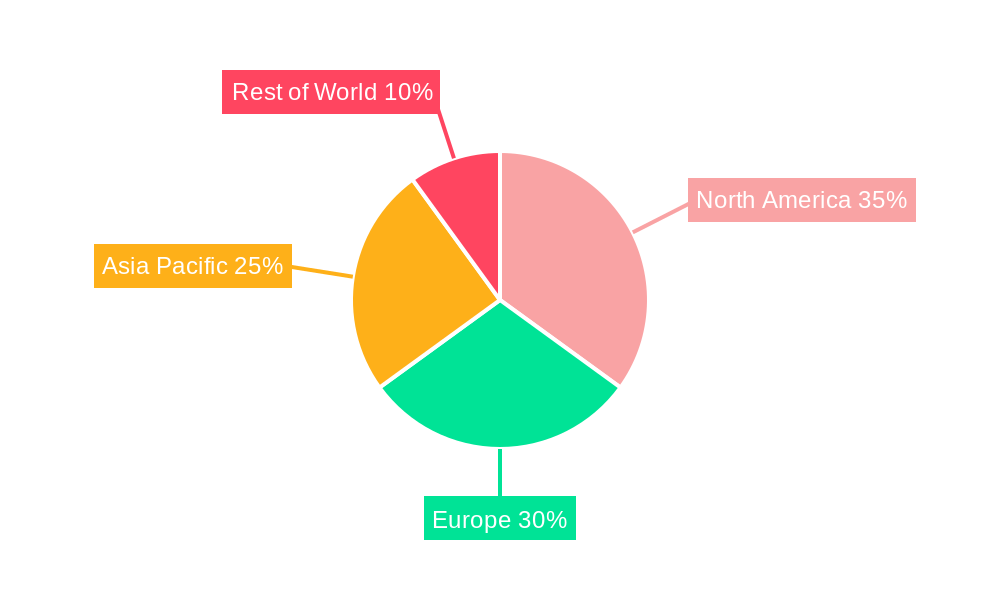
Medical Device Brazing Service Regional Market Share
Geographic Coverage of Medical Device Brazing Service
Medical Device Brazing Service REPORT HIGHLIGHTS
| Aspects | Details |
|---|---|
| Study Period | 2020-2034 |
| Base Year | 2025 |
| Estimated Year | 2026 |
| Forecast Period | 2026-2034 |
| Historical Period | 2020-2025 |
| Growth Rate | CAGR of 10.4% from 2020-2034 |
| Segmentation |
|
Table of Contents
- 1. Introduction
- 1.1. Research Scope
- 1.2. Market Segmentation
- 1.3. Research Methodology
- 1.4. Definitions and Assumptions
- 2. Executive Summary
- 2.1. Introduction
- 3. Market Dynamics
- 3.1. Introduction
- 3.2. Market Drivers
- 3.3. Market Restrains
- 3.4. Market Trends
- 4. Market Factor Analysis
- 4.1. Porters Five Forces
- 4.2. Supply/Value Chain
- 4.3. PESTEL analysis
- 4.4. Market Entropy
- 4.5. Patent/Trademark Analysis
- 5. Global Medical Device Brazing Service Analysis, Insights and Forecast, 2020-2032
- 5.1. Market Analysis, Insights and Forecast - by Application
- 5.1.1. Orthopedic Devices
- 5.1.2. Dental Devices
- 5.1.3. Cardiovascular Devices
- 5.1.4. Ophthalmic Devices
- 5.1.5. Others
- 5.2. Market Analysis, Insights and Forecast - by Types
- 5.2.1. Vacuum Brazing
- 5.2.2. Hydrogen Furnace Brazing
- 5.2.3. Induction Brazing
- 5.2.4. Infrared (Quartz Lamp) Brazing
- 5.2.5. Others
- 5.3. Market Analysis, Insights and Forecast - by Region
- 5.3.1. North America
- 5.3.2. South America
- 5.3.3. Europe
- 5.3.4. Middle East & Africa
- 5.3.5. Asia Pacific
- 5.1. Market Analysis, Insights and Forecast - by Application
- 6. North America Medical Device Brazing Service Analysis, Insights and Forecast, 2020-2032
- 6.1. Market Analysis, Insights and Forecast - by Application
- 6.1.1. Orthopedic Devices
- 6.1.2. Dental Devices
- 6.1.3. Cardiovascular Devices
- 6.1.4. Ophthalmic Devices
- 6.1.5. Others
- 6.2. Market Analysis, Insights and Forecast - by Types
- 6.2.1. Vacuum Brazing
- 6.2.2. Hydrogen Furnace Brazing
- 6.2.3. Induction Brazing
- 6.2.4. Infrared (Quartz Lamp) Brazing
- 6.2.5. Others
- 6.1. Market Analysis, Insights and Forecast - by Application
- 7. South America Medical Device Brazing Service Analysis, Insights and Forecast, 2020-2032
- 7.1. Market Analysis, Insights and Forecast - by Application
- 7.1.1. Orthopedic Devices
- 7.1.2. Dental Devices
- 7.1.3. Cardiovascular Devices
- 7.1.4. Ophthalmic Devices
- 7.1.5. Others
- 7.2. Market Analysis, Insights and Forecast - by Types
- 7.2.1. Vacuum Brazing
- 7.2.2. Hydrogen Furnace Brazing
- 7.2.3. Induction Brazing
- 7.2.4. Infrared (Quartz Lamp) Brazing
- 7.2.5. Others
- 7.1. Market Analysis, Insights and Forecast - by Application
- 8. Europe Medical Device Brazing Service Analysis, Insights and Forecast, 2020-2032
- 8.1. Market Analysis, Insights and Forecast - by Application
- 8.1.1. Orthopedic Devices
- 8.1.2. Dental Devices
- 8.1.3. Cardiovascular Devices
- 8.1.4. Ophthalmic Devices
- 8.1.5. Others
- 8.2. Market Analysis, Insights and Forecast - by Types
- 8.2.1. Vacuum Brazing
- 8.2.2. Hydrogen Furnace Brazing
- 8.2.3. Induction Brazing
- 8.2.4. Infrared (Quartz Lamp) Brazing
- 8.2.5. Others
- 8.1. Market Analysis, Insights and Forecast - by Application
- 9. Middle East & Africa Medical Device Brazing Service Analysis, Insights and Forecast, 2020-2032
- 9.1. Market Analysis, Insights and Forecast - by Application
- 9.1.1. Orthopedic Devices
- 9.1.2. Dental Devices
- 9.1.3. Cardiovascular Devices
- 9.1.4. Ophthalmic Devices
- 9.1.5. Others
- 9.2. Market Analysis, Insights and Forecast - by Types
- 9.2.1. Vacuum Brazing
- 9.2.2. Hydrogen Furnace Brazing
- 9.2.3. Induction Brazing
- 9.2.4. Infrared (Quartz Lamp) Brazing
- 9.2.5. Others
- 9.1. Market Analysis, Insights and Forecast - by Application
- 10. Asia Pacific Medical Device Brazing Service Analysis, Insights and Forecast, 2020-2032
- 10.1. Market Analysis, Insights and Forecast - by Application
- 10.1.1. Orthopedic Devices
- 10.1.2. Dental Devices
- 10.1.3. Cardiovascular Devices
- 10.1.4. Ophthalmic Devices
- 10.1.5. Others
- 10.2. Market Analysis, Insights and Forecast - by Types
- 10.2.1. Vacuum Brazing
- 10.2.2. Hydrogen Furnace Brazing
- 10.2.3. Induction Brazing
- 10.2.4. Infrared (Quartz Lamp) Brazing
- 10.2.5. Others
- 10.1. Market Analysis, Insights and Forecast - by Application
- 11. Competitive Analysis
- 11.1. Global Market Share Analysis 2025
- 11.2. Company Profiles
- 11.2.1 Applied Thermal Technologies
- 11.2.1.1. Overview
- 11.2.1.2. Products
- 11.2.1.3. SWOT Analysis
- 11.2.1.4. Recent Developments
- 11.2.1.5. Financials (Based on Availability)
- 11.2.2 Lucas Milhaupt
- 11.2.2.1. Overview
- 11.2.2.2. Products
- 11.2.2.3. SWOT Analysis
- 11.2.2.4. Recent Developments
- 11.2.2.5. Financials (Based on Availability)
- 11.2.3 Accurate Brazing
- 11.2.3.1. Overview
- 11.2.3.2. Products
- 11.2.3.3. SWOT Analysis
- 11.2.3.4. Recent Developments
- 11.2.3.5. Financials (Based on Availability)
- 11.2.4 California Brazing
- 11.2.4.1. Overview
- 11.2.4.2. Products
- 11.2.4.3. SWOT Analysis
- 11.2.4.4. Recent Developments
- 11.2.4.5. Financials (Based on Availability)
- 11.2.5 Tecvac
- 11.2.5.1. Overview
- 11.2.5.2. Products
- 11.2.5.3. SWOT Analysis
- 11.2.5.4. Recent Developments
- 11.2.5.5. Financials (Based on Availability)
- 11.2.6 Bluewater Thermal Solutions
- 11.2.6.1. Overview
- 11.2.6.2. Products
- 11.2.6.3. SWOT Analysis
- 11.2.6.4. Recent Developments
- 11.2.6.5. Financials (Based on Availability)
- 11.2.7 S-Bond Technologies
- 11.2.7.1. Overview
- 11.2.7.2. Products
- 11.2.7.3. SWOT Analysis
- 11.2.7.4. Recent Developments
- 11.2.7.5. Financials (Based on Availability)
- 11.2.8 Hi-Yew Laser Molding Services
- 11.2.8.1. Overview
- 11.2.8.2. Products
- 11.2.8.3. SWOT Analysis
- 11.2.8.4. Recent Developments
- 11.2.8.5. Financials (Based on Availability)
- 11.2.9 Bodycote Plc
- 11.2.9.1. Overview
- 11.2.9.2. Products
- 11.2.9.3. SWOT Analysis
- 11.2.9.4. Recent Developments
- 11.2.9.5. Financials (Based on Availability)
- 11.2.10 GH Induction Atmospheres
- 11.2.10.1. Overview
- 11.2.10.2. Products
- 11.2.10.3. SWOT Analysis
- 11.2.10.4. Recent Developments
- 11.2.10.5. Financials (Based on Availability)
- 11.2.11 Morgan Advanced Materials
- 11.2.11.1. Overview
- 11.2.11.2. Products
- 11.2.11.3. SWOT Analysis
- 11.2.11.4. Recent Developments
- 11.2.11.5. Financials (Based on Availability)
- 11.2.12 IMG Altair
- 11.2.12.1. Overview
- 11.2.12.2. Products
- 11.2.12.3. SWOT Analysis
- 11.2.12.4. Recent Developments
- 11.2.12.5. Financials (Based on Availability)
- 11.2.13 Vacuum Process Engineering (VPE)
- 11.2.13.1. Overview
- 11.2.13.2. Products
- 11.2.13.3. SWOT Analysis
- 11.2.13.4. Recent Developments
- 11.2.13.5. Financials (Based on Availability)
- 11.2.14 Automatic Machine Products
- 11.2.14.1. Overview
- 11.2.14.2. Products
- 11.2.14.3. SWOT Analysis
- 11.2.14.4. Recent Developments
- 11.2.14.5. Financials (Based on Availability)
- 11.2.15 ELCON PRECISION LLC
- 11.2.15.1. Overview
- 11.2.15.2. Products
- 11.2.15.3. SWOT Analysis
- 11.2.15.4. Recent Developments
- 11.2.15.5. Financials (Based on Availability)
- 11.2.16 Specialty Steel Treating
- 11.2.16.1. Overview
- 11.2.16.2. Products
- 11.2.16.3. SWOT Analysis
- 11.2.16.4. Recent Developments
- 11.2.16.5. Financials (Based on Availability)
- 11.2.17 Micro Precision Welding
- 11.2.17.1. Overview
- 11.2.17.2. Products
- 11.2.17.3. SWOT Analysis
- 11.2.17.4. Recent Developments
- 11.2.17.5. Financials (Based on Availability)
- 11.2.18 Bruce Diamond Corp
- 11.2.18.1. Overview
- 11.2.18.2. Products
- 11.2.18.3. SWOT Analysis
- 11.2.18.4. Recent Developments
- 11.2.18.5. Financials (Based on Availability)
- 11.2.1 Applied Thermal Technologies
List of Figures
- Figure 1: Global Medical Device Brazing Service Revenue Breakdown (billion, %) by Region 2025 & 2033
- Figure 2: North America Medical Device Brazing Service Revenue (billion), by Application 2025 & 2033
- Figure 3: North America Medical Device Brazing Service Revenue Share (%), by Application 2025 & 2033
- Figure 4: North America Medical Device Brazing Service Revenue (billion), by Types 2025 & 2033
- Figure 5: North America Medical Device Brazing Service Revenue Share (%), by Types 2025 & 2033
- Figure 6: North America Medical Device Brazing Service Revenue (billion), by Country 2025 & 2033
- Figure 7: North America Medical Device Brazing Service Revenue Share (%), by Country 2025 & 2033
- Figure 8: South America Medical Device Brazing Service Revenue (billion), by Application 2025 & 2033
- Figure 9: South America Medical Device Brazing Service Revenue Share (%), by Application 2025 & 2033
- Figure 10: South America Medical Device Brazing Service Revenue (billion), by Types 2025 & 2033
- Figure 11: South America Medical Device Brazing Service Revenue Share (%), by Types 2025 & 2033
- Figure 12: South America Medical Device Brazing Service Revenue (billion), by Country 2025 & 2033
- Figure 13: South America Medical Device Brazing Service Revenue Share (%), by Country 2025 & 2033
- Figure 14: Europe Medical Device Brazing Service Revenue (billion), by Application 2025 & 2033
- Figure 15: Europe Medical Device Brazing Service Revenue Share (%), by Application 2025 & 2033
- Figure 16: Europe Medical Device Brazing Service Revenue (billion), by Types 2025 & 2033
- Figure 17: Europe Medical Device Brazing Service Revenue Share (%), by Types 2025 & 2033
- Figure 18: Europe Medical Device Brazing Service Revenue (billion), by Country 2025 & 2033
- Figure 19: Europe Medical Device Brazing Service Revenue Share (%), by Country 2025 & 2033
- Figure 20: Middle East & Africa Medical Device Brazing Service Revenue (billion), by Application 2025 & 2033
- Figure 21: Middle East & Africa Medical Device Brazing Service Revenue Share (%), by Application 2025 & 2033
- Figure 22: Middle East & Africa Medical Device Brazing Service Revenue (billion), by Types 2025 & 2033
- Figure 23: Middle East & Africa Medical Device Brazing Service Revenue Share (%), by Types 2025 & 2033
- Figure 24: Middle East & Africa Medical Device Brazing Service Revenue (billion), by Country 2025 & 2033
- Figure 25: Middle East & Africa Medical Device Brazing Service Revenue Share (%), by Country 2025 & 2033
- Figure 26: Asia Pacific Medical Device Brazing Service Revenue (billion), by Application 2025 & 2033
- Figure 27: Asia Pacific Medical Device Brazing Service Revenue Share (%), by Application 2025 & 2033
- Figure 28: Asia Pacific Medical Device Brazing Service Revenue (billion), by Types 2025 & 2033
- Figure 29: Asia Pacific Medical Device Brazing Service Revenue Share (%), by Types 2025 & 2033
- Figure 30: Asia Pacific Medical Device Brazing Service Revenue (billion), by Country 2025 & 2033
- Figure 31: Asia Pacific Medical Device Brazing Service Revenue Share (%), by Country 2025 & 2033
List of Tables
- Table 1: Global Medical Device Brazing Service Revenue billion Forecast, by Application 2020 & 2033
- Table 2: Global Medical Device Brazing Service Revenue billion Forecast, by Types 2020 & 2033
- Table 3: Global Medical Device Brazing Service Revenue billion Forecast, by Region 2020 & 2033
- Table 4: Global Medical Device Brazing Service Revenue billion Forecast, by Application 2020 & 2033
- Table 5: Global Medical Device Brazing Service Revenue billion Forecast, by Types 2020 & 2033
- Table 6: Global Medical Device Brazing Service Revenue billion Forecast, by Country 2020 & 2033
- Table 7: United States Medical Device Brazing Service Revenue (billion) Forecast, by Application 2020 & 2033
- Table 8: Canada Medical Device Brazing Service Revenue (billion) Forecast, by Application 2020 & 2033
- Table 9: Mexico Medical Device Brazing Service Revenue (billion) Forecast, by Application 2020 & 2033
- Table 10: Global Medical Device Brazing Service Revenue billion Forecast, by Application 2020 & 2033
- Table 11: Global Medical Device Brazing Service Revenue billion Forecast, by Types 2020 & 2033
- Table 12: Global Medical Device Brazing Service Revenue billion Forecast, by Country 2020 & 2033
- Table 13: Brazil Medical Device Brazing Service Revenue (billion) Forecast, by Application 2020 & 2033
- Table 14: Argentina Medical Device Brazing Service Revenue (billion) Forecast, by Application 2020 & 2033
- Table 15: Rest of South America Medical Device Brazing Service Revenue (billion) Forecast, by Application 2020 & 2033
- Table 16: Global Medical Device Brazing Service Revenue billion Forecast, by Application 2020 & 2033
- Table 17: Global Medical Device Brazing Service Revenue billion Forecast, by Types 2020 & 2033
- Table 18: Global Medical Device Brazing Service Revenue billion Forecast, by Country 2020 & 2033
- Table 19: United Kingdom Medical Device Brazing Service Revenue (billion) Forecast, by Application 2020 & 2033
- Table 20: Germany Medical Device Brazing Service Revenue (billion) Forecast, by Application 2020 & 2033
- Table 21: France Medical Device Brazing Service Revenue (billion) Forecast, by Application 2020 & 2033
- Table 22: Italy Medical Device Brazing Service Revenue (billion) Forecast, by Application 2020 & 2033
- Table 23: Spain Medical Device Brazing Service Revenue (billion) Forecast, by Application 2020 & 2033
- Table 24: Russia Medical Device Brazing Service Revenue (billion) Forecast, by Application 2020 & 2033
- Table 25: Benelux Medical Device Brazing Service Revenue (billion) Forecast, by Application 2020 & 2033
- Table 26: Nordics Medical Device Brazing Service Revenue (billion) Forecast, by Application 2020 & 2033
- Table 27: Rest of Europe Medical Device Brazing Service Revenue (billion) Forecast, by Application 2020 & 2033
- Table 28: Global Medical Device Brazing Service Revenue billion Forecast, by Application 2020 & 2033
- Table 29: Global Medical Device Brazing Service Revenue billion Forecast, by Types 2020 & 2033
- Table 30: Global Medical Device Brazing Service Revenue billion Forecast, by Country 2020 & 2033
- Table 31: Turkey Medical Device Brazing Service Revenue (billion) Forecast, by Application 2020 & 2033
- Table 32: Israel Medical Device Brazing Service Revenue (billion) Forecast, by Application 2020 & 2033
- Table 33: GCC Medical Device Brazing Service Revenue (billion) Forecast, by Application 2020 & 2033
- Table 34: North Africa Medical Device Brazing Service Revenue (billion) Forecast, by Application 2020 & 2033
- Table 35: South Africa Medical Device Brazing Service Revenue (billion) Forecast, by Application 2020 & 2033
- Table 36: Rest of Middle East & Africa Medical Device Brazing Service Revenue (billion) Forecast, by Application 2020 & 2033
- Table 37: Global Medical Device Brazing Service Revenue billion Forecast, by Application 2020 & 2033
- Table 38: Global Medical Device Brazing Service Revenue billion Forecast, by Types 2020 & 2033
- Table 39: Global Medical Device Brazing Service Revenue billion Forecast, by Country 2020 & 2033
- Table 40: China Medical Device Brazing Service Revenue (billion) Forecast, by Application 2020 & 2033
- Table 41: India Medical Device Brazing Service Revenue (billion) Forecast, by Application 2020 & 2033
- Table 42: Japan Medical Device Brazing Service Revenue (billion) Forecast, by Application 2020 & 2033
- Table 43: South Korea Medical Device Brazing Service Revenue (billion) Forecast, by Application 2020 & 2033
- Table 44: ASEAN Medical Device Brazing Service Revenue (billion) Forecast, by Application 2020 & 2033
- Table 45: Oceania Medical Device Brazing Service Revenue (billion) Forecast, by Application 2020 & 2033
- Table 46: Rest of Asia Pacific Medical Device Brazing Service Revenue (billion) Forecast, by Application 2020 & 2033
Frequently Asked Questions
1. What is the projected Compound Annual Growth Rate (CAGR) of the Medical Device Brazing Service?
The projected CAGR is approximately 10.4%.
2. Which companies are prominent players in the Medical Device Brazing Service?
Key companies in the market include Applied Thermal Technologies, Lucas Milhaupt, Accurate Brazing, California Brazing, Tecvac, Bluewater Thermal Solutions, S-Bond Technologies, Hi-Yew Laser Molding Services, Bodycote Plc, GH Induction Atmospheres, Morgan Advanced Materials, IMG Altair, Vacuum Process Engineering (VPE), Automatic Machine Products, ELCON PRECISION LLC, Specialty Steel Treating, Micro Precision Welding, Bruce Diamond Corp.
3. What are the main segments of the Medical Device Brazing Service?
The market segments include Application, Types.
4. Can you provide details about the market size?
The market size is estimated to be USD 2.52 billion as of 2022.
5. What are some drivers contributing to market growth?
N/A
6. What are the notable trends driving market growth?
N/A
7. Are there any restraints impacting market growth?
N/A
8. Can you provide examples of recent developments in the market?
N/A
9. What pricing options are available for accessing the report?
Pricing options include single-user, multi-user, and enterprise licenses priced at USD 4900.00, USD 7350.00, and USD 9800.00 respectively.
10. Is the market size provided in terms of value or volume?
The market size is provided in terms of value, measured in billion.
11. Are there any specific market keywords associated with the report?
Yes, the market keyword associated with the report is "Medical Device Brazing Service," which aids in identifying and referencing the specific market segment covered.
12. How do I determine which pricing option suits my needs best?
The pricing options vary based on user requirements and access needs. Individual users may opt for single-user licenses, while businesses requiring broader access may choose multi-user or enterprise licenses for cost-effective access to the report.
13. Are there any additional resources or data provided in the Medical Device Brazing Service report?
While the report offers comprehensive insights, it's advisable to review the specific contents or supplementary materials provided to ascertain if additional resources or data are available.
14. How can I stay updated on further developments or reports in the Medical Device Brazing Service?
To stay informed about further developments, trends, and reports in the Medical Device Brazing Service, consider subscribing to industry newsletters, following relevant companies and organizations, or regularly checking reputable industry news sources and publications.
Methodology
Step 1 - Identification of Relevant Samples Size from Population Database



Step 2 - Approaches for Defining Global Market Size (Value, Volume* & Price*)

Note*: In applicable scenarios
Step 3 - Data Sources
Primary Research
- Web Analytics
- Survey Reports
- Research Institute
- Latest Research Reports
- Opinion Leaders
Secondary Research
- Annual Reports
- White Paper
- Latest Press Release
- Industry Association
- Paid Database
- Investor Presentations

Step 4 - Data Triangulation
Involves using different sources of information in order to increase the validity of a study
These sources are likely to be stakeholders in a program - participants, other researchers, program staff, other community members, and so on.
Then we put all data in single framework & apply various statistical tools to find out the dynamic on the market.
During the analysis stage, feedback from the stakeholder groups would be compared to determine areas of agreement as well as areas of divergence