


Key Insights
The Medical Amorphous Alloy Components market is poised for significant expansion, projected to reach an estimated USD 1,500 million by 2025, with a robust Compound Annual Growth Rate (CAGR) of 12.5% through 2033. This dynamic growth is primarily fueled by the exceptional properties of amorphous alloys, such as high strength, excellent corrosion resistance, and biocompatibility, making them ideal for critical medical applications. The increasing prevalence of chronic diseases, the aging global population, and the continuous advancements in medical device technology are key drivers propelling this market forward. Specifically, orthopedic implants and dental implants are experiencing burgeoning demand due to the superior performance and longevity offered by these advanced materials compared to traditional alloys. The rising adoption of minimally invasive surgical techniques also necessitates the use of high-precision, durable components, further boosting the market.
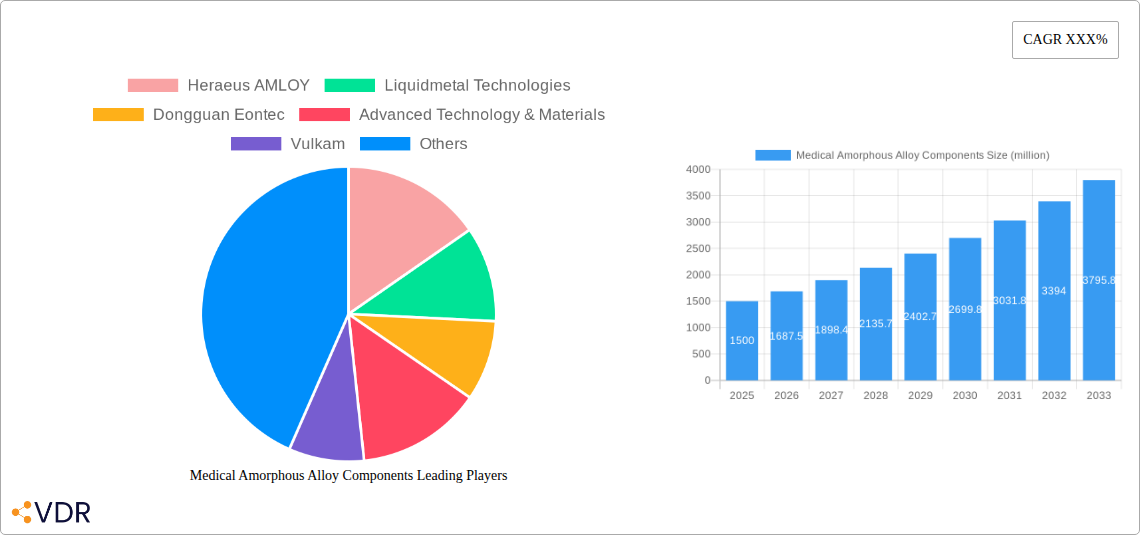
Medical Amorphous Alloy Components Market Size (In Billion)

The market is segmented across various applications and material types, with Orthopedic Implants and Dental Implants forming the dominant segments. Zirconium-based Amorphous Alloys are leading the charge due to their excellent biocompatibility and mechanical strength, closely followed by Niobium-based Amorphous Alloys. Key players like Heraeus AMLOY, Liquidmetal Technologies, and Dongguan Eontec are actively investing in research and development to innovate and expand their product portfolios, addressing the growing demand for high-performance medical devices. While the market presents substantial opportunities, challenges such as the high cost of production and the need for specialized manufacturing processes could pose restraints. However, ongoing technological advancements and increasing economies of scale are expected to mitigate these challenges over the forecast period, ensuring sustained market growth and widespread adoption of amorphous alloy components in the healthcare industry.
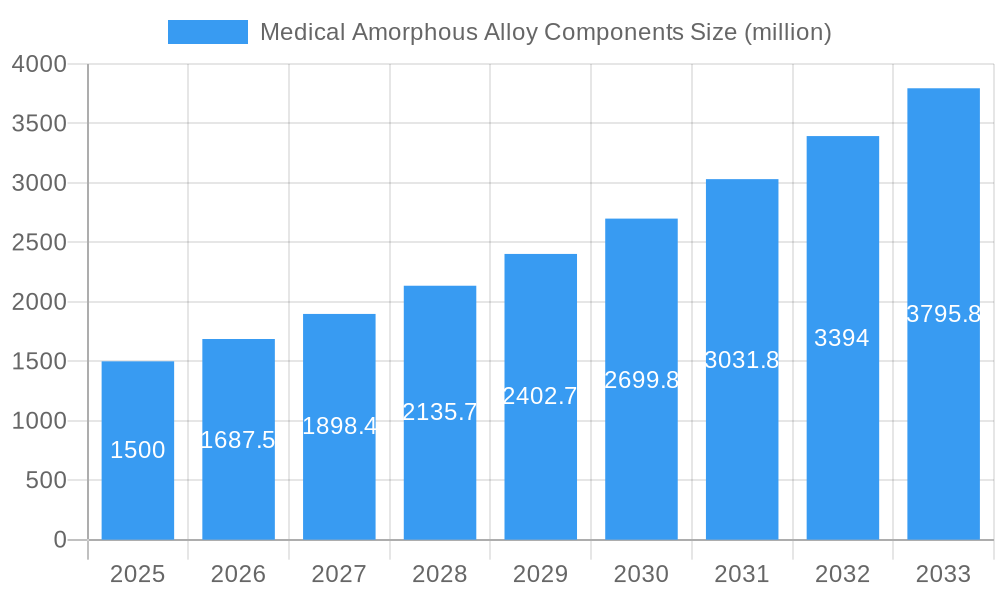
Medical Amorphous Alloy Components Company Market Share
Medical Amorphous Alloy Components Market Report: Comprehensive Analysis & Future Outlook (2019-2033)
This in-depth market research report offers a holistic view of the global Medical Amorphous Alloy Components market, delving into its intricate dynamics, growth trajectories, and future potential. Leveraging advanced analytical tools and extensive primary and secondary research, this report provides actionable insights for stakeholders seeking to capitalize on this rapidly evolving sector. The study encompasses a comprehensive analysis of market size, segmentation, competitive landscape, technological advancements, and regulatory environments, covering the historical period from 2019 to 2024, a base year of 2025, and a robust forecast period extending to 2033.
Medical Amorphous Alloy Components Market Dynamics & Structure
The Medical Amorphous Alloy Components market exhibits a moderately concentrated structure, with key players such as Heraeus AMLOY, Liquidmetal Technologies, Dongguan Eontec, Advanced Technology & Materials, Vulkam, and Panxing New Alloy Materials holding significant influence. Technological innovation serves as a primary driver, fueled by ongoing research into novel alloy compositions and advanced manufacturing techniques that enhance biocompatibility, mechanical strength, and corrosion resistance – crucial for medical applications. The stringent regulatory frameworks governing medical devices, including FDA approvals and CE marking, play a vital role in shaping market entry and product development. Competitive product substitutes, primarily traditional materials like stainless steel and titanium alloys, are continuously being challenged by the superior properties of amorphous alloys. End-user demographics, particularly the aging global population and the increasing prevalence of chronic diseases, are driving demand for advanced medical solutions. Mergers and Acquisitions (M&A) trends are expected to continue as larger players seek to consolidate their market position and acquire specialized technological expertise. For instance, recent M&A activities indicate a strategic push towards vertical integration and the acquisition of innovative intellectual property.
- Market Concentration: Moderate, with leading players dominating key segments.
- Technological Innovation: Driven by advancements in alloy design, manufacturing processes (e.g., precision casting, additive manufacturing), and biocompatibility testing.
- Regulatory Landscape: Governed by strict medical device regulations, requiring extensive testing and approval processes.
- Competitive Substitutes: Stainless steel and titanium alloys, though increasingly challenged by amorphous alloy performance.
- End-User Demographics: Aging populations, rise in orthopedic and dental procedures, and demand for minimally invasive surgical tools.
- M&A Trends: Strategic acquisitions for technology, market access, and portfolio expansion. Estimated M&A deal volume in the medical materials sector projected to reach $5,500 million in 2025.
Medical Amorphous Alloy Components Growth Trends & Insights
The Medical Amorphous Alloy Components market is poised for substantial growth, driven by a confluence of factors including escalating demand for advanced medical implants, the inherent superior properties of amorphous alloys, and continuous technological advancements. The global market size for medical amorphous alloy components is projected to expand from an estimated $1,200 million in 2024 to reach approximately $4,500 million by 2033, exhibiting a Compound Annual Growth Rate (CAGR) of 15.8% during the forecast period (2025-2033). This robust growth is underpinned by increasing adoption rates across various medical applications, spurred by their exceptional strength-to-weight ratio, fatigue resistance, and biocompatibility. Technological disruptions, such as the refinement of additive manufacturing techniques for amorphous alloys, are enabling the creation of highly complex and customized implant designs, further accelerating market penetration. Consumer behavior is also shifting, with a growing preference for durable, long-lasting, and minimally invasive medical devices, a trend that amorphous alloys are well-positioned to address. The market penetration of amorphous alloys in orthopedic and dental implants, while still nascent compared to traditional materials, is expected to witness significant increases as awareness and clinical validation grow. The parent market for advanced metallic biomaterials, valued at an estimated $18,500 million in 2025, provides a substantial ecosystem within which medical amorphous alloy components are carving out a significant niche. Within this, the child market for high-performance metallic implants is estimated at $7,200 million in 2025, representing a key target area for amorphous alloy applications.
Dominant Regions, Countries, or Segments in Medical Amorphous Alloy Components
The Orthopedic Implants segment is currently the dominant force driving growth within the Medical Amorphous Alloy Components market, projected to account for an estimated 45% of the total market share in 2025, with a market value of $540 million. This dominance is attributed to the increasing demand for high-performance hip, knee, and spinal implants, where the superior fatigue strength and corrosion resistance of amorphous alloys offer significant advantages over conventional materials. North America, particularly the United States, leads in market adoption due to its advanced healthcare infrastructure, high disposable incomes, and a robust regulatory environment that fosters innovation. The region's market share is estimated at 38% in 2025. Economic policies supporting R&D and healthcare advancements, coupled with substantial investments in medical technology, further bolster its position.
Dominant Segment: Orthopedic Implants
- Market Share (2025): ~45%
- Estimated Market Value (2025): $540 million
- Key Drivers: Aging population, rising incidence of osteoarthritis and degenerative bone diseases, demand for longer-lasting and more biocompatible implants, advancements in surgical techniques.
- Growth Potential: High, driven by the increasing number of joint replacement surgeries and the need for improved implant performance.
Dominant Region: North America
- Market Share (2025): ~38%
- Estimated Market Value (2025): $456 million
- Key Drivers: Advanced healthcare infrastructure, high R&D spending, favorable reimbursement policies, strong presence of leading medical device manufacturers, high patient awareness and acceptance of advanced medical technologies.
- Growth Potential: Strong, supported by continuous technological innovation and a large patient pool requiring complex orthopedic and dental procedures.
Within the "Type" segmentation, Zirconium-based Amorphous Alloys are expected to hold a significant market share of approximately 55% in 2025, valued at an estimated $660 million. This is due to their excellent biocompatibility, corrosion resistance, and mechanical properties, making them ideal for a wide range of implantable devices. The "Others" application segment, encompassing cardiovascular devices, neurosurgical tools, and advanced prosthetics, is also exhibiting a notable growth trajectory, indicating the expanding scope of amorphous alloys in the medical field.
Medical Amorphous Alloy Components Product Landscape
The product landscape for medical amorphous alloy components is characterized by rapid innovation and a focus on enhancing biocompatibility and performance for critical medical applications. Products range from intricately designed orthopedic implants, such as hip stems and spinal fusion cages, to precise dental implants and sophisticated surgical instruments. Heraeus AMLOY's development of amorphous alloys for medical applications, for instance, offers superior strength and corrosion resistance compared to traditional materials, leading to improved longevity and patient outcomes. Liquidmetal Technologies is at the forefront of developing amorphous alloy components with unique combinations of properties, including excellent wear resistance and radiopacity, crucial for surgical tools. These advancements enable the creation of lighter, stronger, and more durable medical devices, addressing unmet clinical needs and improving the quality of patient care.
Key Drivers, Barriers & Challenges in Medical Amorphous Alloy Components
Key Drivers:
- Superior Material Properties: Exceptional strength-to-weight ratio, excellent fatigue and corrosion resistance, and high biocompatibility make amorphous alloys ideal for demanding medical applications.
- Growing Demand for Advanced Implants: Aging global population and the increasing prevalence of degenerative diseases drive demand for long-lasting and high-performance orthopedic and dental implants.
- Technological Advancements: Innovations in manufacturing processes, particularly additive manufacturing, enable the creation of complex, customized amorphous alloy components.
- Biocompatibility & Reduced Allergic Reactions: Amorphous alloys often exhibit lower ion release compared to traditional metallic implants, minimizing the risk of adverse reactions.
Barriers & Challenges:
- High Manufacturing Costs: The specialized processing required for amorphous alloys can lead to higher production costs compared to conventional materials. Estimated production cost premium is between 15-25%.
- Regulatory Hurdles: Obtaining regulatory approval for new medical devices made from novel materials can be a lengthy and expensive process, requiring extensive clinical trials and testing.
- Limited Clinical Data & Awareness: While promising, widespread adoption is hindered by a lack of extensive long-term clinical data and physician awareness compared to established biomaterials.
- Supply Chain Development: Establishing a robust and scalable supply chain for amorphous alloy raw materials and finished components is still in its nascent stages. Estimated supply chain lead times for specialized alloys can be 12-16 weeks.
Emerging Opportunities in Medical Amorphous Alloy Components
Emerging opportunities in the Medical Amorphous Alloy Components market lie in the development of novel applications beyond traditional implants. The unique properties of amorphous alloys are opening doors for their use in advanced drug delivery systems, biosensors, and minimally invasive surgical tools that require exceptional precision and durability. Furthermore, the growing interest in personalized medicine presents a significant opportunity for custom-designed amorphous alloy implants tailored to individual patient anatomy. The expansion of amorphous alloy applications in the veterinary medical sector also represents an untapped market. The estimated untapped market potential for amorphous alloys in emerging medical device categories is valued at $800 million by 2028.
Growth Accelerators in the Medical Amorphous Alloy Components Industry
Key growth accelerators for the Medical Amorphous Alloy Components industry include relentless innovation in alloy compositions, leading to enhanced biocompatibility and mechanical performance. Strategic partnerships between alloy manufacturers and leading medical device companies are crucial for co-development and market penetration. The increasing focus on additive manufacturing (3D printing) of amorphous alloys is a significant accelerator, enabling the creation of complex geometries and patient-specific implants, thereby reducing lead times and improving customization. Government initiatives supporting advanced materials research and development, alongside favorable reimbursement policies for innovative medical devices, will further fuel growth. Investments in clinical trials and the generation of robust long-term data are also critical for accelerating adoption.
Key Players Shaping the Medical Amorphous Alloy Components Market
- Heraeus AMLOY
- Liquidmetal Technologies
- Dongguan Eontec
- Advanced Technology & Materials
- Vulkam
- Panxing New Alloy Materials
Notable Milestones in Medical Amorphous Alloy Components Sector
- 2019: Heraeus AMLOY expands its portfolio of amorphous alloys for medical applications with enhanced biocompatibility testing.
- 2020: Liquidmetal Technologies secures new patents for advanced amorphous alloy compositions and manufacturing processes for medical implants.
- 2021: Dongguan Eontec announces significant investment in R&D for amorphous alloy-based orthopedic components.
- 2022: Advanced Technology & Materials demonstrates promising results in clinical trials for amorphous alloy spinal implants.
- 2023: Vulkam develops a novel niobium-based amorphous alloy with superior resistance to corrosion for surgical tools.
- 2024: Panxing New Alloy Materials achieves ISO 13485 certification, indicating commitment to quality in medical device manufacturing.
In-Depth Medical Amorphous Alloy Components Market Outlook
The outlook for the Medical Amorphous Alloy Components market is exceptionally bright, driven by sustained demand for high-performance biomaterials and continuous technological advancements. Growth accelerators such as the refinement of additive manufacturing techniques and the expanding understanding of amorphous alloy biocompatibility will pave the way for broader adoption across a wider range of medical applications. Strategic collaborations between material science innovators and medical device giants will be pivotal in translating research into commercially viable products. The increasing focus on personalized medicine and the development of tailored implants will unlock significant market potential. Furthermore, the ongoing exploration of novel amorphous alloy compositions for specific therapeutic areas, such as cardiovascular and neurological devices, promises to diversify and expand the market. The future market potential for medical amorphous alloy components is projected to reach $4,500 million by 2033, signifying a significant opportunity for stakeholders.
Medical Amorphous Alloy Components Segmentation
-
1. Application
- 1.1. Orthopedic Implants
- 1.2. Dental Implants
- 1.3. Surgery Tools
- 1.4. Others
-
2. Type
- 2.1. Zirconium-based Amorphous Alloys
- 2.2. Niobium-based Amorphous Alloys
- 2.3. Others
Medical Amorphous Alloy Components Segmentation By Geography
-
1. North America
- 1.1. United States
- 1.2. Canada
- 1.3. Mexico
-
2. South America
- 2.1. Brazil
- 2.2. Argentina
- 2.3. Rest of South America
-
3. Europe
- 3.1. United Kingdom
- 3.2. Germany
- 3.3. France
- 3.4. Italy
- 3.5. Spain
- 3.6. Russia
- 3.7. Benelux
- 3.8. Nordics
- 3.9. Rest of Europe
-
4. Middle East & Africa
- 4.1. Turkey
- 4.2. Israel
- 4.3. GCC
- 4.4. North Africa
- 4.5. South Africa
- 4.6. Rest of Middle East & Africa
-
5. Asia Pacific
- 5.1. China
- 5.2. India
- 5.3. Japan
- 5.4. South Korea
- 5.5. ASEAN
- 5.6. Oceania
- 5.7. Rest of Asia Pacific
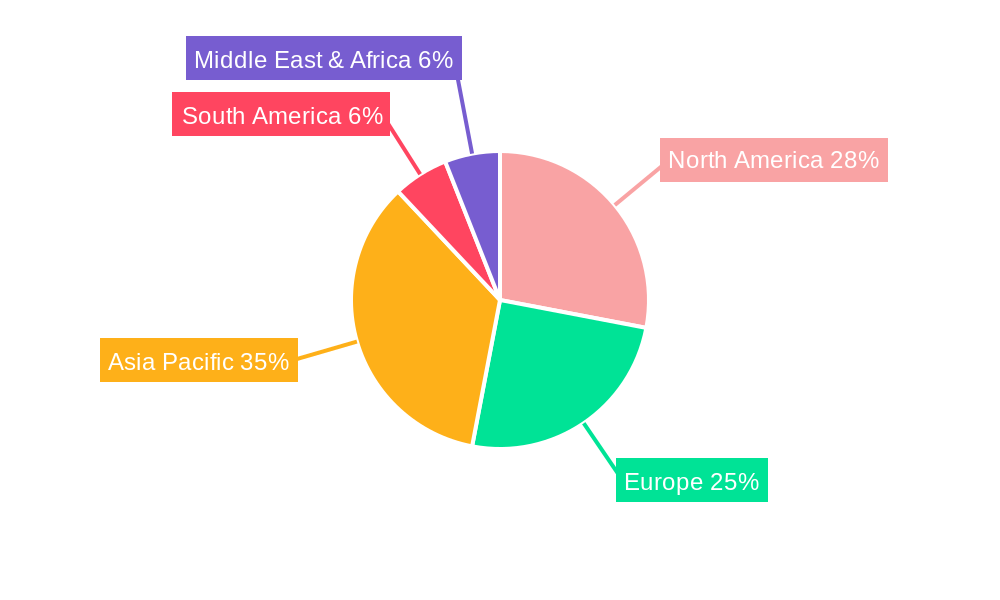
Medical Amorphous Alloy Components Regional Market Share
Geographic Coverage of Medical Amorphous Alloy Components
Medical Amorphous Alloy Components REPORT HIGHLIGHTS
| Aspects | Details |
|---|---|
| Study Period | 2020-2034 |
| Base Year | 2025 |
| Estimated Year | 2026 |
| Forecast Period | 2026-2034 |
| Historical Period | 2020-2025 |
| Growth Rate | CAGR of XXX% from 2020-2034 |
| Segmentation |
|
Table of Contents
- 1. Introduction
- 1.1. Research Scope
- 1.2. Market Segmentation
- 1.3. Research Methodology
- 1.4. Definitions and Assumptions
- 2. Executive Summary
- 2.1. Introduction
- 3. Market Dynamics
- 3.1. Introduction
- 3.2. Market Drivers
- 3.3. Market Restrains
- 3.4. Market Trends
- 4. Market Factor Analysis
- 4.1. Porters Five Forces
- 4.2. Supply/Value Chain
- 4.3. PESTEL analysis
- 4.4. Market Entropy
- 4.5. Patent/Trademark Analysis
- 5. Global Medical Amorphous Alloy Components Analysis, Insights and Forecast, 2020-2032
- 5.1. Market Analysis, Insights and Forecast - by Application
- 5.1.1. Orthopedic Implants
- 5.1.2. Dental Implants
- 5.1.3. Surgery Tools
- 5.1.4. Others
- 5.2. Market Analysis, Insights and Forecast - by Type
- 5.2.1. Zirconium-based Amorphous Alloys
- 5.2.2. Niobium-based Amorphous Alloys
- 5.2.3. Others
- 5.3. Market Analysis, Insights and Forecast - by Region
- 5.3.1. North America
- 5.3.2. South America
- 5.3.3. Europe
- 5.3.4. Middle East & Africa
- 5.3.5. Asia Pacific
- 5.1. Market Analysis, Insights and Forecast - by Application
- 6. North America Medical Amorphous Alloy Components Analysis, Insights and Forecast, 2020-2032
- 6.1. Market Analysis, Insights and Forecast - by Application
- 6.1.1. Orthopedic Implants
- 6.1.2. Dental Implants
- 6.1.3. Surgery Tools
- 6.1.4. Others
- 6.2. Market Analysis, Insights and Forecast - by Type
- 6.2.1. Zirconium-based Amorphous Alloys
- 6.2.2. Niobium-based Amorphous Alloys
- 6.2.3. Others
- 6.1. Market Analysis, Insights and Forecast - by Application
- 7. South America Medical Amorphous Alloy Components Analysis, Insights and Forecast, 2020-2032
- 7.1. Market Analysis, Insights and Forecast - by Application
- 7.1.1. Orthopedic Implants
- 7.1.2. Dental Implants
- 7.1.3. Surgery Tools
- 7.1.4. Others
- 7.2. Market Analysis, Insights and Forecast - by Type
- 7.2.1. Zirconium-based Amorphous Alloys
- 7.2.2. Niobium-based Amorphous Alloys
- 7.2.3. Others
- 7.1. Market Analysis, Insights and Forecast - by Application
- 8. Europe Medical Amorphous Alloy Components Analysis, Insights and Forecast, 2020-2032
- 8.1. Market Analysis, Insights and Forecast - by Application
- 8.1.1. Orthopedic Implants
- 8.1.2. Dental Implants
- 8.1.3. Surgery Tools
- 8.1.4. Others
- 8.2. Market Analysis, Insights and Forecast - by Type
- 8.2.1. Zirconium-based Amorphous Alloys
- 8.2.2. Niobium-based Amorphous Alloys
- 8.2.3. Others
- 8.1. Market Analysis, Insights and Forecast - by Application
- 9. Middle East & Africa Medical Amorphous Alloy Components Analysis, Insights and Forecast, 2020-2032
- 9.1. Market Analysis, Insights and Forecast - by Application
- 9.1.1. Orthopedic Implants
- 9.1.2. Dental Implants
- 9.1.3. Surgery Tools
- 9.1.4. Others
- 9.2. Market Analysis, Insights and Forecast - by Type
- 9.2.1. Zirconium-based Amorphous Alloys
- 9.2.2. Niobium-based Amorphous Alloys
- 9.2.3. Others
- 9.1. Market Analysis, Insights and Forecast - by Application
- 10. Asia Pacific Medical Amorphous Alloy Components Analysis, Insights and Forecast, 2020-2032
- 10.1. Market Analysis, Insights and Forecast - by Application
- 10.1.1. Orthopedic Implants
- 10.1.2. Dental Implants
- 10.1.3. Surgery Tools
- 10.1.4. Others
- 10.2. Market Analysis, Insights and Forecast - by Type
- 10.2.1. Zirconium-based Amorphous Alloys
- 10.2.2. Niobium-based Amorphous Alloys
- 10.2.3. Others
- 10.1. Market Analysis, Insights and Forecast - by Application
- 11. Competitive Analysis
- 11.1. Global Market Share Analysis 2025
- 11.2. Company Profiles
- 11.2.1 Heraeus AMLOY
- 11.2.1.1. Overview
- 11.2.1.2. Products
- 11.2.1.3. SWOT Analysis
- 11.2.1.4. Recent Developments
- 11.2.1.5. Financials (Based on Availability)
- 11.2.2 Liquidmetal Technologies
- 11.2.2.1. Overview
- 11.2.2.2. Products
- 11.2.2.3. SWOT Analysis
- 11.2.2.4. Recent Developments
- 11.2.2.5. Financials (Based on Availability)
- 11.2.3 Dongguan Eontec
- 11.2.3.1. Overview
- 11.2.3.2. Products
- 11.2.3.3. SWOT Analysis
- 11.2.3.4. Recent Developments
- 11.2.3.5. Financials (Based on Availability)
- 11.2.4 Advanced Technology & Materials
- 11.2.4.1. Overview
- 11.2.4.2. Products
- 11.2.4.3. SWOT Analysis
- 11.2.4.4. Recent Developments
- 11.2.4.5. Financials (Based on Availability)
- 11.2.5 Vulkam
- 11.2.5.1. Overview
- 11.2.5.2. Products
- 11.2.5.3. SWOT Analysis
- 11.2.5.4. Recent Developments
- 11.2.5.5. Financials (Based on Availability)
- 11.2.6 Panxing New Alloy Materials
- 11.2.6.1. Overview
- 11.2.6.2. Products
- 11.2.6.3. SWOT Analysis
- 11.2.6.4. Recent Developments
- 11.2.6.5. Financials (Based on Availability)
- 11.2.1 Heraeus AMLOY
List of Figures
- Figure 1: Global Medical Amorphous Alloy Components Revenue Breakdown (million, %) by Region 2025 & 2033
- Figure 2: North America Medical Amorphous Alloy Components Revenue (million), by Application 2025 & 2033
- Figure 3: North America Medical Amorphous Alloy Components Revenue Share (%), by Application 2025 & 2033
- Figure 4: North America Medical Amorphous Alloy Components Revenue (million), by Type 2025 & 2033
- Figure 5: North America Medical Amorphous Alloy Components Revenue Share (%), by Type 2025 & 2033
- Figure 6: North America Medical Amorphous Alloy Components Revenue (million), by Country 2025 & 2033
- Figure 7: North America Medical Amorphous Alloy Components Revenue Share (%), by Country 2025 & 2033
- Figure 8: South America Medical Amorphous Alloy Components Revenue (million), by Application 2025 & 2033
- Figure 9: South America Medical Amorphous Alloy Components Revenue Share (%), by Application 2025 & 2033
- Figure 10: South America Medical Amorphous Alloy Components Revenue (million), by Type 2025 & 2033
- Figure 11: South America Medical Amorphous Alloy Components Revenue Share (%), by Type 2025 & 2033
- Figure 12: South America Medical Amorphous Alloy Components Revenue (million), by Country 2025 & 2033
- Figure 13: South America Medical Amorphous Alloy Components Revenue Share (%), by Country 2025 & 2033
- Figure 14: Europe Medical Amorphous Alloy Components Revenue (million), by Application 2025 & 2033
- Figure 15: Europe Medical Amorphous Alloy Components Revenue Share (%), by Application 2025 & 2033
- Figure 16: Europe Medical Amorphous Alloy Components Revenue (million), by Type 2025 & 2033
- Figure 17: Europe Medical Amorphous Alloy Components Revenue Share (%), by Type 2025 & 2033
- Figure 18: Europe Medical Amorphous Alloy Components Revenue (million), by Country 2025 & 2033
- Figure 19: Europe Medical Amorphous Alloy Components Revenue Share (%), by Country 2025 & 2033
- Figure 20: Middle East & Africa Medical Amorphous Alloy Components Revenue (million), by Application 2025 & 2033
- Figure 21: Middle East & Africa Medical Amorphous Alloy Components Revenue Share (%), by Application 2025 & 2033
- Figure 22: Middle East & Africa Medical Amorphous Alloy Components Revenue (million), by Type 2025 & 2033
- Figure 23: Middle East & Africa Medical Amorphous Alloy Components Revenue Share (%), by Type 2025 & 2033
- Figure 24: Middle East & Africa Medical Amorphous Alloy Components Revenue (million), by Country 2025 & 2033
- Figure 25: Middle East & Africa Medical Amorphous Alloy Components Revenue Share (%), by Country 2025 & 2033
- Figure 26: Asia Pacific Medical Amorphous Alloy Components Revenue (million), by Application 2025 & 2033
- Figure 27: Asia Pacific Medical Amorphous Alloy Components Revenue Share (%), by Application 2025 & 2033
- Figure 28: Asia Pacific Medical Amorphous Alloy Components Revenue (million), by Type 2025 & 2033
- Figure 29: Asia Pacific Medical Amorphous Alloy Components Revenue Share (%), by Type 2025 & 2033
- Figure 30: Asia Pacific Medical Amorphous Alloy Components Revenue (million), by Country 2025 & 2033
- Figure 31: Asia Pacific Medical Amorphous Alloy Components Revenue Share (%), by Country 2025 & 2033
List of Tables
- Table 1: Global Medical Amorphous Alloy Components Revenue million Forecast, by Application 2020 & 2033
- Table 2: Global Medical Amorphous Alloy Components Revenue million Forecast, by Type 2020 & 2033
- Table 3: Global Medical Amorphous Alloy Components Revenue million Forecast, by Region 2020 & 2033
- Table 4: Global Medical Amorphous Alloy Components Revenue million Forecast, by Application 2020 & 2033
- Table 5: Global Medical Amorphous Alloy Components Revenue million Forecast, by Type 2020 & 2033
- Table 6: Global Medical Amorphous Alloy Components Revenue million Forecast, by Country 2020 & 2033
- Table 7: United States Medical Amorphous Alloy Components Revenue (million) Forecast, by Application 2020 & 2033
- Table 8: Canada Medical Amorphous Alloy Components Revenue (million) Forecast, by Application 2020 & 2033
- Table 9: Mexico Medical Amorphous Alloy Components Revenue (million) Forecast, by Application 2020 & 2033
- Table 10: Global Medical Amorphous Alloy Components Revenue million Forecast, by Application 2020 & 2033
- Table 11: Global Medical Amorphous Alloy Components Revenue million Forecast, by Type 2020 & 2033
- Table 12: Global Medical Amorphous Alloy Components Revenue million Forecast, by Country 2020 & 2033
- Table 13: Brazil Medical Amorphous Alloy Components Revenue (million) Forecast, by Application 2020 & 2033
- Table 14: Argentina Medical Amorphous Alloy Components Revenue (million) Forecast, by Application 2020 & 2033
- Table 15: Rest of South America Medical Amorphous Alloy Components Revenue (million) Forecast, by Application 2020 & 2033
- Table 16: Global Medical Amorphous Alloy Components Revenue million Forecast, by Application 2020 & 2033
- Table 17: Global Medical Amorphous Alloy Components Revenue million Forecast, by Type 2020 & 2033
- Table 18: Global Medical Amorphous Alloy Components Revenue million Forecast, by Country 2020 & 2033
- Table 19: United Kingdom Medical Amorphous Alloy Components Revenue (million) Forecast, by Application 2020 & 2033
- Table 20: Germany Medical Amorphous Alloy Components Revenue (million) Forecast, by Application 2020 & 2033
- Table 21: France Medical Amorphous Alloy Components Revenue (million) Forecast, by Application 2020 & 2033
- Table 22: Italy Medical Amorphous Alloy Components Revenue (million) Forecast, by Application 2020 & 2033
- Table 23: Spain Medical Amorphous Alloy Components Revenue (million) Forecast, by Application 2020 & 2033
- Table 24: Russia Medical Amorphous Alloy Components Revenue (million) Forecast, by Application 2020 & 2033
- Table 25: Benelux Medical Amorphous Alloy Components Revenue (million) Forecast, by Application 2020 & 2033
- Table 26: Nordics Medical Amorphous Alloy Components Revenue (million) Forecast, by Application 2020 & 2033
- Table 27: Rest of Europe Medical Amorphous Alloy Components Revenue (million) Forecast, by Application 2020 & 2033
- Table 28: Global Medical Amorphous Alloy Components Revenue million Forecast, by Application 2020 & 2033
- Table 29: Global Medical Amorphous Alloy Components Revenue million Forecast, by Type 2020 & 2033
- Table 30: Global Medical Amorphous Alloy Components Revenue million Forecast, by Country 2020 & 2033
- Table 31: Turkey Medical Amorphous Alloy Components Revenue (million) Forecast, by Application 2020 & 2033
- Table 32: Israel Medical Amorphous Alloy Components Revenue (million) Forecast, by Application 2020 & 2033
- Table 33: GCC Medical Amorphous Alloy Components Revenue (million) Forecast, by Application 2020 & 2033
- Table 34: North Africa Medical Amorphous Alloy Components Revenue (million) Forecast, by Application 2020 & 2033
- Table 35: South Africa Medical Amorphous Alloy Components Revenue (million) Forecast, by Application 2020 & 2033
- Table 36: Rest of Middle East & Africa Medical Amorphous Alloy Components Revenue (million) Forecast, by Application 2020 & 2033
- Table 37: Global Medical Amorphous Alloy Components Revenue million Forecast, by Application 2020 & 2033
- Table 38: Global Medical Amorphous Alloy Components Revenue million Forecast, by Type 2020 & 2033
- Table 39: Global Medical Amorphous Alloy Components Revenue million Forecast, by Country 2020 & 2033
- Table 40: China Medical Amorphous Alloy Components Revenue (million) Forecast, by Application 2020 & 2033
- Table 41: India Medical Amorphous Alloy Components Revenue (million) Forecast, by Application 2020 & 2033
- Table 42: Japan Medical Amorphous Alloy Components Revenue (million) Forecast, by Application 2020 & 2033
- Table 43: South Korea Medical Amorphous Alloy Components Revenue (million) Forecast, by Application 2020 & 2033
- Table 44: ASEAN Medical Amorphous Alloy Components Revenue (million) Forecast, by Application 2020 & 2033
- Table 45: Oceania Medical Amorphous Alloy Components Revenue (million) Forecast, by Application 2020 & 2033
- Table 46: Rest of Asia Pacific Medical Amorphous Alloy Components Revenue (million) Forecast, by Application 2020 & 2033
Frequently Asked Questions
1. What is the projected Compound Annual Growth Rate (CAGR) of the Medical Amorphous Alloy Components?
The projected CAGR is approximately XXX%.
2. Which companies are prominent players in the Medical Amorphous Alloy Components?
Key companies in the market include Heraeus AMLOY, Liquidmetal Technologies, Dongguan Eontec, Advanced Technology & Materials, Vulkam, Panxing New Alloy Materials.
3. What are the main segments of the Medical Amorphous Alloy Components?
The market segments include Application, Type.
4. Can you provide details about the market size?
The market size is estimated to be USD XXX million as of 2022.
5. What are some drivers contributing to market growth?
N/A
6. What are the notable trends driving market growth?
N/A
7. Are there any restraints impacting market growth?
N/A
8. Can you provide examples of recent developments in the market?
N/A
9. What pricing options are available for accessing the report?
Pricing options include single-user, multi-user, and enterprise licenses priced at USD 2900.00, USD 4350.00, and USD 5800.00 respectively.
10. Is the market size provided in terms of value or volume?
The market size is provided in terms of value, measured in million.
11. Are there any specific market keywords associated with the report?
Yes, the market keyword associated with the report is "Medical Amorphous Alloy Components," which aids in identifying and referencing the specific market segment covered.
12. How do I determine which pricing option suits my needs best?
The pricing options vary based on user requirements and access needs. Individual users may opt for single-user licenses, while businesses requiring broader access may choose multi-user or enterprise licenses for cost-effective access to the report.
13. Are there any additional resources or data provided in the Medical Amorphous Alloy Components report?
While the report offers comprehensive insights, it's advisable to review the specific contents or supplementary materials provided to ascertain if additional resources or data are available.
14. How can I stay updated on further developments or reports in the Medical Amorphous Alloy Components?
To stay informed about further developments, trends, and reports in the Medical Amorphous Alloy Components, consider subscribing to industry newsletters, following relevant companies and organizations, or regularly checking reputable industry news sources and publications.
Methodology
Step 1 - Identification of Relevant Samples Size from Population Database



Step 2 - Approaches for Defining Global Market Size (Value, Volume* & Price*)

Note*: In applicable scenarios
Step 3 - Data Sources
Primary Research
- Web Analytics
- Survey Reports
- Research Institute
- Latest Research Reports
- Opinion Leaders
Secondary Research
- Annual Reports
- White Paper
- Latest Press Release
- Industry Association
- Paid Database
- Investor Presentations

Step 4 - Data Triangulation
Involves using different sources of information in order to increase the validity of a study
These sources are likely to be stakeholders in a program - participants, other researchers, program staff, other community members, and so on.
Then we put all data in single framework & apply various statistical tools to find out the dynamic on the market.
During the analysis stage, feedback from the stakeholder groups would be compared to determine areas of agreement as well as areas of divergence