
Key Insights
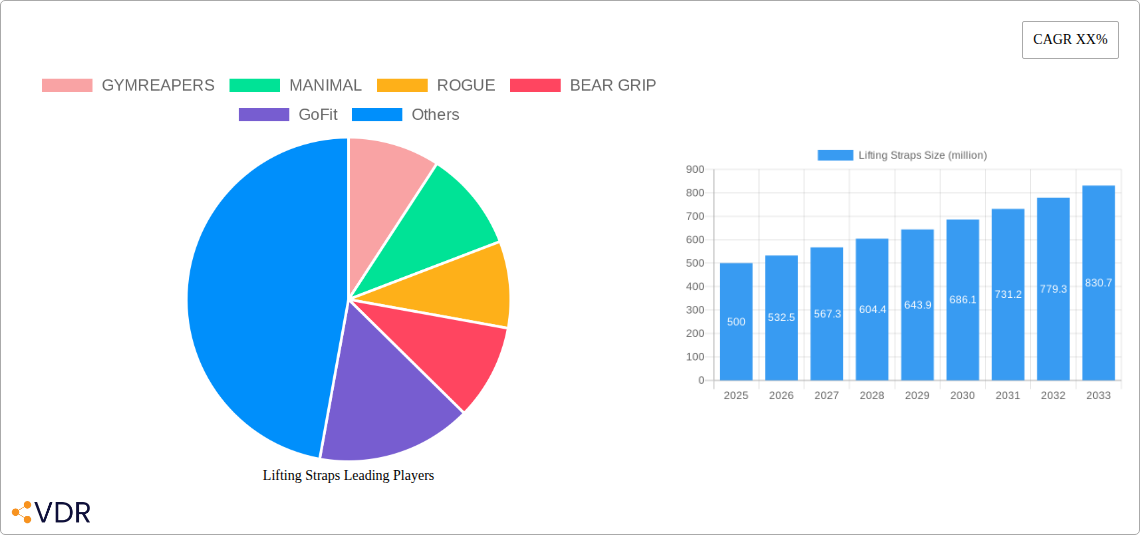
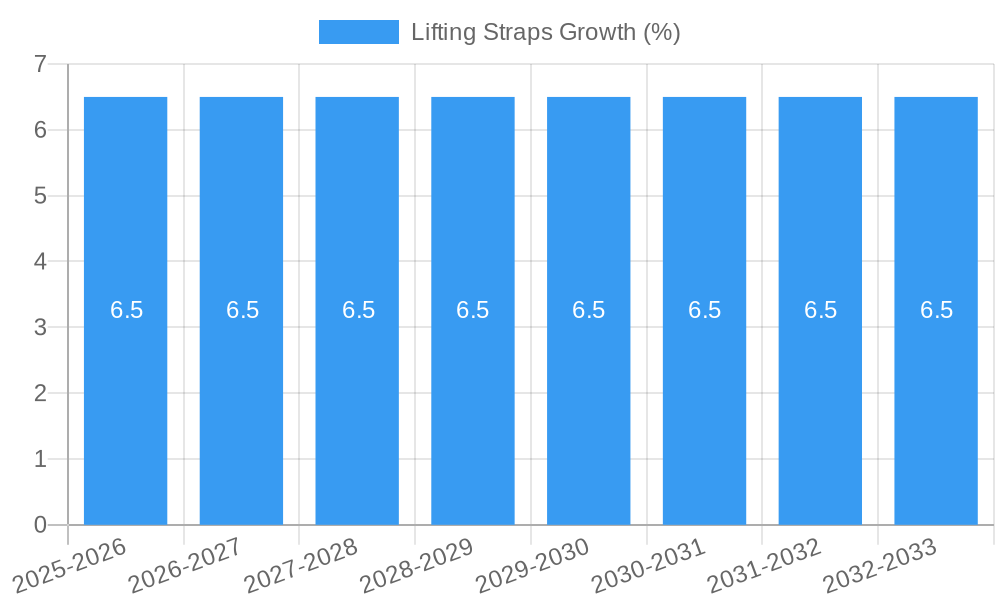
The global lifting straps market is poised for significant expansion, projected to reach approximately $500 million in 2025, with a robust Compound Annual Growth Rate (CAGR) of around 6.5% expected through 2033. This growth is primarily fueled by the burgeoning fitness industry and an increasing global emphasis on strength training and bodybuilding. The rising popularity of gym memberships and home fitness setups directly correlates with the demand for accessories like lifting straps, which are crucial for enhancing grip strength, preventing injuries, and enabling users to lift heavier weights. Furthermore, the growing awareness among athletes and fitness enthusiasts about the benefits of using specialized gear for performance optimization is a key driver. The market is segmented by application, with gyms dominating the current landscape due to high foot traffic and widespread adoption of weightlifting equipment, followed by household use as more individuals invest in home gyms. The "Others" segment, encompassing sports training facilities and rehabilitation centers, also presents a growing avenue.
The product type segmentation reveals a dynamic interplay between traditional materials and newer innovations. Cotton and leather straps, known for their durability and comfort, continue to hold a significant market share. However, the rise of synthetic materials like nylon and neoprene is a notable trend, offering advantages such as enhanced flexibility, sweat resistance, and improved grip in humid conditions. Companies like GYMREAPERS, MANIMAL, and ROGUE are at the forefront, catering to a discerning customer base seeking high-performance and durable lifting gear. The market is characterized by increasing product innovation, with manufacturers focusing on ergonomic designs, reinforced stitching, and improved padding to enhance user experience and safety. Despite the upward trajectory, potential restraints such as the availability of alternative grip enhancers and the initial cost for some premium products could pose challenges. However, the overall market outlook remains strongly positive, driven by sustained interest in strength training and a continuous quest for enhanced athletic performance worldwide.
This comprehensive report delivers an in-depth analysis of the global lifting straps market, spanning from 2019 to 2033, with a base and estimated year of 2025. It provides critical insights into market dynamics, growth trends, regional dominance, product landscape, key drivers, emerging opportunities, and the competitive environment, all optimized for SEO with high-traffic keywords relevant to fitness equipment, strength training accessories, and weightlifting gear.
Lifting Straps Market Dynamics & Structure
The lifting straps market is characterized by a moderate to high degree of concentration, with established brands and emerging players vying for market share. Technological innovation is primarily driven by advancements in material science, leading to more durable, comfortable, and ergonomic strap designs, particularly for nylon and neoprene variants. Regulatory frameworks are generally minimal, focusing on product safety and material standards, with minimal impact on market entry. Competitive product substitutes include weightlifting gloves, chalk, and specialized grips, though lifting straps offer distinct advantages for specific exercises like deadlifts and rows. End-user demographics are predominantly male, aged 18-45, actively engaged in weightlifting, bodybuilding, and powerlifting, with a growing segment of home fitness enthusiasts. Mergers and acquisitions (M&A) trends are present but relatively infrequent, with acquisitions often focused on gaining access to innovative product lines or expanding distribution networks. For instance, small-scale acquisitions by larger fitness accessory companies to broaden their product portfolios are anticipated. The market share of leading companies is estimated to be around 15-20%, while the top 5 players hold approximately 40-50% of the market. Innovation barriers are primarily related to achieving significant performance breakthroughs in materials and design, alongside the cost of R&D and bringing novel products to market.
Lifting Straps Growth Trends & Insights
The global lifting straps market is poised for robust growth, projected to expand at a Compound Annual Growth Rate (CAGR) of approximately 7.5% over the forecast period of 2025–2033. This growth is fueled by a burgeoning fitness culture and increasing participation in strength training activities worldwide. The market size, valued at an estimated $250 million in 2025, is expected to reach over $450 million by 2033. Adoption rates for lifting straps are steadily increasing, driven by greater awareness of their benefits in enhancing grip strength, reducing forearm fatigue, and enabling heavier lifts. Technological disruptions, such as the development of integrated wrist support and advanced material compositions, are enhancing product appeal and performance. Consumer behavior shifts are evident, with a growing preference for durable, comfortable, and aesthetically pleasing lifting straps. The home fitness segment, accelerated by recent global events, is also contributing significantly to market expansion, as individuals invest in home gym equipment, including essential accessories like lifting straps. Market penetration is currently estimated at 30% of the target demographic, with significant room for further expansion as the benefits of using lifting straps become more widely understood among novice and intermediate lifters. The influence of social media and fitness influencers in promoting proper lifting techniques and the use of accessories like straps is a key factor in this increasing adoption.
Dominant Regions, Countries, or Segments in Lifting Straps
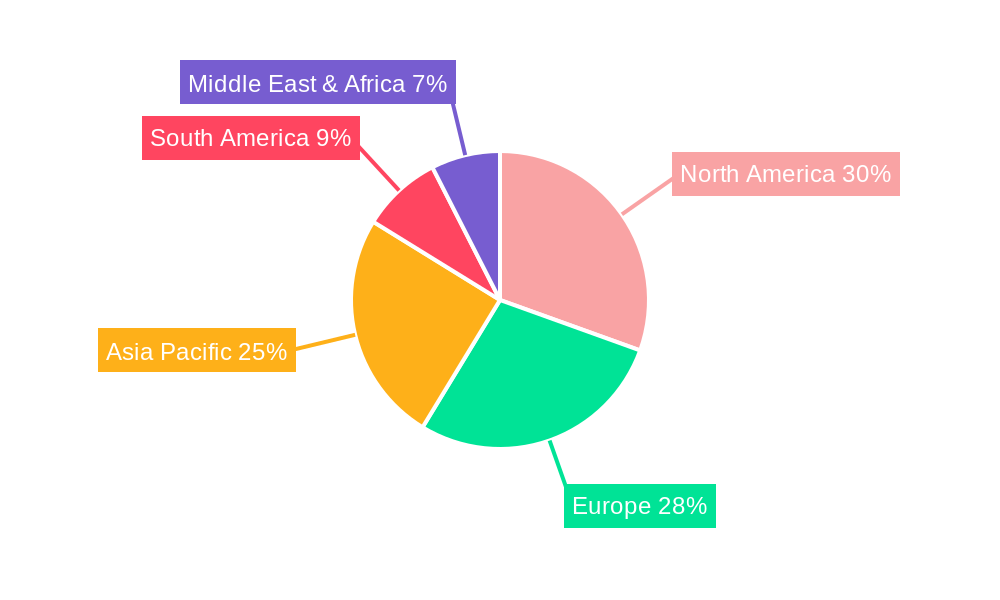
The North America region, particularly the United States, currently dominates the global lifting straps market, driven by a well-established fitness infrastructure and a high prevalence of gym-goers and professional athletes. Within North America, the United States holds a significant market share, estimated at 40% of the global market value. This dominance is attributed to strong economic policies that support the sporting goods industry, extensive retail distribution networks, and a deeply ingrained culture of health and fitness. The dominant application segment is the Gym, accounting for an estimated 65% of the market. This is followed by Household (25%) and Others (10%), which includes specialized training facilities and athletic performance centers. In terms of material type, Nylon lifting straps are the most dominant, holding an estimated 50% market share due to their superior durability, adjustability, and affordability. Leather straps follow with a 30% share, valued for their premium feel and durability, while Neoprene and Cotton straps collectively make up the remaining 20%, catering to specific comfort and aesthetic preferences. Key drivers for regional dominance include the presence of major fitness brands, significant consumer spending on fitness equipment, and a proactive approach to health and wellness. For instance, the extensive network of commercial gyms and fitness studios in the U.S. provides a consistent demand for lifting straps. Furthermore, the growing popularity of functional fitness and Crossfit-style training in countries like Canada and Mexico is also contributing to substantial growth within the North American region. Economic policies supporting sports and recreation, coupled with substantial disposable income for discretionary spending on fitness accessories, solidify North America's leading position.
Lifting Straps Product Landscape
The lifting straps product landscape is evolving with a focus on enhanced functionality and user comfort. Innovations include reinforced stitching for increased durability, padded wrist support to prevent chafing, and specialized coatings for improved grip. Applications range from traditional weightlifting exercises such as deadlifts, rows, and shrugs, to rehabilitative strength training and occupational lifting tasks. Performance metrics are evaluated based on tensile strength, abrasion resistance, and ergonomic design, ensuring maximum support without compromising mobility. Unique selling propositions often revolve around proprietary material blends that offer superior grip or longer lifespan. Technological advancements are also seen in the integration of antimicrobial properties and the development of eco-friendly material options.
Key Drivers, Barriers & Challenges in Lifting Straps
Key Drivers:
- Growing Health and Fitness Consciousness: Increasing global emphasis on health and wellness drives demand for strength training accessories.
- Rise of Home Fitness: The expansion of home gym setups fuels the purchase of essential workout equipment, including lifting straps.
- Performance Enhancement Focus: Athletes and fitness enthusiasts seek tools to improve strength, reduce fatigue, and break personal records.
- Product Innovation: Development of more durable, comfortable, and specialized lifting straps caters to diverse user needs.
Barriers & Challenges:
- Price Sensitivity: Some consumers may opt for cheaper alternatives or forgo straps if perceived as too expensive.
- Availability of Substitutes: Weightlifting gloves, chalk, and raw grip strength can serve as alternatives, albeit with different benefits.
- Supply Chain Volatility: Fluctuations in raw material costs and global logistics can impact production and pricing.
- Market Saturation in Mature Markets: Established markets may face challenges with rapid growth due to intense competition.
- Lack of Standardization: Variations in quality and design can lead to consumer confusion and dissatisfaction.
Emerging Opportunities in Lifting Straps
Emerging opportunities in the lifting straps market lie in the development of smart lifting straps with integrated sensors for performance tracking and form analysis. Expansion into niche sports requiring specialized grip assistance, such as rock climbing and Olympic weightlifting, presents untapped potential. The increasing demand for sustainable and eco-friendly fitness products also offers a significant opportunity for manufacturers to develop straps made from recycled or biodegradable materials. Furthermore, personalized strap designs catering to specific anatomical needs or preferences can capture a dedicated segment of the market.
Growth Accelerators in the Lifting Straps Industry
Long-term growth in the lifting straps industry will be significantly accelerated by continued technological breakthroughs in material science, leading to lighter, stronger, and more breathable strap designs. Strategic partnerships between lifting strap manufacturers and prominent fitness influencers, gyms, and athletic organizations will enhance brand visibility and consumer trust. Market expansion into developing economies with a growing middle class and increasing interest in fitness will unlock new revenue streams. The development of comprehensive educational content highlighting the proper use and benefits of lifting straps will also drive adoption rates and market penetration.
Key Players Shaping the Lifting Straps Market
GYMREAPERS, MANIMAL, ROGUE, BEAR GRIP, GoFit, Harbinger, IronMind, UPPPER, SUNDA INDUSTRY AND TRADE CO.,LIMITED, Yiwu Zhanji Import And Export Co.,Ltd., Quanzhou Hongfa Groups Co.,Ltd.
Notable Milestones in Lifting Straps Sector
- 2019: Increased adoption of reinforced stitching techniques in nylon lifting straps for enhanced durability.
- 2020: Surge in demand for home-use lifting straps driven by global lockdowns and the rise of home gyms.
- 2021: Introduction of ergonomic padding and wrist support features in premium lifting straps.
- 2022: Growing consumer interest in eco-friendly lifting strap options made from sustainable materials.
- 2023: Advancements in Neoprene strap designs offering superior comfort and sweat-wicking properties.
- 2024: Expansion of online retail channels, making lifting straps more accessible globally.
In-Depth Lifting Straps Market Outlook
The lifting straps market is set for sustained and dynamic growth, driven by an unyielding global commitment to physical fitness and performance enhancement. Emerging opportunities in smart technology integration and sustainable materials will redefine product offerings and consumer appeal. The continuous evolution of training methodologies, coupled with increased accessibility through diverse retail channels, including online platforms and specialized fitness outlets, will further propel market penetration. Strategic collaborations and a focus on innovation in materials and design are poised to be the primary catalysts for future expansion, ensuring the lifting straps sector remains a vital and growing component of the global fitness accessories market.
Lifting Straps Segmentation
-
1. Application
- 1.1. Gym
- 1.2. Household
- 1.3. Others
-
2. Types
- 2.1. Cotton
- 2.2. Leather
- 2.3. Nylon
- 2.4. Neoprene
Lifting Straps Segmentation By Geography
-
1. North America
- 1.1. United States
- 1.2. Canada
- 1.3. Mexico
-
2. South America
- 2.1. Brazil
- 2.2. Argentina
- 2.3. Rest of South America
-
3. Europe
- 3.1. United Kingdom
- 3.2. Germany
- 3.3. France
- 3.4. Italy
- 3.5. Spain
- 3.6. Russia
- 3.7. Benelux
- 3.8. Nordics
- 3.9. Rest of Europe
-
4. Middle East & Africa
- 4.1. Turkey
- 4.2. Israel
- 4.3. GCC
- 4.4. North Africa
- 4.5. South Africa
- 4.6. Rest of Middle East & Africa
-
5. Asia Pacific
- 5.1. China
- 5.2. India
- 5.3. Japan
- 5.4. South Korea
- 5.5. ASEAN
- 5.6. Oceania
- 5.7. Rest of Asia Pacific
Lifting Straps REPORT HIGHLIGHTS
| Aspects | Details |
|---|---|
| Study Period | 2019-2033 |
| Base Year | 2024 |
| Estimated Year | 2025 |
| Forecast Period | 2025-2033 |
| Historical Period | 2019-2024 |
| Growth Rate | CAGR of XX% from 2019-2033 |
| Segmentation |
|
Table of Contents
- 1. Introduction
- 1.1. Research Scope
- 1.2. Market Segmentation
- 1.3. Research Methodology
- 1.4. Definitions and Assumptions
- 2. Executive Summary
- 2.1. Introduction
- 3. Market Dynamics
- 3.1. Introduction
- 3.2. Market Drivers
- 3.3. Market Restrains
- 3.4. Market Trends
- 4. Market Factor Analysis
- 4.1. Porters Five Forces
- 4.2. Supply/Value Chain
- 4.3. PESTEL analysis
- 4.4. Market Entropy
- 4.5. Patent/Trademark Analysis
- 5. Global Lifting Straps Analysis, Insights and Forecast, 2019-2031
- 5.1. Market Analysis, Insights and Forecast - by Application
- 5.1.1. Gym
- 5.1.2. Household
- 5.1.3. Others
- 5.2. Market Analysis, Insights and Forecast - by Types
- 5.2.1. Cotton
- 5.2.2. Leather
- 5.2.3. Nylon
- 5.2.4. Neoprene
- 5.3. Market Analysis, Insights and Forecast - by Region
- 5.3.1. North America
- 5.3.2. South America
- 5.3.3. Europe
- 5.3.4. Middle East & Africa
- 5.3.5. Asia Pacific
- 5.1. Market Analysis, Insights and Forecast - by Application
- 6. North America Lifting Straps Analysis, Insights and Forecast, 2019-2031
- 6.1. Market Analysis, Insights and Forecast - by Application
- 6.1.1. Gym
- 6.1.2. Household
- 6.1.3. Others
- 6.2. Market Analysis, Insights and Forecast - by Types
- 6.2.1. Cotton
- 6.2.2. Leather
- 6.2.3. Nylon
- 6.2.4. Neoprene
- 6.1. Market Analysis, Insights and Forecast - by Application
- 7. South America Lifting Straps Analysis, Insights and Forecast, 2019-2031
- 7.1. Market Analysis, Insights and Forecast - by Application
- 7.1.1. Gym
- 7.1.2. Household
- 7.1.3. Others
- 7.2. Market Analysis, Insights and Forecast - by Types
- 7.2.1. Cotton
- 7.2.2. Leather
- 7.2.3. Nylon
- 7.2.4. Neoprene
- 7.1. Market Analysis, Insights and Forecast - by Application
- 8. Europe Lifting Straps Analysis, Insights and Forecast, 2019-2031
- 8.1. Market Analysis, Insights and Forecast - by Application
- 8.1.1. Gym
- 8.1.2. Household
- 8.1.3. Others
- 8.2. Market Analysis, Insights and Forecast - by Types
- 8.2.1. Cotton
- 8.2.2. Leather
- 8.2.3. Nylon
- 8.2.4. Neoprene
- 8.1. Market Analysis, Insights and Forecast - by Application
- 9. Middle East & Africa Lifting Straps Analysis, Insights and Forecast, 2019-2031
- 9.1. Market Analysis, Insights and Forecast - by Application
- 9.1.1. Gym
- 9.1.2. Household
- 9.1.3. Others
- 9.2. Market Analysis, Insights and Forecast - by Types
- 9.2.1. Cotton
- 9.2.2. Leather
- 9.2.3. Nylon
- 9.2.4. Neoprene
- 9.1. Market Analysis, Insights and Forecast - by Application
- 10. Asia Pacific Lifting Straps Analysis, Insights and Forecast, 2019-2031
- 10.1. Market Analysis, Insights and Forecast - by Application
- 10.1.1. Gym
- 10.1.2. Household
- 10.1.3. Others
- 10.2. Market Analysis, Insights and Forecast - by Types
- 10.2.1. Cotton
- 10.2.2. Leather
- 10.2.3. Nylon
- 10.2.4. Neoprene
- 10.1. Market Analysis, Insights and Forecast - by Application
- 11. Competitive Analysis
- 11.1. Global Market Share Analysis 2024
- 11.2. Company Profiles
- 11.2.1 GYMREAPERS
- 11.2.1.1. Overview
- 11.2.1.2. Products
- 11.2.1.3. SWOT Analysis
- 11.2.1.4. Recent Developments
- 11.2.1.5. Financials (Based on Availability)
- 11.2.2 MANIMAL
- 11.2.2.1. Overview
- 11.2.2.2. Products
- 11.2.2.3. SWOT Analysis
- 11.2.2.4. Recent Developments
- 11.2.2.5. Financials (Based on Availability)
- 11.2.3 ROGUE
- 11.2.3.1. Overview
- 11.2.3.2. Products
- 11.2.3.3. SWOT Analysis
- 11.2.3.4. Recent Developments
- 11.2.3.5. Financials (Based on Availability)
- 11.2.4 BEAR GRIP
- 11.2.4.1. Overview
- 11.2.4.2. Products
- 11.2.4.3. SWOT Analysis
- 11.2.4.4. Recent Developments
- 11.2.4.5. Financials (Based on Availability)
- 11.2.5 GoFit
- 11.2.5.1. Overview
- 11.2.5.2. Products
- 11.2.5.3. SWOT Analysis
- 11.2.5.4. Recent Developments
- 11.2.5.5. Financials (Based on Availability)
- 11.2.6 Harbinger
- 11.2.6.1. Overview
- 11.2.6.2. Products
- 11.2.6.3. SWOT Analysis
- 11.2.6.4. Recent Developments
- 11.2.6.5. Financials (Based on Availability)
- 11.2.7 IronMind
- 11.2.7.1. Overview
- 11.2.7.2. Products
- 11.2.7.3. SWOT Analysis
- 11.2.7.4. Recent Developments
- 11.2.7.5. Financials (Based on Availability)
- 11.2.8 UPPPER
- 11.2.8.1. Overview
- 11.2.8.2. Products
- 11.2.8.3. SWOT Analysis
- 11.2.8.4. Recent Developments
- 11.2.8.5. Financials (Based on Availability)
- 11.2.9 SUNDA INDUSTRY AND TRADE CO.
- 11.2.9.1. Overview
- 11.2.9.2. Products
- 11.2.9.3. SWOT Analysis
- 11.2.9.4. Recent Developments
- 11.2.9.5. Financials (Based on Availability)
- 11.2.10 LIMITED
- 11.2.10.1. Overview
- 11.2.10.2. Products
- 11.2.10.3. SWOT Analysis
- 11.2.10.4. Recent Developments
- 11.2.10.5. Financials (Based on Availability)
- 11.2.11 Yiwu Zhanji Import And Export Co.
- 11.2.11.1. Overview
- 11.2.11.2. Products
- 11.2.11.3. SWOT Analysis
- 11.2.11.4. Recent Developments
- 11.2.11.5. Financials (Based on Availability)
- 11.2.12 Ltd.
- 11.2.12.1. Overview
- 11.2.12.2. Products
- 11.2.12.3. SWOT Analysis
- 11.2.12.4. Recent Developments
- 11.2.12.5. Financials (Based on Availability)
- 11.2.13 Quanzhou Hongfa Groups Co.
- 11.2.13.1. Overview
- 11.2.13.2. Products
- 11.2.13.3. SWOT Analysis
- 11.2.13.4. Recent Developments
- 11.2.13.5. Financials (Based on Availability)
- 11.2.14 Ltd
- 11.2.14.1. Overview
- 11.2.14.2. Products
- 11.2.14.3. SWOT Analysis
- 11.2.14.4. Recent Developments
- 11.2.14.5. Financials (Based on Availability)
- 11.2.1 GYMREAPERS
List of Figures
- Figure 1: Global Lifting Straps Revenue Breakdown (million, %) by Region 2024 & 2032
- Figure 2: North America Lifting Straps Revenue (million), by Application 2024 & 2032
- Figure 3: North America Lifting Straps Revenue Share (%), by Application 2024 & 2032
- Figure 4: North America Lifting Straps Revenue (million), by Types 2024 & 2032
- Figure 5: North America Lifting Straps Revenue Share (%), by Types 2024 & 2032
- Figure 6: North America Lifting Straps Revenue (million), by Country 2024 & 2032
- Figure 7: North America Lifting Straps Revenue Share (%), by Country 2024 & 2032
- Figure 8: South America Lifting Straps Revenue (million), by Application 2024 & 2032
- Figure 9: South America Lifting Straps Revenue Share (%), by Application 2024 & 2032
- Figure 10: South America Lifting Straps Revenue (million), by Types 2024 & 2032
- Figure 11: South America Lifting Straps Revenue Share (%), by Types 2024 & 2032
- Figure 12: South America Lifting Straps Revenue (million), by Country 2024 & 2032
- Figure 13: South America Lifting Straps Revenue Share (%), by Country 2024 & 2032
- Figure 14: Europe Lifting Straps Revenue (million), by Application 2024 & 2032
- Figure 15: Europe Lifting Straps Revenue Share (%), by Application 2024 & 2032
- Figure 16: Europe Lifting Straps Revenue (million), by Types 2024 & 2032
- Figure 17: Europe Lifting Straps Revenue Share (%), by Types 2024 & 2032
- Figure 18: Europe Lifting Straps Revenue (million), by Country 2024 & 2032
- Figure 19: Europe Lifting Straps Revenue Share (%), by Country 2024 & 2032
- Figure 20: Middle East & Africa Lifting Straps Revenue (million), by Application 2024 & 2032
- Figure 21: Middle East & Africa Lifting Straps Revenue Share (%), by Application 2024 & 2032
- Figure 22: Middle East & Africa Lifting Straps Revenue (million), by Types 2024 & 2032
- Figure 23: Middle East & Africa Lifting Straps Revenue Share (%), by Types 2024 & 2032
- Figure 24: Middle East & Africa Lifting Straps Revenue (million), by Country 2024 & 2032
- Figure 25: Middle East & Africa Lifting Straps Revenue Share (%), by Country 2024 & 2032
- Figure 26: Asia Pacific Lifting Straps Revenue (million), by Application 2024 & 2032
- Figure 27: Asia Pacific Lifting Straps Revenue Share (%), by Application 2024 & 2032
- Figure 28: Asia Pacific Lifting Straps Revenue (million), by Types 2024 & 2032
- Figure 29: Asia Pacific Lifting Straps Revenue Share (%), by Types 2024 & 2032
- Figure 30: Asia Pacific Lifting Straps Revenue (million), by Country 2024 & 2032
- Figure 31: Asia Pacific Lifting Straps Revenue Share (%), by Country 2024 & 2032
List of Tables
- Table 1: Global Lifting Straps Revenue million Forecast, by Region 2019 & 2032
- Table 2: Global Lifting Straps Revenue million Forecast, by Application 2019 & 2032
- Table 3: Global Lifting Straps Revenue million Forecast, by Types 2019 & 2032
- Table 4: Global Lifting Straps Revenue million Forecast, by Region 2019 & 2032
- Table 5: Global Lifting Straps Revenue million Forecast, by Application 2019 & 2032
- Table 6: Global Lifting Straps Revenue million Forecast, by Types 2019 & 2032
- Table 7: Global Lifting Straps Revenue million Forecast, by Country 2019 & 2032
- Table 8: United States Lifting Straps Revenue (million) Forecast, by Application 2019 & 2032
- Table 9: Canada Lifting Straps Revenue (million) Forecast, by Application 2019 & 2032
- Table 10: Mexico Lifting Straps Revenue (million) Forecast, by Application 2019 & 2032
- Table 11: Global Lifting Straps Revenue million Forecast, by Application 2019 & 2032
- Table 12: Global Lifting Straps Revenue million Forecast, by Types 2019 & 2032
- Table 13: Global Lifting Straps Revenue million Forecast, by Country 2019 & 2032
- Table 14: Brazil Lifting Straps Revenue (million) Forecast, by Application 2019 & 2032
- Table 15: Argentina Lifting Straps Revenue (million) Forecast, by Application 2019 & 2032
- Table 16: Rest of South America Lifting Straps Revenue (million) Forecast, by Application 2019 & 2032
- Table 17: Global Lifting Straps Revenue million Forecast, by Application 2019 & 2032
- Table 18: Global Lifting Straps Revenue million Forecast, by Types 2019 & 2032
- Table 19: Global Lifting Straps Revenue million Forecast, by Country 2019 & 2032
- Table 20: United Kingdom Lifting Straps Revenue (million) Forecast, by Application 2019 & 2032
- Table 21: Germany Lifting Straps Revenue (million) Forecast, by Application 2019 & 2032
- Table 22: France Lifting Straps Revenue (million) Forecast, by Application 2019 & 2032
- Table 23: Italy Lifting Straps Revenue (million) Forecast, by Application 2019 & 2032
- Table 24: Spain Lifting Straps Revenue (million) Forecast, by Application 2019 & 2032
- Table 25: Russia Lifting Straps Revenue (million) Forecast, by Application 2019 & 2032
- Table 26: Benelux Lifting Straps Revenue (million) Forecast, by Application 2019 & 2032
- Table 27: Nordics Lifting Straps Revenue (million) Forecast, by Application 2019 & 2032
- Table 28: Rest of Europe Lifting Straps Revenue (million) Forecast, by Application 2019 & 2032
- Table 29: Global Lifting Straps Revenue million Forecast, by Application 2019 & 2032
- Table 30: Global Lifting Straps Revenue million Forecast, by Types 2019 & 2032
- Table 31: Global Lifting Straps Revenue million Forecast, by Country 2019 & 2032
- Table 32: Turkey Lifting Straps Revenue (million) Forecast, by Application 2019 & 2032
- Table 33: Israel Lifting Straps Revenue (million) Forecast, by Application 2019 & 2032
- Table 34: GCC Lifting Straps Revenue (million) Forecast, by Application 2019 & 2032
- Table 35: North Africa Lifting Straps Revenue (million) Forecast, by Application 2019 & 2032
- Table 36: South Africa Lifting Straps Revenue (million) Forecast, by Application 2019 & 2032
- Table 37: Rest of Middle East & Africa Lifting Straps Revenue (million) Forecast, by Application 2019 & 2032
- Table 38: Global Lifting Straps Revenue million Forecast, by Application 2019 & 2032
- Table 39: Global Lifting Straps Revenue million Forecast, by Types 2019 & 2032
- Table 40: Global Lifting Straps Revenue million Forecast, by Country 2019 & 2032
- Table 41: China Lifting Straps Revenue (million) Forecast, by Application 2019 & 2032
- Table 42: India Lifting Straps Revenue (million) Forecast, by Application 2019 & 2032
- Table 43: Japan Lifting Straps Revenue (million) Forecast, by Application 2019 & 2032
- Table 44: South Korea Lifting Straps Revenue (million) Forecast, by Application 2019 & 2032
- Table 45: ASEAN Lifting Straps Revenue (million) Forecast, by Application 2019 & 2032
- Table 46: Oceania Lifting Straps Revenue (million) Forecast, by Application 2019 & 2032
- Table 47: Rest of Asia Pacific Lifting Straps Revenue (million) Forecast, by Application 2019 & 2032
Frequently Asked Questions
1. What is the projected Compound Annual Growth Rate (CAGR) of the Lifting Straps?
The projected CAGR is approximately XX%.
2. Which companies are prominent players in the Lifting Straps?
Key companies in the market include GYMREAPERS, MANIMAL, ROGUE, BEAR GRIP, GoFit, Harbinger, IronMind, UPPPER, SUNDA INDUSTRY AND TRADE CO., LIMITED, Yiwu Zhanji Import And Export Co., Ltd., Quanzhou Hongfa Groups Co., Ltd.
3. What are the main segments of the Lifting Straps?
The market segments include Application, Types.
4. Can you provide details about the market size?
The market size is estimated to be USD XXX million as of 2022.
5. What are some drivers contributing to market growth?
N/A
6. What are the notable trends driving market growth?
N/A
7. Are there any restraints impacting market growth?
N/A
8. Can you provide examples of recent developments in the market?
N/A
9. What pricing options are available for accessing the report?
Pricing options include single-user, multi-user, and enterprise licenses priced at USD 2900.00, USD 4350.00, and USD 5800.00 respectively.
10. Is the market size provided in terms of value or volume?
The market size is provided in terms of value, measured in million.
11. Are there any specific market keywords associated with the report?
Yes, the market keyword associated with the report is "Lifting Straps," which aids in identifying and referencing the specific market segment covered.
12. How do I determine which pricing option suits my needs best?
The pricing options vary based on user requirements and access needs. Individual users may opt for single-user licenses, while businesses requiring broader access may choose multi-user or enterprise licenses for cost-effective access to the report.
13. Are there any additional resources or data provided in the Lifting Straps report?
While the report offers comprehensive insights, it's advisable to review the specific contents or supplementary materials provided to ascertain if additional resources or data are available.
14. How can I stay updated on further developments or reports in the Lifting Straps?
To stay informed about further developments, trends, and reports in the Lifting Straps, consider subscribing to industry newsletters, following relevant companies and organizations, or regularly checking reputable industry news sources and publications.
Methodology
Step 1 - Identification of Relevant Samples Size from Population Database



Step 2 - Approaches for Defining Global Market Size (Value, Volume* & Price*)

Note*: In applicable scenarios
Step 3 - Data Sources
Primary Research
- Web Analytics
- Survey Reports
- Research Institute
- Latest Research Reports
- Opinion Leaders
Secondary Research
- Annual Reports
- White Paper
- Latest Press Release
- Industry Association
- Paid Database
- Investor Presentations

Step 4 - Data Triangulation
Involves using different sources of information in order to increase the validity of a study
These sources are likely to be stakeholders in a program - participants, other researchers, program staff, other community members, and so on.
Then we put all data in single framework & apply various statistical tools to find out the dynamic on the market.
During the analysis stage, feedback from the stakeholder groups would be compared to determine areas of agreement as well as areas of divergence


