


Key Insights
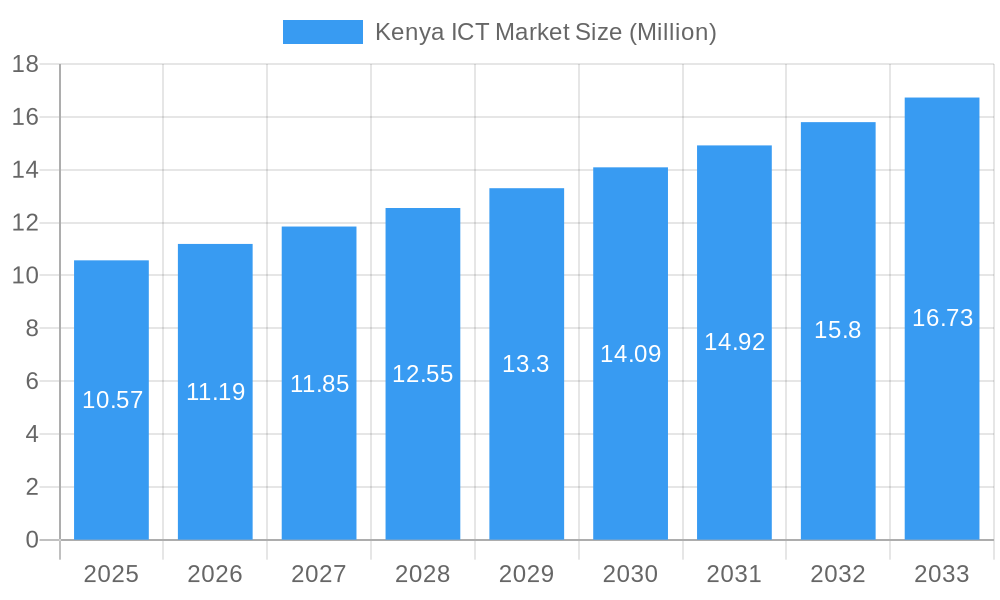
The Kenyan ICT market is poised for robust expansion, projected to reach a substantial size of approximately USD 10.57 million by 2025, growing at a Compound Annual Growth Rate (CAGR) of 5.91% through 2033. This dynamic growth is primarily fueled by significant drivers including the increasing adoption of cloud computing services, the burgeoning demand for advanced cybersecurity solutions, and the strategic investments in digital transformation initiatives across various sectors. The government's commitment to fostering a digital economy, coupled with the rapid proliferation of mobile internet penetration and the growing ecosystem of startups, are further propelling this upward trajectory. The market is witnessing a surge in demand for integrated hardware, sophisticated software, and comprehensive services, with a particular emphasis on telecommunication services that underpin the digital infrastructure. Small and medium enterprises (SMEs) are increasingly recognizing the value of ICT solutions in enhancing their operational efficiency and competitiveness, while large enterprises are investing in cutting-edge technologies to maintain their market leadership.

Kenya ICT Market Market Size (In Million)

The industry verticals experiencing the most significant ICT adoption include the BFSI (Banking, Financial Services, and Insurance) sector, leveraging technology for digital banking and secure transactions, and the IT and Telecom sector itself, which is a primary driver and consumer of ICT innovation. The government is also a key player, driving digital public services and infrastructure development. Retail and e-commerce are experiencing a digital revolution, with ICT solutions enabling seamless online shopping experiences and efficient supply chain management. Manufacturing firms are embracing Industry 4.0 principles through ICT adoption for automation and data analytics, while the energy and utilities sector is enhancing its operations with smart grid technologies and data-driven insights. While the market shows immense promise, potential restraints include the need for skilled ICT talent, infrastructure development challenges in certain regions, and the evolving regulatory landscape that needs to keep pace with technological advancements. However, the overall outlook for the Kenyan ICT market remains highly positive, driven by a confluence of technological innovation, increasing digital literacy, and a supportive economic environment.
Kenya ICT Market Company Market Share
Kenya ICT Market Report: Forecast to 2033 - Growth, Trends, and Key Players
This comprehensive report delves into the dynamic Kenya Information and Communication Technology (ICT) market, providing an in-depth analysis of its structure, growth trends, and future outlook. Covering the period from 2019 to 2033, with a base year of 2025, this report offers critical insights for stakeholders seeking to navigate and capitalize on the rapidly evolving digital landscape in Kenya. We explore the parent and child market segments, analyze key industry verticals, and highlight the strategic initiatives shaping the future of Kenya's technology sector.
Kenya ICT Market Market Dynamics & Structure
The Kenya ICT market is characterized by a moderate level of market concentration, with established global technology giants coexisting alongside a burgeoning ecosystem of local innovators. Technological innovation serves as a primary growth driver, fueled by increasing internet penetration, mobile adoption, and the government's commitment to digitalization. Regulatory frameworks are evolving to foster a conducive environment for investment and digital transformation, although challenges related to data privacy and cybersecurity remain. Competitive product substitutes exist across all segments, from hardware and software to telecommunication services, necessitating continuous innovation and service differentiation. End-user demographics are shifting towards a younger, digitally native population with growing demands for advanced digital solutions. Mergers and acquisitions (M&A) activity, while not at peak levels, indicates consolidation and strategic partnerships aimed at expanding market reach and enhancing service offerings. The market is projected to see significant growth in the coming years, driven by increased digital adoption across various sectors.
- Market Concentration: Dominated by a mix of multinational corporations and agile local players, with a growing trend towards strategic alliances.
- Technological Innovation Drivers: High mobile penetration, cloud computing adoption, and AI/ML integration are key enablers.
- Regulatory Frameworks: Government initiatives promoting digital transformation and cybersecurity are fostering growth.
- Competitive Product Substitutes: Intense competition across hardware, software, and services segments requires continuous adaptation.
- End-User Demographics: A young, tech-savvy population is driving demand for innovative digital solutions and services.
- M&A Trends: Strategic acquisitions and partnerships are observed as companies seek to expand their portfolios and market share.
Kenya ICT Market Growth Trends & Insights
The Kenya ICT market is poised for substantial expansion, driven by a confluence of factors that are reshaping its trajectory. The market size is projected to witness a significant increase from its current valuation, fueled by accelerated digital adoption across Small and Medium Enterprises (SMEs) and Large Enterprises alike. Adoption rates for cloud services, cybersecurity solutions, and digital transformation platforms are on an upward trend, indicating a growing reliance on technology for business efficiency and growth. Technological disruptions, particularly in areas like Artificial Intelligence (AI), Machine Learning (ML), and the Internet of Things (IoT), are creating new avenues for innovation and service delivery. Consumer behavior is increasingly shifting towards online channels for services, e-commerce, and digital entertainment, further stimulating demand for robust ICT infrastructure and solutions. The projected Compound Annual Growth Rate (CAGR) for the forecast period is expected to be robust, reflecting the country's commitment to becoming a regional digital hub. Market penetration for advanced ICT solutions is anticipated to deepen across all industry verticals. The increasing adoption of digital payment systems and e-commerce platforms is a testament to the evolving consumer landscape. Furthermore, the expansion of broadband internet connectivity, both fixed and mobile, is a critical enabler of this growth, ensuring wider access to digital services and opportunities. The government's ongoing investments in digital infrastructure, including national fiber optic networks and data centers, are laying a strong foundation for sustained market expansion. The synergy between technological advancements and shifting consumer preferences will continue to be a defining characteristic of the Kenya ICT market.
Dominant Regions, Countries, or Segments in Kenya ICT Market
The Services segment stands out as the dominant force driving growth within the Kenya ICT market, encompassing a wide array of offerings that cater to diverse enterprise needs. This segment's leadership is underpinned by the increasing demand for digital transformation initiatives, cloud migration, cybersecurity solutions, and managed IT services. Small and Medium Enterprises (SMEs), in particular, are increasingly relying on specialized ICT services to enhance their operational efficiency and competitiveness without significant upfront capital investment. Large Enterprises, meanwhile, are seeking sophisticated solutions for data analytics, artificial intelligence, and complex system integrations.
The IT and Telecom industry vertical is a primary consumer and driver of ICT services, leveraging these solutions to expand network infrastructure, enhance customer experience, and introduce innovative digital products. The BFSI (Banking, Financial Services, and Insurance) sector is another significant contributor, driven by the need for secure and efficient digital banking, payment gateways, and data management solutions. The Government sector is also a key player, actively investing in e-governance initiatives, smart city projects, and digital public services, all of which heavily depend on advanced ICT services.
- Services Segment Dominance: This segment, including cloud computing, cybersecurity, managed IT, and consulting, is the primary growth engine, fueled by digital transformation needs.
- Key Industry Verticals:
- IT and Telecom: Driving demand for infrastructure, network solutions, and digital services.
- BFSI: Seeking secure digital banking, payment solutions, and data analytics.
- Government: Investing in e-governance, smart cities, and digital public services.
- Enterprise Size Impact: Both SMEs and Large Enterprises are key consumers of ICT services, with SMEs increasingly adopting service-based models for agility and cost-effectiveness.
- Growth Potential: The continuous evolution of digital technologies and the increasing reliance on outsourced IT expertise ensure sustained growth for the services segment.
Kenya ICT Market Product Landscape
The Kenya ICT market's product landscape is characterized by increasing sophistication and a growing emphasis on integrated solutions. Hardware offerings are evolving from basic computing devices to more specialized equipment like IoT sensors, advanced networking hardware, and high-performance servers tailored for cloud environments. Software innovation is vibrant, with a surge in enterprise resource planning (ERP) systems, customer relationship management (CRM) solutions, cybersecurity platforms, and AI-powered analytical tools designed to meet local business needs. Unique selling propositions often lie in localized software development, cloud-based solutions offering scalability and flexibility, and robust cybersecurity measures addressing the region's specific threats. Technological advancements are focused on enhancing data processing capabilities, enabling seamless integration across different platforms, and delivering user-friendly interfaces.
Key Drivers, Barriers & Challenges in Kenya ICT Market
Key Drivers:
- Digital Transformation Initiatives: Government and private sector focus on digitalizing operations.
- Increasing Internet and Mobile Penetration: Wider access to digital services.
- Growing Startup Ecosystem: Innovation and demand for agile tech solutions.
- Foreign Direct Investment: Influx of capital and expertise.
- Growing Youth Population: Tech-savvy demographic driving digital consumption.
Barriers & Challenges:
- Cybersecurity Threats: Evolving and sophisticated cyberattacks pose a significant risk.
- Skills Gap: Shortage of skilled ICT professionals in specialized areas.
- Affordability and Access: High cost of advanced technology for some SMEs.
- Regulatory Ambiguities: Evolving data protection and privacy laws.
- Infrastructure Limitations: Uneven distribution of reliable power and internet connectivity in some areas.
Emerging Opportunities in Kenya ICT Market
Emerging opportunities in the Kenya ICT market are abundant, particularly within the rapidly growing cloud computing sector, which offers scalability and cost-efficiency for businesses of all sizes. The demand for sophisticated cybersecurity solutions is creating a niche for specialized firms adept at protecting digital assets against an increasing threat landscape. Furthermore, the development and adoption of AI and machine learning technologies present significant opportunities for data analytics, automation, and personalized customer experiences. The expansion of e-commerce platforms and digital payment systems continues to open avenues for fintech innovations and logistics technology. Untapped markets in rural areas, coupled with the increasing affordability of mobile devices, signal potential for digital inclusion initiatives.
Growth Accelerators in the Kenya ICT Market Industry
Several catalysts are accelerating the long-term growth of the Kenya ICT market. Technological breakthroughs, such as the widespread adoption of 5G networks and advancements in cloud infrastructure, are providing the backbone for more sophisticated digital services. Strategic partnerships between multinational tech giants and local enterprises are fostering knowledge transfer, localized product development, and expanded market reach. Market expansion strategies, including the development of tailored solutions for specific industry verticals like agriculture and healthcare, are unlocking new revenue streams. The government's commitment to digital infrastructure development, including investments in data centers and fiber optic networks, further solidifies the foundation for sustained growth.
Key Players Shaping the Kenya ICT Market Market
- Honeywell International Inc
- The International Business Machines Corporation (IBM)
- Oracle Corporation
- Microsoft Corporation
- SAP SE
- Google LLC
- Xtranet Communications Ltd
- Eujim Solutions Limited
- Agile Cloud Limited
- Eldama Technologies Lt
Notable Milestones in Kenya ICT Market Sector
- June 2024: Microsoft Africa Development Center (ADC) and Serianu Limited signed an MOU to enhance cybersecurity skills in Kenya, aiming to empower 100 students across 10 universities in areas like network security, cloud security, incident response, and Microsoft Defender Threat Intelligence.
- May 2024: Microsoft Corp. and G42 unveiled an extensive digital investment package in Kenya, in collaboration with the Republic of Kenya's Ministry of Information, Communications, and the Digital Economy. G42, with Microsoft and other stakeholders, committed an initial investment of USD 1 billion to fund diverse components of this comprehensive package.
In-Depth Kenya ICT Market Market Outlook
The Kenya ICT market is characterized by a bright future, with sustained growth fueled by ongoing digital transformation efforts and increasing technological adoption. Strategic opportunities lie in leveraging advancements in AI, IoT, and cloud computing to deliver innovative solutions that address specific industry needs and consumer demands. The continuous expansion of digital infrastructure, coupled with supportive government policies, will further accelerate market penetration and foster a more inclusive digital economy. The growing emphasis on cybersecurity and data protection presents a significant area for development and investment. Overall, the market is on a robust growth trajectory, poised to solidify Kenya's position as a leading digital hub in East Africa.
Kenya ICT Market Segmentation
-
1. Type
- 1.1. Hardware
- 1.2. Software
- 1.3. Services
- 1.4. Telecommunication Services
-
2. Size of Enterprise
- 2.1. Small and Medium Enterprises
- 2.2. Large Enterprises
-
3. Industry Vertical
- 3.1. BFSI
- 3.2. IT and Telecom
- 3.3. Government
- 3.4. Retail and E-commerce
- 3.5. Manufacturing
- 3.6. Energy and Utilities
- 3.7. Other Industry Verticals
Kenya ICT Market Segmentation By Geography
- 1. Kenya
Kenya ICT Market Regional Market Share
Geographic Coverage of Kenya ICT Market
Kenya ICT Market REPORT HIGHLIGHTS
| Aspects | Details |
|---|---|
| Study Period | 2020-2034 |
| Base Year | 2025 |
| Estimated Year | 2026 |
| Forecast Period | 2026-2034 |
| Historical Period | 2020-2025 |
| Growth Rate | CAGR of 5.91% from 2020-2034 |
| Segmentation |
|
Table of Contents
- 1. Introduction
- 1.1. Research Scope
- 1.2. Market Segmentation
- 1.3. Research Methodology
- 1.4. Definitions and Assumptions
- 2. Executive Summary
- 2.1. Introduction
- 3. Market Dynamics
- 3.1. Introduction
- 3.2. Market Drivers
- 3.2.1. Implementation of 5G is Back on Track; Growing Demand for Cloud Technology
- 3.3. Market Restrains
- 3.3.1. Implementation of 5G is Back on Track; Growing Demand for Cloud Technology
- 3.4. Market Trends
- 3.4.1. Growing Demand for Cloud Technology
- 4. Market Factor Analysis
- 4.1. Porters Five Forces
- 4.2. Supply/Value Chain
- 4.3. PESTEL analysis
- 4.4. Market Entropy
- 4.5. Patent/Trademark Analysis
- 5. Kenya ICT Market Analysis, Insights and Forecast, 2020-2032
- 5.1. Market Analysis, Insights and Forecast - by Type
- 5.1.1. Hardware
- 5.1.2. Software
- 5.1.3. Services
- 5.1.4. Telecommunication Services
- 5.2. Market Analysis, Insights and Forecast - by Size of Enterprise
- 5.2.1. Small and Medium Enterprises
- 5.2.2. Large Enterprises
- 5.3. Market Analysis, Insights and Forecast - by Industry Vertical
- 5.3.1. BFSI
- 5.3.2. IT and Telecom
- 5.3.3. Government
- 5.3.4. Retail and E-commerce
- 5.3.5. Manufacturing
- 5.3.6. Energy and Utilities
- 5.3.7. Other Industry Verticals
- 5.4. Market Analysis, Insights and Forecast - by Region
- 5.4.1. Kenya
- 5.1. Market Analysis, Insights and Forecast - by Type
- 6. Competitive Analysis
- 6.1. Market Share Analysis 2025
- 6.2. Company Profiles
- 6.2.1 Honeywell International Inc
- 6.2.1.1. Overview
- 6.2.1.2. Products
- 6.2.1.3. SWOT Analysis
- 6.2.1.4. Recent Developments
- 6.2.1.5. Financials (Based on Availability)
- 6.2.2 The International Business Machines Corporation (IBM)
- 6.2.2.1. Overview
- 6.2.2.2. Products
- 6.2.2.3. SWOT Analysis
- 6.2.2.4. Recent Developments
- 6.2.2.5. Financials (Based on Availability)
- 6.2.3 Oracle Corporation
- 6.2.3.1. Overview
- 6.2.3.2. Products
- 6.2.3.3. SWOT Analysis
- 6.2.3.4. Recent Developments
- 6.2.3.5. Financials (Based on Availability)
- 6.2.4 Microsoft Corporation
- 6.2.4.1. Overview
- 6.2.4.2. Products
- 6.2.4.3. SWOT Analysis
- 6.2.4.4. Recent Developments
- 6.2.4.5. Financials (Based on Availability)
- 6.2.5 SAP SE
- 6.2.5.1. Overview
- 6.2.5.2. Products
- 6.2.5.3. SWOT Analysis
- 6.2.5.4. Recent Developments
- 6.2.5.5. Financials (Based on Availability)
- 6.2.6 Google LLC
- 6.2.6.1. Overview
- 6.2.6.2. Products
- 6.2.6.3. SWOT Analysis
- 6.2.6.4. Recent Developments
- 6.2.6.5. Financials (Based on Availability)
- 6.2.7 Xtranet Communications Ltd
- 6.2.7.1. Overview
- 6.2.7.2. Products
- 6.2.7.3. SWOT Analysis
- 6.2.7.4. Recent Developments
- 6.2.7.5. Financials (Based on Availability)
- 6.2.8 Eujim Solutions Limited
- 6.2.8.1. Overview
- 6.2.8.2. Products
- 6.2.8.3. SWOT Analysis
- 6.2.8.4. Recent Developments
- 6.2.8.5. Financials (Based on Availability)
- 6.2.9 Agile Cloud Limited
- 6.2.9.1. Overview
- 6.2.9.2. Products
- 6.2.9.3. SWOT Analysis
- 6.2.9.4. Recent Developments
- 6.2.9.5. Financials (Based on Availability)
- 6.2.10 Eldama Technologies Lt
- 6.2.10.1. Overview
- 6.2.10.2. Products
- 6.2.10.3. SWOT Analysis
- 6.2.10.4. Recent Developments
- 6.2.10.5. Financials (Based on Availability)
- 6.2.1 Honeywell International Inc
List of Figures
- Figure 1: Kenya ICT Market Revenue Breakdown (Million, %) by Product 2025 & 2033
- Figure 2: Kenya ICT Market Share (%) by Company 2025
List of Tables
- Table 1: Kenya ICT Market Revenue Million Forecast, by Type 2020 & 2033
- Table 2: Kenya ICT Market Volume Billion Forecast, by Type 2020 & 2033
- Table 3: Kenya ICT Market Revenue Million Forecast, by Size of Enterprise 2020 & 2033
- Table 4: Kenya ICT Market Volume Billion Forecast, by Size of Enterprise 2020 & 2033
- Table 5: Kenya ICT Market Revenue Million Forecast, by Industry Vertical 2020 & 2033
- Table 6: Kenya ICT Market Volume Billion Forecast, by Industry Vertical 2020 & 2033
- Table 7: Kenya ICT Market Revenue Million Forecast, by Region 2020 & 2033
- Table 8: Kenya ICT Market Volume Billion Forecast, by Region 2020 & 2033
- Table 9: Kenya ICT Market Revenue Million Forecast, by Type 2020 & 2033
- Table 10: Kenya ICT Market Volume Billion Forecast, by Type 2020 & 2033
- Table 11: Kenya ICT Market Revenue Million Forecast, by Size of Enterprise 2020 & 2033
- Table 12: Kenya ICT Market Volume Billion Forecast, by Size of Enterprise 2020 & 2033
- Table 13: Kenya ICT Market Revenue Million Forecast, by Industry Vertical 2020 & 2033
- Table 14: Kenya ICT Market Volume Billion Forecast, by Industry Vertical 2020 & 2033
- Table 15: Kenya ICT Market Revenue Million Forecast, by Country 2020 & 2033
- Table 16: Kenya ICT Market Volume Billion Forecast, by Country 2020 & 2033
Frequently Asked Questions
1. What is the projected Compound Annual Growth Rate (CAGR) of the Kenya ICT Market?
The projected CAGR is approximately 5.91%.
2. Which companies are prominent players in the Kenya ICT Market?
Key companies in the market include Honeywell International Inc, The International Business Machines Corporation (IBM), Oracle Corporation, Microsoft Corporation, SAP SE, Google LLC, Xtranet Communications Ltd, Eujim Solutions Limited, Agile Cloud Limited, Eldama Technologies Lt.
3. What are the main segments of the Kenya ICT Market?
The market segments include Type, Size of Enterprise, Industry Vertical.
4. Can you provide details about the market size?
The market size is estimated to be USD 10.57 Million as of 2022.
5. What are some drivers contributing to market growth?
Implementation of 5G is Back on Track; Growing Demand for Cloud Technology.
6. What are the notable trends driving market growth?
Growing Demand for Cloud Technology.
7. Are there any restraints impacting market growth?
Implementation of 5G is Back on Track; Growing Demand for Cloud Technology.
8. Can you provide examples of recent developments in the market?
June 2024: Microsoft Africa Development Center (ADC) and Serianu Limited signed a memorandum of understanding (MOU) aimed at enhancing cybersecurity skills in Kenya. This strategic partnership aims to empower cybersecurity professionals with the essential skills to safeguard digital infrastructures. This initiative aims to engage 100 students across 10 public and private universities, emphasizing key areas such as network security, cloud security, incident response, and Microsoft Defender Threat Intelligence.
9. What pricing options are available for accessing the report?
Pricing options include single-user, multi-user, and enterprise licenses priced at USD 3800, USD 4500, and USD 5800 respectively.
10. Is the market size provided in terms of value or volume?
The market size is provided in terms of value, measured in Million and volume, measured in Billion.
11. Are there any specific market keywords associated with the report?
Yes, the market keyword associated with the report is "Kenya ICT Market," which aids in identifying and referencing the specific market segment covered.
12. How do I determine which pricing option suits my needs best?
The pricing options vary based on user requirements and access needs. Individual users may opt for single-user licenses, while businesses requiring broader access may choose multi-user or enterprise licenses for cost-effective access to the report.
13. Are there any additional resources or data provided in the Kenya ICT Market report?
While the report offers comprehensive insights, it's advisable to review the specific contents or supplementary materials provided to ascertain if additional resources or data are available.
14. How can I stay updated on further developments or reports in the Kenya ICT Market?
To stay informed about further developments, trends, and reports in the Kenya ICT Market, consider subscribing to industry newsletters, following relevant companies and organizations, or regularly checking reputable industry news sources and publications.
Methodology
Step 1 - Identification of Relevant Samples Size from Population Database



Step 2 - Approaches for Defining Global Market Size (Value, Volume* & Price*)

Note*: In applicable scenarios
Step 3 - Data Sources
Primary Research
- Web Analytics
- Survey Reports
- Research Institute
- Latest Research Reports
- Opinion Leaders
Secondary Research
- Annual Reports
- White Paper
- Latest Press Release
- Industry Association
- Paid Database
- Investor Presentations

Step 4 - Data Triangulation
Involves using different sources of information in order to increase the validity of a study
These sources are likely to be stakeholders in a program - participants, other researchers, program staff, other community members, and so on.
Then we put all data in single framework & apply various statistical tools to find out the dynamic on the market.
During the analysis stage, feedback from the stakeholder groups would be compared to determine areas of agreement as well as areas of divergence