


Key Insights
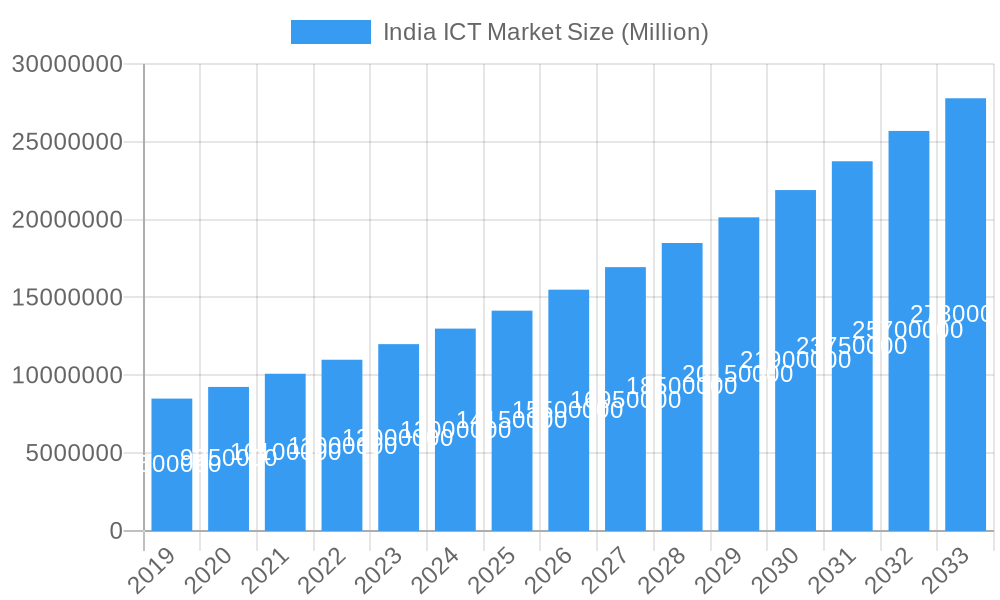
The Indian ICT market is projected for significant expansion, expected to reach 176 billion by 2024, at a CAGR of 17.9%. This growth is primarily driven by accelerated digital transformation across industries, supported by government initiatives such as Digital India. The increasing enterprise demand for cloud computing, AI, big data analytics, and IoT solutions further fuels market momentum. The telecommunications sector's ongoing development, including 5G deployment and broadband infrastructure enhancement, creates new opportunities for ICT service providers. A rapidly growing digital economy and a large, tech-savvy youth population are also key contributors to this upward trend.
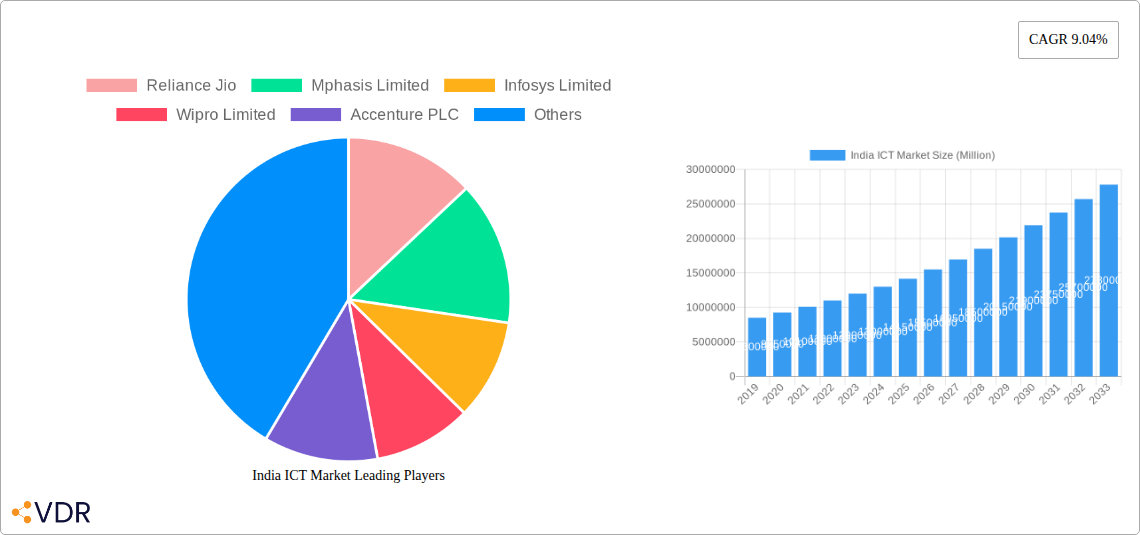
India ICT Market Market Size (In Billion)

The market is segmented into hardware, software, IT services, and telecommunication services, with IT services anticipated to lead, driven by the growing need for digital transformation consulting, system integration, and managed services. Geographically, Western and Southern India are expected to lead market growth due to the presence of major IT hubs and higher adoption rates of advanced technologies. Leading players like Reliance Jio, TCS, Infosys, and Wipro are spearheading innovation and expanding their offerings to meet evolving market needs. Potential challenges include a shortage of skilled IT talent and intense competition, though the long-term outlook remains highly favorable.
India ICT Market Company Market Share
India ICT Market: Comprehensive Analysis and Future Outlook (2019-2033)
This in-depth report provides a strategic overview of the dynamic India ICT Market, encompassing Hardware, Software, IT Services, and Telecommunication Services. Analyzing parent and child markets, we delve into the intricate growth trajectory, from micro, small, and medium enterprises (MSMEs) to large enterprises, across key industry verticals such as BFSI, IT and Telecom, Government, Retail and E-commerce, Manufacturing, and Energy and Utilities. With a Study Period of 2019–2033, Base Year 2025, and Forecast Period 2025–2033, this report offers critical insights for stakeholders navigating the evolving landscape of India's digital economy. High-traffic keywords like Digital Transformation India, IT Outsourcing India, Cloud Computing India, SaaS India, Telecom India, and Enterprise Software India are integrated throughout for maximum search engine visibility and engagement.
India ICT Market Market Dynamics & Structure
The India ICT Market exhibits a moderately concentrated structure, with a few dominant players like Reliance Jio, Infosys Limited, and Tata Consultancy Services Limited holding significant market share. However, the presence of agile and innovative smaller firms, particularly in niche Software and IT Services segments, fosters healthy competition. Technological innovation is primarily driven by the rapid adoption of Cloud Computing, Artificial Intelligence (AI), and Machine Learning (ML), fueled by increasing digital penetration and government initiatives like Digital India. Regulatory frameworks are evolving, with the government actively promoting data localization and cybersecurity. Competitive product substitutes are prevalent, especially in the Hardware segment, where global players constantly introduce more efficient and cost-effective solutions. End-user demographics are shifting towards a younger, digitally-savvy population, driving demand for mobile-first solutions and personalized digital experiences. Mergers and acquisitions (M&A) trends indicate a consolidation phase, with larger companies acquiring startups to enhance their technological capabilities and market reach.
- Market Concentration: Moderate, with key players dominating specific segments.
- Technological Innovation Drivers: Cloud adoption, AI/ML integration, 5G rollout, IoT deployment.
- Regulatory Frameworks: Focus on data security, digital infrastructure development, and ease of doing business.
- Competitive Product Substitutes: Intense competition in hardware and mass-market software solutions.
- End-User Demographics: Growing youth population, increasing internet penetration, and rise of digital consumers.
- M&A Trends: Strategic acquisitions for technology integration and market expansion.
India ICT Market Growth Trends & Insights
The India ICT Market is poised for robust growth, driven by several transformative trends and a progressively digitalizing economy. The Telecommunication Services segment, particularly the widespread adoption of 5G technology and increasing broadband penetration, is a primary growth engine. This is complemented by a surge in demand for IT Services, including cloud migration, digital transformation consulting, and managed services, as businesses across all verticals accelerate their digital journeys. The Software segment is witnessing significant expansion, fueled by the adoption of Software-as-a-Service (SaaS) models, advanced analytics, and enterprise resource planning (ERP) solutions. The Hardware segment, while facing commoditization, is being revitalized by the demand for high-performance computing, AI-enabled devices, and robust networking infrastructure.
The adoption rate of digital technologies is rapidly increasing across Micro, Small, and Medium Enterprises (MSMEs) and Large Enterprises. Government initiatives promoting digital literacy and e-governance further accelerate this adoption. Technological disruptions, such as the proliferation of AI-powered tools, blockchain applications, and the expansion of the Internet of Things (IoT) ecosystem, are creating new avenues for growth and innovation. Consumer behavior is continuously shifting towards online platforms for services, entertainment, and commerce, thereby driving demand for scalable and secure digital infrastructure. The IT and Telecom industry vertical itself remains a major contributor to growth, alongside the BFSI sector's aggressive digital transformation efforts. The forecast indicates a Compound Annual Growth Rate (CAGR) of approximately xx% for the overall India ICT Market during the forecast period. Market penetration of cloud-based services is expected to reach over xx% by 2033, underscoring the shift towards subscription-based and flexible IT solutions. The rural digital connectivity initiatives are also expected to bring millions of new users online, expanding the addressable market significantly. The increasing per capita income and growing disposable income in India are also contributing factors to the increased spending on technology and digital services across both consumer and enterprise segments.
Dominant Regions, Countries, or Segments in India ICT Market
The South region consistently emerges as a dominant force in the India ICT Market, driven by a potent combination of established IT hubs, a skilled workforce, and proactive government policies fostering innovation. Cities like Bengaluru, Chennai, and Hyderabad are global leaders in IT services and software development, attracting significant foreign direct investment. This dominance is further amplified by the strong presence of large enterprises in sectors such as IT and Telecom, BFSI, and Manufacturing, which are early adopters of advanced technologies. The robust infrastructure, including widespread internet connectivity and data centers, supports the seamless operation and expansion of ICT services across the region.
Within the segments, IT Services is the leading growth driver, propelled by the global demand for India's expertise in areas like digital transformation, cloud migration, application development, and business process outsourcing (BPO). The Software segment also plays a crucial role, with a burgeoning ecosystem of SaaS providers and enterprise software solutions catering to diverse industry needs. Telecommunication Services are experiencing rapid expansion, driven by the ongoing 5G rollout and increasing data consumption. In terms of enterprise size, Large Enterprises represent the largest market share due to their substantial IT budgets and complex requirements. However, the Micro, Small, and Medium Enterprises (MSMEs) segment presents a significant growth opportunity as digital adoption becomes more accessible and affordable. The IT and Telecom industry vertical, followed closely by BFSI and Retail and E-commerce, are the primary consumers of ICT solutions, reflecting their inherent reliance on technology for operations and customer engagement. The government's digital initiatives also contribute significantly to the demand for ICT solutions across all regions.
- Dominant Region: South India (e.g., Bengaluru, Chennai, Hyderabad).
- Key Drivers in the South: Strong IT talent pool, established IT infrastructure, government support for innovation, presence of large enterprises.
- Leading Segment: IT Services.
- Contributing Segments: Software, Telecommunication Services.
- Enterprise Size Dominance: Large Enterprises, with significant growth potential in MSMEs.
- Primary Industry Verticals: IT and Telecom, BFSI, Retail and E-commerce.
India ICT Market Product Landscape
The India ICT Market product landscape is characterized by rapid innovation and diversification. In Hardware, the focus is on high-performance computing devices, advanced networking equipment for 5G and IoT, and smart devices for consumer and enterprise use. The Software segment is dominated by the rise of cloud-native applications, AI-powered analytics platforms, cybersecurity solutions, and specialized enterprise software for sectors like BFSI and Manufacturing. IT Services encompass a broad spectrum, from traditional system integration and maintenance to cutting-edge digital transformation consulting, cloud migration services, and data analytics. Telecommunication Services are evolving with the deployment of 5G networks, offering enhanced speed, lower latency, and enabling new applications like IoT and augmented reality. Unique selling propositions often revolve around cost-effectiveness, scalability, and tailored solutions for the Indian market. Technological advancements are focused on enhancing user experience, data security, and operational efficiency.
Key Drivers, Barriers & Challenges in India ICT Market
Key Drivers:
- Digital Transformation Initiatives: Widespread adoption of digital technologies by businesses across all sectors.
- Government Support & Policies: Initiatives like 'Digital India' and 'Make in India' promoting technology adoption and manufacturing.
- Growing Internet and Smartphone Penetration: Expanding user base for digital services and e-commerce.
- Skilled IT Workforce: Availability of a large pool of engineers and IT professionals.
- Foreign Direct Investment (FDI): Increasing investments from global technology companies.
Barriers & Challenges:
- Infrastructure Gaps: Uneven internet connectivity and power supply in certain regions.
- Cybersecurity Threats: Increasing sophistication of cyberattacks requires robust security solutions.
- Regulatory Hurdles: Evolving data privacy laws and compliance requirements can pose challenges.
- Digital Divide: Disparities in digital literacy and access persist, particularly in rural areas.
- Talent Skilling & Upskilling: Rapid technological advancements necessitate continuous upskilling of the workforce.
- Supply Chain Disruptions: Global supply chain issues can impact hardware availability and pricing.
Emerging Opportunities in India ICT Market
Emerging opportunities in the India ICT Market are abundant, driven by the nation's rapid digital evolution. The expanding MSME sector presents a vast untapped market for affordable and scalable Software and IT Services. The burgeoning Retail and E-commerce sector is creating demand for advanced analytics, personalized customer experiences, and robust supply chain management solutions. The increasing adoption of IoT across industries like Manufacturing and Energy and Utilities is opening new avenues for specialized hardware and software solutions. Furthermore, the demand for niche Software solutions in areas like AI-driven healthcare, ed-tech, and agritech is on the rise. Evolving consumer preferences for immersive experiences are also fueling opportunities in augmented reality (AR) and virtual reality (VR) applications. The push for sustainable technology solutions, or 'Green ICT', is another promising area.
Growth Accelerators in the India ICT Market Industry
Several factors are accelerating the long-term growth of the India ICT Market. The continuous advancements in Cloud Computing infrastructure and services are enabling businesses to scale operations efficiently and cost-effectively. Strategic partnerships between global technology giants and Indian IT firms are crucial, fostering knowledge transfer and market access. The increasing adoption of advanced technologies like AI, ML, and Big Data analytics is creating new revenue streams and enhancing operational efficiencies across industries. The government's ongoing focus on developing digital infrastructure, including broadband connectivity and smart city initiatives, acts as a significant catalyst. Furthermore, the growing venture capital funding for technology startups is fueling innovation and the development of disruptive solutions, contributing to the market's dynamic growth. The expansion of digital payment ecosystems is also a key accelerator, reducing transaction friction and encouraging online commerce.
Key Players Shaping the India ICT Market Market
- Reliance Jio
- Mphasis Limited
- Infosys Limited
- Wipro Limited
- Accenture PLC
- Atria Convergence Technologies Ltd
- HCL Technologies
- Allied Digital Services Ltd
- Vodafone India
- Tata Consultancy Services Limited
- Tech Mahindra Ltd
- Bharti Airtel Limited
- IBM Global Services
- Mindtree Ltd
- BSNL
- Capgemini Technology Services India Ltd
Notable Milestones in India ICT Market Sector
- May 2023: SolarWinds and Infosys announced a collaboration to advance the shift of SolarWinds solutions to a new SaaS model. This engagement leverages Infosys's engineering capabilities to accelerate the SaaSification of SolarWinds products and platforms designed to enhance customer visibility in complex hybrid and multi-cloud environments, aligning with SolarWinds' strategy for value-based solutions empowering digital transformation.
- October 2022: HCL Technologies announced the expansion of its strategic partnership with Google Cloud, introducing new capabilities and service options to expedite HCL Tech's cloud migration efforts. This fortification of their partnership significantly enhances HCL Tech's capacity to support digital transformation and provide enterprise clients with critical migration and system modernization services.
In-Depth India ICT Market Market Outlook
The India ICT Market is projected for sustained and accelerated growth, driven by a confluence of factors that position it as a global digital powerhouse. The ongoing digital transformation across all sectors, from BFSI to Manufacturing, fueled by government impetus and increasing enterprise adoption of advanced technologies like AI and cloud, will continue to be primary growth accelerators. The expanding digital infrastructure, particularly the nationwide rollout of 5G and enhanced broadband connectivity, will unlock new opportunities for Telecommunication Services and pave the way for innovations in areas like IoT and edge computing. The strong emphasis on innovation, coupled with a skilled IT workforce and increasing FDI, will foster a dynamic ecosystem for both established players and emerging startups. Strategic partnerships and M&A activities will further consolidate the market and drive technological advancements. The India ICT Market is thus poised to witness significant expansion, offering substantial strategic opportunities for stakeholders seeking to capitalize on India's rapidly evolving digital landscape.
India ICT Market Segmentation
-
1. Type
- 1.1. Hardware
- 1.2. Software
- 1.3. IT Services
- 1.4. Telecommunication Services
-
2. Size of Enterprise
- 2.1. Micro, Small, and Medium Enterprises
- 2.2. Large Enterprises
-
3. Industry Vertical
- 3.1. BFSI
- 3.2. IT and Telecom
- 3.3. Government
- 3.4. Retail and E-commerce
- 3.5. Manufacturing
- 3.6. Energy and Utilities
- 3.7. Other Industry Verticals
-
4. Geography
- 4.1. North
- 4.2. East
- 4.3. West
- 4.4. South
India ICT Market Segmentation By Geography
- 1. North
- 2. East
- 3. West
- 4. South
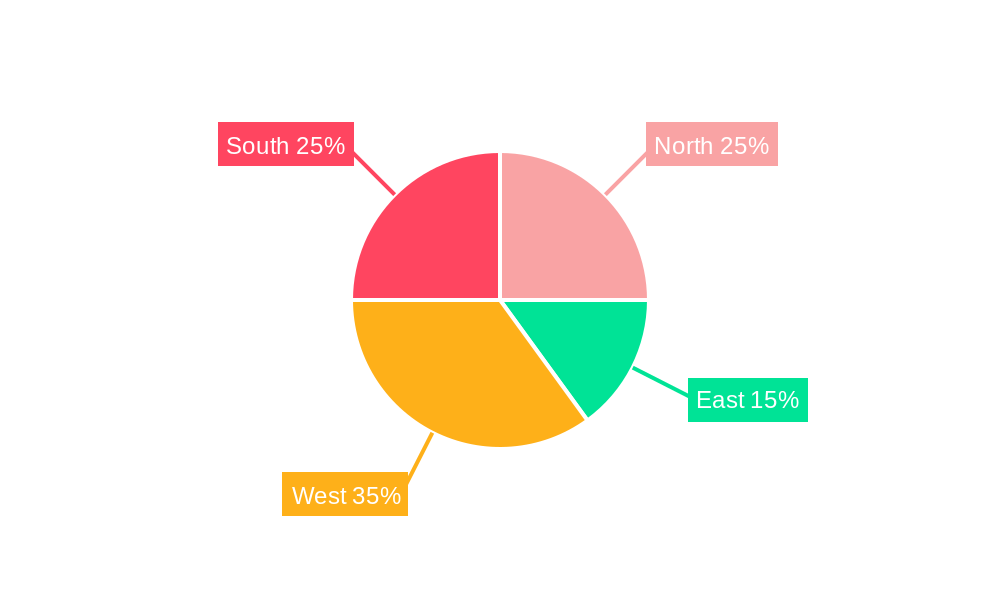
India ICT Market Regional Market Share
Geographic Coverage of India ICT Market
India ICT Market REPORT HIGHLIGHTS
| Aspects | Details |
|---|---|
| Study Period | 2020-2034 |
| Base Year | 2025 |
| Estimated Year | 2026 |
| Forecast Period | 2026-2034 |
| Historical Period | 2020-2025 |
| Growth Rate | CAGR of 17.9% from 2020-2034 |
| Segmentation |
|
Table of Contents
- 1. Introduction
- 1.1. Research Scope
- 1.2. Market Segmentation
- 1.3. Research Methodology
- 1.4. Definitions and Assumptions
- 2. Executive Summary
- 2.1. Introduction
- 3. Market Dynamics
- 3.1. Introduction
- 3.2. Market Drivers
- 3.2.1. Rising Need to Explore and Adopt Digital technologies and Initiatives
- 3.3. Market Restrains
- 3.3.1. Managing Regulatory and Compliance Needs Across the World
- 3.4. Market Trends
- 3.4.1 Micro
- 3.4.2 Small
- 3.4.3 and Medium Enterprises to Register Significant Growth
- 4. Market Factor Analysis
- 4.1. Porters Five Forces
- 4.2. Supply/Value Chain
- 4.3. PESTEL analysis
- 4.4. Market Entropy
- 4.5. Patent/Trademark Analysis
- 5. India ICT Market Analysis, Insights and Forecast, 2020-2032
- 5.1. Market Analysis, Insights and Forecast - by Type
- 5.1.1. Hardware
- 5.1.2. Software
- 5.1.3. IT Services
- 5.1.4. Telecommunication Services
- 5.2. Market Analysis, Insights and Forecast - by Size of Enterprise
- 5.2.1. Micro, Small, and Medium Enterprises
- 5.2.2. Large Enterprises
- 5.3. Market Analysis, Insights and Forecast - by Industry Vertical
- 5.3.1. BFSI
- 5.3.2. IT and Telecom
- 5.3.3. Government
- 5.3.4. Retail and E-commerce
- 5.3.5. Manufacturing
- 5.3.6. Energy and Utilities
- 5.3.7. Other Industry Verticals
- 5.4. Market Analysis, Insights and Forecast - by Geography
- 5.4.1. North
- 5.4.2. East
- 5.4.3. West
- 5.4.4. South
- 5.5. Market Analysis, Insights and Forecast - by Region
- 5.5.1. North
- 5.5.2. East
- 5.5.3. West
- 5.5.4. South
- 5.1. Market Analysis, Insights and Forecast - by Type
- 6. North India ICT Market Analysis, Insights and Forecast, 2020-2032
- 6.1. Market Analysis, Insights and Forecast - by Type
- 6.1.1. Hardware
- 6.1.2. Software
- 6.1.3. IT Services
- 6.1.4. Telecommunication Services
- 6.2. Market Analysis, Insights and Forecast - by Size of Enterprise
- 6.2.1. Micro, Small, and Medium Enterprises
- 6.2.2. Large Enterprises
- 6.3. Market Analysis, Insights and Forecast - by Industry Vertical
- 6.3.1. BFSI
- 6.3.2. IT and Telecom
- 6.3.3. Government
- 6.3.4. Retail and E-commerce
- 6.3.5. Manufacturing
- 6.3.6. Energy and Utilities
- 6.3.7. Other Industry Verticals
- 6.4. Market Analysis, Insights and Forecast - by Geography
- 6.4.1. North
- 6.4.2. East
- 6.4.3. West
- 6.4.4. South
- 6.1. Market Analysis, Insights and Forecast - by Type
- 7. East India ICT Market Analysis, Insights and Forecast, 2020-2032
- 7.1. Market Analysis, Insights and Forecast - by Type
- 7.1.1. Hardware
- 7.1.2. Software
- 7.1.3. IT Services
- 7.1.4. Telecommunication Services
- 7.2. Market Analysis, Insights and Forecast - by Size of Enterprise
- 7.2.1. Micro, Small, and Medium Enterprises
- 7.2.2. Large Enterprises
- 7.3. Market Analysis, Insights and Forecast - by Industry Vertical
- 7.3.1. BFSI
- 7.3.2. IT and Telecom
- 7.3.3. Government
- 7.3.4. Retail and E-commerce
- 7.3.5. Manufacturing
- 7.3.6. Energy and Utilities
- 7.3.7. Other Industry Verticals
- 7.4. Market Analysis, Insights and Forecast - by Geography
- 7.4.1. North
- 7.4.2. East
- 7.4.3. West
- 7.4.4. South
- 7.1. Market Analysis, Insights and Forecast - by Type
- 8. West India ICT Market Analysis, Insights and Forecast, 2020-2032
- 8.1. Market Analysis, Insights and Forecast - by Type
- 8.1.1. Hardware
- 8.1.2. Software
- 8.1.3. IT Services
- 8.1.4. Telecommunication Services
- 8.2. Market Analysis, Insights and Forecast - by Size of Enterprise
- 8.2.1. Micro, Small, and Medium Enterprises
- 8.2.2. Large Enterprises
- 8.3. Market Analysis, Insights and Forecast - by Industry Vertical
- 8.3.1. BFSI
- 8.3.2. IT and Telecom
- 8.3.3. Government
- 8.3.4. Retail and E-commerce
- 8.3.5. Manufacturing
- 8.3.6. Energy and Utilities
- 8.3.7. Other Industry Verticals
- 8.4. Market Analysis, Insights and Forecast - by Geography
- 8.4.1. North
- 8.4.2. East
- 8.4.3. West
- 8.4.4. South
- 8.1. Market Analysis, Insights and Forecast - by Type
- 9. South India ICT Market Analysis, Insights and Forecast, 2020-2032
- 9.1. Market Analysis, Insights and Forecast - by Type
- 9.1.1. Hardware
- 9.1.2. Software
- 9.1.3. IT Services
- 9.1.4. Telecommunication Services
- 9.2. Market Analysis, Insights and Forecast - by Size of Enterprise
- 9.2.1. Micro, Small, and Medium Enterprises
- 9.2.2. Large Enterprises
- 9.3. Market Analysis, Insights and Forecast - by Industry Vertical
- 9.3.1. BFSI
- 9.3.2. IT and Telecom
- 9.3.3. Government
- 9.3.4. Retail and E-commerce
- 9.3.5. Manufacturing
- 9.3.6. Energy and Utilities
- 9.3.7. Other Industry Verticals
- 9.4. Market Analysis, Insights and Forecast - by Geography
- 9.4.1. North
- 9.4.2. East
- 9.4.3. West
- 9.4.4. South
- 9.1. Market Analysis, Insights and Forecast - by Type
- 10. Competitive Analysis
- 10.1. Market Share Analysis 2025
- 10.2. Company Profiles
- 10.2.1 Reliance Jio
- 10.2.1.1. Overview
- 10.2.1.2. Products
- 10.2.1.3. SWOT Analysis
- 10.2.1.4. Recent Developments
- 10.2.1.5. Financials (Based on Availability)
- 10.2.2 Mphasis Limited
- 10.2.2.1. Overview
- 10.2.2.2. Products
- 10.2.2.3. SWOT Analysis
- 10.2.2.4. Recent Developments
- 10.2.2.5. Financials (Based on Availability)
- 10.2.3 Infosys Limited
- 10.2.3.1. Overview
- 10.2.3.2. Products
- 10.2.3.3. SWOT Analysis
- 10.2.3.4. Recent Developments
- 10.2.3.5. Financials (Based on Availability)
- 10.2.4 Wipro Limited
- 10.2.4.1. Overview
- 10.2.4.2. Products
- 10.2.4.3. SWOT Analysis
- 10.2.4.4. Recent Developments
- 10.2.4.5. Financials (Based on Availability)
- 10.2.5 Accenture PLC
- 10.2.5.1. Overview
- 10.2.5.2. Products
- 10.2.5.3. SWOT Analysis
- 10.2.5.4. Recent Developments
- 10.2.5.5. Financials (Based on Availability)
- 10.2.6 Atria Convergence Technologies Ltd
- 10.2.6.1. Overview
- 10.2.6.2. Products
- 10.2.6.3. SWOT Analysis
- 10.2.6.4. Recent Developments
- 10.2.6.5. Financials (Based on Availability)
- 10.2.7 HCL Technologies
- 10.2.7.1. Overview
- 10.2.7.2. Products
- 10.2.7.3. SWOT Analysis
- 10.2.7.4. Recent Developments
- 10.2.7.5. Financials (Based on Availability)
- 10.2.8 Allied Digital Services Ltd
- 10.2.8.1. Overview
- 10.2.8.2. Products
- 10.2.8.3. SWOT Analysis
- 10.2.8.4. Recent Developments
- 10.2.8.5. Financials (Based on Availability)
- 10.2.9 Vodafone India*List Not Exhaustive
- 10.2.9.1. Overview
- 10.2.9.2. Products
- 10.2.9.3. SWOT Analysis
- 10.2.9.4. Recent Developments
- 10.2.9.5. Financials (Based on Availability)
- 10.2.10 Tata Consultancy Services Limited
- 10.2.10.1. Overview
- 10.2.10.2. Products
- 10.2.10.3. SWOT Analysis
- 10.2.10.4. Recent Developments
- 10.2.10.5. Financials (Based on Availability)
- 10.2.11 Tech Mahindra Ltd
- 10.2.11.1. Overview
- 10.2.11.2. Products
- 10.2.11.3. SWOT Analysis
- 10.2.11.4. Recent Developments
- 10.2.11.5. Financials (Based on Availability)
- 10.2.12 Bharti Airtel Limited
- 10.2.12.1. Overview
- 10.2.12.2. Products
- 10.2.12.3. SWOT Analysis
- 10.2.12.4. Recent Developments
- 10.2.12.5. Financials (Based on Availability)
- 10.2.13 IBM Global Services
- 10.2.13.1. Overview
- 10.2.13.2. Products
- 10.2.13.3. SWOT Analysis
- 10.2.13.4. Recent Developments
- 10.2.13.5. Financials (Based on Availability)
- 10.2.14 Mindtree Ltd
- 10.2.14.1. Overview
- 10.2.14.2. Products
- 10.2.14.3. SWOT Analysis
- 10.2.14.4. Recent Developments
- 10.2.14.5. Financials (Based on Availability)
- 10.2.15 BSNL
- 10.2.15.1. Overview
- 10.2.15.2. Products
- 10.2.15.3. SWOT Analysis
- 10.2.15.4. Recent Developments
- 10.2.15.5. Financials (Based on Availability)
- 10.2.16 Capgemini Technology Services India Ltd
- 10.2.16.1. Overview
- 10.2.16.2. Products
- 10.2.16.3. SWOT Analysis
- 10.2.16.4. Recent Developments
- 10.2.16.5. Financials (Based on Availability)
- 10.2.1 Reliance Jio
List of Figures
- Figure 1: India ICT Market Revenue Breakdown (billion, %) by Product 2025 & 2033
- Figure 2: India ICT Market Share (%) by Company 2025
List of Tables
- Table 1: India ICT Market Revenue billion Forecast, by Type 2020 & 2033
- Table 2: India ICT Market Revenue billion Forecast, by Size of Enterprise 2020 & 2033
- Table 3: India ICT Market Revenue billion Forecast, by Industry Vertical 2020 & 2033
- Table 4: India ICT Market Revenue billion Forecast, by Geography 2020 & 2033
- Table 5: India ICT Market Revenue billion Forecast, by Region 2020 & 2033
- Table 6: India ICT Market Revenue billion Forecast, by Type 2020 & 2033
- Table 7: India ICT Market Revenue billion Forecast, by Size of Enterprise 2020 & 2033
- Table 8: India ICT Market Revenue billion Forecast, by Industry Vertical 2020 & 2033
- Table 9: India ICT Market Revenue billion Forecast, by Geography 2020 & 2033
- Table 10: India ICT Market Revenue billion Forecast, by Country 2020 & 2033
- Table 11: India ICT Market Revenue billion Forecast, by Type 2020 & 2033
- Table 12: India ICT Market Revenue billion Forecast, by Size of Enterprise 2020 & 2033
- Table 13: India ICT Market Revenue billion Forecast, by Industry Vertical 2020 & 2033
- Table 14: India ICT Market Revenue billion Forecast, by Geography 2020 & 2033
- Table 15: India ICT Market Revenue billion Forecast, by Country 2020 & 2033
- Table 16: India ICT Market Revenue billion Forecast, by Type 2020 & 2033
- Table 17: India ICT Market Revenue billion Forecast, by Size of Enterprise 2020 & 2033
- Table 18: India ICT Market Revenue billion Forecast, by Industry Vertical 2020 & 2033
- Table 19: India ICT Market Revenue billion Forecast, by Geography 2020 & 2033
- Table 20: India ICT Market Revenue billion Forecast, by Country 2020 & 2033
- Table 21: India ICT Market Revenue billion Forecast, by Type 2020 & 2033
- Table 22: India ICT Market Revenue billion Forecast, by Size of Enterprise 2020 & 2033
- Table 23: India ICT Market Revenue billion Forecast, by Industry Vertical 2020 & 2033
- Table 24: India ICT Market Revenue billion Forecast, by Geography 2020 & 2033
- Table 25: India ICT Market Revenue billion Forecast, by Country 2020 & 2033
Frequently Asked Questions
1. What is the projected Compound Annual Growth Rate (CAGR) of the India ICT Market?
The projected CAGR is approximately 17.9%.
2. Which companies are prominent players in the India ICT Market?
Key companies in the market include Reliance Jio, Mphasis Limited, Infosys Limited, Wipro Limited, Accenture PLC, Atria Convergence Technologies Ltd, HCL Technologies, Allied Digital Services Ltd, Vodafone India*List Not Exhaustive, Tata Consultancy Services Limited, Tech Mahindra Ltd, Bharti Airtel Limited, IBM Global Services, Mindtree Ltd, BSNL, Capgemini Technology Services India Ltd.
3. What are the main segments of the India ICT Market?
The market segments include Type, Size of Enterprise, Industry Vertical, Geography.
4. Can you provide details about the market size?
The market size is estimated to be USD 176 billion as of 2022.
5. What are some drivers contributing to market growth?
Rising Need to Explore and Adopt Digital technologies and Initiatives.
6. What are the notable trends driving market growth?
Micro. Small. and Medium Enterprises to Register Significant Growth.
7. Are there any restraints impacting market growth?
Managing Regulatory and Compliance Needs Across the World.
8. Can you provide examples of recent developments in the market?
May 2023: Solarwinds and Infoysis have announced a collaboration to advance the shift of SolarWinds solutions to a new SaaS model. Through this engagement, Infosys will leverage its engineering capabilities to accelerate the SaaSification of SolarWinds products and platforms built to increase customer visibility in highly complex hybrid and multi-cloud environments. This collaboration is a key component of the SolarWinds strategy to offer accessible, highly effective, and value-based solutions built to empower its customers to accelerate their digital transformation efforts regardless of where they are on their journey to the cloud.
9. What pricing options are available for accessing the report?
Pricing options include single-user, multi-user, and enterprise licenses priced at USD 4750, USD 5250, and USD 8750 respectively.
10. Is the market size provided in terms of value or volume?
The market size is provided in terms of value, measured in billion.
11. Are there any specific market keywords associated with the report?
Yes, the market keyword associated with the report is "India ICT Market," which aids in identifying and referencing the specific market segment covered.
12. How do I determine which pricing option suits my needs best?
The pricing options vary based on user requirements and access needs. Individual users may opt for single-user licenses, while businesses requiring broader access may choose multi-user or enterprise licenses for cost-effective access to the report.
13. Are there any additional resources or data provided in the India ICT Market report?
While the report offers comprehensive insights, it's advisable to review the specific contents or supplementary materials provided to ascertain if additional resources or data are available.
14. How can I stay updated on further developments or reports in the India ICT Market?
To stay informed about further developments, trends, and reports in the India ICT Market, consider subscribing to industry newsletters, following relevant companies and organizations, or regularly checking reputable industry news sources and publications.
Methodology
Step 1 - Identification of Relevant Samples Size from Population Database



Step 2 - Approaches for Defining Global Market Size (Value, Volume* & Price*)

Note*: In applicable scenarios
Step 3 - Data Sources
Primary Research
- Web Analytics
- Survey Reports
- Research Institute
- Latest Research Reports
- Opinion Leaders
Secondary Research
- Annual Reports
- White Paper
- Latest Press Release
- Industry Association
- Paid Database
- Investor Presentations

Step 4 - Data Triangulation
Involves using different sources of information in order to increase the validity of a study
These sources are likely to be stakeholders in a program - participants, other researchers, program staff, other community members, and so on.
Then we put all data in single framework & apply various statistical tools to find out the dynamic on the market.
During the analysis stage, feedback from the stakeholder groups would be compared to determine areas of agreement as well as areas of divergence