


Key Insights
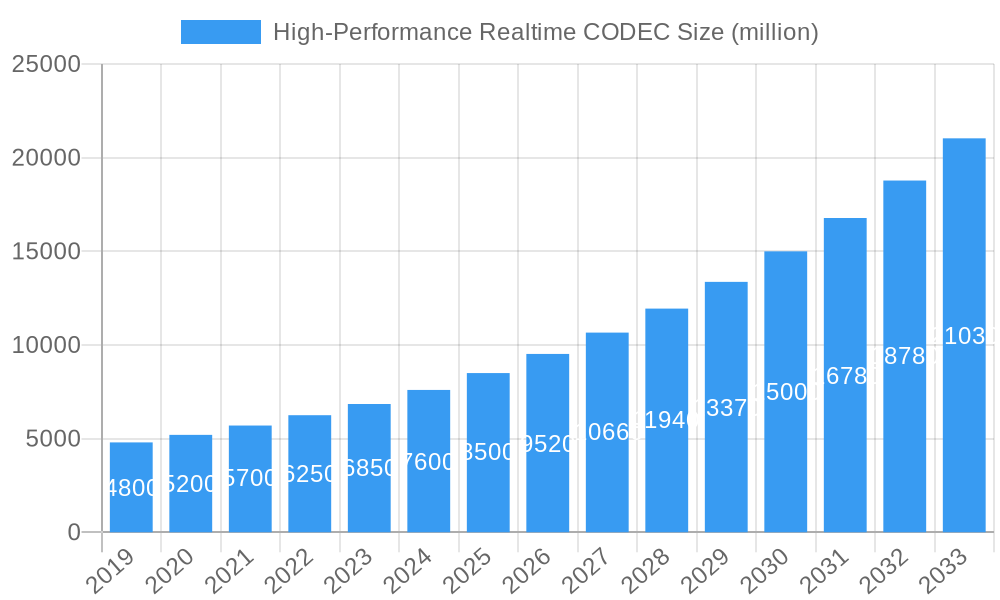
The High-Performance Realtime CODEC market is experiencing robust growth, projected to reach an estimated market size of approximately $8,500 million by 2025, with a significant Compound Annual Growth Rate (CAGR) of around 12%. This expansion is primarily fueled by the ever-increasing demand for seamless video and audio streaming services, the proliferation of digital video broadcasting, and the surge in video conferencing necessitated by remote work trends and global connectivity. Advancements in compression technologies, coupled with the growing adoption of digital media players and the continuous need for efficient audio and video codecs, are further propelling this market forward. The development of more sophisticated lossless codecs also plays a crucial role, catering to applications where pristine audio and video quality are paramount, such as professional broadcasting and high-fidelity content creation.
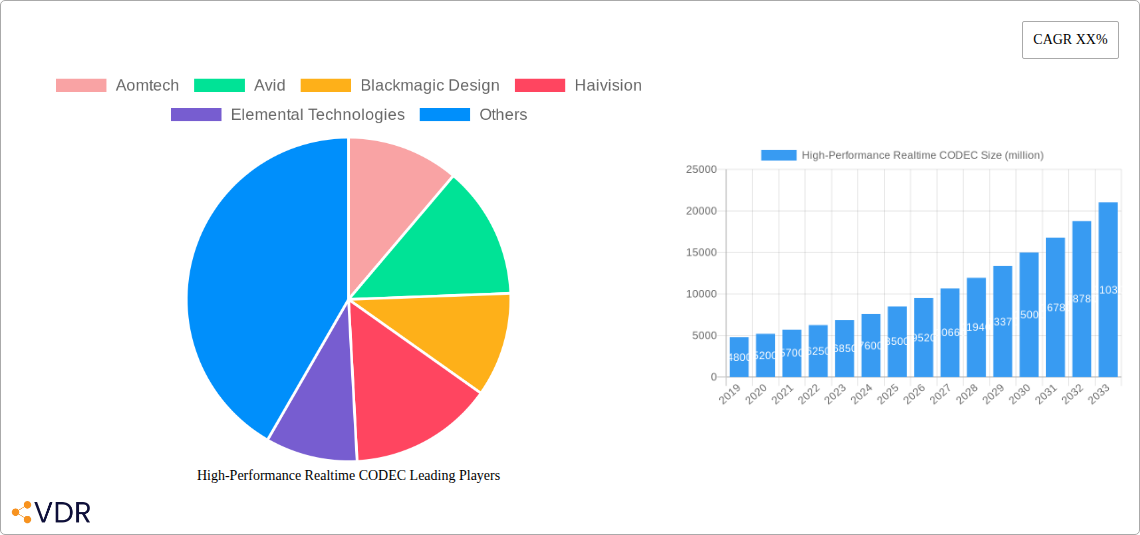
High-Performance Realtime CODEC Market Size (In Billion)

The market landscape for High-Performance Realtime CODEC is characterized by several key drivers and trends. The insatiable consumer appetite for high-definition content, coupled with the exponential growth of online video platforms, necessitates highly efficient and low-latency CODEC solutions. Furthermore, the ongoing digital transformation across various industries, including media and entertainment, telecommunications, and enterprise communications, is creating substantial demand for advanced real-time encoding and decoding capabilities. Despite the promising outlook, certain restraints such as the high cost of implementing cutting-edge CODEC technologies and the complexity associated with integrating them into existing infrastructure can pose challenges. However, innovative solutions and strategic partnerships among leading companies like Aomtech, Avid, Blackmagic Design, Haivision, and Ericsson are expected to overcome these hurdles, driving significant advancements and market penetration in the coming years.
High-Performance Realtime CODEC Company Market Share
High-Performance Realtime CODEC Market: Comprehensive Analysis and Forecast 2019-2033
This report offers a deep dive into the High-Performance Realtime CODEC market, providing an in-depth analysis of its dynamics, growth trends, and future outlook. It is meticulously crafted for industry professionals, researchers, and stakeholders seeking critical insights into this rapidly evolving sector. With a focus on high-traffic keywords and a structured presentation, this report aims to maximize search engine visibility and deliver actionable intelligence. The study encompasses a detailed examination from the historical period of 2019–2024, with the base year set at 2025, and forecasts the market's trajectory through 2033.
High-Performance Realtime CODEC Market Dynamics & Structure
The High-Performance Realtime CODEC market exhibits a moderately consolidated structure, characterized by the strategic presence of key industry players like Ericsson, Avid, and Harmonic Inc., alongside innovative emerging companies. Technological innovation is the primary driver, with continuous advancements in compression algorithms and processing power pushing the boundaries of real-time audio and video delivery. Regulatory frameworks, particularly those related to broadcast standards and data privacy, subtly influence development but rarely act as significant barriers. Competitive product substitutes, primarily software-based codecs and less demanding hardware solutions, exist but often fall short of the low-latency, high-fidelity requirements of true high-performance applications. End-user demographics are diverse, ranging from professional broadcasters and content creators to enterprise communication platforms and demanding consumer electronics. Mergers and acquisitions (M&A) are an ongoing trend, with an estimated 5-7 significant M&A deals occurring within the historical period, driven by the desire to acquire patented technologies and expand market reach. Innovation barriers are generally low for incremental improvements but can be high for breakthroughs requiring substantial R&D investment.
- Market Concentration: Moderately consolidated with a few dominant players and several niche contributors.
- Technological Innovation Drivers: Demand for higher resolutions (4K, 8K), lower latency, and enhanced audio fidelity.
- Regulatory Frameworks: Broadcast standards (e.g., ATSC, DVB), IP transmission protocols, and data privacy regulations.
- Competitive Product Substitutes: Software-only codecs, older generation hardware codecs.
- End-User Demographics: Broad spectrum from professional broadcast to enterprise and prosumer markets.
- M&A Trends: Driven by technology acquisition and market expansion; estimated 30-40 million units in cumulative acquisition volumes.
High-Performance Realtime CODEC Growth Trends & Insights
The High-Performance Realtime CODEC market is poised for substantial growth, driven by the relentless demand for immersive and efficient media experiences across various applications. The market size is projected to expand from approximately $2.5 billion in 2025 to an estimated $6.8 billion by 2033, reflecting a robust Compound Annual Growth Rate (CAGR) of 13.5% during the forecast period. This impressive expansion is fueled by several key trends. Firstly, the proliferation of high-resolution content, including 4K and 8K video, necessitates advanced codecs capable of efficient compression without sacrificing quality. Secondly, the exponential growth of live streaming services, esports, and remote collaboration tools demands ultra-low latency and high-fidelity audio-visual communication, making real-time CODECs indispensable.
Technological disruptions are continuously reshaping the landscape. The adoption of AI and machine learning in codec optimization is leading to more intelligent and adaptive compression techniques, promising further gains in efficiency and performance. Furthermore, the increasing adoption of cloud-based workflows and edge computing environments is creating new opportunities for optimized real-time CODEC solutions that can operate efficiently in distributed architectures. Consumer behavior is also playing a crucial role; viewers and users are increasingly expecting seamless, uninterrupted, and high-quality streaming experiences, pushing content providers and platform operators to invest in superior CODEC technologies. Market penetration for advanced real-time CODECs is expected to rise from 35% in 2025 to over 60% by 2033, particularly within the professional broadcast and enterprise video conferencing segments.
- Market Size Evolution: Projected growth from $2.5 billion (2025) to $6.8 billion (2033).
- CAGR: 13.5% during the forecast period (2025-2033).
- Adoption Rates: Increasing penetration across broadcast, enterprise, and emerging applications.
- Technological Disruptions: AI/ML in optimization, cloud-native solutions, edge computing compatibility.
- Consumer Behavior Shifts: Demand for low-latency, high-quality, and immersive media experiences.
- Market Penetration: Expected to reach over 60% by 2033.
Dominant Regions, Countries, or Segments in High-Performance Realtime CODEC
The Video and Audio Streaming segment, within the broader Application market, is currently the dominant force and is anticipated to remain so throughout the forecast period. This leadership is underpinned by the massive global appetite for live content, on-demand video, and high-fidelity audio experiences. The segment's growth is propelled by several key drivers. Economically, significant investments in digital infrastructure, including high-speed internet and 5G deployments, directly enable higher bandwidth consumption and facilitate the adoption of advanced streaming CODECs. The market share within this segment alone is estimated to be around 45% of the total High-Performance Realtime CODEC market in 2025, with a projected growth potential that outpaces other segments.
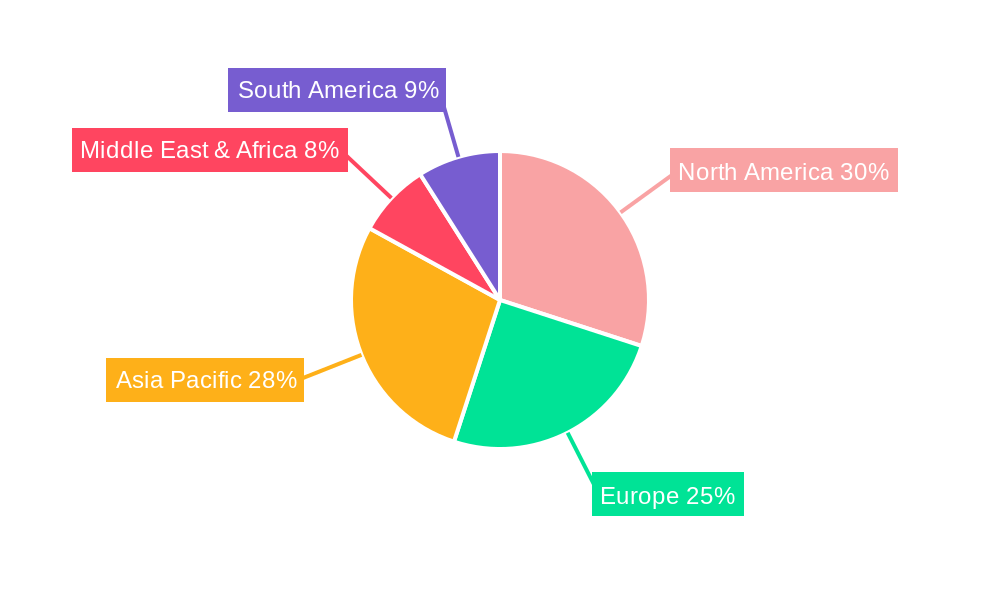
North America, particularly the United States, is a leading country due to its robust technological ecosystem, early adoption of streaming technologies, and the presence of major content creators and distributors. Europe also presents a significant market, driven by strong regulatory support for digital broadcasting and a growing demand for immersive entertainment. Asia Pacific, with its rapidly expanding internet penetration and a burgeoning middle class, represents the fastest-growing region, expected to exhibit a CAGR of 15% during the forecast period. Within the Types segment, Video Codecs are the largest contributor, accounting for approximately 60% of the market value due to the higher computational demands of video compression. However, the growth in Audio Codecs is accelerating, driven by the increasing demand for high-resolution audio in music streaming and professional audio production.
- Dominant Segment (Application): Video and Audio Streaming, contributing approximately $1.125 billion in 2025.
- Key Growth Drivers: Infrastructure development (5G, broadband), content creation boom, consumer demand for immersive experiences.
- Leading Region: North America, followed by Europe and Asia Pacific.
- Fastest-Growing Region: Asia Pacific, with an estimated CAGR of 15%.
- Dominant Segment (Type): Video Codecs, representing around 60% of the market value.
- Market Share (Video & Audio Streaming): Estimated at 45% of the total market in 2025.
High-Performance Realtime CODEC Product Landscape
The product landscape for High-Performance Realtime CODECs is characterized by relentless innovation aimed at achieving unprecedented levels of compression efficiency, latency reduction, and audio-visual fidelity. Companies like Elemental Technologies and Haivision are at the forefront, offering solutions that support next-generation codecs such as AV1, HEVC, and VVC for video, alongside advanced audio codecs like Opus and AAC-ELD for superior real-time audio delivery. Performance metrics frequently highlighted include end-to-end latency figures in the tens of milliseconds, bitrate savings of up to 50% compared to previous generations, and support for resolutions up to 8K. Unique selling propositions often revolve around hardware acceleration, AI-powered adaptive compression, and seamless integration into broadcast and enterprise workflows.
Key Drivers, Barriers & Challenges in High-Performance Realtime CODEC
The primary forces propelling the High-Performance Realtime CODEC market are the escalating demand for high-quality video and audio streaming, the exponential growth of live content production and consumption, and the increasing adoption of remote work and collaboration tools that necessitate low-latency communication. Technological advancements in AI and machine learning are also significant drivers, enabling more efficient compression algorithms. Furthermore, the rollout of 5G networks provides the necessary bandwidth for high-fidelity real-time data transmission.
However, the market faces several key challenges and restraints. The significant initial investment required for high-performance hardware and software can be a barrier for smaller organizations. Supply chain issues, particularly for specialized semiconductor components, can impact manufacturing and availability, with potential impacts on 5-10% of production output in certain periods. Regulatory hurdles related to content licensing and data security can also pose challenges. Competitive pressures from well-established players and the constant need for R&D to keep pace with technological advancements require substantial financial commitment.
Emerging Opportunities in High-Performance Realtime CODEC
Emerging opportunities in the High-Performance Realtime CODEC sector are ripe for exploitation. The burgeoning metaverse and extended reality (XR) applications present a significant untapped market, requiring ultra-low latency and highly efficient CODECs for immersive, real-time experiences. The increasing adoption of AI-powered content generation and editing tools also creates demand for CODECs that can handle these new forms of media. Furthermore, the growing need for secure and efficient real-time communication in critical infrastructure, such as smart grids and autonomous systems, offers a new avenue for specialized CODEC solutions. Evolving consumer preferences for personalized and interactive content also present opportunities for CODECs that can support dynamic stream adaptation.
Growth Accelerators in the High-Performance Realtime CODEC Industry
Several catalysts are driving long-term growth in the High-Performance Realtime CODEC industry. Technological breakthroughs, such as the development of novel, ultra-efficient compression algorithms and advancements in hardware-based acceleration, will be crucial. Strategic partnerships between CODEC developers, chip manufacturers, and platform providers are accelerating product integration and market adoption. Market expansion into new verticals, including healthcare (telemedicine), education (virtual classrooms), and industrial applications (remote monitoring), will unlock significant growth potential. The ongoing transition to IP-based broadcast infrastructure also presents a sustained opportunity for high-performance real-time CODEC solutions.
Key Players Shaping the High-Performance Realtime CODEC Market
- Aomtech
- Avid
- Blackmagic Design
- Haivision
- Elemental Technologies
- Harmonic Inc.
- NTT Electronics
- Ateme
- Ericsson
- JVC Kenwood
Notable Milestones in High-Performance Realtime CODEC Sector
- 2019: Release of AV1 codec enabling royalty-free, high-efficiency video compression.
- 2020: Significant advancements in hardware acceleration for HEVC and VVC, leading to lower latency.
- 2021: Rise of cloud-native CODEC solutions for flexible and scalable video processing.
- 2022: Increased adoption of AI/ML for intelligent CODEC optimization and adaptive bitrate streaming.
- 2023: Growing demand for ultra-low latency CODECs for esports and interactive live events.
- 2024: Introduction of more efficient real-time audio codecs for immersive spatial audio experiences.
- Early 2025: Projected release of next-generation VVC profiles with enhanced performance.
In-Depth High-Performance Realtime CODEC Market Outlook
The future of the High-Performance Realtime CODEC market is exceptionally bright, driven by an ongoing technological arms race and an insatiable global demand for seamless, high-fidelity digital experiences. Growth accelerators such as continued AI integration, the expansion of 5G networks, and the emergence of immersive technologies like the metaverse will propel market expansion. Strategic partnerships and market penetration into new industrial and enterprise verticals will further solidify this growth trajectory. The market is well-positioned to capitalize on the increasing importance of real-time communication and content delivery across all facets of society and industry.
High-Performance Realtime CODEC Segmentation
-
1. Application
- 1.1. Video and Audio Streaming
- 1.2. Digital Video Broadcasting
- 1.3. Video Conferencing
- 1.4. Digital Media Players
-
2. Types
- 2.1. Audio Codecs
- 2.2. Video Codecs
- 2.3. Lossless Codecs
High-Performance Realtime CODEC Segmentation By Geography
-
1. North America
- 1.1. United States
- 1.2. Canada
- 1.3. Mexico
-
2. South America
- 2.1. Brazil
- 2.2. Argentina
- 2.3. Rest of South America
-
3. Europe
- 3.1. United Kingdom
- 3.2. Germany
- 3.3. France
- 3.4. Italy
- 3.5. Spain
- 3.6. Russia
- 3.7. Benelux
- 3.8. Nordics
- 3.9. Rest of Europe
-
4. Middle East & Africa
- 4.1. Turkey
- 4.2. Israel
- 4.3. GCC
- 4.4. North Africa
- 4.5. South Africa
- 4.6. Rest of Middle East & Africa
-
5. Asia Pacific
- 5.1. China
- 5.2. India
- 5.3. Japan
- 5.4. South Korea
- 5.5. ASEAN
- 5.6. Oceania
- 5.7. Rest of Asia Pacific
High-Performance Realtime CODEC Regional Market Share
Geographic Coverage of High-Performance Realtime CODEC
High-Performance Realtime CODEC REPORT HIGHLIGHTS
| Aspects | Details |
|---|---|
| Study Period | 2020-2034 |
| Base Year | 2025 |
| Estimated Year | 2026 |
| Forecast Period | 2026-2034 |
| Historical Period | 2020-2025 |
| Growth Rate | CAGR of XX% from 2020-2034 |
| Segmentation |
|
Table of Contents
- 1. Introduction
- 1.1. Research Scope
- 1.2. Market Segmentation
- 1.3. Research Methodology
- 1.4. Definitions and Assumptions
- 2. Executive Summary
- 2.1. Introduction
- 3. Market Dynamics
- 3.1. Introduction
- 3.2. Market Drivers
- 3.3. Market Restrains
- 3.4. Market Trends
- 4. Market Factor Analysis
- 4.1. Porters Five Forces
- 4.2. Supply/Value Chain
- 4.3. PESTEL analysis
- 4.4. Market Entropy
- 4.5. Patent/Trademark Analysis
- 5. Global High-Performance Realtime CODEC Analysis, Insights and Forecast, 2020-2032
- 5.1. Market Analysis, Insights and Forecast - by Application
- 5.1.1. Video and Audio Streaming
- 5.1.2. Digital Video Broadcasting
- 5.1.3. Video Conferencing
- 5.1.4. Digital Media Players
- 5.2. Market Analysis, Insights and Forecast - by Types
- 5.2.1. Audio Codecs
- 5.2.2. Video Codecs
- 5.2.3. Lossless Codecs
- 5.3. Market Analysis, Insights and Forecast - by Region
- 5.3.1. North America
- 5.3.2. South America
- 5.3.3. Europe
- 5.3.4. Middle East & Africa
- 5.3.5. Asia Pacific
- 5.1. Market Analysis, Insights and Forecast - by Application
- 6. North America High-Performance Realtime CODEC Analysis, Insights and Forecast, 2020-2032
- 6.1. Market Analysis, Insights and Forecast - by Application
- 6.1.1. Video and Audio Streaming
- 6.1.2. Digital Video Broadcasting
- 6.1.3. Video Conferencing
- 6.1.4. Digital Media Players
- 6.2. Market Analysis, Insights and Forecast - by Types
- 6.2.1. Audio Codecs
- 6.2.2. Video Codecs
- 6.2.3. Lossless Codecs
- 6.1. Market Analysis, Insights and Forecast - by Application
- 7. South America High-Performance Realtime CODEC Analysis, Insights and Forecast, 2020-2032
- 7.1. Market Analysis, Insights and Forecast - by Application
- 7.1.1. Video and Audio Streaming
- 7.1.2. Digital Video Broadcasting
- 7.1.3. Video Conferencing
- 7.1.4. Digital Media Players
- 7.2. Market Analysis, Insights and Forecast - by Types
- 7.2.1. Audio Codecs
- 7.2.2. Video Codecs
- 7.2.3. Lossless Codecs
- 7.1. Market Analysis, Insights and Forecast - by Application
- 8. Europe High-Performance Realtime CODEC Analysis, Insights and Forecast, 2020-2032
- 8.1. Market Analysis, Insights and Forecast - by Application
- 8.1.1. Video and Audio Streaming
- 8.1.2. Digital Video Broadcasting
- 8.1.3. Video Conferencing
- 8.1.4. Digital Media Players
- 8.2. Market Analysis, Insights and Forecast - by Types
- 8.2.1. Audio Codecs
- 8.2.2. Video Codecs
- 8.2.3. Lossless Codecs
- 8.1. Market Analysis, Insights and Forecast - by Application
- 9. Middle East & Africa High-Performance Realtime CODEC Analysis, Insights and Forecast, 2020-2032
- 9.1. Market Analysis, Insights and Forecast - by Application
- 9.1.1. Video and Audio Streaming
- 9.1.2. Digital Video Broadcasting
- 9.1.3. Video Conferencing
- 9.1.4. Digital Media Players
- 9.2. Market Analysis, Insights and Forecast - by Types
- 9.2.1. Audio Codecs
- 9.2.2. Video Codecs
- 9.2.3. Lossless Codecs
- 9.1. Market Analysis, Insights and Forecast - by Application
- 10. Asia Pacific High-Performance Realtime CODEC Analysis, Insights and Forecast, 2020-2032
- 10.1. Market Analysis, Insights and Forecast - by Application
- 10.1.1. Video and Audio Streaming
- 10.1.2. Digital Video Broadcasting
- 10.1.3. Video Conferencing
- 10.1.4. Digital Media Players
- 10.2. Market Analysis, Insights and Forecast - by Types
- 10.2.1. Audio Codecs
- 10.2.2. Video Codecs
- 10.2.3. Lossless Codecs
- 10.1. Market Analysis, Insights and Forecast - by Application
- 11. Competitive Analysis
- 11.1. Global Market Share Analysis 2025
- 11.2. Company Profiles
- 11.2.1 Aomtech
- 11.2.1.1. Overview
- 11.2.1.2. Products
- 11.2.1.3. SWOT Analysis
- 11.2.1.4. Recent Developments
- 11.2.1.5. Financials (Based on Availability)
- 11.2.2 Avid
- 11.2.2.1. Overview
- 11.2.2.2. Products
- 11.2.2.3. SWOT Analysis
- 11.2.2.4. Recent Developments
- 11.2.2.5. Financials (Based on Availability)
- 11.2.3 Blackmagic Design
- 11.2.3.1. Overview
- 11.2.3.2. Products
- 11.2.3.3. SWOT Analysis
- 11.2.3.4. Recent Developments
- 11.2.3.5. Financials (Based on Availability)
- 11.2.4 Haivision
- 11.2.4.1. Overview
- 11.2.4.2. Products
- 11.2.4.3. SWOT Analysis
- 11.2.4.4. Recent Developments
- 11.2.4.5. Financials (Based on Availability)
- 11.2.5 Elemental Technologies
- 11.2.5.1. Overview
- 11.2.5.2. Products
- 11.2.5.3. SWOT Analysis
- 11.2.5.4. Recent Developments
- 11.2.5.5. Financials (Based on Availability)
- 11.2.6 Harmonic Inc.
- 11.2.6.1. Overview
- 11.2.6.2. Products
- 11.2.6.3. SWOT Analysis
- 11.2.6.4. Recent Developments
- 11.2.6.5. Financials (Based on Availability)
- 11.2.7 NTT Electronics
- 11.2.7.1. Overview
- 11.2.7.2. Products
- 11.2.7.3. SWOT Analysis
- 11.2.7.4. Recent Developments
- 11.2.7.5. Financials (Based on Availability)
- 11.2.8 Ateme
- 11.2.8.1. Overview
- 11.2.8.2. Products
- 11.2.8.3. SWOT Analysis
- 11.2.8.4. Recent Developments
- 11.2.8.5. Financials (Based on Availability)
- 11.2.9 Ericsson
- 11.2.9.1. Overview
- 11.2.9.2. Products
- 11.2.9.3. SWOT Analysis
- 11.2.9.4. Recent Developments
- 11.2.9.5. Financials (Based on Availability)
- 11.2.10 JVC Kenwood
- 11.2.10.1. Overview
- 11.2.10.2. Products
- 11.2.10.3. SWOT Analysis
- 11.2.10.4. Recent Developments
- 11.2.10.5. Financials (Based on Availability)
- 11.2.1 Aomtech
List of Figures
- Figure 1: Global High-Performance Realtime CODEC Revenue Breakdown (million, %) by Region 2025 & 2033
- Figure 2: North America High-Performance Realtime CODEC Revenue (million), by Application 2025 & 2033
- Figure 3: North America High-Performance Realtime CODEC Revenue Share (%), by Application 2025 & 2033
- Figure 4: North America High-Performance Realtime CODEC Revenue (million), by Types 2025 & 2033
- Figure 5: North America High-Performance Realtime CODEC Revenue Share (%), by Types 2025 & 2033
- Figure 6: North America High-Performance Realtime CODEC Revenue (million), by Country 2025 & 2033
- Figure 7: North America High-Performance Realtime CODEC Revenue Share (%), by Country 2025 & 2033
- Figure 8: South America High-Performance Realtime CODEC Revenue (million), by Application 2025 & 2033
- Figure 9: South America High-Performance Realtime CODEC Revenue Share (%), by Application 2025 & 2033
- Figure 10: South America High-Performance Realtime CODEC Revenue (million), by Types 2025 & 2033
- Figure 11: South America High-Performance Realtime CODEC Revenue Share (%), by Types 2025 & 2033
- Figure 12: South America High-Performance Realtime CODEC Revenue (million), by Country 2025 & 2033
- Figure 13: South America High-Performance Realtime CODEC Revenue Share (%), by Country 2025 & 2033
- Figure 14: Europe High-Performance Realtime CODEC Revenue (million), by Application 2025 & 2033
- Figure 15: Europe High-Performance Realtime CODEC Revenue Share (%), by Application 2025 & 2033
- Figure 16: Europe High-Performance Realtime CODEC Revenue (million), by Types 2025 & 2033
- Figure 17: Europe High-Performance Realtime CODEC Revenue Share (%), by Types 2025 & 2033
- Figure 18: Europe High-Performance Realtime CODEC Revenue (million), by Country 2025 & 2033
- Figure 19: Europe High-Performance Realtime CODEC Revenue Share (%), by Country 2025 & 2033
- Figure 20: Middle East & Africa High-Performance Realtime CODEC Revenue (million), by Application 2025 & 2033
- Figure 21: Middle East & Africa High-Performance Realtime CODEC Revenue Share (%), by Application 2025 & 2033
- Figure 22: Middle East & Africa High-Performance Realtime CODEC Revenue (million), by Types 2025 & 2033
- Figure 23: Middle East & Africa High-Performance Realtime CODEC Revenue Share (%), by Types 2025 & 2033
- Figure 24: Middle East & Africa High-Performance Realtime CODEC Revenue (million), by Country 2025 & 2033
- Figure 25: Middle East & Africa High-Performance Realtime CODEC Revenue Share (%), by Country 2025 & 2033
- Figure 26: Asia Pacific High-Performance Realtime CODEC Revenue (million), by Application 2025 & 2033
- Figure 27: Asia Pacific High-Performance Realtime CODEC Revenue Share (%), by Application 2025 & 2033
- Figure 28: Asia Pacific High-Performance Realtime CODEC Revenue (million), by Types 2025 & 2033
- Figure 29: Asia Pacific High-Performance Realtime CODEC Revenue Share (%), by Types 2025 & 2033
- Figure 30: Asia Pacific High-Performance Realtime CODEC Revenue (million), by Country 2025 & 2033
- Figure 31: Asia Pacific High-Performance Realtime CODEC Revenue Share (%), by Country 2025 & 2033
List of Tables
- Table 1: Global High-Performance Realtime CODEC Revenue million Forecast, by Application 2020 & 2033
- Table 2: Global High-Performance Realtime CODEC Revenue million Forecast, by Types 2020 & 2033
- Table 3: Global High-Performance Realtime CODEC Revenue million Forecast, by Region 2020 & 2033
- Table 4: Global High-Performance Realtime CODEC Revenue million Forecast, by Application 2020 & 2033
- Table 5: Global High-Performance Realtime CODEC Revenue million Forecast, by Types 2020 & 2033
- Table 6: Global High-Performance Realtime CODEC Revenue million Forecast, by Country 2020 & 2033
- Table 7: United States High-Performance Realtime CODEC Revenue (million) Forecast, by Application 2020 & 2033
- Table 8: Canada High-Performance Realtime CODEC Revenue (million) Forecast, by Application 2020 & 2033
- Table 9: Mexico High-Performance Realtime CODEC Revenue (million) Forecast, by Application 2020 & 2033
- Table 10: Global High-Performance Realtime CODEC Revenue million Forecast, by Application 2020 & 2033
- Table 11: Global High-Performance Realtime CODEC Revenue million Forecast, by Types 2020 & 2033
- Table 12: Global High-Performance Realtime CODEC Revenue million Forecast, by Country 2020 & 2033
- Table 13: Brazil High-Performance Realtime CODEC Revenue (million) Forecast, by Application 2020 & 2033
- Table 14: Argentina High-Performance Realtime CODEC Revenue (million) Forecast, by Application 2020 & 2033
- Table 15: Rest of South America High-Performance Realtime CODEC Revenue (million) Forecast, by Application 2020 & 2033
- Table 16: Global High-Performance Realtime CODEC Revenue million Forecast, by Application 2020 & 2033
- Table 17: Global High-Performance Realtime CODEC Revenue million Forecast, by Types 2020 & 2033
- Table 18: Global High-Performance Realtime CODEC Revenue million Forecast, by Country 2020 & 2033
- Table 19: United Kingdom High-Performance Realtime CODEC Revenue (million) Forecast, by Application 2020 & 2033
- Table 20: Germany High-Performance Realtime CODEC Revenue (million) Forecast, by Application 2020 & 2033
- Table 21: France High-Performance Realtime CODEC Revenue (million) Forecast, by Application 2020 & 2033
- Table 22: Italy High-Performance Realtime CODEC Revenue (million) Forecast, by Application 2020 & 2033
- Table 23: Spain High-Performance Realtime CODEC Revenue (million) Forecast, by Application 2020 & 2033
- Table 24: Russia High-Performance Realtime CODEC Revenue (million) Forecast, by Application 2020 & 2033
- Table 25: Benelux High-Performance Realtime CODEC Revenue (million) Forecast, by Application 2020 & 2033
- Table 26: Nordics High-Performance Realtime CODEC Revenue (million) Forecast, by Application 2020 & 2033
- Table 27: Rest of Europe High-Performance Realtime CODEC Revenue (million) Forecast, by Application 2020 & 2033
- Table 28: Global High-Performance Realtime CODEC Revenue million Forecast, by Application 2020 & 2033
- Table 29: Global High-Performance Realtime CODEC Revenue million Forecast, by Types 2020 & 2033
- Table 30: Global High-Performance Realtime CODEC Revenue million Forecast, by Country 2020 & 2033
- Table 31: Turkey High-Performance Realtime CODEC Revenue (million) Forecast, by Application 2020 & 2033
- Table 32: Israel High-Performance Realtime CODEC Revenue (million) Forecast, by Application 2020 & 2033
- Table 33: GCC High-Performance Realtime CODEC Revenue (million) Forecast, by Application 2020 & 2033
- Table 34: North Africa High-Performance Realtime CODEC Revenue (million) Forecast, by Application 2020 & 2033
- Table 35: South Africa High-Performance Realtime CODEC Revenue (million) Forecast, by Application 2020 & 2033
- Table 36: Rest of Middle East & Africa High-Performance Realtime CODEC Revenue (million) Forecast, by Application 2020 & 2033
- Table 37: Global High-Performance Realtime CODEC Revenue million Forecast, by Application 2020 & 2033
- Table 38: Global High-Performance Realtime CODEC Revenue million Forecast, by Types 2020 & 2033
- Table 39: Global High-Performance Realtime CODEC Revenue million Forecast, by Country 2020 & 2033
- Table 40: China High-Performance Realtime CODEC Revenue (million) Forecast, by Application 2020 & 2033
- Table 41: India High-Performance Realtime CODEC Revenue (million) Forecast, by Application 2020 & 2033
- Table 42: Japan High-Performance Realtime CODEC Revenue (million) Forecast, by Application 2020 & 2033
- Table 43: South Korea High-Performance Realtime CODEC Revenue (million) Forecast, by Application 2020 & 2033
- Table 44: ASEAN High-Performance Realtime CODEC Revenue (million) Forecast, by Application 2020 & 2033
- Table 45: Oceania High-Performance Realtime CODEC Revenue (million) Forecast, by Application 2020 & 2033
- Table 46: Rest of Asia Pacific High-Performance Realtime CODEC Revenue (million) Forecast, by Application 2020 & 2033
Frequently Asked Questions
1. What is the projected Compound Annual Growth Rate (CAGR) of the High-Performance Realtime CODEC?
The projected CAGR is approximately XX%.
2. Which companies are prominent players in the High-Performance Realtime CODEC?
Key companies in the market include Aomtech, Avid, Blackmagic Design, Haivision, Elemental Technologies, Harmonic Inc., NTT Electronics, Ateme, Ericsson, JVC Kenwood.
3. What are the main segments of the High-Performance Realtime CODEC?
The market segments include Application, Types.
4. Can you provide details about the market size?
The market size is estimated to be USD XXX million as of 2022.
5. What are some drivers contributing to market growth?
N/A
6. What are the notable trends driving market growth?
N/A
7. Are there any restraints impacting market growth?
N/A
8. Can you provide examples of recent developments in the market?
N/A
9. What pricing options are available for accessing the report?
Pricing options include single-user, multi-user, and enterprise licenses priced at USD 4900.00, USD 7350.00, and USD 9800.00 respectively.
10. Is the market size provided in terms of value or volume?
The market size is provided in terms of value, measured in million.
11. Are there any specific market keywords associated with the report?
Yes, the market keyword associated with the report is "High-Performance Realtime CODEC," which aids in identifying and referencing the specific market segment covered.
12. How do I determine which pricing option suits my needs best?
The pricing options vary based on user requirements and access needs. Individual users may opt for single-user licenses, while businesses requiring broader access may choose multi-user or enterprise licenses for cost-effective access to the report.
13. Are there any additional resources or data provided in the High-Performance Realtime CODEC report?
While the report offers comprehensive insights, it's advisable to review the specific contents or supplementary materials provided to ascertain if additional resources or data are available.
14. How can I stay updated on further developments or reports in the High-Performance Realtime CODEC?
To stay informed about further developments, trends, and reports in the High-Performance Realtime CODEC, consider subscribing to industry newsletters, following relevant companies and organizations, or regularly checking reputable industry news sources and publications.
Methodology
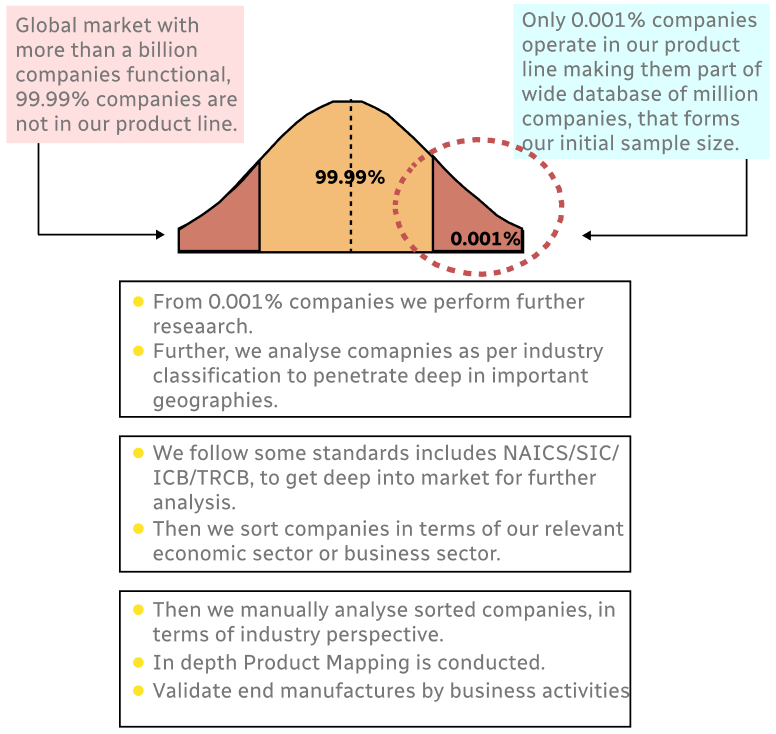
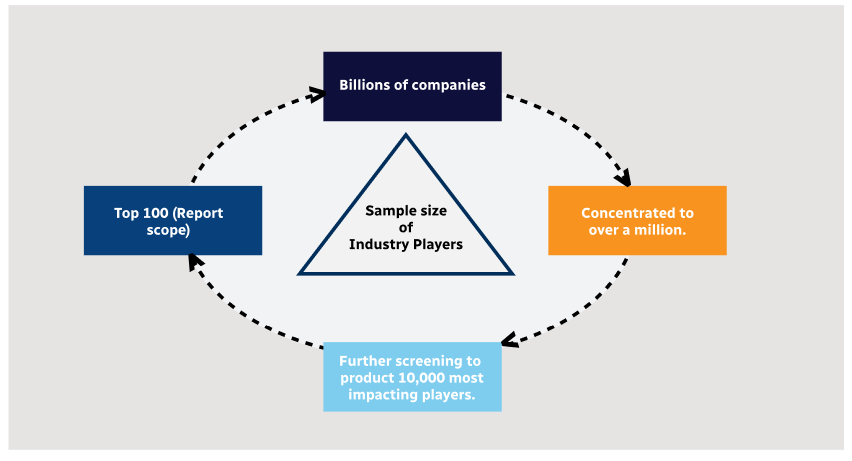
Step 1 - Identification of Relevant Samples Size from Population Database
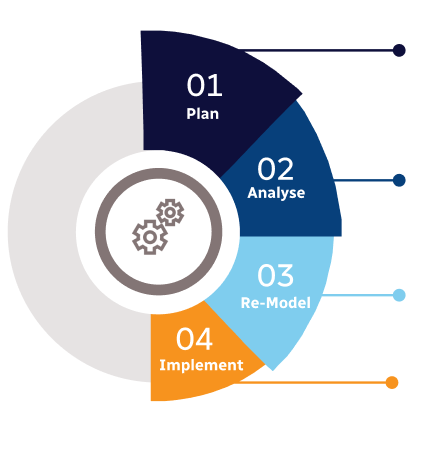
Step 2 - Approaches for Defining Global Market Size (Value, Volume* & Price*)
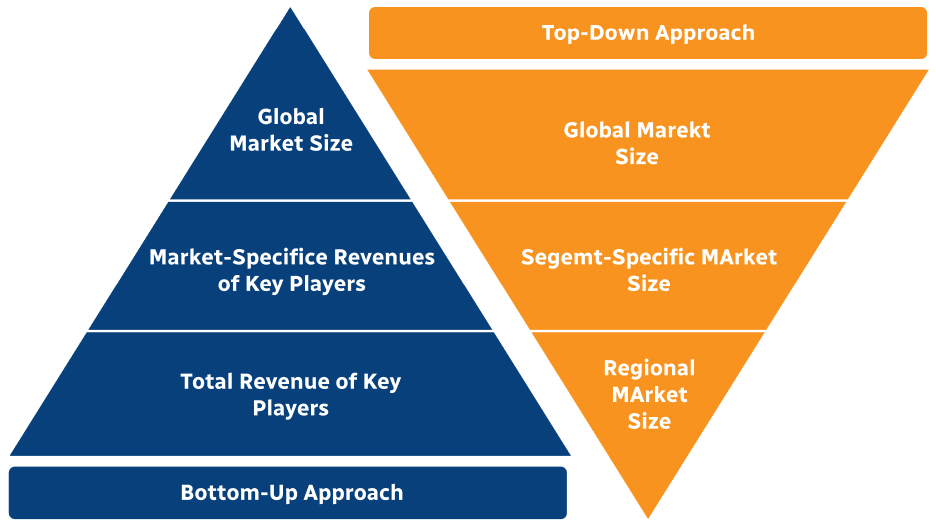
Note*: In applicable scenarios
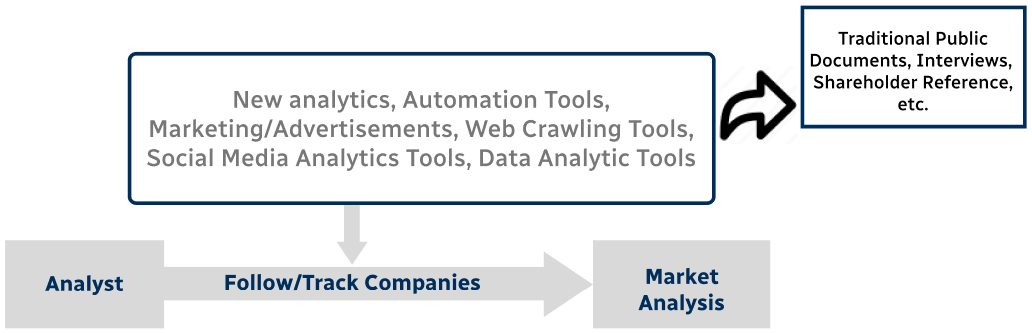
Step 3 - Data Sources
Primary Research
- Web Analytics
- Survey Reports
- Research Institute
- Latest Research Reports
- Opinion Leaders
Secondary Research
- Annual Reports
- White Paper
- Latest Press Release
- Industry Association
- Paid Database
- Investor Presentations
Step 4 - Data Triangulation
Involves using different sources of information in order to increase the validity of a study
These sources are likely to be stakeholders in a program - participants, other researchers, program staff, other community members, and so on.
Then we put all data in single framework & apply various statistical tools to find out the dynamic on the market.
During the analysis stage, feedback from the stakeholder groups would be compared to determine areas of agreement as well as areas of divergence