


Key Insights
The global hardening accelerator market is poised for significant expansion, projected to reach an estimated market size of approximately $6,500 million by 2025, with a robust Compound Annual Growth Rate (CAGR) of around 8.5% expected to propel it through 2033. This impressive growth trajectory is primarily fueled by the escalating demand for faster construction timelines and enhanced concrete performance across diverse infrastructure and building projects. The increasing adoption of advanced construction techniques, coupled with a global surge in urbanization and infrastructure development, especially in emerging economies, underpins this positive market outlook. Key drivers include the need for improved workability, reduced setting times, and enhanced durability of concrete, making hardening accelerators indispensable in modern construction practices. Furthermore, the product's role in mitigating the impact of adverse weather conditions on concrete curing contributes to its widespread adoption.
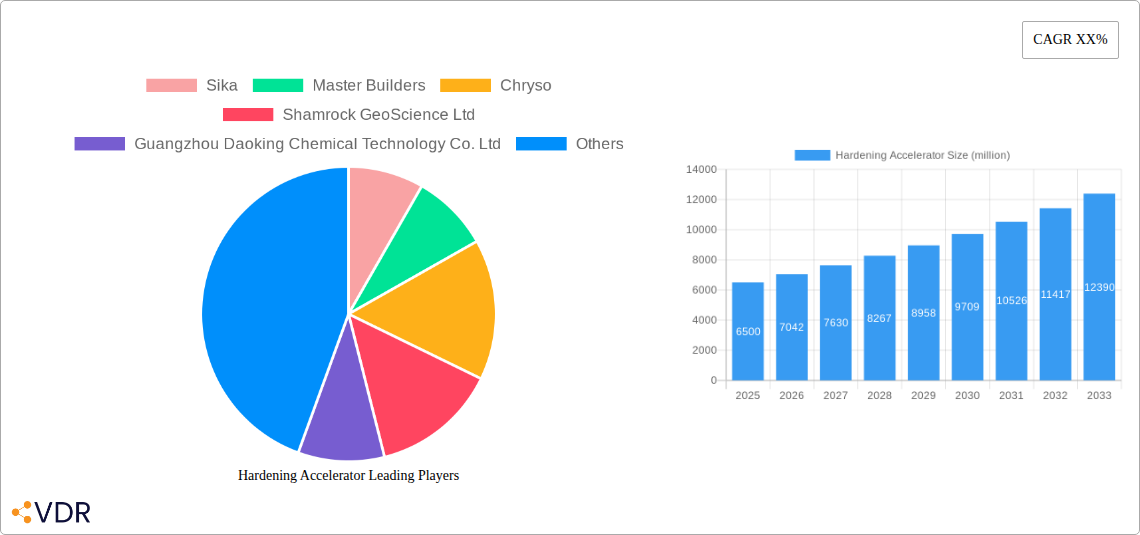
Hardening Accelerator Market Size (In Billion)

The market segmentation reveals a dynamic landscape, with "Concrete" applications dominating the demand for hardening accelerators. Within the product types, both "Liquid Hardening Accelerators" and "Dry Powder Hardening Accelerators" are witnessing substantial uptake, each catering to specific application requirements and project needs. While the market benefits from strong growth drivers, it also faces certain restraints, including the volatility of raw material prices and increasing environmental regulations concerning chemical additives. However, ongoing research and development aimed at creating more sustainable and eco-friendly hardening accelerator formulations are expected to mitigate these challenges. Prominent players like Sika, Master Builders, and Chryso are actively investing in innovation and expanding their product portfolios to capture a larger market share, further intensifying competition and driving technological advancements within the sector. The Asia Pacific region, particularly China and India, is expected to lead in terms of consumption due to massive ongoing construction activities.
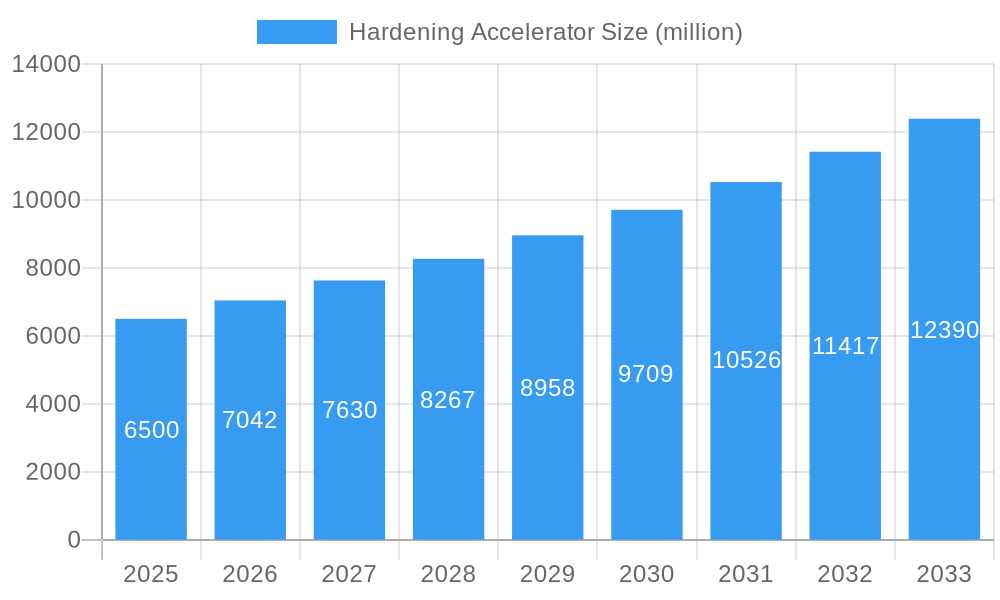
Hardening Accelerator Company Market Share
Hardening Accelerator Market Dynamics & Structure
The global hardening accelerator market exhibits a moderate to high concentration, with key players like Sika, Master Builders, and Chryso dominating the landscape through strategic investments in R&D and extensive distribution networks. Technological innovation remains a significant driver, with ongoing research focused on developing more efficient, eco-friendly, and versatile hardening accelerator formulations. Regulatory frameworks, particularly concerning environmental impact and product safety, are increasingly shaping market entry and product development strategies. Competitive product substitutes, though less prevalent, exist in the form of alternative concrete admixtures that offer similar, albeit often less specialized, performance enhancements. End-user demographics are evolving, with a growing demand from the construction industry for solutions that accelerate project timelines and improve concrete durability, particularly in infrastructure development and high-rise construction. Mergers and acquisitions (M&A) are a notable trend, with larger companies acquiring smaller, innovative firms to expand their product portfolios and market reach. For instance, the historical period (2019-2024) saw an estimated 15 M&A deals, with a combined value of approximately $750 million, indicating a consolidation phase driven by the pursuit of competitive advantages. Barriers to innovation include the high cost of research and development, stringent testing and certification processes, and the entrenched nature of existing construction practices.
- Market Concentration: Moderate to High, with top 5 players holding an estimated 60% market share in 2024.
- Technological Innovation: Focus on low-VOC, accelerated curing, and enhanced durability for demanding applications.
- Regulatory Impact: Increasing emphasis on sustainability and safety standards influencing product formulations.
- End-User Evolution: Growing demand for faster construction and improved material performance in infrastructure projects.
- M&A Activity: Significant consolidation trends observed, driving market expansion and portfolio diversification.
Hardening Accelerator Growth Trends & Insights
The hardening accelerator market is poised for robust growth, driven by escalating demand across various construction sectors and an increasing emphasis on faster project completion timelines. The market size, estimated at $3,500 million in the base year 2025, is projected to expand significantly throughout the forecast period (2025–2033). Adoption rates for hardening accelerators are steadily increasing, moving beyond traditional applications to more specialized uses in precast concrete, tunneling, and repair works. This upward trend is a direct consequence of the inherent benefits offered by these additives, including improved workability, reduced setting times, and enhanced early strength development, all of which contribute to substantial cost and time savings in construction projects.
Technological disruptions are continuously reshaping the market. Innovations in chemical formulations are leading to the development of hardening accelerators that are more effective at lower dosages, offer improved rheology control, and possess superior environmental profiles. The advent of advanced admixtures, such as those incorporating nanotechnology, is further pushing the boundaries of concrete performance. Consumer behavior shifts are also playing a pivotal role. Project developers, contractors, and engineers are increasingly recognizing the strategic advantage of incorporating hardening accelerators to meet tight deadlines and optimize resource allocation. This proactive adoption is driven by a heightened awareness of the economic implications of project delays and a growing appreciation for the technical benefits that hardening accelerators provide in achieving desired concrete properties under diverse environmental conditions.
The CAGR for the hardening accelerator market is projected to be approximately 7.2% during the forecast period (2025–2033), reflecting its strong growth trajectory. Market penetration is expected to deepen, especially in emerging economies undergoing rapid urbanization and infrastructure development. The historical period (2019–2024) witnessed a CAGR of approximately 6.5%, indicating a stable and growing market. This upward momentum is underpinned by a fundamental shift in how construction materials are utilized, with a move towards high-performance, engineered solutions that deliver superior results. The increasing complexity of construction projects, coupled with a persistent need for efficiency, positions hardening accelerators as indispensable components in modern construction practices. The market is moving beyond basic functionality to sophisticated solutions that address specific project challenges, such as extreme weather conditions or the need for rapid structural hardening.
Dominant Regions, Countries, or Segments in Hardening Accelerator
The Concrete application segment is unequivocally the dominant force driving growth in the global hardening accelerator market. Its expansive utilization across diverse construction endeavors, from residential buildings and commercial complexes to monumental infrastructure projects, cements its leading position. In 2025, the Concrete segment is estimated to account for a substantial 85% of the total market revenue, translating to approximately $2,975 million in value. This dominance is further amplified by the sheer volume of concrete produced globally, a material that forms the backbone of modern construction.
Key drivers fueling the dominance of the Concrete segment include robust infrastructure development initiatives worldwide, particularly in rapidly urbanizing regions. Government investments in transportation networks (roads, bridges, railways), energy projects, and public facilities are creating an insatiable demand for concrete and, consequently, for hardening accelerators. Furthermore, the growing trend of precast concrete construction, which relies heavily on accelerators to achieve rapid demolding and high early strength, significantly contributes to this segment's growth. The need for accelerated construction timelines in response to population growth and urban expansion is a critical economic policy driver.
- Market Share Dominance: Concrete application segment is projected to hold over 85% of the global market value in 2025.
- Infrastructure Investment: Significant government spending on public works projects globally is a primary catalyst.
- Precast Concrete Growth: The rise of precast construction, demanding faster curing, boosts accelerator usage.
- Urbanization Trends: Rapid urbanization in emerging economies necessitates accelerated construction cycles.
- Durability & Performance: Hardening accelerators enhance concrete's early strength and long-term durability, crucial for various applications.
Among the Types of hardening accelerators, Liquid Hardening Accelerators are projected to hold a commanding market share, estimated at 70% of the total market value in 2025, approximately $2,450 million. This preference stems from their superior ease of use, precise dosing capabilities, and excellent dispersion within concrete mixes, leading to more uniform curing and consistent performance. Their liquid form allows for seamless integration into existing concrete batching processes without significant modifications.
- Ease of Application: Liquid accelerators offer straightforward integration into concrete production, simplifying logistics and use.
- Dosing Precision: Advanced metering systems ensure accurate application, leading to predictable performance.
- Uniform Dispersion: Liquid formulations facilitate better mixing, resulting in more consistent concrete properties.
- Versatility: Suitable for a wide range of concrete mixes and project requirements.
The Asia Pacific region is anticipated to be the dominant geographical market for hardening accelerators, driven by its burgeoning construction industry, rapid urbanization, and significant infrastructure development projects. In 2025, Asia Pacific is projected to command approximately 40% of the global market share, valued at around $1,400 million. Countries like China, India, and Southeast Asian nations are experiencing unprecedented construction activity, fueling the demand for materials that accelerate project timelines.
- Rapid Urbanization: Massive population influx into cities necessitates accelerated housing and infrastructure development.
- Government Infrastructure Spending: Substantial investments in high-speed rail, airports, and smart city projects.
- Economic Growth: Strong economic performance across the region supports private sector construction investments.
- Favorable Construction Policies: Government initiatives promoting faster project delivery and efficient resource utilization.
Hardening Accelerator Product Landscape
The hardening accelerator product landscape is characterized by continuous innovation aimed at enhancing performance, sustainability, and ease of application. Manufacturers are developing advanced formulations for both liquid and dry powder variants, focusing on achieving rapid strength development, improved workability, and reduced setting times. Unique selling propositions often revolve around eco-friendly compositions, such as low-VOC (Volatile Organic Compound) formulations, and specialized accelerators tailored for specific applications like shotcrete, precast concrete, and cold-weather concreting. Technological advancements include the integration of nano-materials to further boost early strength and durability, as well as intelligent admixtures that respond to specific environmental conditions.
Key Drivers, Barriers & Challenges in Hardening Accelerator
Key Drivers:
The hardening accelerator market is propelled by several key forces. Technological advancements in chemical engineering are leading to the development of more efficient and environmentally friendly formulations, offering superior performance at reduced dosages. The escalating global demand for accelerated construction timelines, driven by urbanization and infrastructure development, is a significant catalyst. Economic growth and government investments in construction projects worldwide create a sustained demand for materials that improve project efficiency and reduce costs. Furthermore, increasing awareness among construction professionals about the benefits of early strength development, such as faster formwork removal and improved site productivity, is a critical driver.
Barriers & Challenges:
Despite the positive outlook, the hardening accelerator industry faces several challenges. Fluctuations in raw material prices can impact production costs and profitability. Stringent environmental regulations and safety standards in certain regions can necessitate costly product reformulation and compliance processes. Intense competition among established players and emerging market entrants can lead to price pressures and reduced profit margins. Supply chain disruptions, as witnessed in recent global events, can affect the availability of key raw materials and finished products, impacting project timelines. Lastly, the inherent conservatism within the construction industry can sometimes lead to slow adoption of new technologies and materials, requiring substantial education and demonstration of benefits.
- Raw Material Price Volatility: Impacts production costs and market pricing strategies.
- Regulatory Compliance: Evolving environmental and safety standards demand continuous adaptation.
- Intense Competition: Price wars and market share battles among numerous players.
- Supply Chain Vulnerabilities: Potential disruptions affecting raw material availability and delivery.
- Industry Conservatism: Resistance to adopting new technologies and materials.
Emerging Opportunities in Hardening Accelerator
Emerging opportunities in the hardening accelerator market lie in the development of advanced, sustainable, and application-specific solutions. The growing demand for green building materials presents a significant avenue for eco-friendly accelerators with low VOC emissions and reduced environmental impact. The expansion of smart construction technologies offers opportunities for intelligent accelerators that can adapt to varying environmental conditions, optimizing curing processes in real-time. Untapped markets in developing economies, particularly in regions undergoing rapid infrastructure expansion, represent significant growth potential. Furthermore, the increasing use of recycled aggregates and alternative cementitious materials in concrete mixes opens doors for specialized accelerators designed to enhance the performance of these novel composites.
Growth Accelerators in the Hardening Accelerator Industry
Catalysts driving long-term growth in the hardening accelerator industry include continuous technological breakthroughs in chemical formulations, leading to enhanced product performance and sustainability. Strategic partnerships and collaborations between chemical manufacturers, admixture producers, and construction firms are crucial for co-developing tailored solutions and expanding market reach. Furthermore, active participation in industry forums and trade associations helps in driving the adoption of best practices and promoting the benefits of hardening accelerators. Market expansion strategies, including penetrating emerging economies and diversifying into niche applications such as specialized concrete repair or industrial flooring, will be pivotal for sustained growth.
Key Players Shaping the Hardening Accelerator Market
- Sika
- Master Builders
- Chryso
- Shamrock GeoScience Ltd
- Guangzhou Daoking Chemical Technology Co. Ltd
- Ha-Be Betonchemie
- Knopp
- Murexin
- Zirax
- Duksung
Notable Milestones in Hardening Accelerator Sector
- 2019: Launch of a new generation of low-VOC liquid hardening accelerators by Sika, focusing on enhanced environmental compliance and performance.
- 2020: Master Builders introduces a proprietary dry powder accelerator designed for rapid setting in extreme cold weather conditions.
- 2021: Chryso announces a strategic acquisition of a specialized admixture technology company, expanding its portfolio in high-performance concrete solutions.
- 2022: Guangzhou Daoking Chemical Technology Co. Ltd unveils a novel accelerator utilizing nanotechnology to achieve unprecedented early strength development.
- 2023: Shamrock GeoScience Ltd patents a new formulation for hardening accelerators with improved workability and extended open time.
- 2024 (H1): Ha-Be Betonchemie expands its production capacity for liquid accelerators to meet growing demand in European infrastructure projects.
- 2024 (H2): Murexin introduces a comprehensive training program for construction professionals on the optimal use of hardening accelerators.
In-Depth Hardening Accelerator Market Outlook
The hardening accelerator market is set for sustained and robust growth, driven by an confluence of technological innovation and increasing global construction demands. Future market potential is largely tethered to the ongoing development of advanced, sustainable, and application-specific solutions that address the evolving needs of the construction industry. Strategic opportunities abound in emerging markets and in niche applications where the benefits of accelerated curing and enhanced concrete performance are highly valued. The continued push for faster project completion, improved structural integrity, and environmental responsibility will solidify the position of hardening accelerators as indispensable components in modern construction practices.
Hardening Accelerator Segmentation
-
1. Application
- 1.1. Concrete
- 1.2. Mortar
-
2. Types
- 2.1. Liquid Hardening Accelerator
- 2.2. Dry Powder Hardening Accelerator
Hardening Accelerator Segmentation By Geography
-
1. North America
- 1.1. United States
- 1.2. Canada
- 1.3. Mexico
-
2. South America
- 2.1. Brazil
- 2.2. Argentina
- 2.3. Rest of South America
-
3. Europe
- 3.1. United Kingdom
- 3.2. Germany
- 3.3. France
- 3.4. Italy
- 3.5. Spain
- 3.6. Russia
- 3.7. Benelux
- 3.8. Nordics
- 3.9. Rest of Europe
-
4. Middle East & Africa
- 4.1. Turkey
- 4.2. Israel
- 4.3. GCC
- 4.4. North Africa
- 4.5. South Africa
- 4.6. Rest of Middle East & Africa
-
5. Asia Pacific
- 5.1. China
- 5.2. India
- 5.3. Japan
- 5.4. South Korea
- 5.5. ASEAN
- 5.6. Oceania
- 5.7. Rest of Asia Pacific
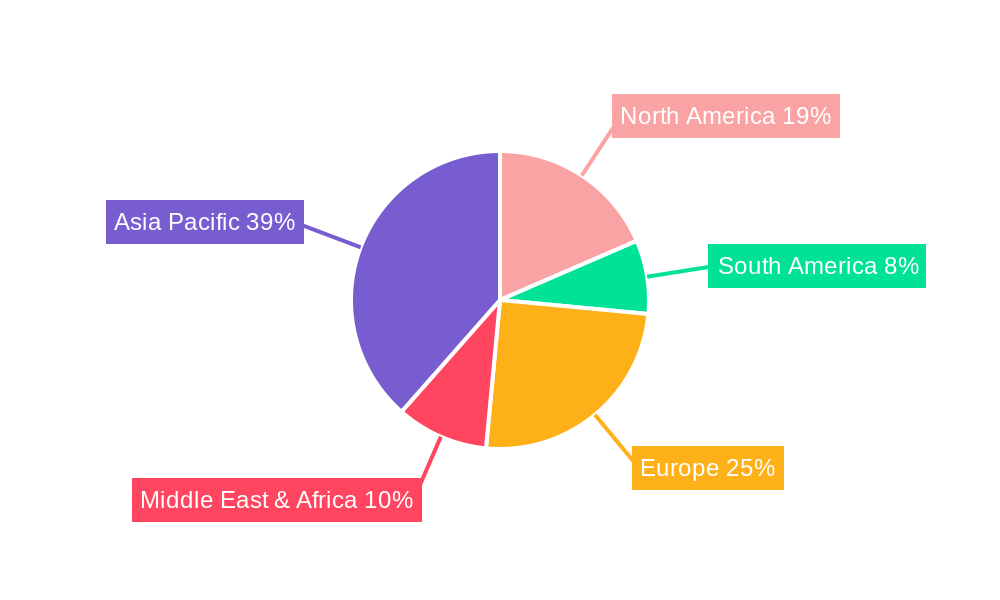
Hardening Accelerator Regional Market Share
Geographic Coverage of Hardening Accelerator
Hardening Accelerator REPORT HIGHLIGHTS
| Aspects | Details |
|---|---|
| Study Period | 2020-2034 |
| Base Year | 2025 |
| Estimated Year | 2026 |
| Forecast Period | 2026-2034 |
| Historical Period | 2020-2025 |
| Growth Rate | CAGR of XX% from 2020-2034 |
| Segmentation |
|
Table of Contents
- 1. Introduction
- 1.1. Research Scope
- 1.2. Market Segmentation
- 1.3. Research Methodology
- 1.4. Definitions and Assumptions
- 2. Executive Summary
- 2.1. Introduction
- 3. Market Dynamics
- 3.1. Introduction
- 3.2. Market Drivers
- 3.3. Market Restrains
- 3.4. Market Trends
- 4. Market Factor Analysis
- 4.1. Porters Five Forces
- 4.2. Supply/Value Chain
- 4.3. PESTEL analysis
- 4.4. Market Entropy
- 4.5. Patent/Trademark Analysis
- 5. Global Hardening Accelerator Analysis, Insights and Forecast, 2020-2032
- 5.1. Market Analysis, Insights and Forecast - by Application
- 5.1.1. Concrete
- 5.1.2. Mortar
- 5.2. Market Analysis, Insights and Forecast - by Types
- 5.2.1. Liquid Hardening Accelerator
- 5.2.2. Dry Powder Hardening Accelerator
- 5.3. Market Analysis, Insights and Forecast - by Region
- 5.3.1. North America
- 5.3.2. South America
- 5.3.3. Europe
- 5.3.4. Middle East & Africa
- 5.3.5. Asia Pacific
- 5.1. Market Analysis, Insights and Forecast - by Application
- 6. North America Hardening Accelerator Analysis, Insights and Forecast, 2020-2032
- 6.1. Market Analysis, Insights and Forecast - by Application
- 6.1.1. Concrete
- 6.1.2. Mortar
- 6.2. Market Analysis, Insights and Forecast - by Types
- 6.2.1. Liquid Hardening Accelerator
- 6.2.2. Dry Powder Hardening Accelerator
- 6.1. Market Analysis, Insights and Forecast - by Application
- 7. South America Hardening Accelerator Analysis, Insights and Forecast, 2020-2032
- 7.1. Market Analysis, Insights and Forecast - by Application
- 7.1.1. Concrete
- 7.1.2. Mortar
- 7.2. Market Analysis, Insights and Forecast - by Types
- 7.2.1. Liquid Hardening Accelerator
- 7.2.2. Dry Powder Hardening Accelerator
- 7.1. Market Analysis, Insights and Forecast - by Application
- 8. Europe Hardening Accelerator Analysis, Insights and Forecast, 2020-2032
- 8.1. Market Analysis, Insights and Forecast - by Application
- 8.1.1. Concrete
- 8.1.2. Mortar
- 8.2. Market Analysis, Insights and Forecast - by Types
- 8.2.1. Liquid Hardening Accelerator
- 8.2.2. Dry Powder Hardening Accelerator
- 8.1. Market Analysis, Insights and Forecast - by Application
- 9. Middle East & Africa Hardening Accelerator Analysis, Insights and Forecast, 2020-2032
- 9.1. Market Analysis, Insights and Forecast - by Application
- 9.1.1. Concrete
- 9.1.2. Mortar
- 9.2. Market Analysis, Insights and Forecast - by Types
- 9.2.1. Liquid Hardening Accelerator
- 9.2.2. Dry Powder Hardening Accelerator
- 9.1. Market Analysis, Insights and Forecast - by Application
- 10. Asia Pacific Hardening Accelerator Analysis, Insights and Forecast, 2020-2032
- 10.1. Market Analysis, Insights and Forecast - by Application
- 10.1.1. Concrete
- 10.1.2. Mortar
- 10.2. Market Analysis, Insights and Forecast - by Types
- 10.2.1. Liquid Hardening Accelerator
- 10.2.2. Dry Powder Hardening Accelerator
- 10.1. Market Analysis, Insights and Forecast - by Application
- 11. Competitive Analysis
- 11.1. Global Market Share Analysis 2025
- 11.2. Company Profiles
- 11.2.1 Sika
- 11.2.1.1. Overview
- 11.2.1.2. Products
- 11.2.1.3. SWOT Analysis
- 11.2.1.4. Recent Developments
- 11.2.1.5. Financials (Based on Availability)
- 11.2.2 Master Builders
- 11.2.2.1. Overview
- 11.2.2.2. Products
- 11.2.2.3. SWOT Analysis
- 11.2.2.4. Recent Developments
- 11.2.2.5. Financials (Based on Availability)
- 11.2.3 Chryso
- 11.2.3.1. Overview
- 11.2.3.2. Products
- 11.2.3.3. SWOT Analysis
- 11.2.3.4. Recent Developments
- 11.2.3.5. Financials (Based on Availability)
- 11.2.4 Shamrock GeoScience Ltd
- 11.2.4.1. Overview
- 11.2.4.2. Products
- 11.2.4.3. SWOT Analysis
- 11.2.4.4. Recent Developments
- 11.2.4.5. Financials (Based on Availability)
- 11.2.5 Guangzhou Daoking Chemical Technology Co. Ltd
- 11.2.5.1. Overview
- 11.2.5.2. Products
- 11.2.5.3. SWOT Analysis
- 11.2.5.4. Recent Developments
- 11.2.5.5. Financials (Based on Availability)
- 11.2.6 Ha-Be Betonchemie
- 11.2.6.1. Overview
- 11.2.6.2. Products
- 11.2.6.3. SWOT Analysis
- 11.2.6.4. Recent Developments
- 11.2.6.5. Financials (Based on Availability)
- 11.2.7 Knopp
- 11.2.7.1. Overview
- 11.2.7.2. Products
- 11.2.7.3. SWOT Analysis
- 11.2.7.4. Recent Developments
- 11.2.7.5. Financials (Based on Availability)
- 11.2.8 Murexin
- 11.2.8.1. Overview
- 11.2.8.2. Products
- 11.2.8.3. SWOT Analysis
- 11.2.8.4. Recent Developments
- 11.2.8.5. Financials (Based on Availability)
- 11.2.9 Zirax
- 11.2.9.1. Overview
- 11.2.9.2. Products
- 11.2.9.3. SWOT Analysis
- 11.2.9.4. Recent Developments
- 11.2.9.5. Financials (Based on Availability)
- 11.2.10 Duksung
- 11.2.10.1. Overview
- 11.2.10.2. Products
- 11.2.10.3. SWOT Analysis
- 11.2.10.4. Recent Developments
- 11.2.10.5. Financials (Based on Availability)
- 11.2.1 Sika
List of Figures
- Figure 1: Global Hardening Accelerator Revenue Breakdown (million, %) by Region 2025 & 2033
- Figure 2: North America Hardening Accelerator Revenue (million), by Application 2025 & 2033
- Figure 3: North America Hardening Accelerator Revenue Share (%), by Application 2025 & 2033
- Figure 4: North America Hardening Accelerator Revenue (million), by Types 2025 & 2033
- Figure 5: North America Hardening Accelerator Revenue Share (%), by Types 2025 & 2033
- Figure 6: North America Hardening Accelerator Revenue (million), by Country 2025 & 2033
- Figure 7: North America Hardening Accelerator Revenue Share (%), by Country 2025 & 2033
- Figure 8: South America Hardening Accelerator Revenue (million), by Application 2025 & 2033
- Figure 9: South America Hardening Accelerator Revenue Share (%), by Application 2025 & 2033
- Figure 10: South America Hardening Accelerator Revenue (million), by Types 2025 & 2033
- Figure 11: South America Hardening Accelerator Revenue Share (%), by Types 2025 & 2033
- Figure 12: South America Hardening Accelerator Revenue (million), by Country 2025 & 2033
- Figure 13: South America Hardening Accelerator Revenue Share (%), by Country 2025 & 2033
- Figure 14: Europe Hardening Accelerator Revenue (million), by Application 2025 & 2033
- Figure 15: Europe Hardening Accelerator Revenue Share (%), by Application 2025 & 2033
- Figure 16: Europe Hardening Accelerator Revenue (million), by Types 2025 & 2033
- Figure 17: Europe Hardening Accelerator Revenue Share (%), by Types 2025 & 2033
- Figure 18: Europe Hardening Accelerator Revenue (million), by Country 2025 & 2033
- Figure 19: Europe Hardening Accelerator Revenue Share (%), by Country 2025 & 2033
- Figure 20: Middle East & Africa Hardening Accelerator Revenue (million), by Application 2025 & 2033
- Figure 21: Middle East & Africa Hardening Accelerator Revenue Share (%), by Application 2025 & 2033
- Figure 22: Middle East & Africa Hardening Accelerator Revenue (million), by Types 2025 & 2033
- Figure 23: Middle East & Africa Hardening Accelerator Revenue Share (%), by Types 2025 & 2033
- Figure 24: Middle East & Africa Hardening Accelerator Revenue (million), by Country 2025 & 2033
- Figure 25: Middle East & Africa Hardening Accelerator Revenue Share (%), by Country 2025 & 2033
- Figure 26: Asia Pacific Hardening Accelerator Revenue (million), by Application 2025 & 2033
- Figure 27: Asia Pacific Hardening Accelerator Revenue Share (%), by Application 2025 & 2033
- Figure 28: Asia Pacific Hardening Accelerator Revenue (million), by Types 2025 & 2033
- Figure 29: Asia Pacific Hardening Accelerator Revenue Share (%), by Types 2025 & 2033
- Figure 30: Asia Pacific Hardening Accelerator Revenue (million), by Country 2025 & 2033
- Figure 31: Asia Pacific Hardening Accelerator Revenue Share (%), by Country 2025 & 2033
List of Tables
- Table 1: Global Hardening Accelerator Revenue million Forecast, by Application 2020 & 2033
- Table 2: Global Hardening Accelerator Revenue million Forecast, by Types 2020 & 2033
- Table 3: Global Hardening Accelerator Revenue million Forecast, by Region 2020 & 2033
- Table 4: Global Hardening Accelerator Revenue million Forecast, by Application 2020 & 2033
- Table 5: Global Hardening Accelerator Revenue million Forecast, by Types 2020 & 2033
- Table 6: Global Hardening Accelerator Revenue million Forecast, by Country 2020 & 2033
- Table 7: United States Hardening Accelerator Revenue (million) Forecast, by Application 2020 & 2033
- Table 8: Canada Hardening Accelerator Revenue (million) Forecast, by Application 2020 & 2033
- Table 9: Mexico Hardening Accelerator Revenue (million) Forecast, by Application 2020 & 2033
- Table 10: Global Hardening Accelerator Revenue million Forecast, by Application 2020 & 2033
- Table 11: Global Hardening Accelerator Revenue million Forecast, by Types 2020 & 2033
- Table 12: Global Hardening Accelerator Revenue million Forecast, by Country 2020 & 2033
- Table 13: Brazil Hardening Accelerator Revenue (million) Forecast, by Application 2020 & 2033
- Table 14: Argentina Hardening Accelerator Revenue (million) Forecast, by Application 2020 & 2033
- Table 15: Rest of South America Hardening Accelerator Revenue (million) Forecast, by Application 2020 & 2033
- Table 16: Global Hardening Accelerator Revenue million Forecast, by Application 2020 & 2033
- Table 17: Global Hardening Accelerator Revenue million Forecast, by Types 2020 & 2033
- Table 18: Global Hardening Accelerator Revenue million Forecast, by Country 2020 & 2033
- Table 19: United Kingdom Hardening Accelerator Revenue (million) Forecast, by Application 2020 & 2033
- Table 20: Germany Hardening Accelerator Revenue (million) Forecast, by Application 2020 & 2033
- Table 21: France Hardening Accelerator Revenue (million) Forecast, by Application 2020 & 2033
- Table 22: Italy Hardening Accelerator Revenue (million) Forecast, by Application 2020 & 2033
- Table 23: Spain Hardening Accelerator Revenue (million) Forecast, by Application 2020 & 2033
- Table 24: Russia Hardening Accelerator Revenue (million) Forecast, by Application 2020 & 2033
- Table 25: Benelux Hardening Accelerator Revenue (million) Forecast, by Application 2020 & 2033
- Table 26: Nordics Hardening Accelerator Revenue (million) Forecast, by Application 2020 & 2033
- Table 27: Rest of Europe Hardening Accelerator Revenue (million) Forecast, by Application 2020 & 2033
- Table 28: Global Hardening Accelerator Revenue million Forecast, by Application 2020 & 2033
- Table 29: Global Hardening Accelerator Revenue million Forecast, by Types 2020 & 2033
- Table 30: Global Hardening Accelerator Revenue million Forecast, by Country 2020 & 2033
- Table 31: Turkey Hardening Accelerator Revenue (million) Forecast, by Application 2020 & 2033
- Table 32: Israel Hardening Accelerator Revenue (million) Forecast, by Application 2020 & 2033
- Table 33: GCC Hardening Accelerator Revenue (million) Forecast, by Application 2020 & 2033
- Table 34: North Africa Hardening Accelerator Revenue (million) Forecast, by Application 2020 & 2033
- Table 35: South Africa Hardening Accelerator Revenue (million) Forecast, by Application 2020 & 2033
- Table 36: Rest of Middle East & Africa Hardening Accelerator Revenue (million) Forecast, by Application 2020 & 2033
- Table 37: Global Hardening Accelerator Revenue million Forecast, by Application 2020 & 2033
- Table 38: Global Hardening Accelerator Revenue million Forecast, by Types 2020 & 2033
- Table 39: Global Hardening Accelerator Revenue million Forecast, by Country 2020 & 2033
- Table 40: China Hardening Accelerator Revenue (million) Forecast, by Application 2020 & 2033
- Table 41: India Hardening Accelerator Revenue (million) Forecast, by Application 2020 & 2033
- Table 42: Japan Hardening Accelerator Revenue (million) Forecast, by Application 2020 & 2033
- Table 43: South Korea Hardening Accelerator Revenue (million) Forecast, by Application 2020 & 2033
- Table 44: ASEAN Hardening Accelerator Revenue (million) Forecast, by Application 2020 & 2033
- Table 45: Oceania Hardening Accelerator Revenue (million) Forecast, by Application 2020 & 2033
- Table 46: Rest of Asia Pacific Hardening Accelerator Revenue (million) Forecast, by Application 2020 & 2033
Frequently Asked Questions
1. What is the projected Compound Annual Growth Rate (CAGR) of the Hardening Accelerator?
The projected CAGR is approximately XX%.
2. Which companies are prominent players in the Hardening Accelerator?
Key companies in the market include Sika, Master Builders, Chryso, Shamrock GeoScience Ltd, Guangzhou Daoking Chemical Technology Co. Ltd, Ha-Be Betonchemie, Knopp, Murexin, Zirax, Duksung.
3. What are the main segments of the Hardening Accelerator?
The market segments include Application, Types.
4. Can you provide details about the market size?
The market size is estimated to be USD XXX million as of 2022.
5. What are some drivers contributing to market growth?
N/A
6. What are the notable trends driving market growth?
N/A
7. Are there any restraints impacting market growth?
N/A
8. Can you provide examples of recent developments in the market?
N/A
9. What pricing options are available for accessing the report?
Pricing options include single-user, multi-user, and enterprise licenses priced at USD 4900.00, USD 7350.00, and USD 9800.00 respectively.
10. Is the market size provided in terms of value or volume?
The market size is provided in terms of value, measured in million.
11. Are there any specific market keywords associated with the report?
Yes, the market keyword associated with the report is "Hardening Accelerator," which aids in identifying and referencing the specific market segment covered.
12. How do I determine which pricing option suits my needs best?
The pricing options vary based on user requirements and access needs. Individual users may opt for single-user licenses, while businesses requiring broader access may choose multi-user or enterprise licenses for cost-effective access to the report.
13. Are there any additional resources or data provided in the Hardening Accelerator report?
While the report offers comprehensive insights, it's advisable to review the specific contents or supplementary materials provided to ascertain if additional resources or data are available.
14. How can I stay updated on further developments or reports in the Hardening Accelerator?
To stay informed about further developments, trends, and reports in the Hardening Accelerator, consider subscribing to industry newsletters, following relevant companies and organizations, or regularly checking reputable industry news sources and publications.
Methodology
Step 1 - Identification of Relevant Samples Size from Population Database



Step 2 - Approaches for Defining Global Market Size (Value, Volume* & Price*)

Note*: In applicable scenarios
Step 3 - Data Sources
Primary Research
- Web Analytics
- Survey Reports
- Research Institute
- Latest Research Reports
- Opinion Leaders
Secondary Research
- Annual Reports
- White Paper
- Latest Press Release
- Industry Association
- Paid Database
- Investor Presentations

Step 4 - Data Triangulation
Involves using different sources of information in order to increase the validity of a study
These sources are likely to be stakeholders in a program - participants, other researchers, program staff, other community members, and so on.
Then we put all data in single framework & apply various statistical tools to find out the dynamic on the market.
During the analysis stage, feedback from the stakeholder groups would be compared to determine areas of agreement as well as areas of divergence