


Key Insights
The global Cell Cycle Assay Kit market is poised for significant expansion, driven by escalating research and development activities across the pharmaceutical, biotechnology, and academic sectors. Projected to reach a substantial market size, the sector is expected to witness a robust Compound Annual Growth Rate (CAGR) over the forecast period. This growth is primarily fueled by the increasing demand for novel drug discovery and development, particularly in oncology, where understanding cell cycle progression is paramount for targeting cancerous cells. Furthermore, advancements in fluorescence microscopy and flow cytometry technologies are enhancing the precision and efficiency of cell cycle analysis, thereby expanding the utility and adoption of these kits. The growing emphasis on personalized medicine and the need for accurate diagnostic tools are also contributing to the market's upward trajectory.
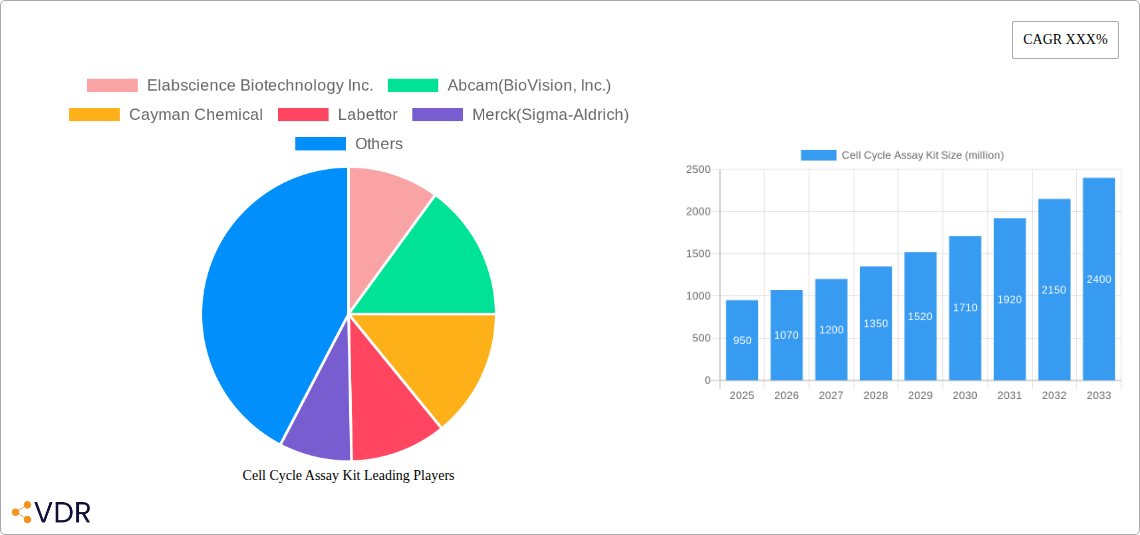
Cell Cycle Assay Kit Market Size (In Million)

The market is segmented by application and type, with laboratories, institutes of biology, and pharmaceutical companies representing key end-users. The demand for both green and red fluorescence-based kits is substantial, catering to diverse research methodologies and experimental requirements. However, the "Others" category, potentially encompassing novel detection methods or multi-parametric assays, might represent a nascent but rapidly growing segment. Geographically, North America and Europe are expected to remain dominant markets due to well-established research infrastructures and significant investments in life sciences. The Asia Pacific region is anticipated to exhibit the fastest growth, propelled by increasing R&D spending, a burgeoning biopharmaceutical industry, and a growing number of research institutions in countries like China and India. Restraints might include the high cost of advanced assay kits and the need for specialized equipment, but ongoing innovation and a growing understanding of cellular mechanisms are expected to mitigate these challenges.
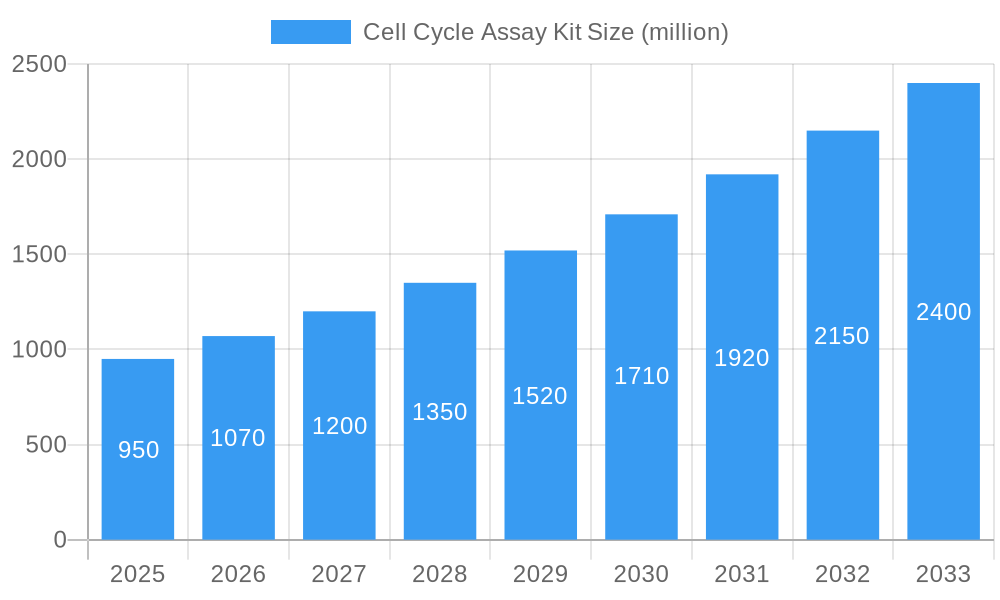
Cell Cycle Assay Kit Company Market Share
Cell Cycle Assay Kit Market Dynamics & Structure
The global Cell Cycle Assay Kit market is characterized by a moderately concentrated structure, with key players like Thermo Fisher Scientific, Merck (Sigma-Aldrich), and Abcam (BioVision, Inc.) holding significant market shares, estimated to be around 25-30% combined. Technological innovation is a primary driver, with ongoing advancements in fluorescent dyes and detection methods enhancing assay sensitivity and specificity. Regulatory frameworks, while generally supportive of life science research, can introduce complexities in product validation and market entry for new entrants. Competitive product substitutes include traditional methods like flow cytometry analysis and manual cell counting, but the convenience and speed offered by kits are increasingly favored. End-user demographics are predominantly researchers in academic institutions and pharmaceutical companies, with a growing segment in contract research organizations (CROs). Mergers and acquisitions (M&A) trends are moderate, focusing on consolidating product portfolios and expanding geographical reach.
- Market Concentration: Moderate, with top 3 players holding approximately 25-30% of the market.
- Technological Innovation Drivers: Development of novel fluorescent probes, multiplexing capabilities, and automation-compatible kits.
- Regulatory Frameworks: Primarily driven by product efficacy and safety standards for research use.
- Competitive Product Substitutes: Flow cytometry, manual cell counting, Western blotting.
- End-User Demographics: Academic research laboratories, pharmaceutical R&D, biotechnology firms, CROs.
- M&A Trends: Strategic acquisitions to enhance product portfolios and market access.
Cell Cycle Assay Kit Growth Trends & Insights
The Cell Cycle Assay Kit market is poised for robust growth, projected to expand from an estimated market size of $350 million in 2024 to $620 million by 2033, exhibiting a Compound Annual Growth Rate (CAGR) of approximately 6.5% during the forecast period. This expansion is propelled by increasing investments in drug discovery and development, particularly in oncology and infectious diseases, where cell cycle analysis is a crucial research tool. The adoption rates of these kits are steadily rising across various research settings due to their ease of use, reduced hands-on time, and improved assay reproducibility compared to conventional methods. Technological disruptions, such as the development of more sensitive and specific fluorescent dyes, have significantly enhanced the capabilities of cell cycle assays, enabling researchers to gain deeper insights into cellular processes. Consumer behavior shifts are evident, with researchers increasingly prioritizing kits that offer multiplexing capabilities for simultaneous analysis of multiple cell cycle markers and compatibility with automated high-throughput screening platforms. The growing demand for personalized medicine and targeted therapies further fuels the need for precise cell cycle profiling to understand drug efficacy and resistance mechanisms. Furthermore, the expanding research landscape in emerging economies, coupled with favorable government initiatives promoting scientific research, is contributing significantly to market penetration. The convenience of ready-to-use kits is also a major factor driving adoption, particularly in academic labs with limited resources. The evolution towards greener and more sustainable laboratory practices is also influencing product development, with a growing preference for kits that minimize reagent waste and utilize eco-friendly components. The increasing prevalence of chronic diseases and the continuous pursuit of novel therapeutic interventions are creating an insatiable demand for advanced cell biology tools, making cell cycle assay kits indispensable. The integration of artificial intelligence (AI) and machine learning (ML) in data analysis for cell cycle studies is also a burgeoning trend, promising to unlock even greater insights from experimental data.
Dominant Regions, Countries, or Segments in Cell Cycle Assay Kit
The North America region stands as the dominant force in the global Cell Cycle Assay Kit market, largely propelled by its robust pharmaceutical and biotechnology industries, coupled with significant government funding for life science research. Within North America, the United States spearheads this dominance, boasting a vast network of leading academic institutions, research centers, and pharmaceutical giants heavily invested in drug discovery and development. The Laboratory application segment, encompassing academic research, hospital labs, and private research institutions, forms the bedrock of this market's growth, accounting for an estimated 45% of the total market share. This is followed by Pharmaceutical Companies, which represent a substantial 35% share, driven by their extensive R&D pipelines and the critical role of cell cycle analysis in preclinical and clinical studies. The Institute of Biology segment, while smaller at approximately 20%, contributes significantly to fundamental research and the exploration of cellular mechanisms.
In terms of product type, Green Fluorescence based kits hold a commanding position, estimated at 40% of the market, owing to their broad excitation and emission spectra, high signal-to-noise ratios, and wide compatibility with standard fluorescent microscopes and flow cytometers. Red Fluorescence kits, while also important, capture an estimated 30% of the market, often chosen for their ability to enable multiplexing with green fluorescent probes or for specific applications requiring longer wavelengths. The Others category, including kits utilizing different detection modalities or combined approaches, accounts for the remaining 30%. Key drivers for North American dominance include strong intellectual property protection, a well-established venture capital ecosystem fostering innovation, and a highly skilled scientific workforce. Favorable economic policies and substantial investments in healthcare infrastructure further solidify its leading position. The region's proactive approach to adopting new technologies and its high penetration of advanced research instrumentation ensure a consistent demand for cutting-edge cell cycle assay kits.
Cell Cycle Assay Kit Product Landscape
The Cell Cycle Assay Kit product landscape is characterized by continuous innovation, with manufacturers focusing on enhancing assay sensitivity, specificity, and ease of use. Key advancements include the development of novel fluorescent probes with improved photostability and brightness, enabling more accurate detection of cell cycle phases. Multiplexing capabilities, allowing the simultaneous detection of multiple cell cycle markers or other cellular events, are a significant USP. These kits find widespread application in fundamental cell biology research, drug discovery, toxicology screening, and cancer research. Performance metrics such as high signal-to-noise ratios, low background fluorescence, and excellent correlation with established methods like flow cytometry are crucial selling points. Many kits are now optimized for various detection platforms, including fluorescence microscopy and flow cytometry, and some are designed for high-throughput screening (HTS) applications.
Key Drivers, Barriers & Challenges in Cell Cycle Assay Kit
Key Drivers:
- Growing R&D Investments: Increased funding for drug discovery and development, particularly in oncology, drives demand for cell cycle analysis.
- Advancements in Life Science Research: Expanding understanding of cellular processes fuels the need for precise research tools.
- Technological Innovations: Development of more sensitive and user-friendly fluorescent dyes and assay formats.
- Rising Incidence of Chronic Diseases: Necessitates continuous research into disease mechanisms and therapeutic interventions.
Barriers & Challenges:
- High Cost of Kits: Can be a restraint for smaller research labs or those with limited budgets.
- Need for Specialized Equipment: Some advanced kits may require specific fluorescence microscopes or flow cytometers.
- Competition from Alternative Technologies: Traditional methods like flow cytometry, while more complex, offer flexibility.
- Regulatory Hurdles for Clinical Applications: Kits intended for diagnostic or therapeutic monitoring face stringent regulatory pathways.
- Supply Chain Disruptions: Global events can impact the availability of critical raw materials, affecting production and leading to price fluctuations.
- Emergence of In-House Assay Development: Some well-equipped institutions may opt to develop their own custom assays, reducing reliance on commercial kits.
Emerging Opportunities in Cell Cycle Assay Kit
Emerging opportunities in the Cell Cycle Assay Kit market lie in the development of single-cell analysis kits that can provide high-resolution data on cell cycle progression at the individual cell level. The increasing interest in epigenetic modifications and their role in cell cycle regulation presents an opportunity for kits that can simultaneously assess these markers alongside cell cycle phase. Furthermore, the demand for rapid and point-of-care cell cycle analysis in clinical settings, particularly for cancer diagnostics and treatment monitoring, represents a significant untapped market. Integration with AI-powered image analysis and data interpretation platforms also offers a novel avenue for market expansion, providing researchers with more sophisticated and automated insights. The development of kits for studying cell cycle in 3D cell culture models (e.g., organoids) is also gaining traction due to their improved physiological relevance.
Growth Accelerators in the Cell Cycle Assay Kit Industry
Long-term growth in the Cell Cycle Assay Kit industry is being accelerated by several key catalysts. Technological breakthroughs in fluorescence microscopy and flow cytometry, enabling higher resolution and throughput, directly benefit the adoption of advanced assay kits. Strategic partnerships between kit manufacturers and instrument providers, as well as collaborations with key opinion leaders (KOLs) in academia and industry, are crucial for driving product adoption and market penetration. Furthermore, market expansion strategies targeting emerging economies with rapidly growing life science sectors are opening up new revenue streams. The increasing focus on personalized medicine and targeted therapies creates a sustained demand for precise cell cycle analysis to understand drug responses and optimize treatment regimens. The ongoing development of novel cancer therapies that target cell cycle checkpoints further fuels this demand.
Key Players Shaping the Cell Cycle Assay Kit Market
- Elabscience Biotechnology Inc.
- Abcam
- BioVision, Inc.
- Cayman Chemical
- Labettor
- Merck
- Sigma-Aldrich
- GenScript
- Thermo Fisher Scientific
- Dojindo Laboratories Co., Ltd.
- Beijing Solarbio Science & Technology Co., Ltd.
- Canvax Reagents SL
- Jiangsu KGI Biotechnology Co., Ltd.
- Whatman
Notable Milestones in Cell Cycle Assay Kit Sector
- 2020: Launch of novel, highly sensitive Green Fluorescence cell cycle probes offering enhanced photostability and reduced background noise.
- 2021: Introduction of multiplexing kits capable of simultaneously detecting cell cycle phase and apoptotic markers, significantly improving research efficiency.
- 2022: Development of automation-compatible Cell Cycle Assay Kits tailored for high-throughput screening platforms in pharmaceutical R&D.
- 2023: Emergence of kits optimized for analyzing cell cycle progression in 3D cell culture models, reflecting the growing trend in advanced cell culture techniques.
- 2024: Release of kits with improved compatibility with newer generation flow cytometers, offering enhanced spectral unmixing capabilities.
- 2024: Significant advancements in the development of Red Fluorescence cell cycle kits with broader excitation ranges for enhanced multiplexing.
In-Depth Cell Cycle Assay Kit Market Outlook
The Cell Cycle Assay Kit market is projected for sustained and strong growth, driven by ongoing technological advancements, particularly in fluorescent probes and multiplexing capabilities, alongside an increasing global emphasis on drug discovery and personalized medicine. The expansion of research infrastructure in emerging economies and the continuous demand for precise cell cycle analysis in cancer and other disease research will serve as significant growth accelerators. Strategic collaborations between manufacturers and research institutions, coupled with market expansion into untapped regions, will further fortify the industry's trajectory. The anticipated market size of approximately $620 million by 2033 underscores the vital and growing role of these kits in modern life science research and development.
Cell Cycle Assay Kit Segmentation
-
1. Application
- 1.1. Laboratory
- 1.2. Institute of Biology
- 1.3. Pharmaceutical Company
-
2. Type
- 2.1. Green Fluorescence
- 2.2. Red Fluorescence
- 2.3. Others
Cell Cycle Assay Kit Segmentation By Geography
-
1. North America
- 1.1. United States
- 1.2. Canada
- 1.3. Mexico
-
2. South America
- 2.1. Brazil
- 2.2. Argentina
- 2.3. Rest of South America
-
3. Europe
- 3.1. United Kingdom
- 3.2. Germany
- 3.3. France
- 3.4. Italy
- 3.5. Spain
- 3.6. Russia
- 3.7. Benelux
- 3.8. Nordics
- 3.9. Rest of Europe
-
4. Middle East & Africa
- 4.1. Turkey
- 4.2. Israel
- 4.3. GCC
- 4.4. North Africa
- 4.5. South Africa
- 4.6. Rest of Middle East & Africa
-
5. Asia Pacific
- 5.1. China
- 5.2. India
- 5.3. Japan
- 5.4. South Korea
- 5.5. ASEAN
- 5.6. Oceania
- 5.7. Rest of Asia Pacific
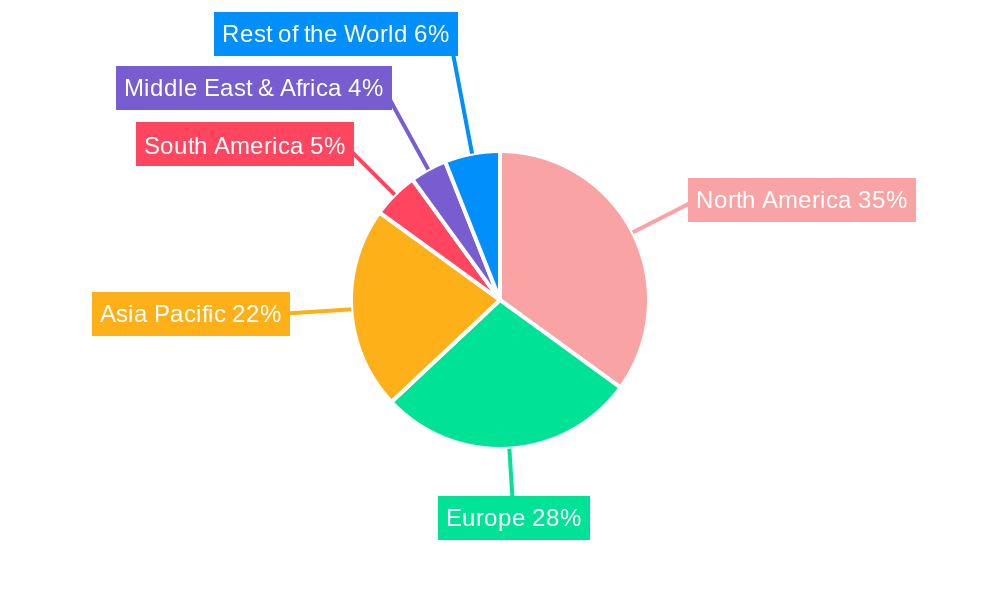
Cell Cycle Assay Kit Regional Market Share
Geographic Coverage of Cell Cycle Assay Kit
Cell Cycle Assay Kit REPORT HIGHLIGHTS
| Aspects | Details |
|---|---|
| Study Period | 2020-2034 |
| Base Year | 2025 |
| Estimated Year | 2026 |
| Forecast Period | 2026-2034 |
| Historical Period | 2020-2025 |
| Growth Rate | CAGR of XXX% from 2020-2034 |
| Segmentation |
|
Table of Contents
- 1. Introduction
- 1.1. Research Scope
- 1.2. Market Segmentation
- 1.3. Research Methodology
- 1.4. Definitions and Assumptions
- 2. Executive Summary
- 2.1. Introduction
- 3. Market Dynamics
- 3.1. Introduction
- 3.2. Market Drivers
- 3.3. Market Restrains
- 3.4. Market Trends
- 4. Market Factor Analysis
- 4.1. Porters Five Forces
- 4.2. Supply/Value Chain
- 4.3. PESTEL analysis
- 4.4. Market Entropy
- 4.5. Patent/Trademark Analysis
- 5. Global Cell Cycle Assay Kit Analysis, Insights and Forecast, 2020-2032
- 5.1. Market Analysis, Insights and Forecast - by Application
- 5.1.1. Laboratory
- 5.1.2. Institute of Biology
- 5.1.3. Pharmaceutical Company
- 5.2. Market Analysis, Insights and Forecast - by Type
- 5.2.1. Green Fluorescence
- 5.2.2. Red Fluorescence
- 5.2.3. Others
- 5.3. Market Analysis, Insights and Forecast - by Region
- 5.3.1. North America
- 5.3.2. South America
- 5.3.3. Europe
- 5.3.4. Middle East & Africa
- 5.3.5. Asia Pacific
- 5.1. Market Analysis, Insights and Forecast - by Application
- 6. North America Cell Cycle Assay Kit Analysis, Insights and Forecast, 2020-2032
- 6.1. Market Analysis, Insights and Forecast - by Application
- 6.1.1. Laboratory
- 6.1.2. Institute of Biology
- 6.1.3. Pharmaceutical Company
- 6.2. Market Analysis, Insights and Forecast - by Type
- 6.2.1. Green Fluorescence
- 6.2.2. Red Fluorescence
- 6.2.3. Others
- 6.1. Market Analysis, Insights and Forecast - by Application
- 7. South America Cell Cycle Assay Kit Analysis, Insights and Forecast, 2020-2032
- 7.1. Market Analysis, Insights and Forecast - by Application
- 7.1.1. Laboratory
- 7.1.2. Institute of Biology
- 7.1.3. Pharmaceutical Company
- 7.2. Market Analysis, Insights and Forecast - by Type
- 7.2.1. Green Fluorescence
- 7.2.2. Red Fluorescence
- 7.2.3. Others
- 7.1. Market Analysis, Insights and Forecast - by Application
- 8. Europe Cell Cycle Assay Kit Analysis, Insights and Forecast, 2020-2032
- 8.1. Market Analysis, Insights and Forecast - by Application
- 8.1.1. Laboratory
- 8.1.2. Institute of Biology
- 8.1.3. Pharmaceutical Company
- 8.2. Market Analysis, Insights and Forecast - by Type
- 8.2.1. Green Fluorescence
- 8.2.2. Red Fluorescence
- 8.2.3. Others
- 8.1. Market Analysis, Insights and Forecast - by Application
- 9. Middle East & Africa Cell Cycle Assay Kit Analysis, Insights and Forecast, 2020-2032
- 9.1. Market Analysis, Insights and Forecast - by Application
- 9.1.1. Laboratory
- 9.1.2. Institute of Biology
- 9.1.3. Pharmaceutical Company
- 9.2. Market Analysis, Insights and Forecast - by Type
- 9.2.1. Green Fluorescence
- 9.2.2. Red Fluorescence
- 9.2.3. Others
- 9.1. Market Analysis, Insights and Forecast - by Application
- 10. Asia Pacific Cell Cycle Assay Kit Analysis, Insights and Forecast, 2020-2032
- 10.1. Market Analysis, Insights and Forecast - by Application
- 10.1.1. Laboratory
- 10.1.2. Institute of Biology
- 10.1.3. Pharmaceutical Company
- 10.2. Market Analysis, Insights and Forecast - by Type
- 10.2.1. Green Fluorescence
- 10.2.2. Red Fluorescence
- 10.2.3. Others
- 10.1. Market Analysis, Insights and Forecast - by Application
- 11. Competitive Analysis
- 11.1. Global Market Share Analysis 2025
- 11.2. Company Profiles
- 11.2.1 Elabscience Biotechnology Inc.
- 11.2.1.1. Overview
- 11.2.1.2. Products
- 11.2.1.3. SWOT Analysis
- 11.2.1.4. Recent Developments
- 11.2.1.5. Financials (Based on Availability)
- 11.2.2 Abcam(BioVision Inc.)
- 11.2.2.1. Overview
- 11.2.2.2. Products
- 11.2.2.3. SWOT Analysis
- 11.2.2.4. Recent Developments
- 11.2.2.5. Financials (Based on Availability)
- 11.2.3 Cayman Chemical
- 11.2.3.1. Overview
- 11.2.3.2. Products
- 11.2.3.3. SWOT Analysis
- 11.2.3.4. Recent Developments
- 11.2.3.5. Financials (Based on Availability)
- 11.2.4 Labettor
- 11.2.4.1. Overview
- 11.2.4.2. Products
- 11.2.4.3. SWOT Analysis
- 11.2.4.4. Recent Developments
- 11.2.4.5. Financials (Based on Availability)
- 11.2.5 Merck(Sigma-Aldrich)
- 11.2.5.1. Overview
- 11.2.5.2. Products
- 11.2.5.3. SWOT Analysis
- 11.2.5.4. Recent Developments
- 11.2.5.5. Financials (Based on Availability)
- 11.2.6 GenScript
- 11.2.6.1. Overview
- 11.2.6.2. Products
- 11.2.6.3. SWOT Analysis
- 11.2.6.4. Recent Developments
- 11.2.6.5. Financials (Based on Availability)
- 11.2.7 Thermo Fisher Scientific
- 11.2.7.1. Overview
- 11.2.7.2. Products
- 11.2.7.3. SWOT Analysis
- 11.2.7.4. Recent Developments
- 11.2.7.5. Financials (Based on Availability)
- 11.2.8 Dojindo Laboratories Co. Ltd.
- 11.2.8.1. Overview
- 11.2.8.2. Products
- 11.2.8.3. SWOT Analysis
- 11.2.8.4. Recent Developments
- 11.2.8.5. Financials (Based on Availability)
- 11.2.9 Beijing Solarbio Science & Technology Co. Ltd.
- 11.2.9.1. Overview
- 11.2.9.2. Products
- 11.2.9.3. SWOT Analysis
- 11.2.9.4. Recent Developments
- 11.2.9.5. Financials (Based on Availability)
- 11.2.10 Canvax Reagents SL
- 11.2.10.1. Overview
- 11.2.10.2. Products
- 11.2.10.3. SWOT Analysis
- 11.2.10.4. Recent Developments
- 11.2.10.5. Financials (Based on Availability)
- 11.2.11 Jiangsu KGI Biotechnology Co. Ltd.
- 11.2.11.1. Overview
- 11.2.11.2. Products
- 11.2.11.3. SWOT Analysis
- 11.2.11.4. Recent Developments
- 11.2.11.5. Financials (Based on Availability)
- 11.2.12 Whatman
- 11.2.12.1. Overview
- 11.2.12.2. Products
- 11.2.12.3. SWOT Analysis
- 11.2.12.4. Recent Developments
- 11.2.12.5. Financials (Based on Availability)
- 11.2.1 Elabscience Biotechnology Inc.
List of Figures
- Figure 1: Global Cell Cycle Assay Kit Revenue Breakdown (million, %) by Region 2025 & 2033
- Figure 2: North America Cell Cycle Assay Kit Revenue (million), by Application 2025 & 2033
- Figure 3: North America Cell Cycle Assay Kit Revenue Share (%), by Application 2025 & 2033
- Figure 4: North America Cell Cycle Assay Kit Revenue (million), by Type 2025 & 2033
- Figure 5: North America Cell Cycle Assay Kit Revenue Share (%), by Type 2025 & 2033
- Figure 6: North America Cell Cycle Assay Kit Revenue (million), by Country 2025 & 2033
- Figure 7: North America Cell Cycle Assay Kit Revenue Share (%), by Country 2025 & 2033
- Figure 8: South America Cell Cycle Assay Kit Revenue (million), by Application 2025 & 2033
- Figure 9: South America Cell Cycle Assay Kit Revenue Share (%), by Application 2025 & 2033
- Figure 10: South America Cell Cycle Assay Kit Revenue (million), by Type 2025 & 2033
- Figure 11: South America Cell Cycle Assay Kit Revenue Share (%), by Type 2025 & 2033
- Figure 12: South America Cell Cycle Assay Kit Revenue (million), by Country 2025 & 2033
- Figure 13: South America Cell Cycle Assay Kit Revenue Share (%), by Country 2025 & 2033
- Figure 14: Europe Cell Cycle Assay Kit Revenue (million), by Application 2025 & 2033
- Figure 15: Europe Cell Cycle Assay Kit Revenue Share (%), by Application 2025 & 2033
- Figure 16: Europe Cell Cycle Assay Kit Revenue (million), by Type 2025 & 2033
- Figure 17: Europe Cell Cycle Assay Kit Revenue Share (%), by Type 2025 & 2033
- Figure 18: Europe Cell Cycle Assay Kit Revenue (million), by Country 2025 & 2033
- Figure 19: Europe Cell Cycle Assay Kit Revenue Share (%), by Country 2025 & 2033
- Figure 20: Middle East & Africa Cell Cycle Assay Kit Revenue (million), by Application 2025 & 2033
- Figure 21: Middle East & Africa Cell Cycle Assay Kit Revenue Share (%), by Application 2025 & 2033
- Figure 22: Middle East & Africa Cell Cycle Assay Kit Revenue (million), by Type 2025 & 2033
- Figure 23: Middle East & Africa Cell Cycle Assay Kit Revenue Share (%), by Type 2025 & 2033
- Figure 24: Middle East & Africa Cell Cycle Assay Kit Revenue (million), by Country 2025 & 2033
- Figure 25: Middle East & Africa Cell Cycle Assay Kit Revenue Share (%), by Country 2025 & 2033
- Figure 26: Asia Pacific Cell Cycle Assay Kit Revenue (million), by Application 2025 & 2033
- Figure 27: Asia Pacific Cell Cycle Assay Kit Revenue Share (%), by Application 2025 & 2033
- Figure 28: Asia Pacific Cell Cycle Assay Kit Revenue (million), by Type 2025 & 2033
- Figure 29: Asia Pacific Cell Cycle Assay Kit Revenue Share (%), by Type 2025 & 2033
- Figure 30: Asia Pacific Cell Cycle Assay Kit Revenue (million), by Country 2025 & 2033
- Figure 31: Asia Pacific Cell Cycle Assay Kit Revenue Share (%), by Country 2025 & 2033
List of Tables
- Table 1: Global Cell Cycle Assay Kit Revenue million Forecast, by Application 2020 & 2033
- Table 2: Global Cell Cycle Assay Kit Revenue million Forecast, by Type 2020 & 2033
- Table 3: Global Cell Cycle Assay Kit Revenue million Forecast, by Region 2020 & 2033
- Table 4: Global Cell Cycle Assay Kit Revenue million Forecast, by Application 2020 & 2033
- Table 5: Global Cell Cycle Assay Kit Revenue million Forecast, by Type 2020 & 2033
- Table 6: Global Cell Cycle Assay Kit Revenue million Forecast, by Country 2020 & 2033
- Table 7: United States Cell Cycle Assay Kit Revenue (million) Forecast, by Application 2020 & 2033
- Table 8: Canada Cell Cycle Assay Kit Revenue (million) Forecast, by Application 2020 & 2033
- Table 9: Mexico Cell Cycle Assay Kit Revenue (million) Forecast, by Application 2020 & 2033
- Table 10: Global Cell Cycle Assay Kit Revenue million Forecast, by Application 2020 & 2033
- Table 11: Global Cell Cycle Assay Kit Revenue million Forecast, by Type 2020 & 2033
- Table 12: Global Cell Cycle Assay Kit Revenue million Forecast, by Country 2020 & 2033
- Table 13: Brazil Cell Cycle Assay Kit Revenue (million) Forecast, by Application 2020 & 2033
- Table 14: Argentina Cell Cycle Assay Kit Revenue (million) Forecast, by Application 2020 & 2033
- Table 15: Rest of South America Cell Cycle Assay Kit Revenue (million) Forecast, by Application 2020 & 2033
- Table 16: Global Cell Cycle Assay Kit Revenue million Forecast, by Application 2020 & 2033
- Table 17: Global Cell Cycle Assay Kit Revenue million Forecast, by Type 2020 & 2033
- Table 18: Global Cell Cycle Assay Kit Revenue million Forecast, by Country 2020 & 2033
- Table 19: United Kingdom Cell Cycle Assay Kit Revenue (million) Forecast, by Application 2020 & 2033
- Table 20: Germany Cell Cycle Assay Kit Revenue (million) Forecast, by Application 2020 & 2033
- Table 21: France Cell Cycle Assay Kit Revenue (million) Forecast, by Application 2020 & 2033
- Table 22: Italy Cell Cycle Assay Kit Revenue (million) Forecast, by Application 2020 & 2033
- Table 23: Spain Cell Cycle Assay Kit Revenue (million) Forecast, by Application 2020 & 2033
- Table 24: Russia Cell Cycle Assay Kit Revenue (million) Forecast, by Application 2020 & 2033
- Table 25: Benelux Cell Cycle Assay Kit Revenue (million) Forecast, by Application 2020 & 2033
- Table 26: Nordics Cell Cycle Assay Kit Revenue (million) Forecast, by Application 2020 & 2033
- Table 27: Rest of Europe Cell Cycle Assay Kit Revenue (million) Forecast, by Application 2020 & 2033
- Table 28: Global Cell Cycle Assay Kit Revenue million Forecast, by Application 2020 & 2033
- Table 29: Global Cell Cycle Assay Kit Revenue million Forecast, by Type 2020 & 2033
- Table 30: Global Cell Cycle Assay Kit Revenue million Forecast, by Country 2020 & 2033
- Table 31: Turkey Cell Cycle Assay Kit Revenue (million) Forecast, by Application 2020 & 2033
- Table 32: Israel Cell Cycle Assay Kit Revenue (million) Forecast, by Application 2020 & 2033
- Table 33: GCC Cell Cycle Assay Kit Revenue (million) Forecast, by Application 2020 & 2033
- Table 34: North Africa Cell Cycle Assay Kit Revenue (million) Forecast, by Application 2020 & 2033
- Table 35: South Africa Cell Cycle Assay Kit Revenue (million) Forecast, by Application 2020 & 2033
- Table 36: Rest of Middle East & Africa Cell Cycle Assay Kit Revenue (million) Forecast, by Application 2020 & 2033
- Table 37: Global Cell Cycle Assay Kit Revenue million Forecast, by Application 2020 & 2033
- Table 38: Global Cell Cycle Assay Kit Revenue million Forecast, by Type 2020 & 2033
- Table 39: Global Cell Cycle Assay Kit Revenue million Forecast, by Country 2020 & 2033
- Table 40: China Cell Cycle Assay Kit Revenue (million) Forecast, by Application 2020 & 2033
- Table 41: India Cell Cycle Assay Kit Revenue (million) Forecast, by Application 2020 & 2033
- Table 42: Japan Cell Cycle Assay Kit Revenue (million) Forecast, by Application 2020 & 2033
- Table 43: South Korea Cell Cycle Assay Kit Revenue (million) Forecast, by Application 2020 & 2033
- Table 44: ASEAN Cell Cycle Assay Kit Revenue (million) Forecast, by Application 2020 & 2033
- Table 45: Oceania Cell Cycle Assay Kit Revenue (million) Forecast, by Application 2020 & 2033
- Table 46: Rest of Asia Pacific Cell Cycle Assay Kit Revenue (million) Forecast, by Application 2020 & 2033
Frequently Asked Questions
1. What is the projected Compound Annual Growth Rate (CAGR) of the Cell Cycle Assay Kit?
The projected CAGR is approximately XXX%.
2. Which companies are prominent players in the Cell Cycle Assay Kit?
Key companies in the market include Elabscience Biotechnology Inc., Abcam(BioVision, Inc.), Cayman Chemical, Labettor, Merck(Sigma-Aldrich), GenScript, Thermo Fisher Scientific, Dojindo Laboratories Co., Ltd., Beijing Solarbio Science & Technology Co., Ltd., Canvax Reagents SL, Jiangsu KGI Biotechnology Co., Ltd., Whatman.
3. What are the main segments of the Cell Cycle Assay Kit?
The market segments include Application, Type.
4. Can you provide details about the market size?
The market size is estimated to be USD XXX million as of 2022.
5. What are some drivers contributing to market growth?
N/A
6. What are the notable trends driving market growth?
N/A
7. Are there any restraints impacting market growth?
N/A
8. Can you provide examples of recent developments in the market?
N/A
9. What pricing options are available for accessing the report?
Pricing options include single-user, multi-user, and enterprise licenses priced at USD 2900.00, USD 4350.00, and USD 5800.00 respectively.
10. Is the market size provided in terms of value or volume?
The market size is provided in terms of value, measured in million.
11. Are there any specific market keywords associated with the report?
Yes, the market keyword associated with the report is "Cell Cycle Assay Kit," which aids in identifying and referencing the specific market segment covered.
12. How do I determine which pricing option suits my needs best?
The pricing options vary based on user requirements and access needs. Individual users may opt for single-user licenses, while businesses requiring broader access may choose multi-user or enterprise licenses for cost-effective access to the report.
13. Are there any additional resources or data provided in the Cell Cycle Assay Kit report?
While the report offers comprehensive insights, it's advisable to review the specific contents or supplementary materials provided to ascertain if additional resources or data are available.
14. How can I stay updated on further developments or reports in the Cell Cycle Assay Kit?
To stay informed about further developments, trends, and reports in the Cell Cycle Assay Kit, consider subscribing to industry newsletters, following relevant companies and organizations, or regularly checking reputable industry news sources and publications.
Methodology
Step 1 - Identification of Relevant Samples Size from Population Database



Step 2 - Approaches for Defining Global Market Size (Value, Volume* & Price*)

Note*: In applicable scenarios
Step 3 - Data Sources
Primary Research
- Web Analytics
- Survey Reports
- Research Institute
- Latest Research Reports
- Opinion Leaders
Secondary Research
- Annual Reports
- White Paper
- Latest Press Release
- Industry Association
- Paid Database
- Investor Presentations

Step 4 - Data Triangulation
Involves using different sources of information in order to increase the validity of a study
These sources are likely to be stakeholders in a program - participants, other researchers, program staff, other community members, and so on.
Then we put all data in single framework & apply various statistical tools to find out the dynamic on the market.
During the analysis stage, feedback from the stakeholder groups would be compared to determine areas of agreement as well as areas of divergence