
Key Insights
The Automotive Avalanche Photodiode Market is projected for significant expansion, with an estimated market size of $12.7 billion by 2025. The market is expected to grow at a Compound Annual Growth Rate (CAGR) of 9.56% from 2025 to 2033. This growth is driven by the increasing adoption of Advanced Driver-Assistance Systems (ADAS) and autonomous driving technologies. Avalanche Photodiodes (APDs) are vital components in LiDAR systems, enabling environmental perception, object detection, and precise distance measurement, which are essential for modern automotive safety and functionality. Evolving automotive lighting systems, including adaptive front-lighting and advanced signaling, also contribute to the rising demand for APDs. Stringent global automotive safety regulations further propel the market by necessitating advanced vehicle sensing capabilities.
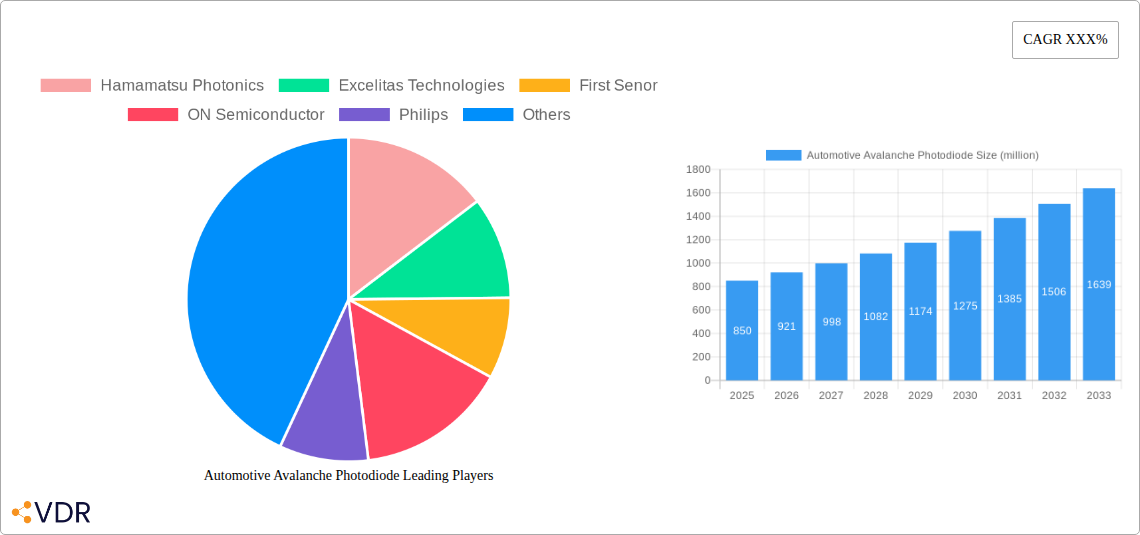
Automotive Avalanche Photodiode Market Size (In Billion)

The market is segmented by application into Commercial Vehicles and Passenger Cars. Passenger cars currently lead due to higher production volumes and faster adoption of advanced technologies. However, the commercial vehicle segment is anticipated to experience substantial growth as fleets integrate ADAS for enhanced safety and operational efficiency. Key product types include Si Avalanche Diodes and InGaAs Avalanche Diodes. Si APDs, known for their cost-effectiveness, are widely used in short-range sensing. InGaAs APDs offer superior performance in longer-wavelength applications, critical for specific LiDAR configurations and advanced optical sensing. Leading players such as Hamamatsu Photonics, Excelitas Technologies, and ON Semiconductor are actively investing in R&D to improve APD performance, miniaturization, and cost-effectiveness, addressing market challenges like high technology costs and integration complexities. The Asia Pacific region, particularly China and Japan, is expected to dominate the market, supported by a strong automotive manufacturing base and rapid technological adoption.
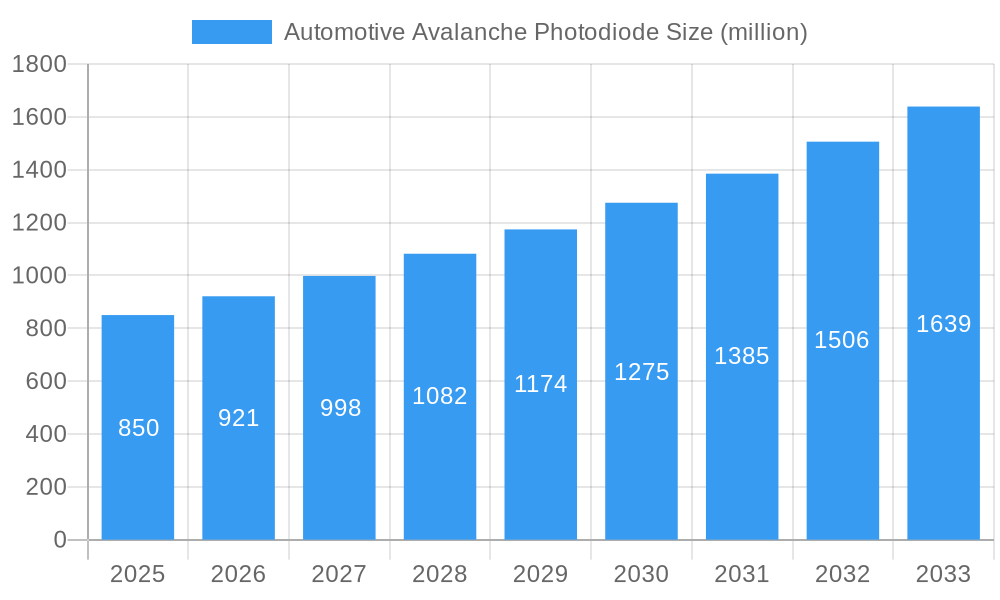
Automotive Avalanche Photodiode Company Market Share
Comprehensive analysis of the Automotive Avalanche Photodiode Market, covering 2025-2033, reveals robust growth driven by automotive safety and performance demands. This report is crucial for stakeholders in automotive LiDAR, ADAS, autonomous driving, automotive sensors, and photonics. It details market dynamics, regional trends, and competitive landscapes, offering insights into market concentration, innovation, regulatory impacts, and player strategies. Key market segments include Si Avalanche Diode and InGaAs Avalanche Diode types, with applications in Commercial Vehicles and Passenger Cars. Leading companies like Hamamatsu Photonics, Excelitas Technologies, First Sensor, and ON Semiconductor are shaping the market through continuous R&D and strategic investments.
Automotive Avalanche Photodiode Market Dynamics & Structure
The Automotive Avalanche Photodiode Market is characterized by a moderately consolidated structure, with key players investing heavily in technological advancements to capture market share. The primary drivers of innovation include the relentless pursuit of enhanced safety features, the widespread adoption of autonomous driving technologies, and the increasing sophistication of LiDAR systems for precise environmental perception. Regulatory frameworks are evolving to mandate advanced safety systems, indirectly boosting demand for high-performance photodiode solutions. Competitive product substitutes, such as PIN photodiodes and CMOS image sensors, offer alternative sensing capabilities but often fall short in sensitivity and response time required for critical automotive applications. End-user demographics are shifting towards a greater appreciation for technologically advanced vehicles, driving demand for innovative ADAS and LiDAR features. Mergers and acquisitions (M&A) are a significant trend, with larger companies acquiring innovative startups to integrate cutting-edge technologies and expand their product portfolios.
- Market Concentration: Moderately concentrated, with leading players holding significant market shares.
- Technological Innovation Drivers: ADAS development, autonomous driving, LiDAR advancement, miniaturization, and improved performance (speed, sensitivity, wavelength response).
- Regulatory Frameworks: Increasing mandates for advanced safety features (e.g., AEB, lane keeping assist) indirectly benefit photodiode demand.
- Competitive Product Substitutes: PIN photodiodes, CMOS image sensors, infrared sensors; generally less sensitive and slower for critical applications.
- End-User Demographics: Growing consumer demand for safety, convenience, and advanced in-car experiences.
- M&A Trends: Strategic acquisitions by larger players to gain technological edge and market access.
Automotive Avalanche Photodiode Growth Trends & Insights
The Automotive Avalanche Photodiode Market is poised for significant expansion, projected to grow at a Compound Annual Growth Rate (CAGR) of approximately 15.2% from the Base Year of 2025 through the Forecast Period of 2025–2033. This robust growth is underpinned by escalating demand for sophisticated automotive sensors essential for the advancement of autonomous driving and enhanced safety systems. The market size, estimated at $1,250 million in 2025, is projected to reach an impressive $3,600 million by 2033. Adoption rates of ADAS features, including advanced emergency braking, adaptive cruise control, and surround-view systems, are steadily increasing across both passenger cars and commercial vehicles, directly fueling the need for high-performance photodetectors like avalanche photodiodes (APDs). Technological disruptions, such as the evolution of LiDAR technology towards solid-state and more compact designs, are creating new opportunities. Consumer behavior is shifting, with a growing preference for vehicles equipped with cutting-edge safety and convenience features, further accelerating market penetration. The historical data from 2019–2024 indicates a steady upward trajectory, laying a strong foundation for future growth.
Dominant Regions, Countries, or Segments in Automotive Avalanche Photodiode
North America is emerging as a dominant region in the Automotive Avalanche Photodiode Market, driven by its leadership in autonomous vehicle research and development, coupled with stringent automotive safety regulations and significant government investment in smart city initiatives. The Passenger Car segment, within the Application category, is a key growth engine, accounting for an estimated 68% of the market share in 2025. This dominance is attributed to the widespread integration of ADAS features in new vehicle models and the growing consumer demand for safety-enhancing technologies in personal transportation.
The Si Avalanche Diode type also holds a substantial market share, estimated at 55% in 2025, due to its cost-effectiveness and suitability for a wide range of automotive sensing applications. However, the InGaAS Avalanche Diode is experiencing rapid growth due to its superior performance in longer wavelength applications, crucial for advanced LiDAR systems that offer better visibility in adverse weather conditions.
- Dominant Region: North America, fueled by R&D in autonomous driving and supportive regulations.
- Dominant Country: United States, leading in EV adoption and smart mobility solutions.
- Dominant Segment (Application): Passenger Car (estimated 68% market share in 2025), driven by ADAS integration.
- Dominant Segment (Type): Si Avalanche Diode (estimated 55% market share in 2025), owing to its balance of performance and cost.
- Growth Segment (Type): InGaAS Avalanche Diode, driven by advanced LiDAR requirements.
- Key Drivers: Government incentives for EV and AV development, strong automotive manufacturing base, consumer demand for advanced safety.
Automotive Avalanche Photodiode Product Landscape
The Automotive Avalanche Photodiode product landscape is rapidly evolving with innovations focused on enhanced sensitivity, faster response times, and miniaturization for seamless integration into vehicle architectures. Manufacturers are developing APDs capable of operating across a wider temperature range and exhibiting improved linearity, crucial for the harsh automotive environment. Key product advancements include single-point APDs optimized for LiDAR applications, as well as linear APD arrays for broader area sensing. The unique selling proposition of these products lies in their ability to provide high-gain, low-noise detection of light signals, enabling critical functionalities such as obstacle detection, object recognition, and precise distance measurement for ADAS and autonomous driving. Technological advancements are also addressing wavelength specificity, with APDs designed for optimal performance in the 905 nm and 1550 nm ranges commonly used in LiDAR.
Key Drivers, Barriers & Challenges in Automotive Avalanche Photodiode
Key Drivers:
- Technological Advancements: The continuous evolution of LiDAR, ADAS, and autonomous driving technologies directly fuels demand for high-performance APDs.
- Safety Regulations: Increasingly stringent automotive safety mandates globally drive the adoption of advanced sensing systems.
- Automotive Electrification & Autonomy: The push towards electric vehicles (EVs) and autonomous driving necessitates sophisticated sensor suites.
- Cost Reduction & Miniaturization: Ongoing efforts to reduce APD costs and enable smaller form factors are critical for widespread adoption.
Barriers & Challenges:
- High Development Costs: The intricate nature of APD technology and rigorous automotive qualification processes lead to substantial R&D expenses.
- Supply Chain Volatility: Geopolitical factors and specialized manufacturing requirements can lead to potential supply chain disruptions and price fluctuations.
- Intense Competition: The market faces competition from alternative sensing technologies and established component manufacturers.
- Harsh Automotive Environment: APDs must withstand extreme temperature variations, vibration, and electromagnetic interference, demanding robust design and manufacturing.
- Standardization Gaps: Lack of universal industry standards for certain automotive sensing applications can create integration challenges.
Emerging Opportunities in Automotive Avalanche Photodiode
Emerging opportunities in the Automotive Avalanche Photodiode Market lie in the development of next-generation LiDAR systems, including those utilizing Frequency-Modulated Continuous Wave (FMCW) technology, which offers enhanced range and velocity measurement capabilities. The expansion of automotive cybersecurity solutions, where APDs can play a role in secure communication systems, presents another promising avenue. Furthermore, the increasing adoption of advanced driver monitoring systems (ADMS) for driver attention and fatigue detection opens up new application areas. Untapped markets in emerging economies with growing automotive sectors also represent significant growth potential as safety and advanced feature adoption increase.
Growth Accelerators in the Automotive Avalanche Photodiode Industry
Growth accelerators in the Automotive Avalanche Photodiode Industry are primarily driven by significant investments in research and development by major automotive OEMs and Tier-1 suppliers. Strategic partnerships between photodiode manufacturers and LiDAR system integrators are crucial for co-developing optimized solutions tailored to specific vehicle platforms. The ongoing push towards higher levels of vehicle autonomy (Level 3, 4, and 5) necessitates more advanced and redundant sensing systems, acting as a powerful catalyst for APD market expansion. Furthermore, government initiatives and subsidies promoting the development and adoption of autonomous vehicle technology indirectly boost the demand for critical components like avalanche photodiodes.
Key Players Shaping the Automotive Avalanche Photodiode Market
- Hamamatsu Photonics
- Excelitas Technologies
- First Sensor
- ON Semiconductor
- Philips
- Advanced Scientific Concepts
- Discovery Semiconductors
- Spectrolabs
- Espros Photonics
- Laser Components
- Micro Photon Devices
- AMS Technologies
- Analog Modules
- OSI Laser Diode
Notable Milestones in Automotive Avalanche Photodiode Sector
- 2019: Increased adoption of LiDAR in premium passenger vehicles for advanced ADAS features.
- 2020: Development of lower-cost, more compact Si avalanche photodiodes suitable for mass-market vehicles.
- 2021: Advancements in InGaAS avalanche photodiodes for improved performance in adverse weather conditions.
- 2022: Major automotive OEMs announce ambitious plans for Level 4/5 autonomous vehicle deployment, boosting demand for high-performance sensors.
- 2023: Emergence of solid-state LiDAR solutions with integrated avalanche photodiode arrays.
- 2024: Growing interest in using APDs for in-cabin sensing applications, such as driver monitoring.
In-Depth Automotive Avalanche Photodiode Market Outlook
The Automotive Avalanche Photodiode Market is set for continued strong growth, driven by the unyielding demand for enhanced vehicle safety and the accelerating transition towards autonomous driving. Future market potential is substantial, with technological breakthroughs in areas like advanced LiDAR, improved sensor fusion algorithms, and miniaturized detector designs acting as key growth accelerators. Strategic opportunities lie in expanding market penetration in emerging economies and catering to the evolving needs of commercial vehicle fleets for advanced sensing capabilities. The industry will likely witness further consolidation and specialized product development to meet the increasingly sophisticated requirements of the automotive sector.
Automotive Avalanche Photodiode Segmentation
-
1. Application
- 1.1. Commercial Vehicle
- 1.2. Passenger Car
-
2. Type
- 2.1. Si Avalanche Diode
- 2.2. InGaAS Avalanche Diode
- 2.3. Other
Automotive Avalanche Photodiode Segmentation By Geography
-
1. North America
- 1.1. United States
- 1.2. Canada
- 1.3. Mexico
-
2. South America
- 2.1. Brazil
- 2.2. Argentina
- 2.3. Rest of South America
-
3. Europe
- 3.1. United Kingdom
- 3.2. Germany
- 3.3. France
- 3.4. Italy
- 3.5. Spain
- 3.6. Russia
- 3.7. Benelux
- 3.8. Nordics
- 3.9. Rest of Europe
-
4. Middle East & Africa
- 4.1. Turkey
- 4.2. Israel
- 4.3. GCC
- 4.4. North Africa
- 4.5. South Africa
- 4.6. Rest of Middle East & Africa
-
5. Asia Pacific
- 5.1. China
- 5.2. India
- 5.3. Japan
- 5.4. South Korea
- 5.5. ASEAN
- 5.6. Oceania
- 5.7. Rest of Asia Pacific
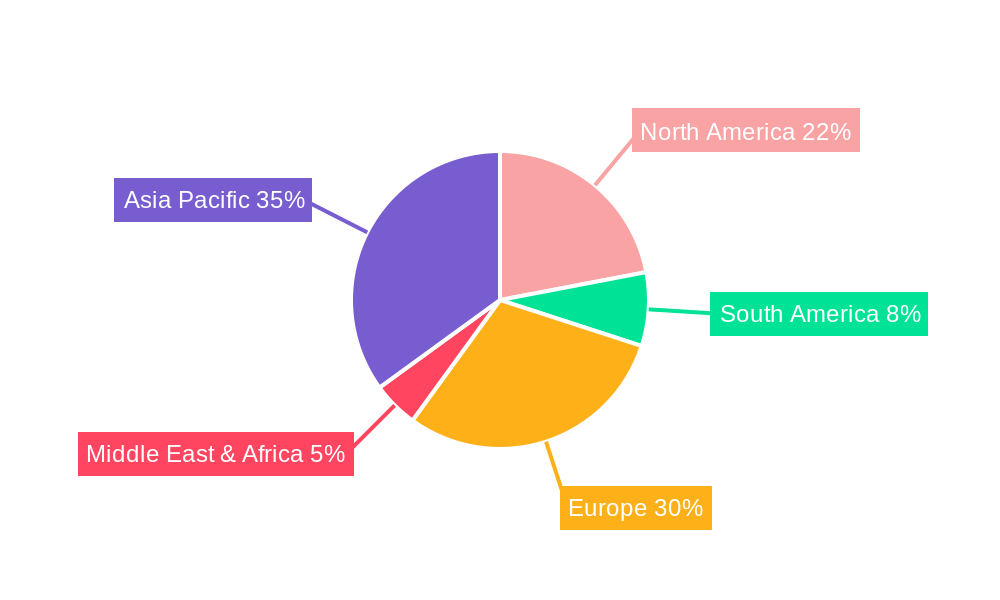
Automotive Avalanche Photodiode Regional Market Share
Geographic Coverage of Automotive Avalanche Photodiode
Automotive Avalanche Photodiode REPORT HIGHLIGHTS
| Aspects | Details |
|---|---|
| Study Period | 2020-2034 |
| Base Year | 2025 |
| Estimated Year | 2026 |
| Forecast Period | 2026-2034 |
| Historical Period | 2020-2025 |
| Growth Rate | CAGR of 9.56% from 2020-2034 |
| Segmentation |
|
Table of Contents
- 1. Introduction
- 1.1. Research Scope
- 1.2. Market Segmentation
- 1.3. Research Methodology
- 1.4. Definitions and Assumptions
- 2. Executive Summary
- 2.1. Introduction
- 3. Market Dynamics
- 3.1. Introduction
- 3.2. Market Drivers
- 3.3. Market Restrains
- 3.4. Market Trends
- 4. Market Factor Analysis
- 4.1. Porters Five Forces
- 4.2. Supply/Value Chain
- 4.3. PESTEL analysis
- 4.4. Market Entropy
- 4.5. Patent/Trademark Analysis
- 5. Global Automotive Avalanche Photodiode Analysis, Insights and Forecast, 2020-2032
- 5.1. Market Analysis, Insights and Forecast - by Application
- 5.1.1. Commercial Vehicle
- 5.1.2. Passenger Car
- 5.2. Market Analysis, Insights and Forecast - by Type
- 5.2.1. Si Avalanche Diode
- 5.2.2. InGaAS Avalanche Diode
- 5.2.3. Other
- 5.3. Market Analysis, Insights and Forecast - by Region
- 5.3.1. North America
- 5.3.2. South America
- 5.3.3. Europe
- 5.3.4. Middle East & Africa
- 5.3.5. Asia Pacific
- 5.1. Market Analysis, Insights and Forecast - by Application
- 6. North America Automotive Avalanche Photodiode Analysis, Insights and Forecast, 2020-2032
- 6.1. Market Analysis, Insights and Forecast - by Application
- 6.1.1. Commercial Vehicle
- 6.1.2. Passenger Car
- 6.2. Market Analysis, Insights and Forecast - by Type
- 6.2.1. Si Avalanche Diode
- 6.2.2. InGaAS Avalanche Diode
- 6.2.3. Other
- 6.1. Market Analysis, Insights and Forecast - by Application
- 7. South America Automotive Avalanche Photodiode Analysis, Insights and Forecast, 2020-2032
- 7.1. Market Analysis, Insights and Forecast - by Application
- 7.1.1. Commercial Vehicle
- 7.1.2. Passenger Car
- 7.2. Market Analysis, Insights and Forecast - by Type
- 7.2.1. Si Avalanche Diode
- 7.2.2. InGaAS Avalanche Diode
- 7.2.3. Other
- 7.1. Market Analysis, Insights and Forecast - by Application
- 8. Europe Automotive Avalanche Photodiode Analysis, Insights and Forecast, 2020-2032
- 8.1. Market Analysis, Insights and Forecast - by Application
- 8.1.1. Commercial Vehicle
- 8.1.2. Passenger Car
- 8.2. Market Analysis, Insights and Forecast - by Type
- 8.2.1. Si Avalanche Diode
- 8.2.2. InGaAS Avalanche Diode
- 8.2.3. Other
- 8.1. Market Analysis, Insights and Forecast - by Application
- 9. Middle East & Africa Automotive Avalanche Photodiode Analysis, Insights and Forecast, 2020-2032
- 9.1. Market Analysis, Insights and Forecast - by Application
- 9.1.1. Commercial Vehicle
- 9.1.2. Passenger Car
- 9.2. Market Analysis, Insights and Forecast - by Type
- 9.2.1. Si Avalanche Diode
- 9.2.2. InGaAS Avalanche Diode
- 9.2.3. Other
- 9.1. Market Analysis, Insights and Forecast - by Application
- 10. Asia Pacific Automotive Avalanche Photodiode Analysis, Insights and Forecast, 2020-2032
- 10.1. Market Analysis, Insights and Forecast - by Application
- 10.1.1. Commercial Vehicle
- 10.1.2. Passenger Car
- 10.2. Market Analysis, Insights and Forecast - by Type
- 10.2.1. Si Avalanche Diode
- 10.2.2. InGaAS Avalanche Diode
- 10.2.3. Other
- 10.1. Market Analysis, Insights and Forecast - by Application
- 11. Competitive Analysis
- 11.1. Global Market Share Analysis 2025
- 11.2. Company Profiles
- 11.2.1 Hamamatsu Photonics
- 11.2.1.1. Overview
- 11.2.1.2. Products
- 11.2.1.3. SWOT Analysis
- 11.2.1.4. Recent Developments
- 11.2.1.5. Financials (Based on Availability)
- 11.2.2 Excelitas Technologies
- 11.2.2.1. Overview
- 11.2.2.2. Products
- 11.2.2.3. SWOT Analysis
- 11.2.2.4. Recent Developments
- 11.2.2.5. Financials (Based on Availability)
- 11.2.3 First Senor
- 11.2.3.1. Overview
- 11.2.3.2. Products
- 11.2.3.3. SWOT Analysis
- 11.2.3.4. Recent Developments
- 11.2.3.5. Financials (Based on Availability)
- 11.2.4 ON Semiconductor
- 11.2.4.1. Overview
- 11.2.4.2. Products
- 11.2.4.3. SWOT Analysis
- 11.2.4.4. Recent Developments
- 11.2.4.5. Financials (Based on Availability)
- 11.2.5 Philips
- 11.2.5.1. Overview
- 11.2.5.2. Products
- 11.2.5.3. SWOT Analysis
- 11.2.5.4. Recent Developments
- 11.2.5.5. Financials (Based on Availability)
- 11.2.6 Advanced Scientific Concepts
- 11.2.6.1. Overview
- 11.2.6.2. Products
- 11.2.6.3. SWOT Analysis
- 11.2.6.4. Recent Developments
- 11.2.6.5. Financials (Based on Availability)
- 11.2.7 Discovery Semiconductors
- 11.2.7.1. Overview
- 11.2.7.2. Products
- 11.2.7.3. SWOT Analysis
- 11.2.7.4. Recent Developments
- 11.2.7.5. Financials (Based on Availability)
- 11.2.8 Spectrolabs
- 11.2.8.1. Overview
- 11.2.8.2. Products
- 11.2.8.3. SWOT Analysis
- 11.2.8.4. Recent Developments
- 11.2.8.5. Financials (Based on Availability)
- 11.2.9 Espros Photonics
- 11.2.9.1. Overview
- 11.2.9.2. Products
- 11.2.9.3. SWOT Analysis
- 11.2.9.4. Recent Developments
- 11.2.9.5. Financials (Based on Availability)
- 11.2.10 Laser Components
- 11.2.10.1. Overview
- 11.2.10.2. Products
- 11.2.10.3. SWOT Analysis
- 11.2.10.4. Recent Developments
- 11.2.10.5. Financials (Based on Availability)
- 11.2.11 Micro Photon Devices
- 11.2.11.1. Overview
- 11.2.11.2. Products
- 11.2.11.3. SWOT Analysis
- 11.2.11.4. Recent Developments
- 11.2.11.5. Financials (Based on Availability)
- 11.2.12 AMS Technologies
- 11.2.12.1. Overview
- 11.2.12.2. Products
- 11.2.12.3. SWOT Analysis
- 11.2.12.4. Recent Developments
- 11.2.12.5. Financials (Based on Availability)
- 11.2.13 Analog Modules
- 11.2.13.1. Overview
- 11.2.13.2. Products
- 11.2.13.3. SWOT Analysis
- 11.2.13.4. Recent Developments
- 11.2.13.5. Financials (Based on Availability)
- 11.2.14 OSI Laser Diode
- 11.2.14.1. Overview
- 11.2.14.2. Products
- 11.2.14.3. SWOT Analysis
- 11.2.14.4. Recent Developments
- 11.2.14.5. Financials (Based on Availability)
- 11.2.1 Hamamatsu Photonics
List of Figures
- Figure 1: Global Automotive Avalanche Photodiode Revenue Breakdown (billion, %) by Region 2025 & 2033
- Figure 2: North America Automotive Avalanche Photodiode Revenue (billion), by Application 2025 & 2033
- Figure 3: North America Automotive Avalanche Photodiode Revenue Share (%), by Application 2025 & 2033
- Figure 4: North America Automotive Avalanche Photodiode Revenue (billion), by Type 2025 & 2033
- Figure 5: North America Automotive Avalanche Photodiode Revenue Share (%), by Type 2025 & 2033
- Figure 6: North America Automotive Avalanche Photodiode Revenue (billion), by Country 2025 & 2033
- Figure 7: North America Automotive Avalanche Photodiode Revenue Share (%), by Country 2025 & 2033
- Figure 8: South America Automotive Avalanche Photodiode Revenue (billion), by Application 2025 & 2033
- Figure 9: South America Automotive Avalanche Photodiode Revenue Share (%), by Application 2025 & 2033
- Figure 10: South America Automotive Avalanche Photodiode Revenue (billion), by Type 2025 & 2033
- Figure 11: South America Automotive Avalanche Photodiode Revenue Share (%), by Type 2025 & 2033
- Figure 12: South America Automotive Avalanche Photodiode Revenue (billion), by Country 2025 & 2033
- Figure 13: South America Automotive Avalanche Photodiode Revenue Share (%), by Country 2025 & 2033
- Figure 14: Europe Automotive Avalanche Photodiode Revenue (billion), by Application 2025 & 2033
- Figure 15: Europe Automotive Avalanche Photodiode Revenue Share (%), by Application 2025 & 2033
- Figure 16: Europe Automotive Avalanche Photodiode Revenue (billion), by Type 2025 & 2033
- Figure 17: Europe Automotive Avalanche Photodiode Revenue Share (%), by Type 2025 & 2033
- Figure 18: Europe Automotive Avalanche Photodiode Revenue (billion), by Country 2025 & 2033
- Figure 19: Europe Automotive Avalanche Photodiode Revenue Share (%), by Country 2025 & 2033
- Figure 20: Middle East & Africa Automotive Avalanche Photodiode Revenue (billion), by Application 2025 & 2033
- Figure 21: Middle East & Africa Automotive Avalanche Photodiode Revenue Share (%), by Application 2025 & 2033
- Figure 22: Middle East & Africa Automotive Avalanche Photodiode Revenue (billion), by Type 2025 & 2033
- Figure 23: Middle East & Africa Automotive Avalanche Photodiode Revenue Share (%), by Type 2025 & 2033
- Figure 24: Middle East & Africa Automotive Avalanche Photodiode Revenue (billion), by Country 2025 & 2033
- Figure 25: Middle East & Africa Automotive Avalanche Photodiode Revenue Share (%), by Country 2025 & 2033
- Figure 26: Asia Pacific Automotive Avalanche Photodiode Revenue (billion), by Application 2025 & 2033
- Figure 27: Asia Pacific Automotive Avalanche Photodiode Revenue Share (%), by Application 2025 & 2033
- Figure 28: Asia Pacific Automotive Avalanche Photodiode Revenue (billion), by Type 2025 & 2033
- Figure 29: Asia Pacific Automotive Avalanche Photodiode Revenue Share (%), by Type 2025 & 2033
- Figure 30: Asia Pacific Automotive Avalanche Photodiode Revenue (billion), by Country 2025 & 2033
- Figure 31: Asia Pacific Automotive Avalanche Photodiode Revenue Share (%), by Country 2025 & 2033
List of Tables
- Table 1: Global Automotive Avalanche Photodiode Revenue billion Forecast, by Application 2020 & 2033
- Table 2: Global Automotive Avalanche Photodiode Revenue billion Forecast, by Type 2020 & 2033
- Table 3: Global Automotive Avalanche Photodiode Revenue billion Forecast, by Region 2020 & 2033
- Table 4: Global Automotive Avalanche Photodiode Revenue billion Forecast, by Application 2020 & 2033
- Table 5: Global Automotive Avalanche Photodiode Revenue billion Forecast, by Type 2020 & 2033
- Table 6: Global Automotive Avalanche Photodiode Revenue billion Forecast, by Country 2020 & 2033
- Table 7: United States Automotive Avalanche Photodiode Revenue (billion) Forecast, by Application 2020 & 2033
- Table 8: Canada Automotive Avalanche Photodiode Revenue (billion) Forecast, by Application 2020 & 2033
- Table 9: Mexico Automotive Avalanche Photodiode Revenue (billion) Forecast, by Application 2020 & 2033
- Table 10: Global Automotive Avalanche Photodiode Revenue billion Forecast, by Application 2020 & 2033
- Table 11: Global Automotive Avalanche Photodiode Revenue billion Forecast, by Type 2020 & 2033
- Table 12: Global Automotive Avalanche Photodiode Revenue billion Forecast, by Country 2020 & 2033
- Table 13: Brazil Automotive Avalanche Photodiode Revenue (billion) Forecast, by Application 2020 & 2033
- Table 14: Argentina Automotive Avalanche Photodiode Revenue (billion) Forecast, by Application 2020 & 2033
- Table 15: Rest of South America Automotive Avalanche Photodiode Revenue (billion) Forecast, by Application 2020 & 2033
- Table 16: Global Automotive Avalanche Photodiode Revenue billion Forecast, by Application 2020 & 2033
- Table 17: Global Automotive Avalanche Photodiode Revenue billion Forecast, by Type 2020 & 2033
- Table 18: Global Automotive Avalanche Photodiode Revenue billion Forecast, by Country 2020 & 2033
- Table 19: United Kingdom Automotive Avalanche Photodiode Revenue (billion) Forecast, by Application 2020 & 2033
- Table 20: Germany Automotive Avalanche Photodiode Revenue (billion) Forecast, by Application 2020 & 2033
- Table 21: France Automotive Avalanche Photodiode Revenue (billion) Forecast, by Application 2020 & 2033
- Table 22: Italy Automotive Avalanche Photodiode Revenue (billion) Forecast, by Application 2020 & 2033
- Table 23: Spain Automotive Avalanche Photodiode Revenue (billion) Forecast, by Application 2020 & 2033
- Table 24: Russia Automotive Avalanche Photodiode Revenue (billion) Forecast, by Application 2020 & 2033
- Table 25: Benelux Automotive Avalanche Photodiode Revenue (billion) Forecast, by Application 2020 & 2033
- Table 26: Nordics Automotive Avalanche Photodiode Revenue (billion) Forecast, by Application 2020 & 2033
- Table 27: Rest of Europe Automotive Avalanche Photodiode Revenue (billion) Forecast, by Application 2020 & 2033
- Table 28: Global Automotive Avalanche Photodiode Revenue billion Forecast, by Application 2020 & 2033
- Table 29: Global Automotive Avalanche Photodiode Revenue billion Forecast, by Type 2020 & 2033
- Table 30: Global Automotive Avalanche Photodiode Revenue billion Forecast, by Country 2020 & 2033
- Table 31: Turkey Automotive Avalanche Photodiode Revenue (billion) Forecast, by Application 2020 & 2033
- Table 32: Israel Automotive Avalanche Photodiode Revenue (billion) Forecast, by Application 2020 & 2033
- Table 33: GCC Automotive Avalanche Photodiode Revenue (billion) Forecast, by Application 2020 & 2033
- Table 34: North Africa Automotive Avalanche Photodiode Revenue (billion) Forecast, by Application 2020 & 2033
- Table 35: South Africa Automotive Avalanche Photodiode Revenue (billion) Forecast, by Application 2020 & 2033
- Table 36: Rest of Middle East & Africa Automotive Avalanche Photodiode Revenue (billion) Forecast, by Application 2020 & 2033
- Table 37: Global Automotive Avalanche Photodiode Revenue billion Forecast, by Application 2020 & 2033
- Table 38: Global Automotive Avalanche Photodiode Revenue billion Forecast, by Type 2020 & 2033
- Table 39: Global Automotive Avalanche Photodiode Revenue billion Forecast, by Country 2020 & 2033
- Table 40: China Automotive Avalanche Photodiode Revenue (billion) Forecast, by Application 2020 & 2033
- Table 41: India Automotive Avalanche Photodiode Revenue (billion) Forecast, by Application 2020 & 2033
- Table 42: Japan Automotive Avalanche Photodiode Revenue (billion) Forecast, by Application 2020 & 2033
- Table 43: South Korea Automotive Avalanche Photodiode Revenue (billion) Forecast, by Application 2020 & 2033
- Table 44: ASEAN Automotive Avalanche Photodiode Revenue (billion) Forecast, by Application 2020 & 2033
- Table 45: Oceania Automotive Avalanche Photodiode Revenue (billion) Forecast, by Application 2020 & 2033
- Table 46: Rest of Asia Pacific Automotive Avalanche Photodiode Revenue (billion) Forecast, by Application 2020 & 2033
Frequently Asked Questions
1. What is the projected Compound Annual Growth Rate (CAGR) of the Automotive Avalanche Photodiode?
The projected CAGR is approximately 9.56%.
2. Which companies are prominent players in the Automotive Avalanche Photodiode?
Key companies in the market include Hamamatsu Photonics, Excelitas Technologies, First Senor, ON Semiconductor, Philips, Advanced Scientific Concepts, Discovery Semiconductors, Spectrolabs, Espros Photonics, Laser Components, Micro Photon Devices, AMS Technologies, Analog Modules, OSI Laser Diode.
3. What are the main segments of the Automotive Avalanche Photodiode?
The market segments include Application, Type.
4. Can you provide details about the market size?
The market size is estimated to be USD 12.7 billion as of 2022.
5. What are some drivers contributing to market growth?
N/A
6. What are the notable trends driving market growth?
N/A
7. Are there any restraints impacting market growth?
N/A
8. Can you provide examples of recent developments in the market?
N/A
9. What pricing options are available for accessing the report?
Pricing options include single-user, multi-user, and enterprise licenses priced at USD 4250.00, USD 6375.00, and USD 8500.00 respectively.
10. Is the market size provided in terms of value or volume?
The market size is provided in terms of value, measured in billion.
11. Are there any specific market keywords associated with the report?
Yes, the market keyword associated with the report is "Automotive Avalanche Photodiode," which aids in identifying and referencing the specific market segment covered.
12. How do I determine which pricing option suits my needs best?
The pricing options vary based on user requirements and access needs. Individual users may opt for single-user licenses, while businesses requiring broader access may choose multi-user or enterprise licenses for cost-effective access to the report.
13. Are there any additional resources or data provided in the Automotive Avalanche Photodiode report?
While the report offers comprehensive insights, it's advisable to review the specific contents or supplementary materials provided to ascertain if additional resources or data are available.
14. How can I stay updated on further developments or reports in the Automotive Avalanche Photodiode?
To stay informed about further developments, trends, and reports in the Automotive Avalanche Photodiode, consider subscribing to industry newsletters, following relevant companies and organizations, or regularly checking reputable industry news sources and publications.
Methodology
Step 1 - Identification of Relevant Samples Size from Population Database



Step 2 - Approaches for Defining Global Market Size (Value, Volume* & Price*)

Note*: In applicable scenarios
Step 3 - Data Sources
Primary Research
- Web Analytics
- Survey Reports
- Research Institute
- Latest Research Reports
- Opinion Leaders
Secondary Research
- Annual Reports
- White Paper
- Latest Press Release
- Industry Association
- Paid Database
- Investor Presentations

Step 4 - Data Triangulation
Involves using different sources of information in order to increase the validity of a study
These sources are likely to be stakeholders in a program - participants, other researchers, program staff, other community members, and so on.
Then we put all data in single framework & apply various statistical tools to find out the dynamic on the market.
During the analysis stage, feedback from the stakeholder groups would be compared to determine areas of agreement as well as areas of divergence

