
Key Insights
The global Automotive Airbag Inflator Chemical market is poised for steady expansion, projected to reach approximately $312 million by 2025, with a Compound Annual Growth Rate (CAGR) of 3.1% expected through 2033. This growth is primarily fueled by the increasing stringency of automotive safety regulations worldwide, mandating the inclusion of advanced airbag systems in both passenger cars and commercial vehicles. The rising global vehicle production, coupled with a heightened consumer awareness and demand for enhanced vehicle safety features, further underpins this market trajectory. Key drivers include the continuous innovation in airbag technology, leading to the development of more efficient and reliable inflator chemistries. The market segment encompassing passenger cars represents the dominant application, driven by mass-market production and widespread adoption of safety technologies.
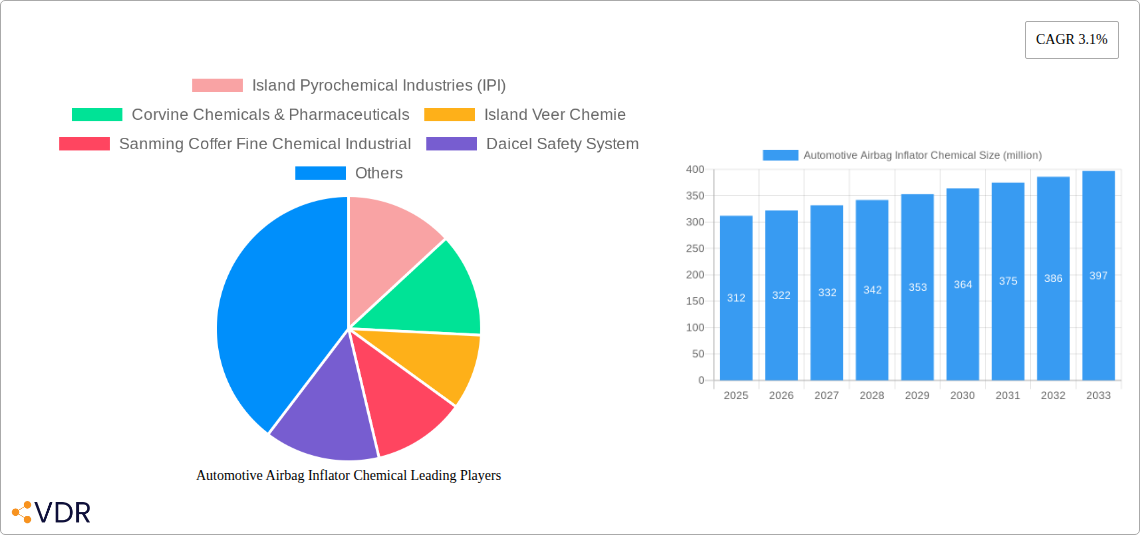
Automotive Airbag Inflator Chemical Market Size (In Million)

While the market exhibits robust growth, certain restraints may influence its pace. The high cost associated with research and development of novel inflator chemicals, coupled with the stringent and evolving regulatory compliance hurdles for automotive safety components, presents significant challenges. Furthermore, the supply chain complexities and the need for specialized manufacturing processes for these chemicals can impact production volumes and costs. Trends such as the development of non-toxic and environmentally friendly inflator chemical alternatives are gaining traction, driven by sustainability initiatives. The market is characterized by key players like Island Pyrochemical Industries (IPI) and Daicel Safety System, who are actively engaged in innovation and strategic partnerships to cater to the evolving demands of the automotive industry. The Asia Pacific region is anticipated to emerge as a significant contributor to market growth, owing to its substantial automotive manufacturing base and increasing adoption of advanced safety features.
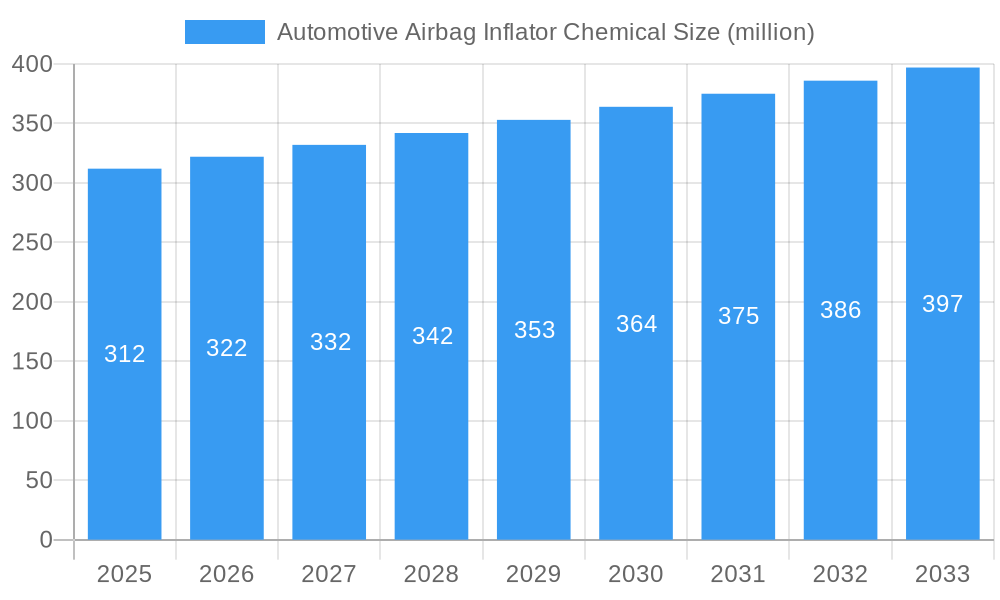
Automotive Airbag Inflator Chemical Company Market Share
Automotive Airbag Inflator Chemical Market: Comprehensive Analysis and Forecast 2019-2033
This report offers an in-depth analysis of the global automotive airbag inflator chemical market, providing critical insights into market dynamics, growth trends, regional dominance, product landscape, and future outlook. Designed for industry professionals, this SEO-optimized report integrates high-traffic keywords to maximize visibility and engagement.
Automotive Airbag Inflator Chemical Market Dynamics & Structure
The automotive airbag inflator chemical market is characterized by a moderate level of concentration, with a few key players dominating production. Technological innovation remains a primary driver, focusing on developing safer, more efficient, and cost-effective inflator compositions. Regulatory frameworks, particularly stringent automotive safety standards globally, are a significant influence, dictating chemical compositions and performance requirements. Competitive product substitutes, such as advancements in passive safety systems and alternative inflation technologies, pose a constant challenge. End-user demographics, driven by increasing vehicle production and a growing demand for enhanced safety features, particularly in emerging economies, shape market evolution. Mergers and acquisition (M&A) trends are observed as companies seek to consolidate market share, expand technological capabilities, and achieve economies of scale.
- Market Concentration: Dominated by a handful of specialized chemical manufacturers.
- Technological Innovation Drivers: Focus on non-azide propellants, faster burn rates, and reduced toxic emissions.
- Regulatory Frameworks: Driven by global NCAP ratings and regional automotive safety mandates.
- Competitive Product Substitutes: Advanced driver-assistance systems (ADAS), reactive safety systems.
- End-User Demographics: Growing middle class in APAC and LATAM, increasing adoption of premium safety features in developed markets.
- M&A Trends: Consolidation for supply chain security and R&D synergies, with an estimated XX M&A deals in the historical period.
Automotive Airbag Inflator Chemical Growth Trends & Insights
The automotive airbag inflator chemical market has witnessed robust growth driven by escalating global vehicle production and an unyielding commitment to automotive safety. The Passenger Car segment, by far the largest application, has consistently outperformed the Commercial Vehicle segment due to higher production volumes. The market is projected to expand from an estimated $XXX million units in the Base Year 2025 to $YYY million units by 2033, reflecting a compound annual growth rate (CAGR) of XX% during the Forecast Period 2025–2033. This sustained growth is underpinned by increasing regulatory mandates for advanced airbag systems across all vehicle classes and a growing consumer awareness of the life-saving benefits of airbags. The adoption rate of advanced inflator technologies, moving beyond traditional Sodium Azide towards safer alternatives like 5-amino Tetrazole, is accelerating. Technological disruptions, such as the development of multi-stage inflators and smart airbag systems that can adjust inflation force based on occupant size and crash severity, are key to market penetration. Consumer behavior shifts towards prioritizing safety features in vehicle purchasing decisions, especially in developed markets, further fuel demand. The historical period (2019–2024) saw steady growth, interrupted briefly by pandemic-related supply chain disruptions, but a strong rebound is evident. The market penetration of airbags in new vehicles is nearing saturation in mature markets but continues to rise significantly in emerging economies. The increasing complexity of vehicle architectures and the integration of more airbags per vehicle (e.g., knee airbags, side curtain airbags) contribute to a higher chemical consumption per vehicle. The development of more compact and lighter inflator systems also allows for greater design flexibility in vehicles, indirectly boosting demand. Furthermore, the aftermarket replacement of airbag systems, though smaller in volume, contributes consistently to market revenue. The shift towards electric vehicles (EVs) presents both opportunities and challenges, as the fundamental need for occupant protection remains paramount, requiring continued innovation in inflator chemistry to accommodate new vehicle designs and weight distributions.
Dominant Regions, Countries, or Segments in Automotive Airbag Inflator Chemical
The Passenger Car segment, encompassing a vast array of vehicles from compact hatchbacks to luxury sedans, is the undisputed leader in driving the growth of the automotive airbag inflator chemical market. Its dominance is fueled by consistently higher production volumes compared to the Commercial Vehicle segment. Within the types of chemicals, 5-amino Tetrazole is emerging as a significant growth driver due to its superior safety profile and environmental advantages over traditional Sodium Azide. The Asia-Pacific (APAC) region, particularly China and India, stands out as the dominant geographical region for this market. This supremacy is attributed to several key factors: a burgeoning automotive manufacturing base, massive domestic demand for vehicles, and increasingly stringent government regulations mandating advanced safety features. China, as the world's largest automotive market, plays a pivotal role, accounting for a substantial share of global production and consequently, airbag inflator chemical consumption. India, with its rapidly expanding middle class and growing vehicle sales, presents immense growth potential. Economic policies promoting domestic manufacturing and foreign investment in the automotive sector further bolster the region's dominance. Infrastructure development, including the expansion of manufacturing facilities and logistics networks, ensures efficient supply chains. The Passenger Car segment's share in the APAC region is estimated to be over XX% of the total market. The increasing adoption of advanced airbag systems, including side-curtain and knee airbags, in mid-range passenger vehicles in these developing economies is a significant contributor to chemical demand. Furthermore, the rise of electric vehicle (EV) adoption in APAC, while a new frontier, necessitates robust safety systems, thus sustaining the demand for inflator chemicals. South Korea and Japan also remain crucial players, known for their technological advancements and premium vehicle exports, which often come equipped with the latest safety innovations. The demand for 5-amino Tetrazole in APAC is projected to grow at a CAGR of XX%, outperforming other regions due to proactive regulatory measures and a higher propensity for adopting next-generation inflator technologies.
Automotive Airbag Inflator Chemical Product Landscape
The product landscape of automotive airbag inflator chemicals is defined by continuous innovation aimed at enhancing safety, reducing environmental impact, and improving cost-effectiveness. Leading chemicals like 5-amino Tetrazole offer improved thermal stability and cleaner combustion byproducts compared to older propellants. Daicel Safety System is a key innovator in this space, focusing on next-generation inflator technologies that are more compact and offer multi-stage inflation capabilities. These advancements allow for tailored airbag deployment based on occupant size, position, and crash severity, enhancing overall occupant protection. The performance metrics of these chemicals are rigorously tested for burn rate, gas yield, and residual toxicity, ensuring compliance with stringent global automotive safety standards. Unique selling propositions often revolve around enhanced safety (non-toxic byproducts), reliability in extreme temperatures, and compatibility with advanced airbag designs.
Key Drivers, Barriers & Challenges in Automotive Airbag Inflator Chemical
Key Drivers:
- Stringent Safety Regulations: Global mandates for advanced airbag systems in all vehicle classes.
- Increasing Vehicle Production: Higher sales volumes directly translate to increased demand.
- Consumer Demand for Safety: Growing awareness and preference for vehicles with comprehensive safety features.
- Technological Advancements: Development of safer, more efficient, and cost-effective inflator chemicals.
- Growth in Emerging Markets: Expanding automotive industries in regions like APAC and LATAM.
Key Barriers & Challenges:
- Supply Chain Volatility: Geopolitical events and raw material availability can impact production and pricing, with potential impact of XX% on component costs.
- Regulatory Hurdles: Evolving and complex chemical safety regulations requiring continuous compliance efforts.
- High R&D Investment: Significant capital required for developing and testing new inflator compositions.
- Competitive Pressures: Intense competition among chemical suppliers to offer cost-effective and superior solutions.
- Environmental Concerns: Increasing scrutiny on the environmental impact of chemical manufacturing and disposal.
Emerging Opportunities in Automotive Airbag Inflator Chemical
Emerging opportunities in the automotive airbag inflator chemical market lie in the development of next-generation propellants with even lower environmental impact and higher energy density. The growing EV market presents a unique opportunity, requiring inflator chemicals that can be integrated into lightweight, advanced battery architectures without compromising safety. Untapped markets in developing nations with increasing vehicle ownership and improving safety awareness offer significant growth potential. Innovative applications, such as smart airbags that can adapt to real-time crash dynamics, and the potential for modular inflator systems that can be customized for different vehicle platforms, are key areas for exploration. Evolving consumer preferences towards sustainable and eco-friendly vehicle components also drive demand for greener inflator chemical solutions.
Growth Accelerators in the Automotive Airbag Inflator Chemical Industry
Catalysts driving long-term growth in the automotive airbag inflator chemical industry are multi-faceted. Technological breakthroughs in materials science are enabling the creation of novel propellants that offer enhanced performance with reduced environmental footprint. Strategic partnerships between chemical manufacturers and automotive OEMs are crucial for co-developing integrated safety solutions and ensuring timely adoption of new technologies. Market expansion strategies, particularly targeting high-growth emerging economies with tailored product offerings and competitive pricing, will be instrumental. Furthermore, the ongoing trend of increasing the number of airbags per vehicle, including advanced curtain and knee airbags, significantly amplifies the demand for inflator chemicals. The continuous drive for miniaturization and weight reduction in vehicle components also necessitates the development of more concentrated and efficient chemical formulations.
Key Players Shaping the Automotive Airbag Inflator Chemical Market
- Island Pyrochemical Industries (IPI)
- Corvine Chemicals & Pharmaceuticals
- Island Veer Chemie
- Sanming Coffer Fine Chemical Industrial
- Daicel Safety System
Notable Milestones in Automotive Airbag Inflator Chemical Sector
- 2019/2020: Increased focus on non-azide propellants due to safety and environmental concerns.
- 2020/2021: Impact of global supply chain disruptions on raw material availability and pricing.
- 2021/2022: Introduction of advanced multi-stage inflator technologies by key players.
- 2022/2023: Growing regulatory pressure for sustainable and recyclable inflator components.
- 2023/2024: Expansion of airbag systems in commercial vehicles, particularly for enhanced driver safety.
In-Depth Automotive Airbag Inflator Chemical Market Outlook
The future market potential for automotive airbag inflator chemicals remains exceptionally strong, driven by an unyielding global commitment to vehicle safety and the continuous evolution of automotive technology. Growth accelerators, including breakthroughs in material science, strategic OEM collaborations, and targeted market expansion in emerging economies, will continue to propel the industry forward. Strategic opportunities lie in developing advanced, eco-friendly propellants for electric vehicles and exploring modular inflator designs for greater customization. The anticipated market size is projected to reach $ZZZ million units by 2033, underscoring the sustained demand and innovation within this critical segment of the automotive safety ecosystem.
Automotive Airbag Inflator Chemical Segmentation
-
1. Application
- 1.1. Passenger Car
- 1.2. Commercial Vehicle
-
2. Types
- 2.1. 5-amino Tetrazole
- 2.2. Sodium Azide
- 2.3. Ammonium Nitrate
- 2.4. Potassium Nitrate
- 2.5. Ammonium Perchlorate
- 2.6. Others
Automotive Airbag Inflator Chemical Segmentation By Geography
-
1. North America
- 1.1. United States
- 1.2. Canada
- 1.3. Mexico
-
2. South America
- 2.1. Brazil
- 2.2. Argentina
- 2.3. Rest of South America
-
3. Europe
- 3.1. United Kingdom
- 3.2. Germany
- 3.3. France
- 3.4. Italy
- 3.5. Spain
- 3.6. Russia
- 3.7. Benelux
- 3.8. Nordics
- 3.9. Rest of Europe
-
4. Middle East & Africa
- 4.1. Turkey
- 4.2. Israel
- 4.3. GCC
- 4.4. North Africa
- 4.5. South Africa
- 4.6. Rest of Middle East & Africa
-
5. Asia Pacific
- 5.1. China
- 5.2. India
- 5.3. Japan
- 5.4. South Korea
- 5.5. ASEAN
- 5.6. Oceania
- 5.7. Rest of Asia Pacific
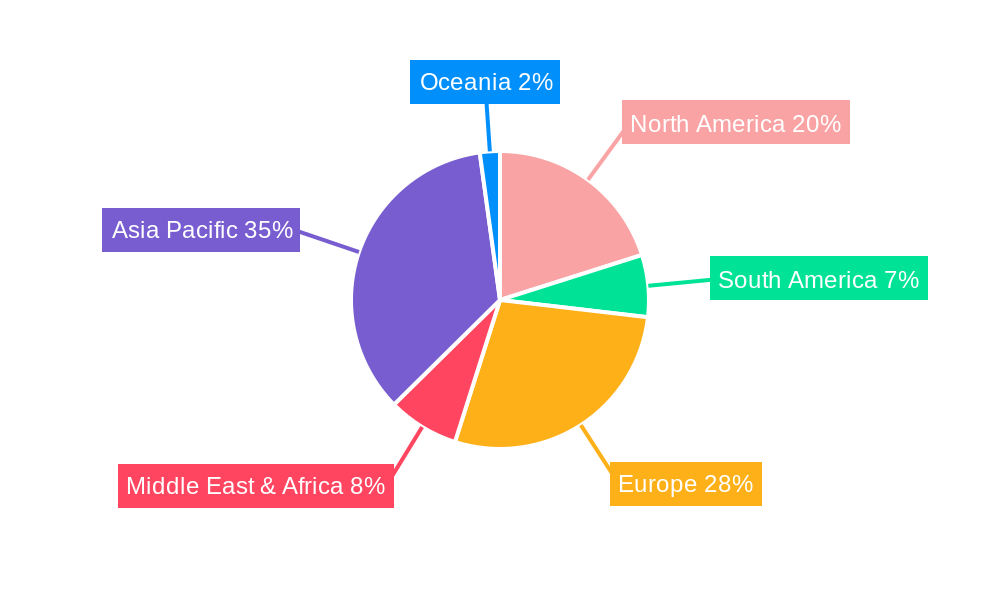
Automotive Airbag Inflator Chemical Regional Market Share
Geographic Coverage of Automotive Airbag Inflator Chemical
Automotive Airbag Inflator Chemical REPORT HIGHLIGHTS
| Aspects | Details |
|---|---|
| Study Period | 2020-2034 |
| Base Year | 2025 |
| Estimated Year | 2026 |
| Forecast Period | 2026-2034 |
| Historical Period | 2020-2025 |
| Growth Rate | CAGR of 3.1% from 2020-2034 |
| Segmentation |
|
Table of Contents
- 1. Introduction
- 1.1. Research Scope
- 1.2. Market Segmentation
- 1.3. Research Methodology
- 1.4. Definitions and Assumptions
- 2. Executive Summary
- 2.1. Introduction
- 3. Market Dynamics
- 3.1. Introduction
- 3.2. Market Drivers
- 3.3. Market Restrains
- 3.4. Market Trends
- 4. Market Factor Analysis
- 4.1. Porters Five Forces
- 4.2. Supply/Value Chain
- 4.3. PESTEL analysis
- 4.4. Market Entropy
- 4.5. Patent/Trademark Analysis
- 5. Global Automotive Airbag Inflator Chemical Analysis, Insights and Forecast, 2020-2032
- 5.1. Market Analysis, Insights and Forecast - by Application
- 5.1.1. Passenger Car
- 5.1.2. Commercial Vehicle
- 5.2. Market Analysis, Insights and Forecast - by Types
- 5.2.1. 5-amino Tetrazole
- 5.2.2. Sodium Azide
- 5.2.3. Ammonium Nitrate
- 5.2.4. Potassium Nitrate
- 5.2.5. Ammonium Perchlorate
- 5.2.6. Others
- 5.3. Market Analysis, Insights and Forecast - by Region
- 5.3.1. North America
- 5.3.2. South America
- 5.3.3. Europe
- 5.3.4. Middle East & Africa
- 5.3.5. Asia Pacific
- 5.1. Market Analysis, Insights and Forecast - by Application
- 6. North America Automotive Airbag Inflator Chemical Analysis, Insights and Forecast, 2020-2032
- 6.1. Market Analysis, Insights and Forecast - by Application
- 6.1.1. Passenger Car
- 6.1.2. Commercial Vehicle
- 6.2. Market Analysis, Insights and Forecast - by Types
- 6.2.1. 5-amino Tetrazole
- 6.2.2. Sodium Azide
- 6.2.3. Ammonium Nitrate
- 6.2.4. Potassium Nitrate
- 6.2.5. Ammonium Perchlorate
- 6.2.6. Others
- 6.1. Market Analysis, Insights and Forecast - by Application
- 7. South America Automotive Airbag Inflator Chemical Analysis, Insights and Forecast, 2020-2032
- 7.1. Market Analysis, Insights and Forecast - by Application
- 7.1.1. Passenger Car
- 7.1.2. Commercial Vehicle
- 7.2. Market Analysis, Insights and Forecast - by Types
- 7.2.1. 5-amino Tetrazole
- 7.2.2. Sodium Azide
- 7.2.3. Ammonium Nitrate
- 7.2.4. Potassium Nitrate
- 7.2.5. Ammonium Perchlorate
- 7.2.6. Others
- 7.1. Market Analysis, Insights and Forecast - by Application
- 8. Europe Automotive Airbag Inflator Chemical Analysis, Insights and Forecast, 2020-2032
- 8.1. Market Analysis, Insights and Forecast - by Application
- 8.1.1. Passenger Car
- 8.1.2. Commercial Vehicle
- 8.2. Market Analysis, Insights and Forecast - by Types
- 8.2.1. 5-amino Tetrazole
- 8.2.2. Sodium Azide
- 8.2.3. Ammonium Nitrate
- 8.2.4. Potassium Nitrate
- 8.2.5. Ammonium Perchlorate
- 8.2.6. Others
- 8.1. Market Analysis, Insights and Forecast - by Application
- 9. Middle East & Africa Automotive Airbag Inflator Chemical Analysis, Insights and Forecast, 2020-2032
- 9.1. Market Analysis, Insights and Forecast - by Application
- 9.1.1. Passenger Car
- 9.1.2. Commercial Vehicle
- 9.2. Market Analysis, Insights and Forecast - by Types
- 9.2.1. 5-amino Tetrazole
- 9.2.2. Sodium Azide
- 9.2.3. Ammonium Nitrate
- 9.2.4. Potassium Nitrate
- 9.2.5. Ammonium Perchlorate
- 9.2.6. Others
- 9.1. Market Analysis, Insights and Forecast - by Application
- 10. Asia Pacific Automotive Airbag Inflator Chemical Analysis, Insights and Forecast, 2020-2032
- 10.1. Market Analysis, Insights and Forecast - by Application
- 10.1.1. Passenger Car
- 10.1.2. Commercial Vehicle
- 10.2. Market Analysis, Insights and Forecast - by Types
- 10.2.1. 5-amino Tetrazole
- 10.2.2. Sodium Azide
- 10.2.3. Ammonium Nitrate
- 10.2.4. Potassium Nitrate
- 10.2.5. Ammonium Perchlorate
- 10.2.6. Others
- 10.1. Market Analysis, Insights and Forecast - by Application
- 11. Competitive Analysis
- 11.1. Global Market Share Analysis 2025
- 11.2. Company Profiles
- 11.2.1 Island Pyrochemical Industries (IPI)
- 11.2.1.1. Overview
- 11.2.1.2. Products
- 11.2.1.3. SWOT Analysis
- 11.2.1.4. Recent Developments
- 11.2.1.5. Financials (Based on Availability)
- 11.2.2 Corvine Chemicals & Pharmaceuticals
- 11.2.2.1. Overview
- 11.2.2.2. Products
- 11.2.2.3. SWOT Analysis
- 11.2.2.4. Recent Developments
- 11.2.2.5. Financials (Based on Availability)
- 11.2.3 Island Veer Chemie
- 11.2.3.1. Overview
- 11.2.3.2. Products
- 11.2.3.3. SWOT Analysis
- 11.2.3.4. Recent Developments
- 11.2.3.5. Financials (Based on Availability)
- 11.2.4 Sanming Coffer Fine Chemical Industrial
- 11.2.4.1. Overview
- 11.2.4.2. Products
- 11.2.4.3. SWOT Analysis
- 11.2.4.4. Recent Developments
- 11.2.4.5. Financials (Based on Availability)
- 11.2.5 Daicel Safety System
- 11.2.5.1. Overview
- 11.2.5.2. Products
- 11.2.5.3. SWOT Analysis
- 11.2.5.4. Recent Developments
- 11.2.5.5. Financials (Based on Availability)
- 11.2.1 Island Pyrochemical Industries (IPI)
List of Figures
- Figure 1: Global Automotive Airbag Inflator Chemical Revenue Breakdown (million, %) by Region 2025 & 2033
- Figure 2: Global Automotive Airbag Inflator Chemical Volume Breakdown (K, %) by Region 2025 & 2033
- Figure 3: North America Automotive Airbag Inflator Chemical Revenue (million), by Application 2025 & 2033
- Figure 4: North America Automotive Airbag Inflator Chemical Volume (K), by Application 2025 & 2033
- Figure 5: North America Automotive Airbag Inflator Chemical Revenue Share (%), by Application 2025 & 2033
- Figure 6: North America Automotive Airbag Inflator Chemical Volume Share (%), by Application 2025 & 2033
- Figure 7: North America Automotive Airbag Inflator Chemical Revenue (million), by Types 2025 & 2033
- Figure 8: North America Automotive Airbag Inflator Chemical Volume (K), by Types 2025 & 2033
- Figure 9: North America Automotive Airbag Inflator Chemical Revenue Share (%), by Types 2025 & 2033
- Figure 10: North America Automotive Airbag Inflator Chemical Volume Share (%), by Types 2025 & 2033
- Figure 11: North America Automotive Airbag Inflator Chemical Revenue (million), by Country 2025 & 2033
- Figure 12: North America Automotive Airbag Inflator Chemical Volume (K), by Country 2025 & 2033
- Figure 13: North America Automotive Airbag Inflator Chemical Revenue Share (%), by Country 2025 & 2033
- Figure 14: North America Automotive Airbag Inflator Chemical Volume Share (%), by Country 2025 & 2033
- Figure 15: South America Automotive Airbag Inflator Chemical Revenue (million), by Application 2025 & 2033
- Figure 16: South America Automotive Airbag Inflator Chemical Volume (K), by Application 2025 & 2033
- Figure 17: South America Automotive Airbag Inflator Chemical Revenue Share (%), by Application 2025 & 2033
- Figure 18: South America Automotive Airbag Inflator Chemical Volume Share (%), by Application 2025 & 2033
- Figure 19: South America Automotive Airbag Inflator Chemical Revenue (million), by Types 2025 & 2033
- Figure 20: South America Automotive Airbag Inflator Chemical Volume (K), by Types 2025 & 2033
- Figure 21: South America Automotive Airbag Inflator Chemical Revenue Share (%), by Types 2025 & 2033
- Figure 22: South America Automotive Airbag Inflator Chemical Volume Share (%), by Types 2025 & 2033
- Figure 23: South America Automotive Airbag Inflator Chemical Revenue (million), by Country 2025 & 2033
- Figure 24: South America Automotive Airbag Inflator Chemical Volume (K), by Country 2025 & 2033
- Figure 25: South America Automotive Airbag Inflator Chemical Revenue Share (%), by Country 2025 & 2033
- Figure 26: South America Automotive Airbag Inflator Chemical Volume Share (%), by Country 2025 & 2033
- Figure 27: Europe Automotive Airbag Inflator Chemical Revenue (million), by Application 2025 & 2033
- Figure 28: Europe Automotive Airbag Inflator Chemical Volume (K), by Application 2025 & 2033
- Figure 29: Europe Automotive Airbag Inflator Chemical Revenue Share (%), by Application 2025 & 2033
- Figure 30: Europe Automotive Airbag Inflator Chemical Volume Share (%), by Application 2025 & 2033
- Figure 31: Europe Automotive Airbag Inflator Chemical Revenue (million), by Types 2025 & 2033
- Figure 32: Europe Automotive Airbag Inflator Chemical Volume (K), by Types 2025 & 2033
- Figure 33: Europe Automotive Airbag Inflator Chemical Revenue Share (%), by Types 2025 & 2033
- Figure 34: Europe Automotive Airbag Inflator Chemical Volume Share (%), by Types 2025 & 2033
- Figure 35: Europe Automotive Airbag Inflator Chemical Revenue (million), by Country 2025 & 2033
- Figure 36: Europe Automotive Airbag Inflator Chemical Volume (K), by Country 2025 & 2033
- Figure 37: Europe Automotive Airbag Inflator Chemical Revenue Share (%), by Country 2025 & 2033
- Figure 38: Europe Automotive Airbag Inflator Chemical Volume Share (%), by Country 2025 & 2033
- Figure 39: Middle East & Africa Automotive Airbag Inflator Chemical Revenue (million), by Application 2025 & 2033
- Figure 40: Middle East & Africa Automotive Airbag Inflator Chemical Volume (K), by Application 2025 & 2033
- Figure 41: Middle East & Africa Automotive Airbag Inflator Chemical Revenue Share (%), by Application 2025 & 2033
- Figure 42: Middle East & Africa Automotive Airbag Inflator Chemical Volume Share (%), by Application 2025 & 2033
- Figure 43: Middle East & Africa Automotive Airbag Inflator Chemical Revenue (million), by Types 2025 & 2033
- Figure 44: Middle East & Africa Automotive Airbag Inflator Chemical Volume (K), by Types 2025 & 2033
- Figure 45: Middle East & Africa Automotive Airbag Inflator Chemical Revenue Share (%), by Types 2025 & 2033
- Figure 46: Middle East & Africa Automotive Airbag Inflator Chemical Volume Share (%), by Types 2025 & 2033
- Figure 47: Middle East & Africa Automotive Airbag Inflator Chemical Revenue (million), by Country 2025 & 2033
- Figure 48: Middle East & Africa Automotive Airbag Inflator Chemical Volume (K), by Country 2025 & 2033
- Figure 49: Middle East & Africa Automotive Airbag Inflator Chemical Revenue Share (%), by Country 2025 & 2033
- Figure 50: Middle East & Africa Automotive Airbag Inflator Chemical Volume Share (%), by Country 2025 & 2033
- Figure 51: Asia Pacific Automotive Airbag Inflator Chemical Revenue (million), by Application 2025 & 2033
- Figure 52: Asia Pacific Automotive Airbag Inflator Chemical Volume (K), by Application 2025 & 2033
- Figure 53: Asia Pacific Automotive Airbag Inflator Chemical Revenue Share (%), by Application 2025 & 2033
- Figure 54: Asia Pacific Automotive Airbag Inflator Chemical Volume Share (%), by Application 2025 & 2033
- Figure 55: Asia Pacific Automotive Airbag Inflator Chemical Revenue (million), by Types 2025 & 2033
- Figure 56: Asia Pacific Automotive Airbag Inflator Chemical Volume (K), by Types 2025 & 2033
- Figure 57: Asia Pacific Automotive Airbag Inflator Chemical Revenue Share (%), by Types 2025 & 2033
- Figure 58: Asia Pacific Automotive Airbag Inflator Chemical Volume Share (%), by Types 2025 & 2033
- Figure 59: Asia Pacific Automotive Airbag Inflator Chemical Revenue (million), by Country 2025 & 2033
- Figure 60: Asia Pacific Automotive Airbag Inflator Chemical Volume (K), by Country 2025 & 2033
- Figure 61: Asia Pacific Automotive Airbag Inflator Chemical Revenue Share (%), by Country 2025 & 2033
- Figure 62: Asia Pacific Automotive Airbag Inflator Chemical Volume Share (%), by Country 2025 & 2033
List of Tables
- Table 1: Global Automotive Airbag Inflator Chemical Revenue million Forecast, by Application 2020 & 2033
- Table 2: Global Automotive Airbag Inflator Chemical Volume K Forecast, by Application 2020 & 2033
- Table 3: Global Automotive Airbag Inflator Chemical Revenue million Forecast, by Types 2020 & 2033
- Table 4: Global Automotive Airbag Inflator Chemical Volume K Forecast, by Types 2020 & 2033
- Table 5: Global Automotive Airbag Inflator Chemical Revenue million Forecast, by Region 2020 & 2033
- Table 6: Global Automotive Airbag Inflator Chemical Volume K Forecast, by Region 2020 & 2033
- Table 7: Global Automotive Airbag Inflator Chemical Revenue million Forecast, by Application 2020 & 2033
- Table 8: Global Automotive Airbag Inflator Chemical Volume K Forecast, by Application 2020 & 2033
- Table 9: Global Automotive Airbag Inflator Chemical Revenue million Forecast, by Types 2020 & 2033
- Table 10: Global Automotive Airbag Inflator Chemical Volume K Forecast, by Types 2020 & 2033
- Table 11: Global Automotive Airbag Inflator Chemical Revenue million Forecast, by Country 2020 & 2033
- Table 12: Global Automotive Airbag Inflator Chemical Volume K Forecast, by Country 2020 & 2033
- Table 13: United States Automotive Airbag Inflator Chemical Revenue (million) Forecast, by Application 2020 & 2033
- Table 14: United States Automotive Airbag Inflator Chemical Volume (K) Forecast, by Application 2020 & 2033
- Table 15: Canada Automotive Airbag Inflator Chemical Revenue (million) Forecast, by Application 2020 & 2033
- Table 16: Canada Automotive Airbag Inflator Chemical Volume (K) Forecast, by Application 2020 & 2033
- Table 17: Mexico Automotive Airbag Inflator Chemical Revenue (million) Forecast, by Application 2020 & 2033
- Table 18: Mexico Automotive Airbag Inflator Chemical Volume (K) Forecast, by Application 2020 & 2033
- Table 19: Global Automotive Airbag Inflator Chemical Revenue million Forecast, by Application 2020 & 2033
- Table 20: Global Automotive Airbag Inflator Chemical Volume K Forecast, by Application 2020 & 2033
- Table 21: Global Automotive Airbag Inflator Chemical Revenue million Forecast, by Types 2020 & 2033
- Table 22: Global Automotive Airbag Inflator Chemical Volume K Forecast, by Types 2020 & 2033
- Table 23: Global Automotive Airbag Inflator Chemical Revenue million Forecast, by Country 2020 & 2033
- Table 24: Global Automotive Airbag Inflator Chemical Volume K Forecast, by Country 2020 & 2033
- Table 25: Brazil Automotive Airbag Inflator Chemical Revenue (million) Forecast, by Application 2020 & 2033
- Table 26: Brazil Automotive Airbag Inflator Chemical Volume (K) Forecast, by Application 2020 & 2033
- Table 27: Argentina Automotive Airbag Inflator Chemical Revenue (million) Forecast, by Application 2020 & 2033
- Table 28: Argentina Automotive Airbag Inflator Chemical Volume (K) Forecast, by Application 2020 & 2033
- Table 29: Rest of South America Automotive Airbag Inflator Chemical Revenue (million) Forecast, by Application 2020 & 2033
- Table 30: Rest of South America Automotive Airbag Inflator Chemical Volume (K) Forecast, by Application 2020 & 2033
- Table 31: Global Automotive Airbag Inflator Chemical Revenue million Forecast, by Application 2020 & 2033
- Table 32: Global Automotive Airbag Inflator Chemical Volume K Forecast, by Application 2020 & 2033
- Table 33: Global Automotive Airbag Inflator Chemical Revenue million Forecast, by Types 2020 & 2033
- Table 34: Global Automotive Airbag Inflator Chemical Volume K Forecast, by Types 2020 & 2033
- Table 35: Global Automotive Airbag Inflator Chemical Revenue million Forecast, by Country 2020 & 2033
- Table 36: Global Automotive Airbag Inflator Chemical Volume K Forecast, by Country 2020 & 2033
- Table 37: United Kingdom Automotive Airbag Inflator Chemical Revenue (million) Forecast, by Application 2020 & 2033
- Table 38: United Kingdom Automotive Airbag Inflator Chemical Volume (K) Forecast, by Application 2020 & 2033
- Table 39: Germany Automotive Airbag Inflator Chemical Revenue (million) Forecast, by Application 2020 & 2033
- Table 40: Germany Automotive Airbag Inflator Chemical Volume (K) Forecast, by Application 2020 & 2033
- Table 41: France Automotive Airbag Inflator Chemical Revenue (million) Forecast, by Application 2020 & 2033
- Table 42: France Automotive Airbag Inflator Chemical Volume (K) Forecast, by Application 2020 & 2033
- Table 43: Italy Automotive Airbag Inflator Chemical Revenue (million) Forecast, by Application 2020 & 2033
- Table 44: Italy Automotive Airbag Inflator Chemical Volume (K) Forecast, by Application 2020 & 2033
- Table 45: Spain Automotive Airbag Inflator Chemical Revenue (million) Forecast, by Application 2020 & 2033
- Table 46: Spain Automotive Airbag Inflator Chemical Volume (K) Forecast, by Application 2020 & 2033
- Table 47: Russia Automotive Airbag Inflator Chemical Revenue (million) Forecast, by Application 2020 & 2033
- Table 48: Russia Automotive Airbag Inflator Chemical Volume (K) Forecast, by Application 2020 & 2033
- Table 49: Benelux Automotive Airbag Inflator Chemical Revenue (million) Forecast, by Application 2020 & 2033
- Table 50: Benelux Automotive Airbag Inflator Chemical Volume (K) Forecast, by Application 2020 & 2033
- Table 51: Nordics Automotive Airbag Inflator Chemical Revenue (million) Forecast, by Application 2020 & 2033
- Table 52: Nordics Automotive Airbag Inflator Chemical Volume (K) Forecast, by Application 2020 & 2033
- Table 53: Rest of Europe Automotive Airbag Inflator Chemical Revenue (million) Forecast, by Application 2020 & 2033
- Table 54: Rest of Europe Automotive Airbag Inflator Chemical Volume (K) Forecast, by Application 2020 & 2033
- Table 55: Global Automotive Airbag Inflator Chemical Revenue million Forecast, by Application 2020 & 2033
- Table 56: Global Automotive Airbag Inflator Chemical Volume K Forecast, by Application 2020 & 2033
- Table 57: Global Automotive Airbag Inflator Chemical Revenue million Forecast, by Types 2020 & 2033
- Table 58: Global Automotive Airbag Inflator Chemical Volume K Forecast, by Types 2020 & 2033
- Table 59: Global Automotive Airbag Inflator Chemical Revenue million Forecast, by Country 2020 & 2033
- Table 60: Global Automotive Airbag Inflator Chemical Volume K Forecast, by Country 2020 & 2033
- Table 61: Turkey Automotive Airbag Inflator Chemical Revenue (million) Forecast, by Application 2020 & 2033
- Table 62: Turkey Automotive Airbag Inflator Chemical Volume (K) Forecast, by Application 2020 & 2033
- Table 63: Israel Automotive Airbag Inflator Chemical Revenue (million) Forecast, by Application 2020 & 2033
- Table 64: Israel Automotive Airbag Inflator Chemical Volume (K) Forecast, by Application 2020 & 2033
- Table 65: GCC Automotive Airbag Inflator Chemical Revenue (million) Forecast, by Application 2020 & 2033
- Table 66: GCC Automotive Airbag Inflator Chemical Volume (K) Forecast, by Application 2020 & 2033
- Table 67: North Africa Automotive Airbag Inflator Chemical Revenue (million) Forecast, by Application 2020 & 2033
- Table 68: North Africa Automotive Airbag Inflator Chemical Volume (K) Forecast, by Application 2020 & 2033
- Table 69: South Africa Automotive Airbag Inflator Chemical Revenue (million) Forecast, by Application 2020 & 2033
- Table 70: South Africa Automotive Airbag Inflator Chemical Volume (K) Forecast, by Application 2020 & 2033
- Table 71: Rest of Middle East & Africa Automotive Airbag Inflator Chemical Revenue (million) Forecast, by Application 2020 & 2033
- Table 72: Rest of Middle East & Africa Automotive Airbag Inflator Chemical Volume (K) Forecast, by Application 2020 & 2033
- Table 73: Global Automotive Airbag Inflator Chemical Revenue million Forecast, by Application 2020 & 2033
- Table 74: Global Automotive Airbag Inflator Chemical Volume K Forecast, by Application 2020 & 2033
- Table 75: Global Automotive Airbag Inflator Chemical Revenue million Forecast, by Types 2020 & 2033
- Table 76: Global Automotive Airbag Inflator Chemical Volume K Forecast, by Types 2020 & 2033
- Table 77: Global Automotive Airbag Inflator Chemical Revenue million Forecast, by Country 2020 & 2033
- Table 78: Global Automotive Airbag Inflator Chemical Volume K Forecast, by Country 2020 & 2033
- Table 79: China Automotive Airbag Inflator Chemical Revenue (million) Forecast, by Application 2020 & 2033
- Table 80: China Automotive Airbag Inflator Chemical Volume (K) Forecast, by Application 2020 & 2033
- Table 81: India Automotive Airbag Inflator Chemical Revenue (million) Forecast, by Application 2020 & 2033
- Table 82: India Automotive Airbag Inflator Chemical Volume (K) Forecast, by Application 2020 & 2033
- Table 83: Japan Automotive Airbag Inflator Chemical Revenue (million) Forecast, by Application 2020 & 2033
- Table 84: Japan Automotive Airbag Inflator Chemical Volume (K) Forecast, by Application 2020 & 2033
- Table 85: South Korea Automotive Airbag Inflator Chemical Revenue (million) Forecast, by Application 2020 & 2033
- Table 86: South Korea Automotive Airbag Inflator Chemical Volume (K) Forecast, by Application 2020 & 2033
- Table 87: ASEAN Automotive Airbag Inflator Chemical Revenue (million) Forecast, by Application 2020 & 2033
- Table 88: ASEAN Automotive Airbag Inflator Chemical Volume (K) Forecast, by Application 2020 & 2033
- Table 89: Oceania Automotive Airbag Inflator Chemical Revenue (million) Forecast, by Application 2020 & 2033
- Table 90: Oceania Automotive Airbag Inflator Chemical Volume (K) Forecast, by Application 2020 & 2033
- Table 91: Rest of Asia Pacific Automotive Airbag Inflator Chemical Revenue (million) Forecast, by Application 2020 & 2033
- Table 92: Rest of Asia Pacific Automotive Airbag Inflator Chemical Volume (K) Forecast, by Application 2020 & 2033
Frequently Asked Questions
1. What is the projected Compound Annual Growth Rate (CAGR) of the Automotive Airbag Inflator Chemical?
The projected CAGR is approximately 3.1%.
2. Which companies are prominent players in the Automotive Airbag Inflator Chemical?
Key companies in the market include Island Pyrochemical Industries (IPI), Corvine Chemicals & Pharmaceuticals, Island Veer Chemie, Sanming Coffer Fine Chemical Industrial, Daicel Safety System.
3. What are the main segments of the Automotive Airbag Inflator Chemical?
The market segments include Application, Types.
4. Can you provide details about the market size?
The market size is estimated to be USD 312 million as of 2022.
5. What are some drivers contributing to market growth?
N/A
6. What are the notable trends driving market growth?
N/A
7. Are there any restraints impacting market growth?
N/A
8. Can you provide examples of recent developments in the market?
N/A
9. What pricing options are available for accessing the report?
Pricing options include single-user, multi-user, and enterprise licenses priced at USD 4350.00, USD 6525.00, and USD 8700.00 respectively.
10. Is the market size provided in terms of value or volume?
The market size is provided in terms of value, measured in million and volume, measured in K.
11. Are there any specific market keywords associated with the report?
Yes, the market keyword associated with the report is "Automotive Airbag Inflator Chemical," which aids in identifying and referencing the specific market segment covered.
12. How do I determine which pricing option suits my needs best?
The pricing options vary based on user requirements and access needs. Individual users may opt for single-user licenses, while businesses requiring broader access may choose multi-user or enterprise licenses for cost-effective access to the report.
13. Are there any additional resources or data provided in the Automotive Airbag Inflator Chemical report?
While the report offers comprehensive insights, it's advisable to review the specific contents or supplementary materials provided to ascertain if additional resources or data are available.
14. How can I stay updated on further developments or reports in the Automotive Airbag Inflator Chemical?
To stay informed about further developments, trends, and reports in the Automotive Airbag Inflator Chemical, consider subscribing to industry newsletters, following relevant companies and organizations, or regularly checking reputable industry news sources and publications.
Methodology
Step 1 - Identification of Relevant Samples Size from Population Database



Step 2 - Approaches for Defining Global Market Size (Value, Volume* & Price*)

Note*: In applicable scenarios
Step 3 - Data Sources
Primary Research
- Web Analytics
- Survey Reports
- Research Institute
- Latest Research Reports
- Opinion Leaders
Secondary Research
- Annual Reports
- White Paper
- Latest Press Release
- Industry Association
- Paid Database
- Investor Presentations

Step 4 - Data Triangulation
Involves using different sources of information in order to increase the validity of a study
These sources are likely to be stakeholders in a program - participants, other researchers, program staff, other community members, and so on.
Then we put all data in single framework & apply various statistical tools to find out the dynamic on the market.
During the analysis stage, feedback from the stakeholder groups would be compared to determine areas of agreement as well as areas of divergence

