


Key Insights
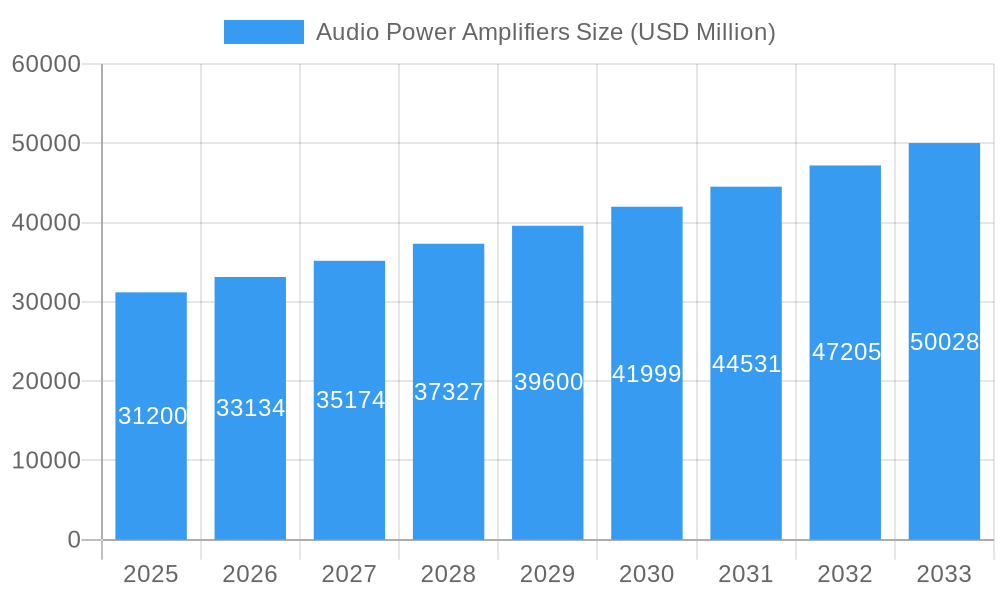
The global Audio Power Amplifiers market is poised for robust growth, projected to reach $31.2 billion in 2025. Driven by the relentless demand for immersive audio experiences across consumer electronics, automotive systems, and computing devices, the market is anticipated to expand at a Compound Annual Growth Rate (CAGR) of 6.2% through 2033. This growth is fueled by several key factors. The burgeoning consumer electronics sector, encompassing smartphones, smart home devices, and portable audio equipment, consistently integrates advanced audio solutions. Simultaneously, the automotive industry's increasing focus on in-car entertainment and advanced driver-assistance systems (ADAS) with audible alerts necessitates sophisticated audio amplification. Furthermore, the expanding use of high-fidelity audio in personal computers and enterprise solutions for communication and multimedia applications contributes significantly to market expansion. Emerging trends such as the integration of Class-D amplifiers for their superior energy efficiency and miniaturization capabilities, coupled with the rising adoption of artificial intelligence for audio processing, are expected to shape the market's trajectory.
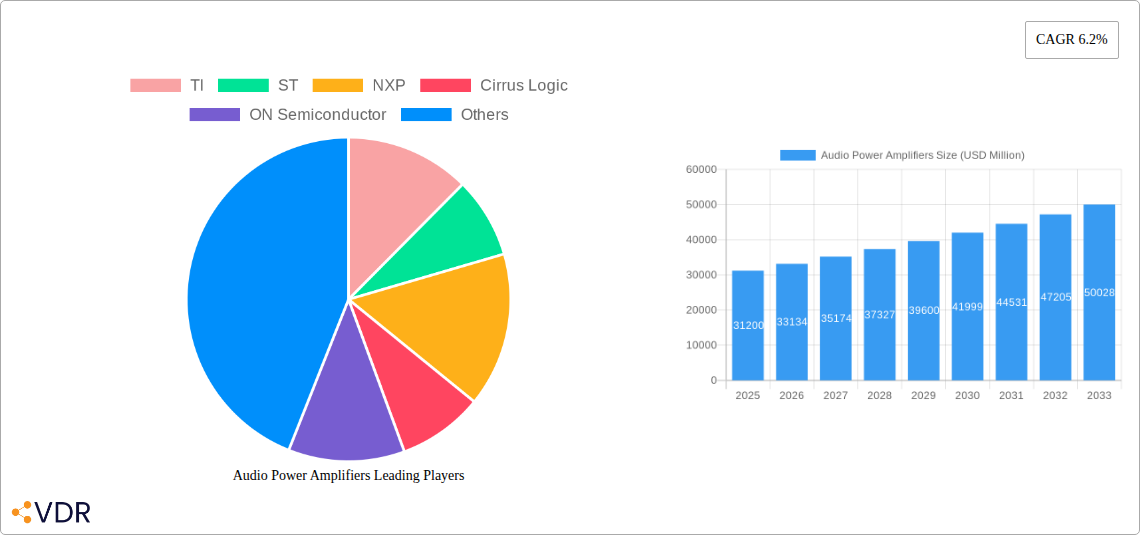
Audio Power Amplifiers Market Size (In Billion)

The market's growth, however, is not without its challenges. While the demand is strong, certain restraints could temper the pace of expansion. High development costs associated with advanced amplifier technologies and the need for specialized manufacturing processes can pose barriers to entry and innovation for smaller players. Additionally, intense price competition among established manufacturers, particularly for high-volume consumer applications, can impact profit margins. Despite these hurdles, the diverse application spectrum, from consumer-grade audio systems to high-performance automotive and enterprise solutions, offers a broad base for sustained growth. The market is segmented by application into Consumer, Automotive, Computer, and Enterprise, with Consumer and Automotive expected to be the largest segments. By type, Class-A, Class-B, Class-A/B, Class-G&H, and Class-D amplifiers cater to varying performance and efficiency requirements. Key regions like Asia Pacific, North America, and Europe are expected to dominate the market due to significant manufacturing capabilities and high consumer spending on audio-centric devices.
Audio Power Amplifiers Company Market Share
Here's a compelling, SEO-optimized report description for Audio Power Amplifiers, structured as requested:
Audio Power Amplifiers Market Dynamics & Structure
The global Audio Power Amplifiers market is characterized by a moderate level of concentration, with key players like Texas Instruments (TI), STMicroelectronics (ST), NXP Semiconductors, Cirrus Logic, and ON Semiconductor holding significant shares. Technological innovation remains a primary driver, fueled by advancements in Class-D amplifier efficiency and miniaturization, crucial for mobile devices and IoT applications. Regulatory frameworks, particularly those concerning energy efficiency and electromagnetic compatibility (EMC), are increasingly shaping product development and market entry. Competitive product substitutes, while present, often struggle to match the integrated solutions and performance metrics offered by specialized audio power amplifier chips. End-user demographics are shifting towards a demand for higher fidelity audio in portable and automotive segments, influencing product design. Mergers & Acquisitions (M&A) activity, while not exceptionally high, has focused on acquiring specialized IP and expanding product portfolios to capture broader market segments. For instance, the acquisition of Maxim Integrated by Analog Devices (ADI) aimed to bolster their analog and mixed-signal offerings.
- Market Concentration: Moderate, with top players dominating specific niches.
- Technological Innovation: Driven by Class-D efficiency, miniaturization, and integration.
- Regulatory Frameworks: Focus on energy efficiency and EMC standards.
- Competitive Substitutes: Limited in achieving comparable integrated performance.
- End-User Demographics: Growing demand for premium audio in consumer and automotive.
- M&A Trends: Strategic acquisitions for IP and portfolio expansion.
Audio Power Amplifiers Growth Trends & Insights
The Audio Power Amplifiers market is poised for robust expansion, projected to grow from an estimated $24.5 billion in 2025 to $40.2 billion by 2033, exhibiting a Compound Annual Growth Rate (CAGR) of approximately 6.5%. This growth is underpinned by the escalating demand for immersive audio experiences across a myriad of applications, from high-fidelity home theater systems and professional audio equipment to the increasingly sophisticated sound systems integrated into automotive vehicles and personal electronic devices. The historical period from 2019 to 2024 saw steady growth, driven by the proliferation of smartphones and the rising popularity of smart speakers and soundbars. The base year of 2025 marks a significant point, with anticipated market size of $24.5 billion, reflecting strong post-pandemic recovery and sustained consumer spending on electronics.
Technological disruptions are a key influencer, with the ongoing refinement of Class-D amplifiers leading to improved efficiency, reduced heat dissipation, and smaller form factors. This has been pivotal in enabling the integration of high-quality audio into increasingly compact and power-sensitive devices. Furthermore, the burgeoning Internet of Things (IoT) ecosystem necessitates power-efficient audio solutions for smart home devices, wearables, and connected appliances, creating substantial new avenues for growth. Consumer behavior is also a significant catalyst; there's a clear trend towards consumers valuing superior audio quality, driving demand for higher-performance amplifiers in both new product development and upgrades. The automotive sector, in particular, is witnessing a dramatic shift towards premium audio systems, with manufacturers increasingly incorporating advanced amplifier technologies to enhance the in-cabin listening experience, making it a critical growth segment. The computer segment also continues its steady trajectory, with enhanced audio capabilities becoming a standard feature in laptops and desktops for gaming, content creation, and entertainment. Enterprise applications, while perhaps not the fastest-growing, contribute to market stability through demand from professional audio installations and communication systems.
Dominant Regions, Countries, or Segments in Audio Power Amplifiers
The Consumer application segment is identified as the dominant force driving growth in the global Audio Power Amplifiers market. This dominance is multifaceted, stemming from a confluence of robust economic policies supporting consumer electronics, widespread infrastructure for digital content consumption, and evolving consumer preferences for high-fidelity audio experiences. In 2025, the consumer segment is estimated to represent a significant portion of the total market value, projected to reach approximately $10.5 billion, with substantial growth potential in the forecast period.
- Key Drivers within the Consumer Segment:
- Ubiquitous Adoption of Smart Devices: The proliferation of smartphones, tablets, smart speakers, soundbars, and wearables creates a perpetual demand for integrated and high-performance audio power amplifiers.
- Growing Demand for Immersive Audio: Consumers are increasingly seeking richer, more engaging audio experiences for entertainment, gaming, and virtual reality, pushing manufacturers to incorporate superior amplifier technologies.
- Rise of the Home Entertainment Ecosystem: Investments in home theater systems, high-resolution audio players, and connected audio devices continue to fuel demand.
- Affordability of Advanced Technologies: The increasing cost-effectiveness of advanced amplifier designs, particularly Class-D, makes them accessible for a wider range of consumer products.
The Class-D amplifier type also plays a pivotal role, often synergizing with the consumer segment's demand for efficiency and miniaturization. By 2025, Class-D amplifiers are projected to command a substantial market share of over 45%, estimated at $11.2 billion, driven by their superior power efficiency and thermal management capabilities. This efficiency is crucial for battery-powered devices and for meeting stringent energy consumption regulations. The automotive segment, while a strong contender, follows closely, with its demand for sophisticated in-car audio systems and the increasing integration of audio in autonomous driving features. Countries within the Asia-Pacific region, particularly China, are major manufacturing hubs and significant consumer markets, contributing heavily to the overall market size. North America and Europe follow, characterized by a strong demand for premium audio products and a high adoption rate of new technologies.
Audio Power Amplifiers Product Landscape
The Audio Power Amplifiers product landscape is dynamic, characterized by continuous innovation focused on enhancing audio fidelity, power efficiency, and integration. Key advancements include the development of ultra-low distortion Class-D amplifiers, multi-channel solutions for immersive audio, and highly integrated System-on-Chips (SoCs) that combine amplifiers with digital signal processing (DSP) and connectivity features. Applications range from high-end Hi-Fi systems and professional audio consoles to compact portable speakers, automotive infotainment, and the burgeoning smart home ecosystem. Performance metrics such as signal-to-noise ratio (SNR), total harmonic distortion plus noise (THD+N), and output power are continuously being pushed to new limits, offering unique selling propositions for manufacturers. Emerging product categories include adaptive amplifiers that dynamically adjust their performance based on the load and listening environment, and advanced Class-G/H amplifiers for specialized applications requiring exceptional dynamic range.
Key Drivers, Barriers & Challenges in Audio Power Amplifiers
The Audio Power Amplifiers market is propelled by several key drivers, including the relentless demand for enhanced audio quality across consumer electronics, the rapid evolution of the automotive infotainment sector, and the pervasive growth of the IoT ecosystem. Technological advancements, particularly in Class-D efficiency and miniaturization, enable new product designs and enhance user experiences. Regulatory mandates for energy efficiency also act as a significant catalyst, encouraging the adoption of power-saving amplifier technologies.
Conversely, the market faces considerable barriers and challenges. Supply chain disruptions, as witnessed in recent years, can impact component availability and lead times, affecting production schedules and pricing. The high cost of research and development for cutting-edge amplifier technologies can be a restraint for smaller players. Furthermore, increasing competition from established giants like TI, ST, NXP, and emerging players in Asia necessitates continuous innovation and aggressive pricing strategies. Achieving higher integration levels while maintaining superior audio performance is a constant technical challenge.
Emerging Opportunities in Audio Power Amplifiers
Emerging opportunities in the Audio Power Amplifiers sector are abundant, driven by evolving consumer preferences and technological frontiers. The expanding market for hearables and advanced hearing aids presents a significant niche for ultra-low power, miniaturized amplifiers with sophisticated audio processing capabilities. Furthermore, the integration of advanced audio into augmented reality (AR) and virtual reality (VR) devices offers a fertile ground for immersive sound solutions. The growing demand for personalized audio experiences, including room correction and adaptive sound profiles, opens avenues for intelligent amplifiers with built-in DSP. Additionally, the development of specialized amplifier solutions for industrial automation and communication systems, where robust performance and reliability are paramount, represents an untapped market potential.
Growth Accelerators in the Audio Power Amplifiers Industry
Several catalysts are accelerating long-term growth within the Audio Power Amplifiers industry. Breakthroughs in wide-bandgap semiconductor materials, such as GaN and SiC, are paving the way for even higher efficiency, higher power density, and wider operating temperature ranges in amplifiers, especially for professional and industrial applications. Strategic partnerships between semiconductor manufacturers and Original Equipment Manufacturers (OEMs) are crucial for co-developing customized audio solutions that meet specific market demands. Furthermore, market expansion strategies targeting emerging economies, where the adoption of advanced audio technologies is rapidly accelerating, will contribute significantly to sustained growth. The increasing focus on sustainability and energy efficiency within the electronics industry also acts as a growth accelerator, favoring the adoption of highly efficient amplifier designs.
Key Players Shaping the Audio Power Amplifiers Market
- Texas Instruments (TI)
- STMicroelectronics (ST)
- NXP Semiconductors
- Cirrus Logic
- ON Semiconductor
- Analog Devices (ADI)
- Maxim Integrated (now part of ADI)
- ESS Technology
- Realtek
- Diodes Incorporated
- ams OSRAM
- Integrated Silicon Solution, Inc. (ISSI)
- Silicon Laboratories
- Infineon Technologies
- New Japan Radio (NJR)
- Toshiba
- ROHM Semiconductor
- Intersil (now part of Renesas Electronics)
- Go2Silicon
- Fangtek
- Maxic
- Segnal Systems
Notable Milestones in Audio Power Amplifiers Sector
- 2019: Texas Instruments launches a new family of high-performance, ultra-low power Class-D audio amplifiers, enhancing battery life in portable devices.
- 2020: Cirrus Logic introduces advanced Class-D amplifiers with integrated DSP capabilities for premium smartphone audio.
- 2021: STMicroelectronics unveils a new generation of Class-G/H amplifiers for automotive applications, delivering superior audio quality and efficiency.
- 2022: Analog Devices announces the acquisition of Maxim Integrated, significantly expanding its portfolio in analog and mixed-signal solutions, including audio power amplifiers.
- 2023: ON Semiconductor showcases its latest automotive-grade Class-D amplifiers with advanced thermal management and protection features.
- 2024 (Q1): NXP Semiconductors launches an innovative Class-D amplifier platform designed for immersive sound experiences in next-generation vehicles.
In-Depth Audio Power Amplifiers Market Outlook
The future of the Audio Power Amplifiers market is exceptionally promising, driven by a convergence of technological advancements, evolving consumer expectations, and expanding application landscapes. The continuous push towards higher audio fidelity, greater power efficiency, and seamless integration will fuel growth across all segments. The increasing sophistication of automotive audio systems, the proliferation of smart home devices, and the emergence of new audio-centric consumer electronics will create sustained demand. Strategic collaborations between component manufacturers and end-product developers will be instrumental in unlocking new market opportunities and accelerating the adoption of innovative amplifier solutions. The market is well-positioned for robust growth, driven by a commitment to delivering superior sound experiences in an increasingly connected world.
Audio Power Amplifiers Segmentation
-
1. Application
- 1.1. Consumer
- 1.2. Automotive
- 1.3. Computer
- 1.4. Enterprise
-
2. Type
- 2.1. Class-A
- 2.2. Class-B
- 2.3. Class-A/B
- 2.4. Class-G&H
- 2.5. Class-D
Audio Power Amplifiers Segmentation By Geography
-
1. North America
- 1.1. United States
- 1.2. Canada
- 1.3. Mexico
-
2. South America
- 2.1. Brazil
- 2.2. Argentina
- 2.3. Rest of South America
-
3. Europe
- 3.1. United Kingdom
- 3.2. Germany
- 3.3. France
- 3.4. Italy
- 3.5. Spain
- 3.6. Russia
- 3.7. Benelux
- 3.8. Nordics
- 3.9. Rest of Europe
-
4. Middle East & Africa
- 4.1. Turkey
- 4.2. Israel
- 4.3. GCC
- 4.4. North Africa
- 4.5. South Africa
- 4.6. Rest of Middle East & Africa
-
5. Asia Pacific
- 5.1. China
- 5.2. India
- 5.3. Japan
- 5.4. South Korea
- 5.5. ASEAN
- 5.6. Oceania
- 5.7. Rest of Asia Pacific
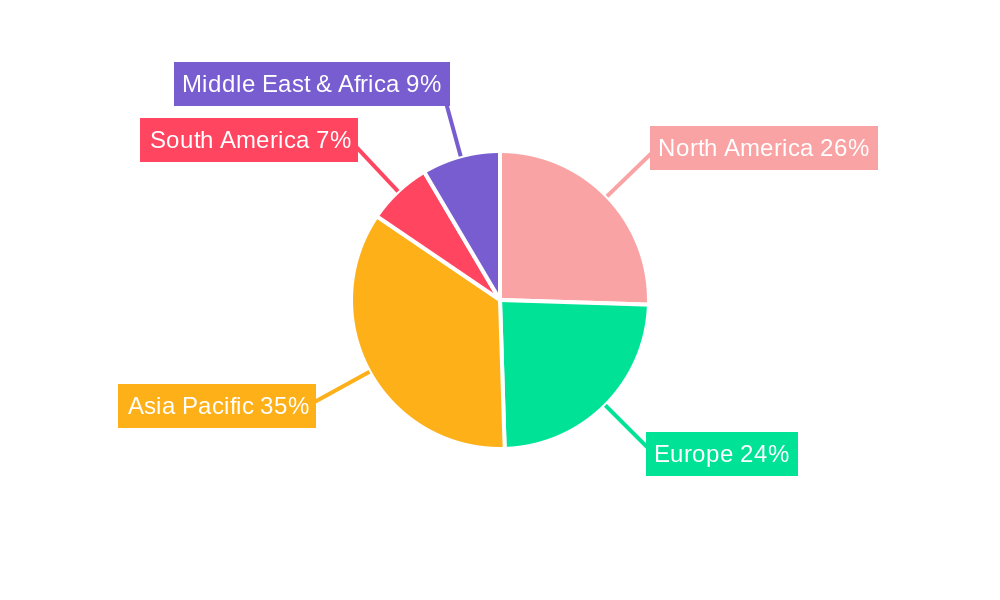
Audio Power Amplifiers Regional Market Share
Geographic Coverage of Audio Power Amplifiers
Audio Power Amplifiers REPORT HIGHLIGHTS
| Aspects | Details |
|---|---|
| Study Period | 2020-2034 |
| Base Year | 2025 |
| Estimated Year | 2026 |
| Forecast Period | 2026-2034 |
| Historical Period | 2020-2025 |
| Growth Rate | CAGR of 6.2% from 2020-2034 |
| Segmentation |
|
Table of Contents
- 1. Introduction
- 1.1. Research Scope
- 1.2. Market Segmentation
- 1.3. Research Methodology
- 1.4. Definitions and Assumptions
- 2. Executive Summary
- 2.1. Introduction
- 3. Market Dynamics
- 3.1. Introduction
- 3.2. Market Drivers
- 3.3. Market Restrains
- 3.4. Market Trends
- 4. Market Factor Analysis
- 4.1. Porters Five Forces
- 4.2. Supply/Value Chain
- 4.3. PESTEL analysis
- 4.4. Market Entropy
- 4.5. Patent/Trademark Analysis
- 5. Global Audio Power Amplifiers Analysis, Insights and Forecast, 2020-2032
- 5.1. Market Analysis, Insights and Forecast - by Application
- 5.1.1. Consumer
- 5.1.2. Automotive
- 5.1.3. Computer
- 5.1.4. Enterprise
- 5.2. Market Analysis, Insights and Forecast - by Type
- 5.2.1. Class-A
- 5.2.2. Class-B
- 5.2.3. Class-A/B
- 5.2.4. Class-G&H
- 5.2.5. Class-D
- 5.3. Market Analysis, Insights and Forecast - by Region
- 5.3.1. North America
- 5.3.2. South America
- 5.3.3. Europe
- 5.3.4. Middle East & Africa
- 5.3.5. Asia Pacific
- 5.1. Market Analysis, Insights and Forecast - by Application
- 6. North America Audio Power Amplifiers Analysis, Insights and Forecast, 2020-2032
- 6.1. Market Analysis, Insights and Forecast - by Application
- 6.1.1. Consumer
- 6.1.2. Automotive
- 6.1.3. Computer
- 6.1.4. Enterprise
- 6.2. Market Analysis, Insights and Forecast - by Type
- 6.2.1. Class-A
- 6.2.2. Class-B
- 6.2.3. Class-A/B
- 6.2.4. Class-G&H
- 6.2.5. Class-D
- 6.1. Market Analysis, Insights and Forecast - by Application
- 7. South America Audio Power Amplifiers Analysis, Insights and Forecast, 2020-2032
- 7.1. Market Analysis, Insights and Forecast - by Application
- 7.1.1. Consumer
- 7.1.2. Automotive
- 7.1.3. Computer
- 7.1.4. Enterprise
- 7.2. Market Analysis, Insights and Forecast - by Type
- 7.2.1. Class-A
- 7.2.2. Class-B
- 7.2.3. Class-A/B
- 7.2.4. Class-G&H
- 7.2.5. Class-D
- 7.1. Market Analysis, Insights and Forecast - by Application
- 8. Europe Audio Power Amplifiers Analysis, Insights and Forecast, 2020-2032
- 8.1. Market Analysis, Insights and Forecast - by Application
- 8.1.1. Consumer
- 8.1.2. Automotive
- 8.1.3. Computer
- 8.1.4. Enterprise
- 8.2. Market Analysis, Insights and Forecast - by Type
- 8.2.1. Class-A
- 8.2.2. Class-B
- 8.2.3. Class-A/B
- 8.2.4. Class-G&H
- 8.2.5. Class-D
- 8.1. Market Analysis, Insights and Forecast - by Application
- 9. Middle East & Africa Audio Power Amplifiers Analysis, Insights and Forecast, 2020-2032
- 9.1. Market Analysis, Insights and Forecast - by Application
- 9.1.1. Consumer
- 9.1.2. Automotive
- 9.1.3. Computer
- 9.1.4. Enterprise
- 9.2. Market Analysis, Insights and Forecast - by Type
- 9.2.1. Class-A
- 9.2.2. Class-B
- 9.2.3. Class-A/B
- 9.2.4. Class-G&H
- 9.2.5. Class-D
- 9.1. Market Analysis, Insights and Forecast - by Application
- 10. Asia Pacific Audio Power Amplifiers Analysis, Insights and Forecast, 2020-2032
- 10.1. Market Analysis, Insights and Forecast - by Application
- 10.1.1. Consumer
- 10.1.2. Automotive
- 10.1.3. Computer
- 10.1.4. Enterprise
- 10.2. Market Analysis, Insights and Forecast - by Type
- 10.2.1. Class-A
- 10.2.2. Class-B
- 10.2.3. Class-A/B
- 10.2.4. Class-G&H
- 10.2.5. Class-D
- 10.1. Market Analysis, Insights and Forecast - by Application
- 11. Competitive Analysis
- 11.1. Global Market Share Analysis 2025
- 11.2. Company Profiles
- 11.2.1 TI
- 11.2.1.1. Overview
- 11.2.1.2. Products
- 11.2.1.3. SWOT Analysis
- 11.2.1.4. Recent Developments
- 11.2.1.5. Financials (Based on Availability)
- 11.2.2 ST
- 11.2.2.1. Overview
- 11.2.2.2. Products
- 11.2.2.3. SWOT Analysis
- 11.2.2.4. Recent Developments
- 11.2.2.5. Financials (Based on Availability)
- 11.2.3 NXP
- 11.2.3.1. Overview
- 11.2.3.2. Products
- 11.2.3.3. SWOT Analysis
- 11.2.3.4. Recent Developments
- 11.2.3.5. Financials (Based on Availability)
- 11.2.4 Cirrus Logic
- 11.2.4.1. Overview
- 11.2.4.2. Products
- 11.2.4.3. SWOT Analysis
- 11.2.4.4. Recent Developments
- 11.2.4.5. Financials (Based on Availability)
- 11.2.5 ON Semiconductor
- 11.2.5.1. Overview
- 11.2.5.2. Products
- 11.2.5.3. SWOT Analysis
- 11.2.5.4. Recent Developments
- 11.2.5.5. Financials (Based on Availability)
- 11.2.6 ADI
- 11.2.6.1. Overview
- 11.2.6.2. Products
- 11.2.6.3. SWOT Analysis
- 11.2.6.4. Recent Developments
- 11.2.6.5. Financials (Based on Availability)
- 11.2.7 Maxim
- 11.2.7.1. Overview
- 11.2.7.2. Products
- 11.2.7.3. SWOT Analysis
- 11.2.7.4. Recent Developments
- 11.2.7.5. Financials (Based on Availability)
- 11.2.8 ESS
- 11.2.8.1. Overview
- 11.2.8.2. Products
- 11.2.8.3. SWOT Analysis
- 11.2.8.4. Recent Developments
- 11.2.8.5. Financials (Based on Availability)
- 11.2.9 Realtek
- 11.2.9.1. Overview
- 11.2.9.2. Products
- 11.2.9.3. SWOT Analysis
- 11.2.9.4. Recent Developments
- 11.2.9.5. Financials (Based on Availability)
- 11.2.10 Diodes
- 11.2.10.1. Overview
- 11.2.10.2. Products
- 11.2.10.3. SWOT Analysis
- 11.2.10.4. Recent Developments
- 11.2.10.5. Financials (Based on Availability)
- 11.2.11 ams
- 11.2.11.1. Overview
- 11.2.11.2. Products
- 11.2.11.3. SWOT Analysis
- 11.2.11.4. Recent Developments
- 11.2.11.5. Financials (Based on Availability)
- 11.2.12 ISSI
- 11.2.12.1. Overview
- 11.2.12.2. Products
- 11.2.12.3. SWOT Analysis
- 11.2.12.4. Recent Developments
- 11.2.12.5. Financials (Based on Availability)
- 11.2.13 Silicon Labs
- 11.2.13.1. Overview
- 11.2.13.2. Products
- 11.2.13.3. SWOT Analysis
- 11.2.13.4. Recent Developments
- 11.2.13.5. Financials (Based on Availability)
- 11.2.14 Infineon
- 11.2.14.1. Overview
- 11.2.14.2. Products
- 11.2.14.3. SWOT Analysis
- 11.2.14.4. Recent Developments
- 11.2.14.5. Financials (Based on Availability)
- 11.2.15 NJR
- 11.2.15.1. Overview
- 11.2.15.2. Products
- 11.2.15.3. SWOT Analysis
- 11.2.15.4. Recent Developments
- 11.2.15.5. Financials (Based on Availability)
- 11.2.16 Toshiba
- 11.2.16.1. Overview
- 11.2.16.2. Products
- 11.2.16.3. SWOT Analysis
- 11.2.16.4. Recent Developments
- 11.2.16.5. Financials (Based on Availability)
- 11.2.17 ROHM
- 11.2.17.1. Overview
- 11.2.17.2. Products
- 11.2.17.3. SWOT Analysis
- 11.2.17.4. Recent Developments
- 11.2.17.5. Financials (Based on Availability)
- 11.2.18 Intersil
- 11.2.18.1. Overview
- 11.2.18.2. Products
- 11.2.18.3. SWOT Analysis
- 11.2.18.4. Recent Developments
- 11.2.18.5. Financials (Based on Availability)
- 11.2.19 Go2Silicon
- 11.2.19.1. Overview
- 11.2.19.2. Products
- 11.2.19.3. SWOT Analysis
- 11.2.19.4. Recent Developments
- 11.2.19.5. Financials (Based on Availability)
- 11.2.20 Fangtek
- 11.2.20.1. Overview
- 11.2.20.2. Products
- 11.2.20.3. SWOT Analysis
- 11.2.20.4. Recent Developments
- 11.2.20.5. Financials (Based on Availability)
- 11.2.21 Maxic
- 11.2.21.1. Overview
- 11.2.21.2. Products
- 11.2.21.3. SWOT Analysis
- 11.2.21.4. Recent Developments
- 11.2.21.5. Financials (Based on Availability)
- 11.2.1 TI
List of Figures
- Figure 1: Global Audio Power Amplifiers Revenue Breakdown (undefined, %) by Region 2025 & 2033
- Figure 2: North America Audio Power Amplifiers Revenue (undefined), by Application 2025 & 2033
- Figure 3: North America Audio Power Amplifiers Revenue Share (%), by Application 2025 & 2033
- Figure 4: North America Audio Power Amplifiers Revenue (undefined), by Type 2025 & 2033
- Figure 5: North America Audio Power Amplifiers Revenue Share (%), by Type 2025 & 2033
- Figure 6: North America Audio Power Amplifiers Revenue (undefined), by Country 2025 & 2033
- Figure 7: North America Audio Power Amplifiers Revenue Share (%), by Country 2025 & 2033
- Figure 8: South America Audio Power Amplifiers Revenue (undefined), by Application 2025 & 2033
- Figure 9: South America Audio Power Amplifiers Revenue Share (%), by Application 2025 & 2033
- Figure 10: South America Audio Power Amplifiers Revenue (undefined), by Type 2025 & 2033
- Figure 11: South America Audio Power Amplifiers Revenue Share (%), by Type 2025 & 2033
- Figure 12: South America Audio Power Amplifiers Revenue (undefined), by Country 2025 & 2033
- Figure 13: South America Audio Power Amplifiers Revenue Share (%), by Country 2025 & 2033
- Figure 14: Europe Audio Power Amplifiers Revenue (undefined), by Application 2025 & 2033
- Figure 15: Europe Audio Power Amplifiers Revenue Share (%), by Application 2025 & 2033
- Figure 16: Europe Audio Power Amplifiers Revenue (undefined), by Type 2025 & 2033
- Figure 17: Europe Audio Power Amplifiers Revenue Share (%), by Type 2025 & 2033
- Figure 18: Europe Audio Power Amplifiers Revenue (undefined), by Country 2025 & 2033
- Figure 19: Europe Audio Power Amplifiers Revenue Share (%), by Country 2025 & 2033
- Figure 20: Middle East & Africa Audio Power Amplifiers Revenue (undefined), by Application 2025 & 2033
- Figure 21: Middle East & Africa Audio Power Amplifiers Revenue Share (%), by Application 2025 & 2033
- Figure 22: Middle East & Africa Audio Power Amplifiers Revenue (undefined), by Type 2025 & 2033
- Figure 23: Middle East & Africa Audio Power Amplifiers Revenue Share (%), by Type 2025 & 2033
- Figure 24: Middle East & Africa Audio Power Amplifiers Revenue (undefined), by Country 2025 & 2033
- Figure 25: Middle East & Africa Audio Power Amplifiers Revenue Share (%), by Country 2025 & 2033
- Figure 26: Asia Pacific Audio Power Amplifiers Revenue (undefined), by Application 2025 & 2033
- Figure 27: Asia Pacific Audio Power Amplifiers Revenue Share (%), by Application 2025 & 2033
- Figure 28: Asia Pacific Audio Power Amplifiers Revenue (undefined), by Type 2025 & 2033
- Figure 29: Asia Pacific Audio Power Amplifiers Revenue Share (%), by Type 2025 & 2033
- Figure 30: Asia Pacific Audio Power Amplifiers Revenue (undefined), by Country 2025 & 2033
- Figure 31: Asia Pacific Audio Power Amplifiers Revenue Share (%), by Country 2025 & 2033
List of Tables
- Table 1: Global Audio Power Amplifiers Revenue undefined Forecast, by Application 2020 & 2033
- Table 2: Global Audio Power Amplifiers Revenue undefined Forecast, by Type 2020 & 2033
- Table 3: Global Audio Power Amplifiers Revenue undefined Forecast, by Region 2020 & 2033
- Table 4: Global Audio Power Amplifiers Revenue undefined Forecast, by Application 2020 & 2033
- Table 5: Global Audio Power Amplifiers Revenue undefined Forecast, by Type 2020 & 2033
- Table 6: Global Audio Power Amplifiers Revenue undefined Forecast, by Country 2020 & 2033
- Table 7: United States Audio Power Amplifiers Revenue (undefined) Forecast, by Application 2020 & 2033
- Table 8: Canada Audio Power Amplifiers Revenue (undefined) Forecast, by Application 2020 & 2033
- Table 9: Mexico Audio Power Amplifiers Revenue (undefined) Forecast, by Application 2020 & 2033
- Table 10: Global Audio Power Amplifiers Revenue undefined Forecast, by Application 2020 & 2033
- Table 11: Global Audio Power Amplifiers Revenue undefined Forecast, by Type 2020 & 2033
- Table 12: Global Audio Power Amplifiers Revenue undefined Forecast, by Country 2020 & 2033
- Table 13: Brazil Audio Power Amplifiers Revenue (undefined) Forecast, by Application 2020 & 2033
- Table 14: Argentina Audio Power Amplifiers Revenue (undefined) Forecast, by Application 2020 & 2033
- Table 15: Rest of South America Audio Power Amplifiers Revenue (undefined) Forecast, by Application 2020 & 2033
- Table 16: Global Audio Power Amplifiers Revenue undefined Forecast, by Application 2020 & 2033
- Table 17: Global Audio Power Amplifiers Revenue undefined Forecast, by Type 2020 & 2033
- Table 18: Global Audio Power Amplifiers Revenue undefined Forecast, by Country 2020 & 2033
- Table 19: United Kingdom Audio Power Amplifiers Revenue (undefined) Forecast, by Application 2020 & 2033
- Table 20: Germany Audio Power Amplifiers Revenue (undefined) Forecast, by Application 2020 & 2033
- Table 21: France Audio Power Amplifiers Revenue (undefined) Forecast, by Application 2020 & 2033
- Table 22: Italy Audio Power Amplifiers Revenue (undefined) Forecast, by Application 2020 & 2033
- Table 23: Spain Audio Power Amplifiers Revenue (undefined) Forecast, by Application 2020 & 2033
- Table 24: Russia Audio Power Amplifiers Revenue (undefined) Forecast, by Application 2020 & 2033
- Table 25: Benelux Audio Power Amplifiers Revenue (undefined) Forecast, by Application 2020 & 2033
- Table 26: Nordics Audio Power Amplifiers Revenue (undefined) Forecast, by Application 2020 & 2033
- Table 27: Rest of Europe Audio Power Amplifiers Revenue (undefined) Forecast, by Application 2020 & 2033
- Table 28: Global Audio Power Amplifiers Revenue undefined Forecast, by Application 2020 & 2033
- Table 29: Global Audio Power Amplifiers Revenue undefined Forecast, by Type 2020 & 2033
- Table 30: Global Audio Power Amplifiers Revenue undefined Forecast, by Country 2020 & 2033
- Table 31: Turkey Audio Power Amplifiers Revenue (undefined) Forecast, by Application 2020 & 2033
- Table 32: Israel Audio Power Amplifiers Revenue (undefined) Forecast, by Application 2020 & 2033
- Table 33: GCC Audio Power Amplifiers Revenue (undefined) Forecast, by Application 2020 & 2033
- Table 34: North Africa Audio Power Amplifiers Revenue (undefined) Forecast, by Application 2020 & 2033
- Table 35: South Africa Audio Power Amplifiers Revenue (undefined) Forecast, by Application 2020 & 2033
- Table 36: Rest of Middle East & Africa Audio Power Amplifiers Revenue (undefined) Forecast, by Application 2020 & 2033
- Table 37: Global Audio Power Amplifiers Revenue undefined Forecast, by Application 2020 & 2033
- Table 38: Global Audio Power Amplifiers Revenue undefined Forecast, by Type 2020 & 2033
- Table 39: Global Audio Power Amplifiers Revenue undefined Forecast, by Country 2020 & 2033
- Table 40: China Audio Power Amplifiers Revenue (undefined) Forecast, by Application 2020 & 2033
- Table 41: India Audio Power Amplifiers Revenue (undefined) Forecast, by Application 2020 & 2033
- Table 42: Japan Audio Power Amplifiers Revenue (undefined) Forecast, by Application 2020 & 2033
- Table 43: South Korea Audio Power Amplifiers Revenue (undefined) Forecast, by Application 2020 & 2033
- Table 44: ASEAN Audio Power Amplifiers Revenue (undefined) Forecast, by Application 2020 & 2033
- Table 45: Oceania Audio Power Amplifiers Revenue (undefined) Forecast, by Application 2020 & 2033
- Table 46: Rest of Asia Pacific Audio Power Amplifiers Revenue (undefined) Forecast, by Application 2020 & 2033
Frequently Asked Questions
1. What is the projected Compound Annual Growth Rate (CAGR) of the Audio Power Amplifiers?
The projected CAGR is approximately 6.2%.
2. Which companies are prominent players in the Audio Power Amplifiers?
Key companies in the market include TI, ST, NXP, Cirrus Logic, ON Semiconductor, ADI, Maxim, ESS, Realtek, Diodes, ams, ISSI, Silicon Labs, Infineon, NJR, Toshiba, ROHM, Intersil, Go2Silicon, Fangtek, Maxic.
3. What are the main segments of the Audio Power Amplifiers?
The market segments include Application, Type.
4. Can you provide details about the market size?
The market size is estimated to be USD XXX N/A as of 2022.
5. What are some drivers contributing to market growth?
N/A
6. What are the notable trends driving market growth?
N/A
7. Are there any restraints impacting market growth?
N/A
8. Can you provide examples of recent developments in the market?
N/A
9. What pricing options are available for accessing the report?
Pricing options include single-user, multi-user, and enterprise licenses priced at USD 2900.00, USD 4350.00, and USD 5800.00 respectively.
10. Is the market size provided in terms of value or volume?
The market size is provided in terms of value, measured in N/A.
11. Are there any specific market keywords associated with the report?
Yes, the market keyword associated with the report is "Audio Power Amplifiers," which aids in identifying and referencing the specific market segment covered.
12. How do I determine which pricing option suits my needs best?
The pricing options vary based on user requirements and access needs. Individual users may opt for single-user licenses, while businesses requiring broader access may choose multi-user or enterprise licenses for cost-effective access to the report.
13. Are there any additional resources or data provided in the Audio Power Amplifiers report?
While the report offers comprehensive insights, it's advisable to review the specific contents or supplementary materials provided to ascertain if additional resources or data are available.
14. How can I stay updated on further developments or reports in the Audio Power Amplifiers?
To stay informed about further developments, trends, and reports in the Audio Power Amplifiers, consider subscribing to industry newsletters, following relevant companies and organizations, or regularly checking reputable industry news sources and publications.
Methodology
Step 1 - Identification of Relevant Samples Size from Population Database



Step 2 - Approaches for Defining Global Market Size (Value, Volume* & Price*)

Note*: In applicable scenarios
Step 3 - Data Sources
Primary Research
- Web Analytics
- Survey Reports
- Research Institute
- Latest Research Reports
- Opinion Leaders
Secondary Research
- Annual Reports
- White Paper
- Latest Press Release
- Industry Association
- Paid Database
- Investor Presentations

Step 4 - Data Triangulation
Involves using different sources of information in order to increase the validity of a study
These sources are likely to be stakeholders in a program - participants, other researchers, program staff, other community members, and so on.
Then we put all data in single framework & apply various statistical tools to find out the dynamic on the market.
During the analysis stage, feedback from the stakeholder groups would be compared to determine areas of agreement as well as areas of divergence