


Key Insights
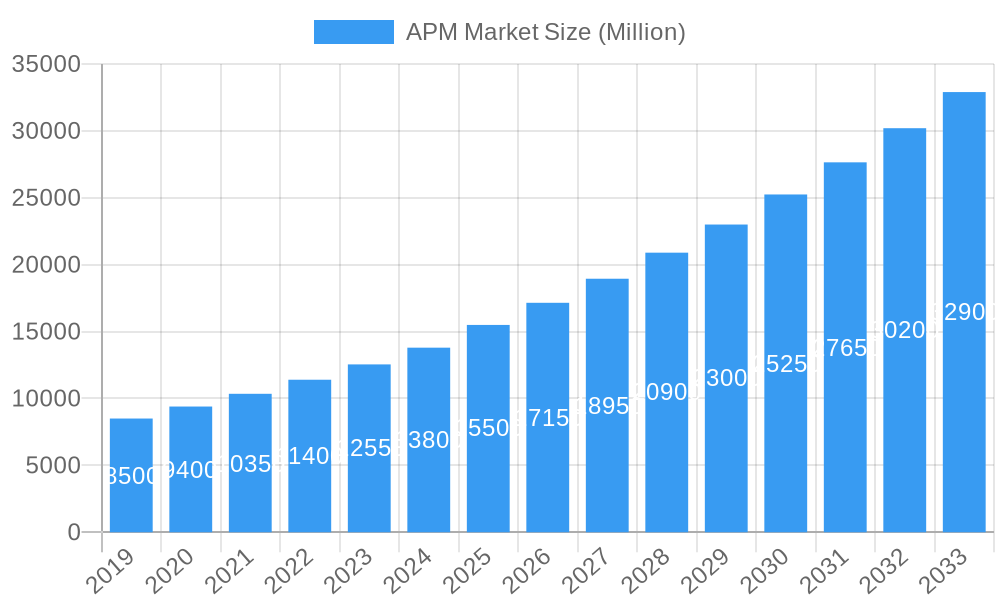
The Asset Performance Management (APM) market is poised for robust growth, projected to reach a substantial market size of approximately $15,500 million by 2025, and expand at a Compound Annual Growth Rate (CAGR) of 10.50% through 2033. This significant expansion is fueled by an escalating need for enhanced operational efficiency, proactive risk mitigation, and extended asset lifecycles across a wide array of industries. The increasing adoption of IoT devices, coupled with advancements in AI and machine learning, are pivotal drivers, enabling real-time data collection and sophisticated predictive analytics. These technologies empower organizations to move beyond reactive maintenance, thereby minimizing downtime, optimizing resource allocation, and improving overall asset reliability. The market's trajectory is further bolstered by stringent regulatory mandates concerning safety and environmental compliance, particularly in sectors like Oil and Gas and Energy and Utilities.
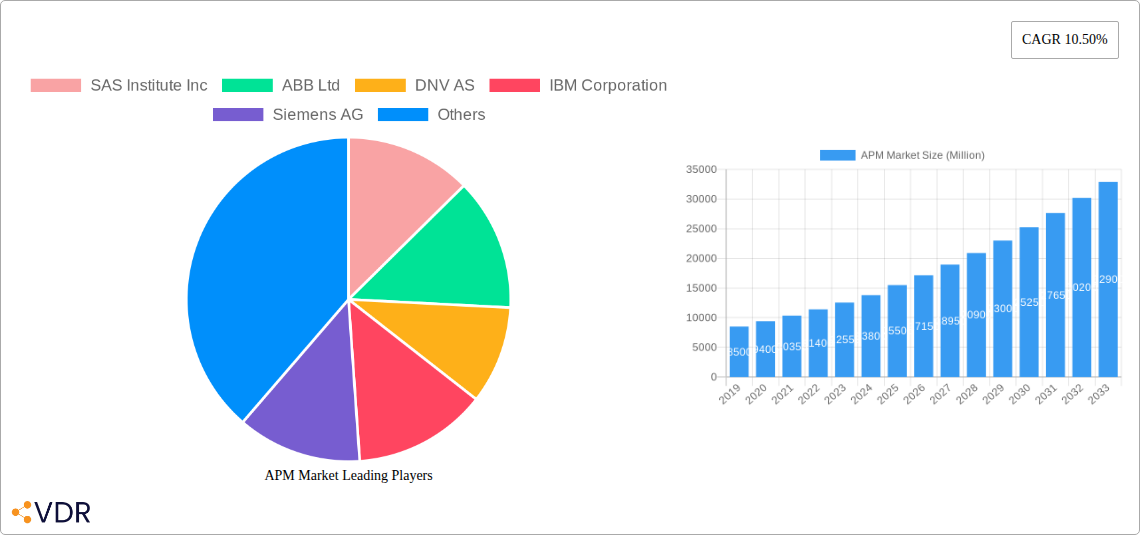
APM Market Market Size (In Billion)

The competitive landscape features a dynamic interplay of established technology giants and innovative specialized players, each vying to capture market share through advanced APM solutions. Segments like Predictive Asset Management, Asset Reliability Management, and Asset Strategy Management are experiencing heightened demand, reflecting a shift towards more intelligent and integrated approaches to asset oversight. Deployment models are also evolving, with a growing preference for hosted solutions, particularly public and private cloud options, offering greater scalability and accessibility. Geographically, North America is expected to lead in market penetration due to early adoption and strong industrial infrastructure, closely followed by a rapidly growing Asia Pacific region driven by increasing industrialization and digital transformation initiatives. Restraints, such as the initial cost of implementation and the need for skilled personnel, are being addressed through evolving service models and cloud-based offerings, ensuring sustained market dynamism.
APM Market Company Market Share
Comprehensive APM Market Report: Predictive Asset Management, Growth, and Key Players (2019-2033)
This in-depth report provides a detailed analysis of the global Asset Performance Management (APM) market, encompassing its current dynamics, growth trajectories, and future outlook from 2019 to 2033. With a base year of 2025 and a forecast period extending to 2033, this study offers invaluable insights for industry professionals, stakeholders, and decision-makers navigating the evolving landscape of predictive asset management, asset reliability management, and asset strategy management. We leverage extensive data to forecast the market size in million units and provide actionable intelligence on market segmentation, regional dominance, and key industry developments.
APM Market Market Dynamics & Structure
The APM market is characterized by a moderately concentrated structure, driven by significant technological innovation and increasing adoption of digital transformation initiatives across various industrial sectors. Key drivers include the imperative to reduce operational costs, enhance asset lifespan, and minimize unscheduled downtime. The market's competitive landscape is shaped by a mix of established enterprise software vendors and specialized APM solution providers, with companies like SAS Institute Inc, ABB Ltd, DNV AS, IBM Corporation, Siemens AG, Emerson Electric Co, GE Digital, AVEVA Group PLC, Uptake Technologies Inc, Aspen Technology Inc, ABS Group, and SAP SE actively competing.
- Technological Innovation: Advancements in Artificial Intelligence (AI), Machine Learning (ML), Industrial Internet of Things (IIoT), and Big Data analytics are fundamental to the growth of APM solutions, enabling more accurate predictive maintenance and enhanced asset health monitoring.
- Regulatory Frameworks: Increasingly stringent safety and environmental regulations in sectors like Oil and Gas and Energy & Utilities are compelling organizations to invest in robust APM systems to ensure compliance and operational integrity.
- Competitive Product Substitutes: While dedicated APM software offers comprehensive functionalities, some organizations may initially leverage existing Enterprise Asset Management (EAM) or Computerized Maintenance Management System (CMMS) with add-on analytics capabilities, posing a form of indirect competition.
- End-User Demographics: The primary users of APM solutions are large-scale industrial enterprises with complex asset bases, including those in the Oil and Gas, Manufacturing, and Energy and Utilities sectors. The growing emphasis on operational efficiency across these verticals fuels demand.
- M&A Trends: The market has witnessed strategic mergers and acquisitions as larger players aim to broaden their APM portfolios or acquire innovative technologies and customer bases. For instance, an estimated 5-10 M&A deals are anticipated annually within the broader industrial software and APM space.
APM Market Growth Trends & Insights
The APM market is poised for robust growth, driven by the escalating need for operational efficiency, cost optimization, and proactive risk management across diverse industries. The market size is projected to expand significantly, with a compound annual growth rate (CAGR) estimated to be in the double digits during the forecast period. This growth is fueled by the increasing adoption of advanced technologies such as Artificial Intelligence (AI), Machine Learning (ML), and the Industrial Internet of Things (IIoT), which are instrumental in enabling predictive maintenance and optimizing asset performance.
- Market Size Evolution: The global APM market is expected to grow from an estimated $XX billion in 2025 to $YY billion by 2033, reflecting a substantial upward trajectory. This expansion is a direct result of industries recognizing the tangible benefits of APM in reducing maintenance costs and enhancing asset reliability.
- Adoption Rates: Adoption rates for APM solutions are steadily increasing, particularly among large enterprises in asset-intensive sectors like Oil & Gas, Manufacturing, and Energy & Utilities. The penetration of predictive asset management is growing as companies transition from reactive to proactive maintenance strategies.
- Technological Disruptions: The integration of AI and ML into APM platforms is a significant disruptive force, enabling more sophisticated anomaly detection, failure prediction, and prescriptive maintenance recommendations. The continuous evolution of IIoT sensors also provides a richer stream of data for analysis, further enhancing APM capabilities.
- Consumer Behavior Shifts: End-user behavior is shifting towards a data-driven approach to asset management. Companies are increasingly prioritizing solutions that offer real-time insights, actionable recommendations, and seamless integration with existing IT and OT infrastructures. The demand for cloud-based APM solutions is also rising due to their scalability and accessibility.
Dominant Regions, Countries, or Segments in APM Market
The global APM market is experiencing significant growth and adoption across various regions, segments, and end-user verticals. North America currently holds a dominant position, driven by its advanced industrial infrastructure, high adoption of cutting-edge technologies, and the presence of major players in the Oil & Gas, Manufacturing, and Energy sectors. The region's strong emphasis on operational excellence and stringent regulatory compliance further bolsters APM investment.
Dominant End-User Vertical: Oil and Gas
The Oil and Gas sector consistently emerges as a leading vertical for APM solutions. The inherent criticality of assets, the high cost of downtime, and the challenging operational environments necessitate robust asset performance management to ensure safety, efficiency, and profitability.
- Market Share: The Oil and Gas vertical is estimated to command approximately 25-30% of the total APM market share during the forecast period.
- Key Drivers:
- Aging Infrastructure: Many existing oil and gas facilities require sophisticated monitoring to ensure the integrity and longevity of aging assets.
- Safety and Environmental Regulations: Strict compliance requirements necessitate proactive measures to prevent failures and environmental incidents.
- Cost Optimization: Reducing maintenance expenses and maximizing production uptime are critical for profitability in this volatile industry.
- Digital Transformation Initiatives: Major oil and gas companies are actively investing in digital technologies to enhance their operational capabilities.
- Growth Potential: The ongoing exploration and production activities, coupled with the drive towards digitalization and sustainability, ensure sustained demand for APM solutions in this sector.
Dominant Deployment Type: Hosted (Public Cloud, Private Cloud)
The trend towards cloud-based APM solutions is accelerating due to their scalability, flexibility, and cost-effectiveness. Hosted deployments, encompassing both public and private cloud environments, are increasingly favored over on-premise solutions.
- Market Share: Hosted deployments are projected to account for over 60% of the APM market by 2033.
- Key Drivers:
- Scalability and Flexibility: Cloud solutions allow organizations to scale their APM capabilities up or down based on demand without significant upfront hardware investments.
- Reduced IT Overhead: Businesses can offload the burden of infrastructure maintenance and management to cloud providers.
- Accessibility and Collaboration: Cloud-based platforms facilitate easier access to data and insights for remote teams and stakeholders.
- Faster Deployment: Cloud solutions generally offer quicker implementation times compared to on-premise installations.
Dominant Segment by Type: Predictive Asset Management
Predictive Asset Management (PAM) is the fastest-growing segment within APM, driven by the ability of AI and ML to forecast potential equipment failures before they occur.
- Market Share: Predictive Asset Management is expected to capture over 40% of the APM market share by 2033.
- Key Drivers:
- Proactive Maintenance: Shifting from reactive or preventive maintenance to predictive approaches significantly reduces unplanned downtime and maintenance costs.
- Enhanced Asset Lifespan: By addressing issues early, PAM helps extend the operational life of critical assets.
- Improved Safety: Predicting failures can prevent hazardous situations and ensure a safer working environment.
- Data-Driven Decision Making: PAM leverages real-time data to provide actionable insights for maintenance scheduling and resource allocation.
APM Market Product Landscape
The APM market is characterized by a dynamic product landscape driven by continuous innovation aimed at enhancing asset reliability, optimizing maintenance strategies, and reducing operational costs. Leading vendors are integrating advanced AI, ML, and IIoT capabilities into their solutions to offer sophisticated predictive analytics, prescriptive maintenance recommendations, and comprehensive asset health monitoring. These advancements enable organizations to move beyond traditional maintenance approaches towards proactive and data-driven asset management, leading to significant improvements in equipment utilization and operational efficiency. Unique selling propositions often revolve around the depth of predictive modeling, the ease of integration with existing systems, and the actionable insights provided to end-users.
Key Drivers, Barriers & Challenges in APM Market
Key Drivers:
- Operational Efficiency and Cost Reduction: The primary driver is the imperative for industries to minimize operational expenses, reduce unplanned downtime, and optimize maintenance spending through proactive and predictive strategies.
- Technological Advancements: The rapid evolution of AI, ML, IIoT, and Big Data analytics provides sophisticated tools for accurate asset monitoring and failure prediction, making APM solutions more powerful and accessible.
- Aging Infrastructure: Many industrial assets are reaching the end of their expected lifespan, necessitating advanced monitoring and management to ensure continued safe and reliable operation.
- Regulatory Compliance: Increasingly stringent safety and environmental regulations across various sectors compel organizations to adopt robust APM practices to prevent failures and ensure compliance.
Barriers & Challenges:
- High Initial Investment: The upfront cost of implementing comprehensive APM systems, including software, hardware, and integration, can be substantial, especially for small and medium-sized enterprises.
- Data Integration Complexity: Integrating data from disparate sources (e.g., SCADA, historians, CMMS, ERP) and ensuring data quality can be a significant technical challenge.
- Skills Gap: A shortage of skilled personnel capable of implementing, managing, and interpreting data from APM solutions can hinder adoption and effective utilization.
- Resistance to Change: Overcoming organizational inertia and convincing stakeholders to transition from traditional reactive or preventive maintenance to advanced predictive methodologies can be difficult.
- Cybersecurity Concerns: The increased reliance on connected devices and cloud platforms raises concerns about data security and potential cyber threats.
Emerging Opportunities in APM Market
Emerging opportunities in the APM market are largely driven by the increasing convergence of operational technology (OT) and information technology (IT), the growing adoption of edge computing, and the demand for more specialized APM solutions tailored to specific industry needs. The expansion of IIoT devices is creating vast datasets that can be leveraged for more granular and accurate asset performance insights. Furthermore, the development of "APM-as-a-Service" models offers a more accessible entry point for smaller organizations. The integration of APM with digital twins is also a significant emerging trend, providing a virtual representation of assets for enhanced simulation, testing, and predictive analysis. The focus is shifting towards delivering not just data, but actionable intelligence and automated maintenance workflows.
Growth Accelerators in the APM Market Industry
Several key catalysts are propelling the long-term growth of the APM market. The relentless pursuit of digital transformation across industries is a primary accelerator, with organizations actively seeking technologies that enhance operational efficiency and competitiveness. Strategic partnerships between APM software vendors and industrial equipment manufacturers are crucial, facilitating seamless integration and co-development of solutions tailored to specific asset types. Market expansion into emerging economies, driven by industrialization and infrastructure development, presents significant growth opportunities. Furthermore, continuous advancements in AI and ML algorithms are making predictive capabilities more accurate and accessible, lowering adoption barriers and demonstrating tangible ROI. The growing emphasis on sustainability and the circular economy also indirectly fuels APM adoption, as optimized asset performance leads to reduced energy consumption and waste.
Key Players Shaping the APM Market Market
- SAS Institute Inc
- ABB Ltd
- DNV AS
- IBM Corporation
- Siemens AG
- Emerson Electric Co
- GE Digital
- AVEVA Group PLC
- Uptake Technologies Inc
- Aspen Technology Inc
- ABS Group
- SAP SE
Notable Milestones in APM Market Sector
- October 2021 - ABB launched the "ABB Ability Genix Asset Performance Management Suite," an enterprise-grade application designed to monitor assets, improve equipment utilization, prescribe maintenance actions, and support lifecycle analysis and capital planning. This suite integrates next-generation AI-based predictive maintenance, asset reliability, and integrity insights, offering actionable intelligence for all aspects of asset performance.
- February 2021 - Siemens Energy and Bentley Systems Inc. announced the joint solution "Asset Performance Management for Oil & Gas" (APM4O&G). This collaboration combines complementary offerings to help operators enhance asset performance, reduce maintenance costs, and eliminate downtime, specifically supporting maintenance for gas processing plants, onshore compressor stations, and offshore production platforms.
In-Depth APM Market Market Outlook
The APM market outlook remains exceptionally strong, fueled by the sustained drive for operational excellence and digital transformation across global industries. Growth accelerators such as the widespread adoption of AI/ML, the expansion of IIoT ecosystems, and strategic vendor partnerships will continue to shape the market. Emerging opportunities in specialized APM solutions, cloud-native platforms, and the integration with digital twins are set to unlock new value streams. The increasing demand for predictive and prescriptive maintenance capabilities, driven by the need to mitigate risks and optimize asset lifecycles, will ensure robust market penetration. Organizations are increasingly recognizing APM not just as a maintenance tool, but as a strategic imperative for achieving competitive advantage, enhancing sustainability, and ensuring long-term business resilience. The forecast period will witness an accelerated shift towards intelligent, data-driven asset management.
APM Market Segmentation
-
1. Type
- 1.1. Predictive Asset Management
- 1.2. Asset Reliability Management
- 1.3. Asset Strategy Management
- 1.4. Other Types
-
2. Deployment
- 2.1. On-premise
-
2.2. Hosted
- 2.2.1. Public Cloud
- 2.2.2. Private Cloud
-
3. End-user Vertical
- 3.1. Oil and Gas
- 3.2. Metal and Mining
- 3.3. Manufacturing
- 3.4. Energy and Utilities
- 3.5. Transportation
- 3.6. Government and Public Sector
- 3.7. Chemical and Pharmaceutical
- 3.8. Other End-user Verticals
APM Market Segmentation By Geography
-
1. North America
- 1.1. United States
- 1.2. Canada
-
2. Europe
- 2.1. United Kingdom
- 2.2. Germany
- 2.3. France
- 2.4. Rest of Europe
-
3. Asia Pacific
- 3.1. China
- 3.2. Japan
- 3.3. India
- 3.4. South Korea
- 3.5. Rest of Asia Pacific
-
4. Latin America
- 4.1. Brazil
- 4.2. Mexico
- 4.3. Rest of Latin America
- 5. Middle East
-
6. Saudi Arabia
- 6.1. United Arab Emirates
- 6.2. South Africa
- 6.3. Rest of Middle East
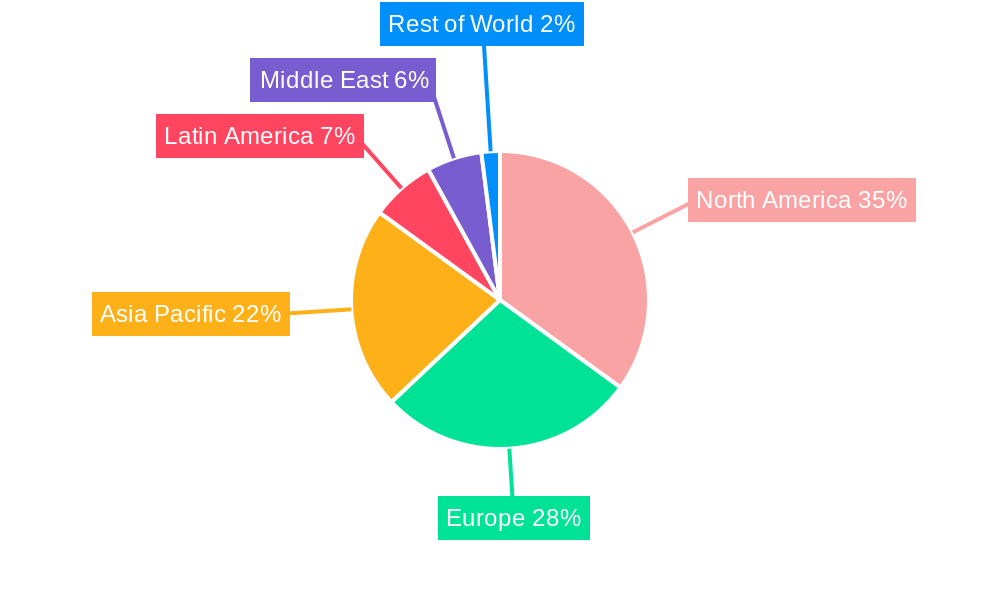
APM Market Regional Market Share
Geographic Coverage of APM Market
APM Market REPORT HIGHLIGHTS
| Aspects | Details |
|---|---|
| Study Period | 2020-2034 |
| Base Year | 2025 |
| Estimated Year | 2026 |
| Forecast Period | 2026-2034 |
| Historical Period | 2020-2025 |
| Growth Rate | CAGR of 10.50% from 2020-2034 |
| Segmentation |
|
Table of Contents
- 1. Introduction
- 1.1. Research Scope
- 1.2. Market Segmentation
- 1.3. Research Methodology
- 1.4. Definitions and Assumptions
- 2. Executive Summary
- 2.1. Introduction
- 3. Market Dynamics
- 3.1. Introduction
- 3.2. Market Drivers
- 3.2.1. Increasing Demand for Energy-efficient Solutions; Growing Need for Automation of Security Systems
- 3.3. Market Restrains
- 3.3.1. Concerns Related to Data Security
- 3.4. Market Trends
- 3.4.1. Oil and Gas Sector to Hold Significant Market Share
- 4. Market Factor Analysis
- 4.1. Porters Five Forces
- 4.2. Supply/Value Chain
- 4.3. PESTEL analysis
- 4.4. Market Entropy
- 4.5. Patent/Trademark Analysis
- 5. Global APM Market Analysis, Insights and Forecast, 2020-2032
- 5.1. Market Analysis, Insights and Forecast - by Type
- 5.1.1. Predictive Asset Management
- 5.1.2. Asset Reliability Management
- 5.1.3. Asset Strategy Management
- 5.1.4. Other Types
- 5.2. Market Analysis, Insights and Forecast - by Deployment
- 5.2.1. On-premise
- 5.2.2. Hosted
- 5.2.2.1. Public Cloud
- 5.2.2.2. Private Cloud
- 5.3. Market Analysis, Insights and Forecast - by End-user Vertical
- 5.3.1. Oil and Gas
- 5.3.2. Metal and Mining
- 5.3.3. Manufacturing
- 5.3.4. Energy and Utilities
- 5.3.5. Transportation
- 5.3.6. Government and Public Sector
- 5.3.7. Chemical and Pharmaceutical
- 5.3.8. Other End-user Verticals
- 5.4. Market Analysis, Insights and Forecast - by Region
- 5.4.1. North America
- 5.4.2. Europe
- 5.4.3. Asia Pacific
- 5.4.4. Latin America
- 5.4.5. Middle East
- 5.4.6. Saudi Arabia
- 5.1. Market Analysis, Insights and Forecast - by Type
- 6. North America APM Market Analysis, Insights and Forecast, 2020-2032
- 6.1. Market Analysis, Insights and Forecast - by Type
- 6.1.1. Predictive Asset Management
- 6.1.2. Asset Reliability Management
- 6.1.3. Asset Strategy Management
- 6.1.4. Other Types
- 6.2. Market Analysis, Insights and Forecast - by Deployment
- 6.2.1. On-premise
- 6.2.2. Hosted
- 6.2.2.1. Public Cloud
- 6.2.2.2. Private Cloud
- 6.3. Market Analysis, Insights and Forecast - by End-user Vertical
- 6.3.1. Oil and Gas
- 6.3.2. Metal and Mining
- 6.3.3. Manufacturing
- 6.3.4. Energy and Utilities
- 6.3.5. Transportation
- 6.3.6. Government and Public Sector
- 6.3.7. Chemical and Pharmaceutical
- 6.3.8. Other End-user Verticals
- 6.1. Market Analysis, Insights and Forecast - by Type
- 7. Europe APM Market Analysis, Insights and Forecast, 2020-2032
- 7.1. Market Analysis, Insights and Forecast - by Type
- 7.1.1. Predictive Asset Management
- 7.1.2. Asset Reliability Management
- 7.1.3. Asset Strategy Management
- 7.1.4. Other Types
- 7.2. Market Analysis, Insights and Forecast - by Deployment
- 7.2.1. On-premise
- 7.2.2. Hosted
- 7.2.2.1. Public Cloud
- 7.2.2.2. Private Cloud
- 7.3. Market Analysis, Insights and Forecast - by End-user Vertical
- 7.3.1. Oil and Gas
- 7.3.2. Metal and Mining
- 7.3.3. Manufacturing
- 7.3.4. Energy and Utilities
- 7.3.5. Transportation
- 7.3.6. Government and Public Sector
- 7.3.7. Chemical and Pharmaceutical
- 7.3.8. Other End-user Verticals
- 7.1. Market Analysis, Insights and Forecast - by Type
- 8. Asia Pacific APM Market Analysis, Insights and Forecast, 2020-2032
- 8.1. Market Analysis, Insights and Forecast - by Type
- 8.1.1. Predictive Asset Management
- 8.1.2. Asset Reliability Management
- 8.1.3. Asset Strategy Management
- 8.1.4. Other Types
- 8.2. Market Analysis, Insights and Forecast - by Deployment
- 8.2.1. On-premise
- 8.2.2. Hosted
- 8.2.2.1. Public Cloud
- 8.2.2.2. Private Cloud
- 8.3. Market Analysis, Insights and Forecast - by End-user Vertical
- 8.3.1. Oil and Gas
- 8.3.2. Metal and Mining
- 8.3.3. Manufacturing
- 8.3.4. Energy and Utilities
- 8.3.5. Transportation
- 8.3.6. Government and Public Sector
- 8.3.7. Chemical and Pharmaceutical
- 8.3.8. Other End-user Verticals
- 8.1. Market Analysis, Insights and Forecast - by Type
- 9. Latin America APM Market Analysis, Insights and Forecast, 2020-2032
- 9.1. Market Analysis, Insights and Forecast - by Type
- 9.1.1. Predictive Asset Management
- 9.1.2. Asset Reliability Management
- 9.1.3. Asset Strategy Management
- 9.1.4. Other Types
- 9.2. Market Analysis, Insights and Forecast - by Deployment
- 9.2.1. On-premise
- 9.2.2. Hosted
- 9.2.2.1. Public Cloud
- 9.2.2.2. Private Cloud
- 9.3. Market Analysis, Insights and Forecast - by End-user Vertical
- 9.3.1. Oil and Gas
- 9.3.2. Metal and Mining
- 9.3.3. Manufacturing
- 9.3.4. Energy and Utilities
- 9.3.5. Transportation
- 9.3.6. Government and Public Sector
- 9.3.7. Chemical and Pharmaceutical
- 9.3.8. Other End-user Verticals
- 9.1. Market Analysis, Insights and Forecast - by Type
- 10. Middle East APM Market Analysis, Insights and Forecast, 2020-2032
- 10.1. Market Analysis, Insights and Forecast - by Type
- 10.1.1. Predictive Asset Management
- 10.1.2. Asset Reliability Management
- 10.1.3. Asset Strategy Management
- 10.1.4. Other Types
- 10.2. Market Analysis, Insights and Forecast - by Deployment
- 10.2.1. On-premise
- 10.2.2. Hosted
- 10.2.2.1. Public Cloud
- 10.2.2.2. Private Cloud
- 10.3. Market Analysis, Insights and Forecast - by End-user Vertical
- 10.3.1. Oil and Gas
- 10.3.2. Metal and Mining
- 10.3.3. Manufacturing
- 10.3.4. Energy and Utilities
- 10.3.5. Transportation
- 10.3.6. Government and Public Sector
- 10.3.7. Chemical and Pharmaceutical
- 10.3.8. Other End-user Verticals
- 10.1. Market Analysis, Insights and Forecast - by Type
- 11. Saudi Arabia APM Market Analysis, Insights and Forecast, 2020-2032
- 11.1. Market Analysis, Insights and Forecast - by Type
- 11.1.1. Predictive Asset Management
- 11.1.2. Asset Reliability Management
- 11.1.3. Asset Strategy Management
- 11.1.4. Other Types
- 11.2. Market Analysis, Insights and Forecast - by Deployment
- 11.2.1. On-premise
- 11.2.2. Hosted
- 11.2.2.1. Public Cloud
- 11.2.2.2. Private Cloud
- 11.3. Market Analysis, Insights and Forecast - by End-user Vertical
- 11.3.1. Oil and Gas
- 11.3.2. Metal and Mining
- 11.3.3. Manufacturing
- 11.3.4. Energy and Utilities
- 11.3.5. Transportation
- 11.3.6. Government and Public Sector
- 11.3.7. Chemical and Pharmaceutical
- 11.3.8. Other End-user Verticals
- 11.1. Market Analysis, Insights and Forecast - by Type
- 12. Competitive Analysis
- 12.1. Global Market Share Analysis 2025
- 12.2. Company Profiles
- 12.2.1 SAS Institute Inc
- 12.2.1.1. Overview
- 12.2.1.2. Products
- 12.2.1.3. SWOT Analysis
- 12.2.1.4. Recent Developments
- 12.2.1.5. Financials (Based on Availability)
- 12.2.2 ABB Ltd
- 12.2.2.1. Overview
- 12.2.2.2. Products
- 12.2.2.3. SWOT Analysis
- 12.2.2.4. Recent Developments
- 12.2.2.5. Financials (Based on Availability)
- 12.2.3 DNV AS
- 12.2.3.1. Overview
- 12.2.3.2. Products
- 12.2.3.3. SWOT Analysis
- 12.2.3.4. Recent Developments
- 12.2.3.5. Financials (Based on Availability)
- 12.2.4 IBM Corporation
- 12.2.4.1. Overview
- 12.2.4.2. Products
- 12.2.4.3. SWOT Analysis
- 12.2.4.4. Recent Developments
- 12.2.4.5. Financials (Based on Availability)
- 12.2.5 Siemens AG
- 12.2.5.1. Overview
- 12.2.5.2. Products
- 12.2.5.3. SWOT Analysis
- 12.2.5.4. Recent Developments
- 12.2.5.5. Financials (Based on Availability)
- 12.2.6 Emerson Electric Co
- 12.2.6.1. Overview
- 12.2.6.2. Products
- 12.2.6.3. SWOT Analysis
- 12.2.6.4. Recent Developments
- 12.2.6.5. Financials (Based on Availability)
- 12.2.7 GE Digital
- 12.2.7.1. Overview
- 12.2.7.2. Products
- 12.2.7.3. SWOT Analysis
- 12.2.7.4. Recent Developments
- 12.2.7.5. Financials (Based on Availability)
- 12.2.8 AVEVA Group PLC
- 12.2.8.1. Overview
- 12.2.8.2. Products
- 12.2.8.3. SWOT Analysis
- 12.2.8.4. Recent Developments
- 12.2.8.5. Financials (Based on Availability)
- 12.2.9 Uptake Technologies Inc
- 12.2.9.1. Overview
- 12.2.9.2. Products
- 12.2.9.3. SWOT Analysis
- 12.2.9.4. Recent Developments
- 12.2.9.5. Financials (Based on Availability)
- 12.2.10 Aspen Technology Inc
- 12.2.10.1. Overview
- 12.2.10.2. Products
- 12.2.10.3. SWOT Analysis
- 12.2.10.4. Recent Developments
- 12.2.10.5. Financials (Based on Availability)
- 12.2.11 ABS Group
- 12.2.11.1. Overview
- 12.2.11.2. Products
- 12.2.11.3. SWOT Analysis
- 12.2.11.4. Recent Developments
- 12.2.11.5. Financials (Based on Availability)
- 12.2.12 SAP SE
- 12.2.12.1. Overview
- 12.2.12.2. Products
- 12.2.12.3. SWOT Analysis
- 12.2.12.4. Recent Developments
- 12.2.12.5. Financials (Based on Availability)
- 12.2.1 SAS Institute Inc
List of Figures
- Figure 1: Global APM Market Revenue Breakdown (Million, %) by Region 2025 & 2033
- Figure 2: Global APM Market Volume Breakdown (K Unit, %) by Region 2025 & 2033
- Figure 3: North America APM Market Revenue (Million), by Type 2025 & 2033
- Figure 4: North America APM Market Volume (K Unit), by Type 2025 & 2033
- Figure 5: North America APM Market Revenue Share (%), by Type 2025 & 2033
- Figure 6: North America APM Market Volume Share (%), by Type 2025 & 2033
- Figure 7: North America APM Market Revenue (Million), by Deployment 2025 & 2033
- Figure 8: North America APM Market Volume (K Unit), by Deployment 2025 & 2033
- Figure 9: North America APM Market Revenue Share (%), by Deployment 2025 & 2033
- Figure 10: North America APM Market Volume Share (%), by Deployment 2025 & 2033
- Figure 11: North America APM Market Revenue (Million), by End-user Vertical 2025 & 2033
- Figure 12: North America APM Market Volume (K Unit), by End-user Vertical 2025 & 2033
- Figure 13: North America APM Market Revenue Share (%), by End-user Vertical 2025 & 2033
- Figure 14: North America APM Market Volume Share (%), by End-user Vertical 2025 & 2033
- Figure 15: North America APM Market Revenue (Million), by Country 2025 & 2033
- Figure 16: North America APM Market Volume (K Unit), by Country 2025 & 2033
- Figure 17: North America APM Market Revenue Share (%), by Country 2025 & 2033
- Figure 18: North America APM Market Volume Share (%), by Country 2025 & 2033
- Figure 19: Europe APM Market Revenue (Million), by Type 2025 & 2033
- Figure 20: Europe APM Market Volume (K Unit), by Type 2025 & 2033
- Figure 21: Europe APM Market Revenue Share (%), by Type 2025 & 2033
- Figure 22: Europe APM Market Volume Share (%), by Type 2025 & 2033
- Figure 23: Europe APM Market Revenue (Million), by Deployment 2025 & 2033
- Figure 24: Europe APM Market Volume (K Unit), by Deployment 2025 & 2033
- Figure 25: Europe APM Market Revenue Share (%), by Deployment 2025 & 2033
- Figure 26: Europe APM Market Volume Share (%), by Deployment 2025 & 2033
- Figure 27: Europe APM Market Revenue (Million), by End-user Vertical 2025 & 2033
- Figure 28: Europe APM Market Volume (K Unit), by End-user Vertical 2025 & 2033
- Figure 29: Europe APM Market Revenue Share (%), by End-user Vertical 2025 & 2033
- Figure 30: Europe APM Market Volume Share (%), by End-user Vertical 2025 & 2033
- Figure 31: Europe APM Market Revenue (Million), by Country 2025 & 2033
- Figure 32: Europe APM Market Volume (K Unit), by Country 2025 & 2033
- Figure 33: Europe APM Market Revenue Share (%), by Country 2025 & 2033
- Figure 34: Europe APM Market Volume Share (%), by Country 2025 & 2033
- Figure 35: Asia Pacific APM Market Revenue (Million), by Type 2025 & 2033
- Figure 36: Asia Pacific APM Market Volume (K Unit), by Type 2025 & 2033
- Figure 37: Asia Pacific APM Market Revenue Share (%), by Type 2025 & 2033
- Figure 38: Asia Pacific APM Market Volume Share (%), by Type 2025 & 2033
- Figure 39: Asia Pacific APM Market Revenue (Million), by Deployment 2025 & 2033
- Figure 40: Asia Pacific APM Market Volume (K Unit), by Deployment 2025 & 2033
- Figure 41: Asia Pacific APM Market Revenue Share (%), by Deployment 2025 & 2033
- Figure 42: Asia Pacific APM Market Volume Share (%), by Deployment 2025 & 2033
- Figure 43: Asia Pacific APM Market Revenue (Million), by End-user Vertical 2025 & 2033
- Figure 44: Asia Pacific APM Market Volume (K Unit), by End-user Vertical 2025 & 2033
- Figure 45: Asia Pacific APM Market Revenue Share (%), by End-user Vertical 2025 & 2033
- Figure 46: Asia Pacific APM Market Volume Share (%), by End-user Vertical 2025 & 2033
- Figure 47: Asia Pacific APM Market Revenue (Million), by Country 2025 & 2033
- Figure 48: Asia Pacific APM Market Volume (K Unit), by Country 2025 & 2033
- Figure 49: Asia Pacific APM Market Revenue Share (%), by Country 2025 & 2033
- Figure 50: Asia Pacific APM Market Volume Share (%), by Country 2025 & 2033
- Figure 51: Latin America APM Market Revenue (Million), by Type 2025 & 2033
- Figure 52: Latin America APM Market Volume (K Unit), by Type 2025 & 2033
- Figure 53: Latin America APM Market Revenue Share (%), by Type 2025 & 2033
- Figure 54: Latin America APM Market Volume Share (%), by Type 2025 & 2033
- Figure 55: Latin America APM Market Revenue (Million), by Deployment 2025 & 2033
- Figure 56: Latin America APM Market Volume (K Unit), by Deployment 2025 & 2033
- Figure 57: Latin America APM Market Revenue Share (%), by Deployment 2025 & 2033
- Figure 58: Latin America APM Market Volume Share (%), by Deployment 2025 & 2033
- Figure 59: Latin America APM Market Revenue (Million), by End-user Vertical 2025 & 2033
- Figure 60: Latin America APM Market Volume (K Unit), by End-user Vertical 2025 & 2033
- Figure 61: Latin America APM Market Revenue Share (%), by End-user Vertical 2025 & 2033
- Figure 62: Latin America APM Market Volume Share (%), by End-user Vertical 2025 & 2033
- Figure 63: Latin America APM Market Revenue (Million), by Country 2025 & 2033
- Figure 64: Latin America APM Market Volume (K Unit), by Country 2025 & 2033
- Figure 65: Latin America APM Market Revenue Share (%), by Country 2025 & 2033
- Figure 66: Latin America APM Market Volume Share (%), by Country 2025 & 2033
- Figure 67: Middle East APM Market Revenue (Million), by Type 2025 & 2033
- Figure 68: Middle East APM Market Volume (K Unit), by Type 2025 & 2033
- Figure 69: Middle East APM Market Revenue Share (%), by Type 2025 & 2033
- Figure 70: Middle East APM Market Volume Share (%), by Type 2025 & 2033
- Figure 71: Middle East APM Market Revenue (Million), by Deployment 2025 & 2033
- Figure 72: Middle East APM Market Volume (K Unit), by Deployment 2025 & 2033
- Figure 73: Middle East APM Market Revenue Share (%), by Deployment 2025 & 2033
- Figure 74: Middle East APM Market Volume Share (%), by Deployment 2025 & 2033
- Figure 75: Middle East APM Market Revenue (Million), by End-user Vertical 2025 & 2033
- Figure 76: Middle East APM Market Volume (K Unit), by End-user Vertical 2025 & 2033
- Figure 77: Middle East APM Market Revenue Share (%), by End-user Vertical 2025 & 2033
- Figure 78: Middle East APM Market Volume Share (%), by End-user Vertical 2025 & 2033
- Figure 79: Middle East APM Market Revenue (Million), by Country 2025 & 2033
- Figure 80: Middle East APM Market Volume (K Unit), by Country 2025 & 2033
- Figure 81: Middle East APM Market Revenue Share (%), by Country 2025 & 2033
- Figure 82: Middle East APM Market Volume Share (%), by Country 2025 & 2033
- Figure 83: Saudi Arabia APM Market Revenue (Million), by Type 2025 & 2033
- Figure 84: Saudi Arabia APM Market Volume (K Unit), by Type 2025 & 2033
- Figure 85: Saudi Arabia APM Market Revenue Share (%), by Type 2025 & 2033
- Figure 86: Saudi Arabia APM Market Volume Share (%), by Type 2025 & 2033
- Figure 87: Saudi Arabia APM Market Revenue (Million), by Deployment 2025 & 2033
- Figure 88: Saudi Arabia APM Market Volume (K Unit), by Deployment 2025 & 2033
- Figure 89: Saudi Arabia APM Market Revenue Share (%), by Deployment 2025 & 2033
- Figure 90: Saudi Arabia APM Market Volume Share (%), by Deployment 2025 & 2033
- Figure 91: Saudi Arabia APM Market Revenue (Million), by End-user Vertical 2025 & 2033
- Figure 92: Saudi Arabia APM Market Volume (K Unit), by End-user Vertical 2025 & 2033
- Figure 93: Saudi Arabia APM Market Revenue Share (%), by End-user Vertical 2025 & 2033
- Figure 94: Saudi Arabia APM Market Volume Share (%), by End-user Vertical 2025 & 2033
- Figure 95: Saudi Arabia APM Market Revenue (Million), by Country 2025 & 2033
- Figure 96: Saudi Arabia APM Market Volume (K Unit), by Country 2025 & 2033
- Figure 97: Saudi Arabia APM Market Revenue Share (%), by Country 2025 & 2033
- Figure 98: Saudi Arabia APM Market Volume Share (%), by Country 2025 & 2033
List of Tables
- Table 1: Global APM Market Revenue Million Forecast, by Type 2020 & 2033
- Table 2: Global APM Market Volume K Unit Forecast, by Type 2020 & 2033
- Table 3: Global APM Market Revenue Million Forecast, by Deployment 2020 & 2033
- Table 4: Global APM Market Volume K Unit Forecast, by Deployment 2020 & 2033
- Table 5: Global APM Market Revenue Million Forecast, by End-user Vertical 2020 & 2033
- Table 6: Global APM Market Volume K Unit Forecast, by End-user Vertical 2020 & 2033
- Table 7: Global APM Market Revenue Million Forecast, by Region 2020 & 2033
- Table 8: Global APM Market Volume K Unit Forecast, by Region 2020 & 2033
- Table 9: Global APM Market Revenue Million Forecast, by Type 2020 & 2033
- Table 10: Global APM Market Volume K Unit Forecast, by Type 2020 & 2033
- Table 11: Global APM Market Revenue Million Forecast, by Deployment 2020 & 2033
- Table 12: Global APM Market Volume K Unit Forecast, by Deployment 2020 & 2033
- Table 13: Global APM Market Revenue Million Forecast, by End-user Vertical 2020 & 2033
- Table 14: Global APM Market Volume K Unit Forecast, by End-user Vertical 2020 & 2033
- Table 15: Global APM Market Revenue Million Forecast, by Country 2020 & 2033
- Table 16: Global APM Market Volume K Unit Forecast, by Country 2020 & 2033
- Table 17: United States APM Market Revenue (Million) Forecast, by Application 2020 & 2033
- Table 18: United States APM Market Volume (K Unit) Forecast, by Application 2020 & 2033
- Table 19: Canada APM Market Revenue (Million) Forecast, by Application 2020 & 2033
- Table 20: Canada APM Market Volume (K Unit) Forecast, by Application 2020 & 2033
- Table 21: Global APM Market Revenue Million Forecast, by Type 2020 & 2033
- Table 22: Global APM Market Volume K Unit Forecast, by Type 2020 & 2033
- Table 23: Global APM Market Revenue Million Forecast, by Deployment 2020 & 2033
- Table 24: Global APM Market Volume K Unit Forecast, by Deployment 2020 & 2033
- Table 25: Global APM Market Revenue Million Forecast, by End-user Vertical 2020 & 2033
- Table 26: Global APM Market Volume K Unit Forecast, by End-user Vertical 2020 & 2033
- Table 27: Global APM Market Revenue Million Forecast, by Country 2020 & 2033
- Table 28: Global APM Market Volume K Unit Forecast, by Country 2020 & 2033
- Table 29: United Kingdom APM Market Revenue (Million) Forecast, by Application 2020 & 2033
- Table 30: United Kingdom APM Market Volume (K Unit) Forecast, by Application 2020 & 2033
- Table 31: Germany APM Market Revenue (Million) Forecast, by Application 2020 & 2033
- Table 32: Germany APM Market Volume (K Unit) Forecast, by Application 2020 & 2033
- Table 33: France APM Market Revenue (Million) Forecast, by Application 2020 & 2033
- Table 34: France APM Market Volume (K Unit) Forecast, by Application 2020 & 2033
- Table 35: Rest of Europe APM Market Revenue (Million) Forecast, by Application 2020 & 2033
- Table 36: Rest of Europe APM Market Volume (K Unit) Forecast, by Application 2020 & 2033
- Table 37: Global APM Market Revenue Million Forecast, by Type 2020 & 2033
- Table 38: Global APM Market Volume K Unit Forecast, by Type 2020 & 2033
- Table 39: Global APM Market Revenue Million Forecast, by Deployment 2020 & 2033
- Table 40: Global APM Market Volume K Unit Forecast, by Deployment 2020 & 2033
- Table 41: Global APM Market Revenue Million Forecast, by End-user Vertical 2020 & 2033
- Table 42: Global APM Market Volume K Unit Forecast, by End-user Vertical 2020 & 2033
- Table 43: Global APM Market Revenue Million Forecast, by Country 2020 & 2033
- Table 44: Global APM Market Volume K Unit Forecast, by Country 2020 & 2033
- Table 45: China APM Market Revenue (Million) Forecast, by Application 2020 & 2033
- Table 46: China APM Market Volume (K Unit) Forecast, by Application 2020 & 2033
- Table 47: Japan APM Market Revenue (Million) Forecast, by Application 2020 & 2033
- Table 48: Japan APM Market Volume (K Unit) Forecast, by Application 2020 & 2033
- Table 49: India APM Market Revenue (Million) Forecast, by Application 2020 & 2033
- Table 50: India APM Market Volume (K Unit) Forecast, by Application 2020 & 2033
- Table 51: South Korea APM Market Revenue (Million) Forecast, by Application 2020 & 2033
- Table 52: South Korea APM Market Volume (K Unit) Forecast, by Application 2020 & 2033
- Table 53: Rest of Asia Pacific APM Market Revenue (Million) Forecast, by Application 2020 & 2033
- Table 54: Rest of Asia Pacific APM Market Volume (K Unit) Forecast, by Application 2020 & 2033
- Table 55: Global APM Market Revenue Million Forecast, by Type 2020 & 2033
- Table 56: Global APM Market Volume K Unit Forecast, by Type 2020 & 2033
- Table 57: Global APM Market Revenue Million Forecast, by Deployment 2020 & 2033
- Table 58: Global APM Market Volume K Unit Forecast, by Deployment 2020 & 2033
- Table 59: Global APM Market Revenue Million Forecast, by End-user Vertical 2020 & 2033
- Table 60: Global APM Market Volume K Unit Forecast, by End-user Vertical 2020 & 2033
- Table 61: Global APM Market Revenue Million Forecast, by Country 2020 & 2033
- Table 62: Global APM Market Volume K Unit Forecast, by Country 2020 & 2033
- Table 63: Brazil APM Market Revenue (Million) Forecast, by Application 2020 & 2033
- Table 64: Brazil APM Market Volume (K Unit) Forecast, by Application 2020 & 2033
- Table 65: Mexico APM Market Revenue (Million) Forecast, by Application 2020 & 2033
- Table 66: Mexico APM Market Volume (K Unit) Forecast, by Application 2020 & 2033
- Table 67: Rest of Latin America APM Market Revenue (Million) Forecast, by Application 2020 & 2033
- Table 68: Rest of Latin America APM Market Volume (K Unit) Forecast, by Application 2020 & 2033
- Table 69: Global APM Market Revenue Million Forecast, by Type 2020 & 2033
- Table 70: Global APM Market Volume K Unit Forecast, by Type 2020 & 2033
- Table 71: Global APM Market Revenue Million Forecast, by Deployment 2020 & 2033
- Table 72: Global APM Market Volume K Unit Forecast, by Deployment 2020 & 2033
- Table 73: Global APM Market Revenue Million Forecast, by End-user Vertical 2020 & 2033
- Table 74: Global APM Market Volume K Unit Forecast, by End-user Vertical 2020 & 2033
- Table 75: Global APM Market Revenue Million Forecast, by Country 2020 & 2033
- Table 76: Global APM Market Volume K Unit Forecast, by Country 2020 & 2033
- Table 77: Global APM Market Revenue Million Forecast, by Type 2020 & 2033
- Table 78: Global APM Market Volume K Unit Forecast, by Type 2020 & 2033
- Table 79: Global APM Market Revenue Million Forecast, by Deployment 2020 & 2033
- Table 80: Global APM Market Volume K Unit Forecast, by Deployment 2020 & 2033
- Table 81: Global APM Market Revenue Million Forecast, by End-user Vertical 2020 & 2033
- Table 82: Global APM Market Volume K Unit Forecast, by End-user Vertical 2020 & 2033
- Table 83: Global APM Market Revenue Million Forecast, by Country 2020 & 2033
- Table 84: Global APM Market Volume K Unit Forecast, by Country 2020 & 2033
- Table 85: United Arab Emirates APM Market Revenue (Million) Forecast, by Application 2020 & 2033
- Table 86: United Arab Emirates APM Market Volume (K Unit) Forecast, by Application 2020 & 2033
- Table 87: South Africa APM Market Revenue (Million) Forecast, by Application 2020 & 2033
- Table 88: South Africa APM Market Volume (K Unit) Forecast, by Application 2020 & 2033
- Table 89: Rest of Middle East APM Market Revenue (Million) Forecast, by Application 2020 & 2033
- Table 90: Rest of Middle East APM Market Volume (K Unit) Forecast, by Application 2020 & 2033
Frequently Asked Questions
1. What is the projected Compound Annual Growth Rate (CAGR) of the APM Market?
The projected CAGR is approximately 10.50%.
2. Which companies are prominent players in the APM Market?
Key companies in the market include SAS Institute Inc, ABB Ltd, DNV AS, IBM Corporation, Siemens AG, Emerson Electric Co, GE Digital, AVEVA Group PLC, Uptake Technologies Inc, Aspen Technology Inc, ABS Group, SAP SE.
3. What are the main segments of the APM Market?
The market segments include Type, Deployment, End-user Vertical.
4. Can you provide details about the market size?
The market size is estimated to be USD XX Million as of 2022.
5. What are some drivers contributing to market growth?
Increasing Demand for Energy-efficient Solutions; Growing Need for Automation of Security Systems.
6. What are the notable trends driving market growth?
Oil and Gas Sector to Hold Significant Market Share.
7. Are there any restraints impacting market growth?
Concerns Related to Data Security.
8. Can you provide examples of recent developments in the market?
October 2021 - ABB launched the "ABB Ability Genix Asset Performance Management Suite," an enterprise-grade application to monitor assets, improve equipment utilization, prescribe maintenance actions, and support lifecycle analysis and capital planning. The solution suite brings next-generation AI-based predictive maintenance, asset reliability, and integrity insights and provides actionable insights into all aspects of asset performance.
9. What pricing options are available for accessing the report?
Pricing options include single-user, multi-user, and enterprise licenses priced at USD 4750, USD 5250, and USD 8750 respectively.
10. Is the market size provided in terms of value or volume?
The market size is provided in terms of value, measured in Million and volume, measured in K Unit.
11. Are there any specific market keywords associated with the report?
Yes, the market keyword associated with the report is "APM Market," which aids in identifying and referencing the specific market segment covered.
12. How do I determine which pricing option suits my needs best?
The pricing options vary based on user requirements and access needs. Individual users may opt for single-user licenses, while businesses requiring broader access may choose multi-user or enterprise licenses for cost-effective access to the report.
13. Are there any additional resources or data provided in the APM Market report?
While the report offers comprehensive insights, it's advisable to review the specific contents or supplementary materials provided to ascertain if additional resources or data are available.
14. How can I stay updated on further developments or reports in the APM Market?
To stay informed about further developments, trends, and reports in the APM Market, consider subscribing to industry newsletters, following relevant companies and organizations, or regularly checking reputable industry news sources and publications.
Methodology
Step 1 - Identification of Relevant Samples Size from Population Database



Step 2 - Approaches for Defining Global Market Size (Value, Volume* & Price*)

Note*: In applicable scenarios
Step 3 - Data Sources
Primary Research
- Web Analytics
- Survey Reports
- Research Institute
- Latest Research Reports
- Opinion Leaders
Secondary Research
- Annual Reports
- White Paper
- Latest Press Release
- Industry Association
- Paid Database
- Investor Presentations

Step 4 - Data Triangulation
Involves using different sources of information in order to increase the validity of a study
These sources are likely to be stakeholders in a program - participants, other researchers, program staff, other community members, and so on.
Then we put all data in single framework & apply various statistical tools to find out the dynamic on the market.
During the analysis stage, feedback from the stakeholder groups would be compared to determine areas of agreement as well as areas of divergence