


Key Insights
The Asia-Pacific (APAC) essential oil market is poised for significant expansion, projected to reach an estimated USD 2.26 billion by 2025, with a robust Compound Annual Growth Rate (CAGR) of 8.21% during the forecast period of 2025-2033. This dynamic growth is fueled by a confluence of factors, including the escalating consumer demand for natural and organic products across diverse sectors such as food & beverages, pharmaceuticals, and cosmetics & personal care. The growing awareness of the therapeutic benefits of essential oils in aromatherapy is a particularly strong driver, encouraging wider adoption for wellness and stress management. Furthermore, advancements in extraction technologies and the increasing availability of a wide array of essential oils, including popular options like lavender, orange, and eucalyptus, are making them more accessible and appealing to a broader consumer base. The region's expanding middle class and their rising disposable incomes also play a crucial role in this market upswing, enabling greater expenditure on premium and natural wellness products.
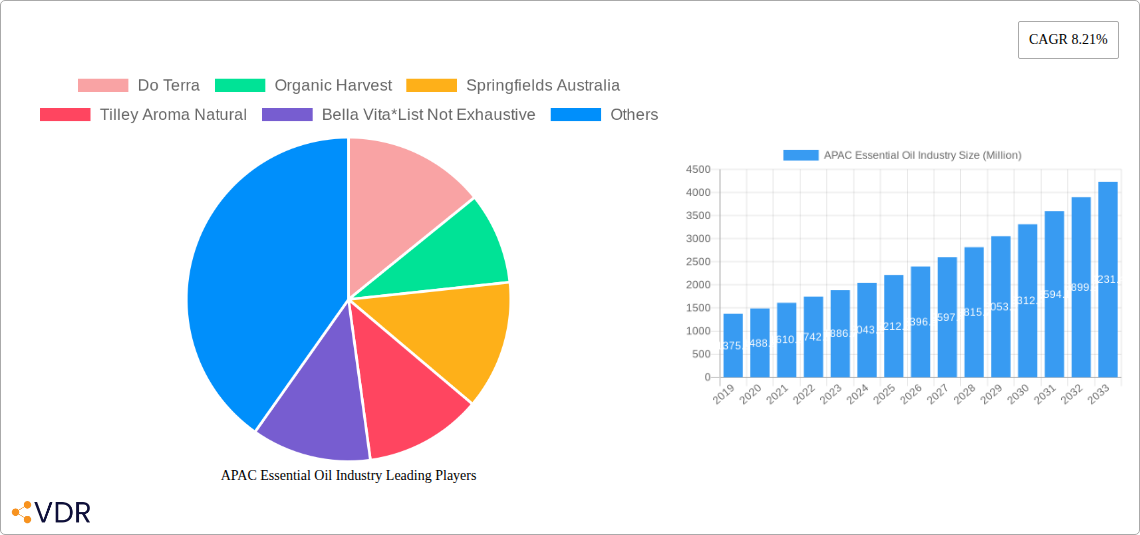
APAC Essential Oil Industry Market Size (In Billion)

Despite the bright growth prospects, certain restraints may influence the market trajectory. Fluctuations in the availability and pricing of raw materials, often influenced by agricultural yields and climate conditions, can pose a challenge. Additionally, stringent regulatory frameworks in some APAC countries regarding the purity, safety, and labeling of essential oils could necessitate significant compliance efforts from market players. However, the overarching trend towards natural ingredients and the growing preference for sustainable and ethically sourced products are expected to outweigh these challenges. Key segments driving growth include the Food & Beverages sector, where essential oils are increasingly used as natural flavorings, and the Cosmetics & Personal Care segment, leveraging their aromatic and therapeutic properties. Geographically, China and India are anticipated to emerge as dominant markets due to their large populations, increasing health consciousness, and burgeoning e-commerce platforms facilitating wider product reach. The rest of the Asia-Pacific region is also expected to witness steady growth as awareness and acceptance of essential oils continue to spread.
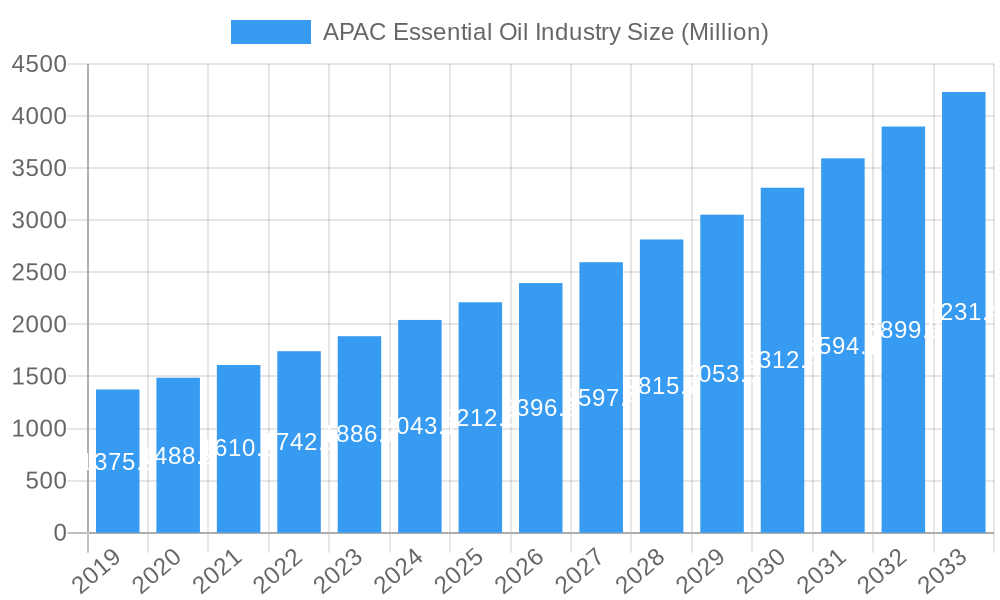
APAC Essential Oil Industry Company Market Share
Report Title: APAC Essential Oil Industry Analysis: Market Dynamics, Growth Trends, and Future Outlook (2019-2033)
Report Description:
Uncover the dynamic landscape of the APAC essential oil market with this comprehensive report. Delve into the intricate market structure, analyze key growth drivers, and forecast future trajectories from 2019 to 2033, with a base year of 2025. This report is meticulously crafted for industry professionals seeking deep insights into the APAC essential oil market size, essential oil market trends in Asia Pacific, and essential oil market opportunities.
Explore the dominance of lavender oil, orange oil, and tea tree oil within the essential oil product types segment. Understand the pivotal role of aromatherapy, cosmetics & personal care, and food & beverages in shaping the essential oil applications. This analysis provides granular detail on the China essential oil market, India essential oil market, Japan essential oil market, and Australia essential oil market, alongside the burgeoning Rest of Asia-Pacific essential oil market.
Gain unparalleled understanding of market concentration, technological innovation, regulatory frameworks, competitive substitutes, and evolving end-user demographics. Identify leading companies such as Do Terra, Organic Harvest, Springfields Australia, Tilley Aroma Natural, Bella Vita, In Essence, Young Living Essentials, Auroma, AT-Aroma Co Ltd, Ultra International BV, and Aroma Treasures. This report offers a forward-looking perspective, highlighting emerging opportunities and growth accelerators in this rapidly expanding sector.
APAC Essential Oil Industry Market Dynamics & Structure
The APAC essential oil market is characterized by a moderate to high level of concentration, with a few major players dominating a significant portion of the market share. Technological innovation acts as a primary driver, fueled by advancements in extraction techniques, product development, and the increasing scientific validation of essential oil benefits. Regulatory frameworks vary across countries, with some nations implementing stringent quality control measures while others offer more lenient guidelines, impacting market entry and product homologation.
- Market Concentration: Dominated by key global and regional players, with a growing presence of niche manufacturers catering to specific market demands.
- Technological Innovation: Focus on sustainable sourcing, advanced distillation methods, and the development of novel delivery systems for enhanced efficacy.
- Regulatory Frameworks: Evolving regulations related to product safety, labeling, and therapeutic claims influence market access and consumer trust.
- Competitive Product Substitutes: While natural essential oils offer unique properties, synthetic fragrances and other wellness products present indirect competition.
- End-User Demographics: A growing segment of health-conscious consumers, particularly millennials and Gen Z, are driving demand for natural and organic products.
- M&A Trends: Strategic acquisitions and partnerships are observed as companies seek to expand their product portfolios, geographical reach, and technological capabilities. For instance, the integration of smaller, innovative companies by larger entities can significantly alter market dynamics.
APAC Essential Oil Industry Growth Trends & Insights
The APAC essential oil industry is on a robust growth trajectory, exhibiting a significant market size evolution driven by a confluence of factors. The increasing consumer awareness regarding the health and wellness benefits of natural products, coupled with a growing preference for aromatherapy and natural remedies, is a primary catalyst. This trend is further amplified by the expanding application of essential oils across various sectors, including cosmetics & personal care, food & beverages, and pharmaceuticals. The essential oil market growth in APAC is also propelled by a rising disposable income in emerging economies within the region, enabling consumers to invest in premium wellness products.
Technological disruptions are playing a crucial role in shaping the industry. Advancements in extraction technologies, such as supercritical fluid extraction and advanced steam distillation, are leading to higher purity and yield of essential oils, thereby enhancing their efficacy and market appeal. Furthermore, the development of innovative product formulations, including ready-to-use blends, diffusers, and topical applications, is broadening the consumer base and facilitating wider adoption. The essential oil market adoption rates are expected to accelerate as more research validates the therapeutic properties of various essential oils and as regulatory bodies increasingly recognize their potential in healthcare and wellness.
Consumer behavior shifts are profoundly impacting the APAC essential oil market. There is a discernible move towards natural and organic ingredients, with consumers actively seeking products free from synthetic chemicals. This demand is creating a significant market for certified organic essential oils. The rise of e-commerce and digital marketing platforms has also democratized access to essential oils, allowing smaller brands to reach a wider audience and educate consumers about product benefits. The perceived link between essential oils and holistic well-being, encompassing physical, mental, and emotional health, is fostering a culture of self-care and preventative health, further boosting market penetration. The CAGR of the APAC essential oil market is projected to remain strong in the coming years, driven by these sustained trends and the untapped potential in many of the region's developing economies. The essential oil market penetration is still relatively low in some sub-regions, indicating substantial room for expansion.
Dominant Regions, Countries, or Segments in APAC Essential Oil Industry
Within the expansive APAC essential oil industry, several regions, countries, and segments stand out as primary drivers of market growth and dominance. China and India, with their vast populations and rapidly growing economies, represent significant essential oil market opportunities. Their burgeoning middle class, coupled with increasing health consciousness and a rising disposable income, fuels demand for essential oils in cosmetics & personal care, food & beverages, and aromatherapy applications. The China essential oil market is particularly influential due to its substantial manufacturing capabilities and its role as a major consumer of aromatherapy and personal care products. India, with its rich traditional medicine heritage, sees a strong demand for essential oils in Ayurvedic practices and natural personal care formulations.
The essential oil product type landscape is led by high-demand oils such as Lavender Oil, Orange Oil, and Tea Tree Oil. Lavender oil's versatility in aromatherapy, cosmetics, and its calming properties makes it a perennial favorite. Orange oil's invigorating scent and widespread use in food flavorings and cleaning products contribute to its consistent demand. Tea Tree Oil, renowned for its antiseptic and medicinal properties, is a staple in natural skincare and pharmaceutical applications. The consistent demand for these oils underpins their dominance in the overall market volume.
Aromatherapy and Cosmetics & Personal Care are the dominant essential oil applications, significantly driving market expansion. The global trend towards natural beauty and wellness strongly favors the integration of essential oils into skincare, haircare, and fragrance products. Similarly, the increasing adoption of aromatherapy for stress relief, mood enhancement, and sleep improvement is creating a substantial market for diffusers and essential oil blends. While the Pharmaceuticals sector represents a smaller but growing segment, the recognized therapeutic benefits of certain essential oils are paving the way for their increased inclusion in natural medicinal formulations and over-the-counter products.
Australia, as a significant producer and exporter of certain essential oils, particularly Eucalyptus and Tea Tree oil, plays a crucial role in the supply chain and contributes to the regional market dynamics. The Rest of Asia-Pacific essential oil market, encompassing countries like South Korea, Southeast Asian nations, and other emerging economies, presents substantial untapped potential. Favorable economic policies, growing investment in the wellness sector, and increasing awareness of natural products are set to accelerate growth in these areas. The strategic expansion of companies like doTERRA in markets like Thailand further underscores the growth potential and the strategic importance of these regions in the global essential oil ecosystem.
APAC Essential Oil Industry Product Landscape
The APAC essential oil industry is witnessing a surge in product innovation, driven by consumer demand for natural, sustainable, and efficacy-driven solutions. Lavender oil continues to be a leading product, with enhanced formulations focusing on specific therapeutic benefits like sleep support and stress reduction. Orange oil, beyond its traditional applications in food and cleaning, is being incorporated into innovative cosmetic formulations for its skin-brightening and mood-lifting properties. Tea tree oil remains a powerhouse, with advancements in its application in targeted skincare solutions for acne and fungal infections.
New product launches frequently highlight unique selling propositions such as organic sourcing, cruelty-free certifications, and specific regional originations that resonate with conscious consumers. Technological advancements in extraction methods are yielding higher purity essential oils, leading to improved performance metrics in terms of scent profile, chemical composition, and therapeutic potency. This focus on quality and innovation is crucial for differentiating products in a competitive market and capturing consumer loyalty.
Key Drivers, Barriers & Challenges in APAC Essential Oil Industry
The APAC essential oil industry is propelled by several key drivers, most notably the escalating global demand for natural and organic products, driven by increasing health consciousness and wellness trends. Technological advancements in extraction and distillation processes are enhancing product quality and efficiency, making essential oils more accessible and appealing. Favorable government initiatives promoting organic farming and the wellness sector in several APAC countries further fuel market expansion. The growing popularity of aromatherapy and the integration of essential oils into cosmetics and personal care products are significant market stimulants.
However, the industry faces notable barriers and challenges. Supply chain complexities, including climate variability affecting crop yields and the ethical sourcing of raw materials, can lead to price volatility and availability issues. Stringent and varying regulatory landscapes across different APAC nations can create hurdles for market entry and product standardization. Intense competition from both established global brands and emerging local players necessitates continuous innovation and competitive pricing strategies. Furthermore, the risk of adulteration and the need for consumer education regarding product purity and safe usage remain ongoing challenges.
Emerging Opportunities in APAC Essential Oil Industry
Emerging opportunities in the APAC essential oil industry are abundant, primarily stemming from evolving consumer preferences and untapped market segments. The burgeoning demand for plant-based and clean-label products presents significant potential for the expansion of essential oils in the food and beverage sector as natural flavoring agents and functional ingredients. The growing awareness of mental well-being is creating a niche for aromatherapy products tailored for stress management, sleep enhancement, and mood elevation, particularly in urban centers.
The integration of essential oils into innovative delivery systems, such as topical patches, ingestible capsules, and advanced skincare formulations, offers new avenues for product development and market penetration. Furthermore, the increasing focus on sustainability and ethical sourcing resonates with a growing segment of environmentally conscious consumers, creating opportunities for brands that prioritize these values. Untapped rural markets within the APAC region, with their growing disposable incomes and interest in natural remedies, also represent significant growth frontiers.
Growth Accelerators in the APAC Essential Oil Industry Industry
Several catalysts are accelerating the long-term growth of the APAC essential oil industry. Technological breakthroughs in sustainable cultivation and extraction techniques are not only improving efficiency and reducing environmental impact but also enhancing the purity and potency of essential oils, thereby bolstering consumer trust and product efficacy. Strategic partnerships between essential oil manufacturers and cosmetic or pharmaceutical companies are driving innovation and expanding the application base of these natural compounds. Market expansion strategies, including direct-to-consumer models and focused B2B engagements in the burgeoning wellness and spa industries, are crucial for capturing market share.
Furthermore, the increasing emphasis on research and development to scientifically validate the therapeutic benefits of essential oils is a significant growth accelerator. This evidence-based approach builds credibility and encourages wider adoption in professional settings and by health-conscious consumers. The development of innovative product formats that cater to convenience and specific user needs, such as pre-diluted rollerballs or specialized diffuser blends, is also contributing to sustained market expansion.
Key Players Shaping the APAC Essential Oil Industry Market
- Do Terra
- Organic Harvest
- Springfields Australia
- Tilley Aroma Natural
- Bella Vita
- In Essence
- Young Living Essentials
- Auroma
- AT-Aroma Co Ltd
- Ultra International BV
- Aroma Treasures
Notable Milestones in APAC Essential Oil Industry Sector
- October 2022: doTERRA introduced a new wellness product line combining pure essential oils, sustainable sourcing, and evidence-based research, including Helichrysum touch, LaLuz Diffuser, Roam Diffuser, Dawn Aroma Humidifier, Balance Bath Bar, On Guard Toothpaste, and On Guard Hand Wipes.
- September 2022: Blossom Kochhar Aroma Magic launched the Neem and Tea Tree range of products, featuring facewash, body wash, face mask, toner, and anti-pimple gel, enriched with essential oil extracts, vitamins, and minerals.
- June 2021: doTERRA announced the expansion of its portfolio in Thailand with the inauguration of its new corporate office in Bangkok, registering 80 local products to cater to the demand for pure, effective, and sustainable essential oils.
In-Depth APAC Essential Oil Industry Market Outlook
The APAC essential oil industry is poised for sustained and significant growth, driven by deeply embedded consumer trends towards natural wellness and self-care. Future market potential is substantial, particularly in emerging economies where disposable incomes are rising and awareness of the benefits of essential oils is expanding. Strategic opportunities lie in catering to the growing demand for specialized therapeutic applications, such as sleep aids, stress relief, and immune support products. The continued integration of essential oils into the cosmetics, personal care, and functional food and beverage sectors will further diversify revenue streams. Focusing on sustainable sourcing, transparent supply chains, and scientifically validated product claims will be paramount for brands aiming to capture market share and build lasting consumer loyalty in this dynamic and promising industry.
APAC Essential Oil Industry Segmentation
-
1. Product Type
- 1.1. Lavender Oil
- 1.2. Orange Oil
- 1.3. Eucalyptus Oil
- 1.4. Peppermint Oil
- 1.5. Spearmint Oil
- 1.6. Lemon Oil
- 1.7. Rosemary Oil
- 1.8. Geranium Oil
- 1.9. Tea Tree Oil
- 1.10. Others
-
2. Application
- 2.1. Food & Beverages
- 2.2. Aromatherapy
- 2.3. Pharmaceuticals
- 2.4. Cosmetics & Personal Care
- 2.5. Others
-
3. Geography
- 3.1. China
- 3.2. India
- 3.3. Japan
- 3.4. Australia
- 3.5. Rest of Asia-Pacific
APAC Essential Oil Industry Segmentation By Geography
- 1. China
- 2. India
- 3. Japan
- 4. Australia
- 5. Rest of Asia Pacific
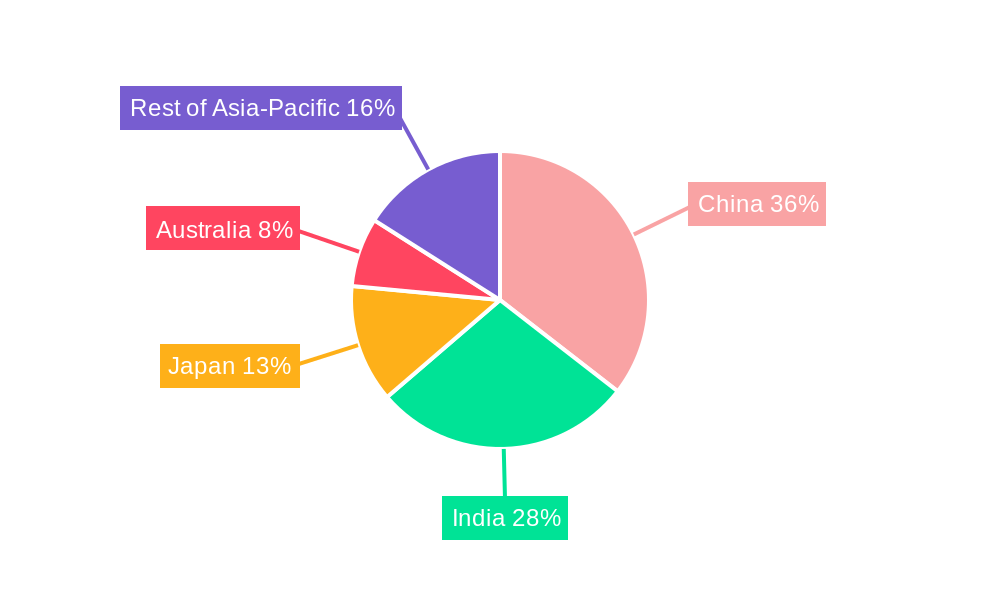
APAC Essential Oil Industry Regional Market Share
Geographic Coverage of APAC Essential Oil Industry
APAC Essential Oil Industry REPORT HIGHLIGHTS
| Aspects | Details |
|---|---|
| Study Period | 2020-2034 |
| Base Year | 2025 |
| Estimated Year | 2026 |
| Forecast Period | 2026-2034 |
| Historical Period | 2020-2025 |
| Growth Rate | CAGR of 8.21% from 2020-2034 |
| Segmentation |
|
Table of Contents
- 1. Introduction
- 1.1. Research Scope
- 1.2. Market Segmentation
- 1.3. Research Methodology
- 1.4. Definitions and Assumptions
- 2. Executive Summary
- 2.1. Introduction
- 3. Market Dynamics
- 3.1. Introduction
- 3.2. Market Drivers
- 3.2.1. Increasing awareness towards fitness among consumers; Demand for convenient fortified foods
- 3.3. Market Restrains
- 3.3.1. Increasing vegan culture in the market
- 3.4. Market Trends
- 3.4.1. Increasing Awareness Toward the Health Benefits of Essential Oil
- 4. Market Factor Analysis
- 4.1. Porters Five Forces
- 4.2. Supply/Value Chain
- 4.3. PESTEL analysis
- 4.4. Market Entropy
- 4.5. Patent/Trademark Analysis
- 5. Global APAC Essential Oil Industry Analysis, Insights and Forecast, 2020-2032
- 5.1. Market Analysis, Insights and Forecast - by Product Type
- 5.1.1. Lavender Oil
- 5.1.2. Orange Oil
- 5.1.3. Eucalyptus Oil
- 5.1.4. Peppermint Oil
- 5.1.5. Spearmint Oil
- 5.1.6. Lemon Oil
- 5.1.7. Rosemary Oil
- 5.1.8. Geranium Oil
- 5.1.9. Tea Tree Oil
- 5.1.10. Others
- 5.2. Market Analysis, Insights and Forecast - by Application
- 5.2.1. Food & Beverages
- 5.2.2. Aromatherapy
- 5.2.3. Pharmaceuticals
- 5.2.4. Cosmetics & Personal Care
- 5.2.5. Others
- 5.3. Market Analysis, Insights and Forecast - by Geography
- 5.3.1. China
- 5.3.2. India
- 5.3.3. Japan
- 5.3.4. Australia
- 5.3.5. Rest of Asia-Pacific
- 5.4. Market Analysis, Insights and Forecast - by Region
- 5.4.1. China
- 5.4.2. India
- 5.4.3. Japan
- 5.4.4. Australia
- 5.4.5. Rest of Asia Pacific
- 5.1. Market Analysis, Insights and Forecast - by Product Type
- 6. China APAC Essential Oil Industry Analysis, Insights and Forecast, 2020-2032
- 6.1. Market Analysis, Insights and Forecast - by Product Type
- 6.1.1. Lavender Oil
- 6.1.2. Orange Oil
- 6.1.3. Eucalyptus Oil
- 6.1.4. Peppermint Oil
- 6.1.5. Spearmint Oil
- 6.1.6. Lemon Oil
- 6.1.7. Rosemary Oil
- 6.1.8. Geranium Oil
- 6.1.9. Tea Tree Oil
- 6.1.10. Others
- 6.2. Market Analysis, Insights and Forecast - by Application
- 6.2.1. Food & Beverages
- 6.2.2. Aromatherapy
- 6.2.3. Pharmaceuticals
- 6.2.4. Cosmetics & Personal Care
- 6.2.5. Others
- 6.3. Market Analysis, Insights and Forecast - by Geography
- 6.3.1. China
- 6.3.2. India
- 6.3.3. Japan
- 6.3.4. Australia
- 6.3.5. Rest of Asia-Pacific
- 6.1. Market Analysis, Insights and Forecast - by Product Type
- 7. India APAC Essential Oil Industry Analysis, Insights and Forecast, 2020-2032
- 7.1. Market Analysis, Insights and Forecast - by Product Type
- 7.1.1. Lavender Oil
- 7.1.2. Orange Oil
- 7.1.3. Eucalyptus Oil
- 7.1.4. Peppermint Oil
- 7.1.5. Spearmint Oil
- 7.1.6. Lemon Oil
- 7.1.7. Rosemary Oil
- 7.1.8. Geranium Oil
- 7.1.9. Tea Tree Oil
- 7.1.10. Others
- 7.2. Market Analysis, Insights and Forecast - by Application
- 7.2.1. Food & Beverages
- 7.2.2. Aromatherapy
- 7.2.3. Pharmaceuticals
- 7.2.4. Cosmetics & Personal Care
- 7.2.5. Others
- 7.3. Market Analysis, Insights and Forecast - by Geography
- 7.3.1. China
- 7.3.2. India
- 7.3.3. Japan
- 7.3.4. Australia
- 7.3.5. Rest of Asia-Pacific
- 7.1. Market Analysis, Insights and Forecast - by Product Type
- 8. Japan APAC Essential Oil Industry Analysis, Insights and Forecast, 2020-2032
- 8.1. Market Analysis, Insights and Forecast - by Product Type
- 8.1.1. Lavender Oil
- 8.1.2. Orange Oil
- 8.1.3. Eucalyptus Oil
- 8.1.4. Peppermint Oil
- 8.1.5. Spearmint Oil
- 8.1.6. Lemon Oil
- 8.1.7. Rosemary Oil
- 8.1.8. Geranium Oil
- 8.1.9. Tea Tree Oil
- 8.1.10. Others
- 8.2. Market Analysis, Insights and Forecast - by Application
- 8.2.1. Food & Beverages
- 8.2.2. Aromatherapy
- 8.2.3. Pharmaceuticals
- 8.2.4. Cosmetics & Personal Care
- 8.2.5. Others
- 8.3. Market Analysis, Insights and Forecast - by Geography
- 8.3.1. China
- 8.3.2. India
- 8.3.3. Japan
- 8.3.4. Australia
- 8.3.5. Rest of Asia-Pacific
- 8.1. Market Analysis, Insights and Forecast - by Product Type
- 9. Australia APAC Essential Oil Industry Analysis, Insights and Forecast, 2020-2032
- 9.1. Market Analysis, Insights and Forecast - by Product Type
- 9.1.1. Lavender Oil
- 9.1.2. Orange Oil
- 9.1.3. Eucalyptus Oil
- 9.1.4. Peppermint Oil
- 9.1.5. Spearmint Oil
- 9.1.6. Lemon Oil
- 9.1.7. Rosemary Oil
- 9.1.8. Geranium Oil
- 9.1.9. Tea Tree Oil
- 9.1.10. Others
- 9.2. Market Analysis, Insights and Forecast - by Application
- 9.2.1. Food & Beverages
- 9.2.2. Aromatherapy
- 9.2.3. Pharmaceuticals
- 9.2.4. Cosmetics & Personal Care
- 9.2.5. Others
- 9.3. Market Analysis, Insights and Forecast - by Geography
- 9.3.1. China
- 9.3.2. India
- 9.3.3. Japan
- 9.3.4. Australia
- 9.3.5. Rest of Asia-Pacific
- 9.1. Market Analysis, Insights and Forecast - by Product Type
- 10. Rest of Asia Pacific APAC Essential Oil Industry Analysis, Insights and Forecast, 2020-2032
- 10.1. Market Analysis, Insights and Forecast - by Product Type
- 10.1.1. Lavender Oil
- 10.1.2. Orange Oil
- 10.1.3. Eucalyptus Oil
- 10.1.4. Peppermint Oil
- 10.1.5. Spearmint Oil
- 10.1.6. Lemon Oil
- 10.1.7. Rosemary Oil
- 10.1.8. Geranium Oil
- 10.1.9. Tea Tree Oil
- 10.1.10. Others
- 10.2. Market Analysis, Insights and Forecast - by Application
- 10.2.1. Food & Beverages
- 10.2.2. Aromatherapy
- 10.2.3. Pharmaceuticals
- 10.2.4. Cosmetics & Personal Care
- 10.2.5. Others
- 10.3. Market Analysis, Insights and Forecast - by Geography
- 10.3.1. China
- 10.3.2. India
- 10.3.3. Japan
- 10.3.4. Australia
- 10.3.5. Rest of Asia-Pacific
- 10.1. Market Analysis, Insights and Forecast - by Product Type
- 11. Competitive Analysis
- 11.1. Global Market Share Analysis 2025
- 11.2. Company Profiles
- 11.2.1 Do Terra
- 11.2.1.1. Overview
- 11.2.1.2. Products
- 11.2.1.3. SWOT Analysis
- 11.2.1.4. Recent Developments
- 11.2.1.5. Financials (Based on Availability)
- 11.2.2 Organic Harvest
- 11.2.2.1. Overview
- 11.2.2.2. Products
- 11.2.2.3. SWOT Analysis
- 11.2.2.4. Recent Developments
- 11.2.2.5. Financials (Based on Availability)
- 11.2.3 Springfields Australia
- 11.2.3.1. Overview
- 11.2.3.2. Products
- 11.2.3.3. SWOT Analysis
- 11.2.3.4. Recent Developments
- 11.2.3.5. Financials (Based on Availability)
- 11.2.4 Tilley Aroma Natural
- 11.2.4.1. Overview
- 11.2.4.2. Products
- 11.2.4.3. SWOT Analysis
- 11.2.4.4. Recent Developments
- 11.2.4.5. Financials (Based on Availability)
- 11.2.5 Bella Vita*List Not Exhaustive
- 11.2.5.1. Overview
- 11.2.5.2. Products
- 11.2.5.3. SWOT Analysis
- 11.2.5.4. Recent Developments
- 11.2.5.5. Financials (Based on Availability)
- 11.2.6 In Essence
- 11.2.6.1. Overview
- 11.2.6.2. Products
- 11.2.6.3. SWOT Analysis
- 11.2.6.4. Recent Developments
- 11.2.6.5. Financials (Based on Availability)
- 11.2.7 Young Living Essentials
- 11.2.7.1. Overview
- 11.2.7.2. Products
- 11.2.7.3. SWOT Analysis
- 11.2.7.4. Recent Developments
- 11.2.7.5. Financials (Based on Availability)
- 11.2.8 Auroma
- 11.2.8.1. Overview
- 11.2.8.2. Products
- 11.2.8.3. SWOT Analysis
- 11.2.8.4. Recent Developments
- 11.2.8.5. Financials (Based on Availability)
- 11.2.9 AT-Aroma Co Ltd
- 11.2.9.1. Overview
- 11.2.9.2. Products
- 11.2.9.3. SWOT Analysis
- 11.2.9.4. Recent Developments
- 11.2.9.5. Financials (Based on Availability)
- 11.2.10 Ultra International BV
- 11.2.10.1. Overview
- 11.2.10.2. Products
- 11.2.10.3. SWOT Analysis
- 11.2.10.4. Recent Developments
- 11.2.10.5. Financials (Based on Availability)
- 11.2.11 Aroma Treasures
- 11.2.11.1. Overview
- 11.2.11.2. Products
- 11.2.11.3. SWOT Analysis
- 11.2.11.4. Recent Developments
- 11.2.11.5. Financials (Based on Availability)
- 11.2.1 Do Terra
List of Figures
- Figure 1: Global APAC Essential Oil Industry Revenue Breakdown (Million, %) by Region 2025 & 2033
- Figure 2: Global APAC Essential Oil Industry Volume Breakdown (K Tons, %) by Region 2025 & 2033
- Figure 3: China APAC Essential Oil Industry Revenue (Million), by Product Type 2025 & 2033
- Figure 4: China APAC Essential Oil Industry Volume (K Tons), by Product Type 2025 & 2033
- Figure 5: China APAC Essential Oil Industry Revenue Share (%), by Product Type 2025 & 2033
- Figure 6: China APAC Essential Oil Industry Volume Share (%), by Product Type 2025 & 2033
- Figure 7: China APAC Essential Oil Industry Revenue (Million), by Application 2025 & 2033
- Figure 8: China APAC Essential Oil Industry Volume (K Tons), by Application 2025 & 2033
- Figure 9: China APAC Essential Oil Industry Revenue Share (%), by Application 2025 & 2033
- Figure 10: China APAC Essential Oil Industry Volume Share (%), by Application 2025 & 2033
- Figure 11: China APAC Essential Oil Industry Revenue (Million), by Geography 2025 & 2033
- Figure 12: China APAC Essential Oil Industry Volume (K Tons), by Geography 2025 & 2033
- Figure 13: China APAC Essential Oil Industry Revenue Share (%), by Geography 2025 & 2033
- Figure 14: China APAC Essential Oil Industry Volume Share (%), by Geography 2025 & 2033
- Figure 15: China APAC Essential Oil Industry Revenue (Million), by Country 2025 & 2033
- Figure 16: China APAC Essential Oil Industry Volume (K Tons), by Country 2025 & 2033
- Figure 17: China APAC Essential Oil Industry Revenue Share (%), by Country 2025 & 2033
- Figure 18: China APAC Essential Oil Industry Volume Share (%), by Country 2025 & 2033
- Figure 19: India APAC Essential Oil Industry Revenue (Million), by Product Type 2025 & 2033
- Figure 20: India APAC Essential Oil Industry Volume (K Tons), by Product Type 2025 & 2033
- Figure 21: India APAC Essential Oil Industry Revenue Share (%), by Product Type 2025 & 2033
- Figure 22: India APAC Essential Oil Industry Volume Share (%), by Product Type 2025 & 2033
- Figure 23: India APAC Essential Oil Industry Revenue (Million), by Application 2025 & 2033
- Figure 24: India APAC Essential Oil Industry Volume (K Tons), by Application 2025 & 2033
- Figure 25: India APAC Essential Oil Industry Revenue Share (%), by Application 2025 & 2033
- Figure 26: India APAC Essential Oil Industry Volume Share (%), by Application 2025 & 2033
- Figure 27: India APAC Essential Oil Industry Revenue (Million), by Geography 2025 & 2033
- Figure 28: India APAC Essential Oil Industry Volume (K Tons), by Geography 2025 & 2033
- Figure 29: India APAC Essential Oil Industry Revenue Share (%), by Geography 2025 & 2033
- Figure 30: India APAC Essential Oil Industry Volume Share (%), by Geography 2025 & 2033
- Figure 31: India APAC Essential Oil Industry Revenue (Million), by Country 2025 & 2033
- Figure 32: India APAC Essential Oil Industry Volume (K Tons), by Country 2025 & 2033
- Figure 33: India APAC Essential Oil Industry Revenue Share (%), by Country 2025 & 2033
- Figure 34: India APAC Essential Oil Industry Volume Share (%), by Country 2025 & 2033
- Figure 35: Japan APAC Essential Oil Industry Revenue (Million), by Product Type 2025 & 2033
- Figure 36: Japan APAC Essential Oil Industry Volume (K Tons), by Product Type 2025 & 2033
- Figure 37: Japan APAC Essential Oil Industry Revenue Share (%), by Product Type 2025 & 2033
- Figure 38: Japan APAC Essential Oil Industry Volume Share (%), by Product Type 2025 & 2033
- Figure 39: Japan APAC Essential Oil Industry Revenue (Million), by Application 2025 & 2033
- Figure 40: Japan APAC Essential Oil Industry Volume (K Tons), by Application 2025 & 2033
- Figure 41: Japan APAC Essential Oil Industry Revenue Share (%), by Application 2025 & 2033
- Figure 42: Japan APAC Essential Oil Industry Volume Share (%), by Application 2025 & 2033
- Figure 43: Japan APAC Essential Oil Industry Revenue (Million), by Geography 2025 & 2033
- Figure 44: Japan APAC Essential Oil Industry Volume (K Tons), by Geography 2025 & 2033
- Figure 45: Japan APAC Essential Oil Industry Revenue Share (%), by Geography 2025 & 2033
- Figure 46: Japan APAC Essential Oil Industry Volume Share (%), by Geography 2025 & 2033
- Figure 47: Japan APAC Essential Oil Industry Revenue (Million), by Country 2025 & 2033
- Figure 48: Japan APAC Essential Oil Industry Volume (K Tons), by Country 2025 & 2033
- Figure 49: Japan APAC Essential Oil Industry Revenue Share (%), by Country 2025 & 2033
- Figure 50: Japan APAC Essential Oil Industry Volume Share (%), by Country 2025 & 2033
- Figure 51: Australia APAC Essential Oil Industry Revenue (Million), by Product Type 2025 & 2033
- Figure 52: Australia APAC Essential Oil Industry Volume (K Tons), by Product Type 2025 & 2033
- Figure 53: Australia APAC Essential Oil Industry Revenue Share (%), by Product Type 2025 & 2033
- Figure 54: Australia APAC Essential Oil Industry Volume Share (%), by Product Type 2025 & 2033
- Figure 55: Australia APAC Essential Oil Industry Revenue (Million), by Application 2025 & 2033
- Figure 56: Australia APAC Essential Oil Industry Volume (K Tons), by Application 2025 & 2033
- Figure 57: Australia APAC Essential Oil Industry Revenue Share (%), by Application 2025 & 2033
- Figure 58: Australia APAC Essential Oil Industry Volume Share (%), by Application 2025 & 2033
- Figure 59: Australia APAC Essential Oil Industry Revenue (Million), by Geography 2025 & 2033
- Figure 60: Australia APAC Essential Oil Industry Volume (K Tons), by Geography 2025 & 2033
- Figure 61: Australia APAC Essential Oil Industry Revenue Share (%), by Geography 2025 & 2033
- Figure 62: Australia APAC Essential Oil Industry Volume Share (%), by Geography 2025 & 2033
- Figure 63: Australia APAC Essential Oil Industry Revenue (Million), by Country 2025 & 2033
- Figure 64: Australia APAC Essential Oil Industry Volume (K Tons), by Country 2025 & 2033
- Figure 65: Australia APAC Essential Oil Industry Revenue Share (%), by Country 2025 & 2033
- Figure 66: Australia APAC Essential Oil Industry Volume Share (%), by Country 2025 & 2033
- Figure 67: Rest of Asia Pacific APAC Essential Oil Industry Revenue (Million), by Product Type 2025 & 2033
- Figure 68: Rest of Asia Pacific APAC Essential Oil Industry Volume (K Tons), by Product Type 2025 & 2033
- Figure 69: Rest of Asia Pacific APAC Essential Oil Industry Revenue Share (%), by Product Type 2025 & 2033
- Figure 70: Rest of Asia Pacific APAC Essential Oil Industry Volume Share (%), by Product Type 2025 & 2033
- Figure 71: Rest of Asia Pacific APAC Essential Oil Industry Revenue (Million), by Application 2025 & 2033
- Figure 72: Rest of Asia Pacific APAC Essential Oil Industry Volume (K Tons), by Application 2025 & 2033
- Figure 73: Rest of Asia Pacific APAC Essential Oil Industry Revenue Share (%), by Application 2025 & 2033
- Figure 74: Rest of Asia Pacific APAC Essential Oil Industry Volume Share (%), by Application 2025 & 2033
- Figure 75: Rest of Asia Pacific APAC Essential Oil Industry Revenue (Million), by Geography 2025 & 2033
- Figure 76: Rest of Asia Pacific APAC Essential Oil Industry Volume (K Tons), by Geography 2025 & 2033
- Figure 77: Rest of Asia Pacific APAC Essential Oil Industry Revenue Share (%), by Geography 2025 & 2033
- Figure 78: Rest of Asia Pacific APAC Essential Oil Industry Volume Share (%), by Geography 2025 & 2033
- Figure 79: Rest of Asia Pacific APAC Essential Oil Industry Revenue (Million), by Country 2025 & 2033
- Figure 80: Rest of Asia Pacific APAC Essential Oil Industry Volume (K Tons), by Country 2025 & 2033
- Figure 81: Rest of Asia Pacific APAC Essential Oil Industry Revenue Share (%), by Country 2025 & 2033
- Figure 82: Rest of Asia Pacific APAC Essential Oil Industry Volume Share (%), by Country 2025 & 2033
List of Tables
- Table 1: Global APAC Essential Oil Industry Revenue Million Forecast, by Product Type 2020 & 2033
- Table 2: Global APAC Essential Oil Industry Volume K Tons Forecast, by Product Type 2020 & 2033
- Table 3: Global APAC Essential Oil Industry Revenue Million Forecast, by Application 2020 & 2033
- Table 4: Global APAC Essential Oil Industry Volume K Tons Forecast, by Application 2020 & 2033
- Table 5: Global APAC Essential Oil Industry Revenue Million Forecast, by Geography 2020 & 2033
- Table 6: Global APAC Essential Oil Industry Volume K Tons Forecast, by Geography 2020 & 2033
- Table 7: Global APAC Essential Oil Industry Revenue Million Forecast, by Region 2020 & 2033
- Table 8: Global APAC Essential Oil Industry Volume K Tons Forecast, by Region 2020 & 2033
- Table 9: Global APAC Essential Oil Industry Revenue Million Forecast, by Product Type 2020 & 2033
- Table 10: Global APAC Essential Oil Industry Volume K Tons Forecast, by Product Type 2020 & 2033
- Table 11: Global APAC Essential Oil Industry Revenue Million Forecast, by Application 2020 & 2033
- Table 12: Global APAC Essential Oil Industry Volume K Tons Forecast, by Application 2020 & 2033
- Table 13: Global APAC Essential Oil Industry Revenue Million Forecast, by Geography 2020 & 2033
- Table 14: Global APAC Essential Oil Industry Volume K Tons Forecast, by Geography 2020 & 2033
- Table 15: Global APAC Essential Oil Industry Revenue Million Forecast, by Country 2020 & 2033
- Table 16: Global APAC Essential Oil Industry Volume K Tons Forecast, by Country 2020 & 2033
- Table 17: Global APAC Essential Oil Industry Revenue Million Forecast, by Product Type 2020 & 2033
- Table 18: Global APAC Essential Oil Industry Volume K Tons Forecast, by Product Type 2020 & 2033
- Table 19: Global APAC Essential Oil Industry Revenue Million Forecast, by Application 2020 & 2033
- Table 20: Global APAC Essential Oil Industry Volume K Tons Forecast, by Application 2020 & 2033
- Table 21: Global APAC Essential Oil Industry Revenue Million Forecast, by Geography 2020 & 2033
- Table 22: Global APAC Essential Oil Industry Volume K Tons Forecast, by Geography 2020 & 2033
- Table 23: Global APAC Essential Oil Industry Revenue Million Forecast, by Country 2020 & 2033
- Table 24: Global APAC Essential Oil Industry Volume K Tons Forecast, by Country 2020 & 2033
- Table 25: Global APAC Essential Oil Industry Revenue Million Forecast, by Product Type 2020 & 2033
- Table 26: Global APAC Essential Oil Industry Volume K Tons Forecast, by Product Type 2020 & 2033
- Table 27: Global APAC Essential Oil Industry Revenue Million Forecast, by Application 2020 & 2033
- Table 28: Global APAC Essential Oil Industry Volume K Tons Forecast, by Application 2020 & 2033
- Table 29: Global APAC Essential Oil Industry Revenue Million Forecast, by Geography 2020 & 2033
- Table 30: Global APAC Essential Oil Industry Volume K Tons Forecast, by Geography 2020 & 2033
- Table 31: Global APAC Essential Oil Industry Revenue Million Forecast, by Country 2020 & 2033
- Table 32: Global APAC Essential Oil Industry Volume K Tons Forecast, by Country 2020 & 2033
- Table 33: Global APAC Essential Oil Industry Revenue Million Forecast, by Product Type 2020 & 2033
- Table 34: Global APAC Essential Oil Industry Volume K Tons Forecast, by Product Type 2020 & 2033
- Table 35: Global APAC Essential Oil Industry Revenue Million Forecast, by Application 2020 & 2033
- Table 36: Global APAC Essential Oil Industry Volume K Tons Forecast, by Application 2020 & 2033
- Table 37: Global APAC Essential Oil Industry Revenue Million Forecast, by Geography 2020 & 2033
- Table 38: Global APAC Essential Oil Industry Volume K Tons Forecast, by Geography 2020 & 2033
- Table 39: Global APAC Essential Oil Industry Revenue Million Forecast, by Country 2020 & 2033
- Table 40: Global APAC Essential Oil Industry Volume K Tons Forecast, by Country 2020 & 2033
- Table 41: Global APAC Essential Oil Industry Revenue Million Forecast, by Product Type 2020 & 2033
- Table 42: Global APAC Essential Oil Industry Volume K Tons Forecast, by Product Type 2020 & 2033
- Table 43: Global APAC Essential Oil Industry Revenue Million Forecast, by Application 2020 & 2033
- Table 44: Global APAC Essential Oil Industry Volume K Tons Forecast, by Application 2020 & 2033
- Table 45: Global APAC Essential Oil Industry Revenue Million Forecast, by Geography 2020 & 2033
- Table 46: Global APAC Essential Oil Industry Volume K Tons Forecast, by Geography 2020 & 2033
- Table 47: Global APAC Essential Oil Industry Revenue Million Forecast, by Country 2020 & 2033
- Table 48: Global APAC Essential Oil Industry Volume K Tons Forecast, by Country 2020 & 2033
Frequently Asked Questions
1. What is the projected Compound Annual Growth Rate (CAGR) of the APAC Essential Oil Industry?
The projected CAGR is approximately 8.21%.
2. Which companies are prominent players in the APAC Essential Oil Industry?
Key companies in the market include Do Terra, Organic Harvest, Springfields Australia, Tilley Aroma Natural, Bella Vita*List Not Exhaustive, In Essence, Young Living Essentials, Auroma, AT-Aroma Co Ltd, Ultra International BV, Aroma Treasures.
3. What are the main segments of the APAC Essential Oil Industry?
The market segments include Product Type, Application, Geography.
4. Can you provide details about the market size?
The market size is estimated to be USD 2.26 Million as of 2022.
5. What are some drivers contributing to market growth?
Increasing awareness towards fitness among consumers; Demand for convenient fortified foods.
6. What are the notable trends driving market growth?
Increasing Awareness Toward the Health Benefits of Essential Oil.
7. Are there any restraints impacting market growth?
Increasing vegan culture in the market.
8. Can you provide examples of recent developments in the market?
October 2022: doTERRA introduced a new wellness product that combines pure essential oils, sustainable sourcing, and evidence-based research. Helichrysum touch, LaLuz Diffuser, Roam Diffuser, Dawn Aroma Humidifier, Balance Bath Bar, On Guard Toothpaste, and On Guard Hand Wipes are among the new products.
9. What pricing options are available for accessing the report?
Pricing options include single-user, multi-user, and enterprise licenses priced at USD 4750, USD 5250, and USD 8750 respectively.
10. Is the market size provided in terms of value or volume?
The market size is provided in terms of value, measured in Million and volume, measured in K Tons.
11. Are there any specific market keywords associated with the report?
Yes, the market keyword associated with the report is "APAC Essential Oil Industry," which aids in identifying and referencing the specific market segment covered.
12. How do I determine which pricing option suits my needs best?
The pricing options vary based on user requirements and access needs. Individual users may opt for single-user licenses, while businesses requiring broader access may choose multi-user or enterprise licenses for cost-effective access to the report.
13. Are there any additional resources or data provided in the APAC Essential Oil Industry report?
While the report offers comprehensive insights, it's advisable to review the specific contents or supplementary materials provided to ascertain if additional resources or data are available.
14. How can I stay updated on further developments or reports in the APAC Essential Oil Industry?
To stay informed about further developments, trends, and reports in the APAC Essential Oil Industry, consider subscribing to industry newsletters, following relevant companies and organizations, or regularly checking reputable industry news sources and publications.
Methodology
Step 1 - Identification of Relevant Samples Size from Population Database



Step 2 - Approaches for Defining Global Market Size (Value, Volume* & Price*)

Note*: In applicable scenarios
Step 3 - Data Sources
Primary Research
- Web Analytics
- Survey Reports
- Research Institute
- Latest Research Reports
- Opinion Leaders
Secondary Research
- Annual Reports
- White Paper
- Latest Press Release
- Industry Association
- Paid Database
- Investor Presentations

Step 4 - Data Triangulation
Involves using different sources of information in order to increase the validity of a study
These sources are likely to be stakeholders in a program - participants, other researchers, program staff, other community members, and so on.
Then we put all data in single framework & apply various statistical tools to find out the dynamic on the market.
During the analysis stage, feedback from the stakeholder groups would be compared to determine areas of agreement as well as areas of divergence